
What Is a Tire Made Of? Inside the Materials & Construction
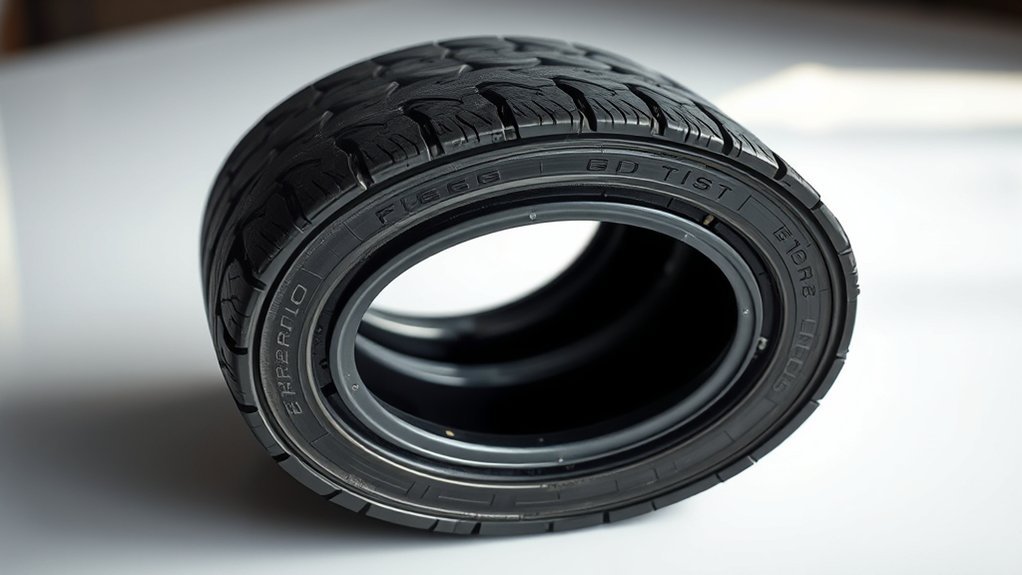
A tire looks like a simple black ring, but it is really a carefully engineered composite. Modern tires combine natural rubber, synthetic rubber, reinforcing fillers, steel, textile cords, oils, resins, sulfur, and other chemicals so the tire can grip the road, hold air, carry weight, resist heat, and wear evenly.
Quick Answer
A car tire is made of natural and synthetic rubber, steel belts, bead wire, textile cords, carbon black, silica, oils, resins, sulfur, antioxidants, and other additives. Each material has a job: grip, strength, air retention, heat control, durability, ride comfort, or fuel efficiency.
Key Takeaways
- Tires are not 100% rubber; they are layered composites made from rubber, steel, textiles, fillers, and chemicals.
- The tread supplies grip and wear resistance, while the inner liner helps hold air pressure.
- Steel belts, bead wire, and textile cords give the tire strength, shape, and load support.
- Carbon black and silica reinforce rubber compounds and help tune durability, wet traction, and rolling resistance.
- Exact material percentages vary by tire type, brand, size, season rating, and performance goal.
What Is a Tire Made Of?
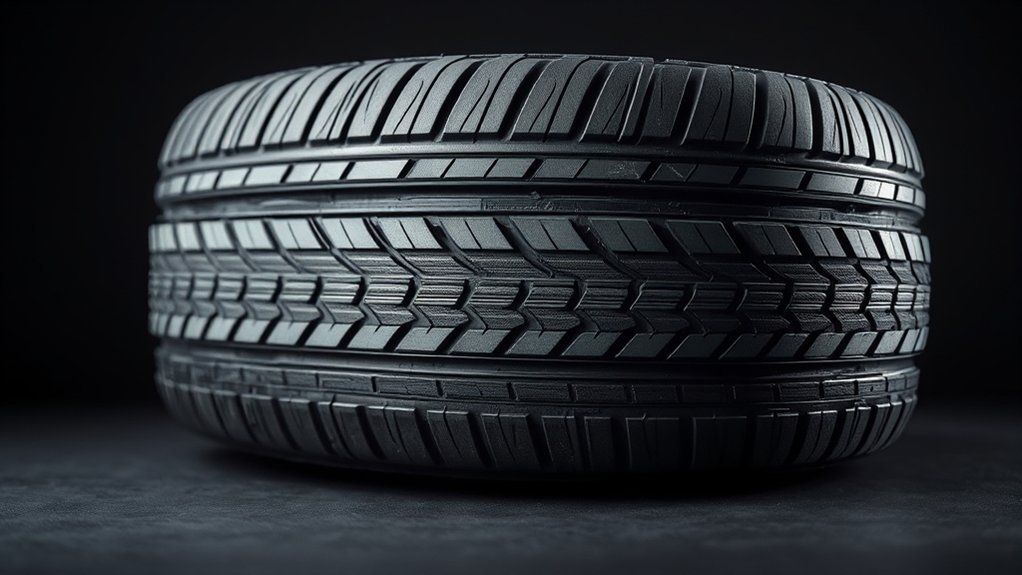
At its core, a tire is a layered structure made from different material families. The U.S. Tire Manufacturers Association describes tires as a complex blend of rubber compounds and materials, with each part of the tire using a compound tailored to its job. Michelin also notes that more than 200 ingredients can go into a tire, depending on the design and performance target.
A tire is best understood as a material system: rubber provides grip and flexibility, steel and textiles provide structure, and fillers and chemicals fine-tune performance.
| Material family | Where it is used | What it does |
|---|---|---|
| Natural rubber | Tread, sidewall, some structural compounds | Adds flexibility, tear resistance, grip, and heat tolerance. |
| Synthetic rubber | Tread, sidewall, bead apex, inner components | Tunes wear, wet grip, cold flexibility, rolling resistance, and heat resistance. |
| Carbon black and silica | Mostly tread and rubber compounds | Reinforce rubber, improve durability, and help tune wet grip and fuel efficiency. |
| Steel | Belts and bead core | Strengthens the tire, stabilizes the tread, and locks the tire to the rim. |
| Textile cords | Body plies, cap plies, reinforcement layers | Support the tire’s shape while allowing controlled flex. |
| Oils, resins, sulfur, and additives | Rubber compounds throughout the tire | Control processing, aging resistance, elasticity, curing, and grip balance. |
Note: There is no single universal tire recipe. A winter tire, summer tire, EV tire, light-truck tire, and racing tire can use different rubber blends, reinforcements, and filler balances.
[Products Worth Considering]

This 4-pack kit converts Presta bike valves to standard Schrader valves so you can inflate with any regular pump or air compressor. The solid brass adapters include an O-ring...
Main Parts of a Tire
A tire works because each layer performs a specific job. If one part is weak, the whole tire can lose grip, run hot, leak air, wear unevenly, or fail under load.
- Tread: The outer rubber layer that touches the road. It provides traction, braking grip, and wear resistance.
- Tread grooves and sipes: Channels and thin slits that help move water, snow, or slush away from the contact patch.
- Steel belts: Layers under the tread that stabilize the footprint and help the tread wear more evenly.
- Body ply or carcass: Rubber-coated textile cords that support the tire’s shape and carry load.
- Sidewall: The side section that protects the carcass and flexes as the tire rolls.
- Bead core: High-strength steel wire that clamps the tire securely to the wheel rim.
- Inner liner: A low-permeability rubber layer, often based on butyl rubber, that helps hold air in a tubeless tire.
These parts are assembled before the tire is cured into its final shape. The result is a flexible but reinforced structure that can carry a vehicle while dealing with heat, water, road impacts, cornering forces, and braking forces.
Natural Rubber in Tire Construction
Natural rubber comes from latex harvested from rubber trees. Tire makers use it because it brings strength, elasticity, tear resistance, and heat-handling ability. It is especially valuable in compounds that need to flex repeatedly without cracking or breaking down too quickly.
| Property | Why it matters | Tire result |
|---|---|---|
| Elasticity | Lets rubber deform and recover | Better comfort and impact absorption |
| Tear resistance | Helps resist cuts and cracking | Longer service life |
| Heat behavior | Helps manage repeated flexing | More stable operation under load |
Natural rubber is rarely used alone. It is blended with synthetic rubber, fillers, oils, and curing chemicals so the final compound can meet the tire’s exact target for grip, durability, comfort, and efficiency.
Synthetic Rubber and Tire Performance
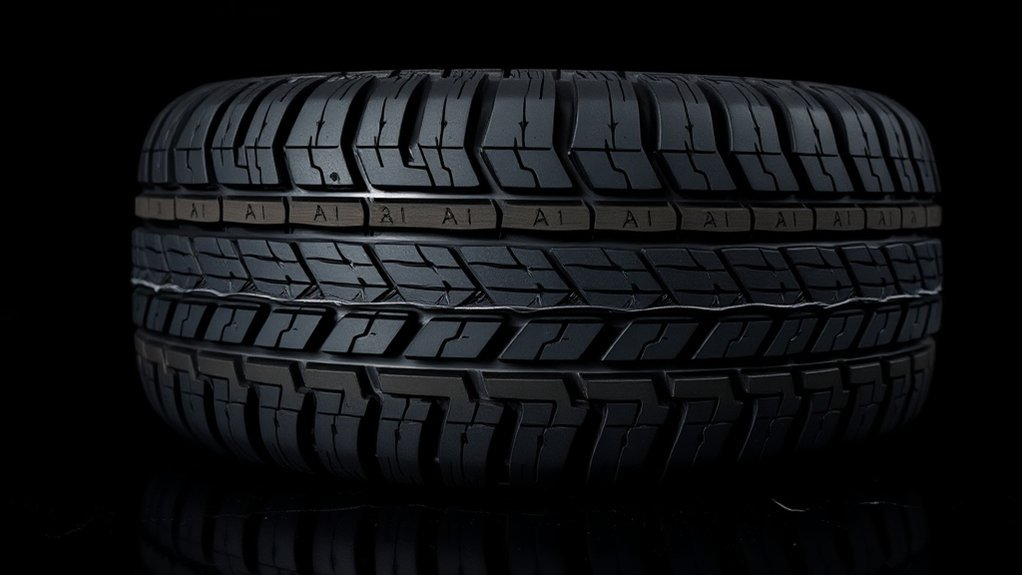
Synthetic rubber is made from engineered polymers. Common examples include styrene-butadiene rubber and polybutadiene rubber. These materials help tire makers tune performance more precisely than natural rubber alone.
Synthetic rubber can help with:
- Wet and dry grip: The tread can be tuned for the road surface and temperature range.
- Wear resistance: Compounds can be engineered to resist abrasion during normal driving.
- Rolling resistance: The rubber can be designed to waste less energy as heat.
- Heat resistance: Certain synthetic rubbers handle repeated flexing and high-speed operation well.
- Cold-weather flexibility: Winter and all-weather tires use special compounds that stay more flexible in low temperatures.
The exact amount of synthetic rubber varies by tire. For example, Continental’s tire-material example lists rubber as one category that includes both natural and synthetic rubber, while fillers, reinforcements, plasticizers, vulcanization chemicals, and anti-aging agents make up the rest.
Carbon Black, Silica, and Other Tire Fillers
Rubber alone would not give a tire the durability, wear resistance, and grip balance drivers expect. That is why tire compounds use reinforcing fillers.
Carbon black has long been used to strengthen rubber, improve abrasion resistance, and help protect against UV-related degradation. It is one of the reasons most tires are black.
Silica is widely used to improve wet traction and reduce rolling resistance when paired with the right rubber chemistry. This is especially important in modern all-season, performance, and low-rolling-resistance tires.
Other fillers and compounding materials may include chalk, oils, resins, waxes, antioxidants, zinc oxide, sulfur, and vulcanization accelerators. These ingredients control how the rubber mixes, cures, flexes, grips, ages, and handles heat.
Pro Tip: When comparing tires, do not judge the compound by one ingredient alone. A tire’s real performance comes from the full recipe: rubber type, filler system, tread pattern, construction, and intended temperature range.
Steel Belts, Beads, and Wire Reinforcement
Steel gives a tire strength where rubber alone would stretch too much. In a modern radial tire, steel is commonly used in the belt package below the tread and in the bead core around the wheel rim.
Steel Belt Function
Steel belts sit beneath the tread. They help keep the tread area flatter and more stable as the tire rolls. That improves steering response, treadwear, and stability at speed.
Steel belts also help reduce tread squirm. Less squirm means the tread blocks move less under braking and cornering, which can improve wear consistency and driver control.
Bead Wire Purpose
The bead wire locks the tire to the wheel rim. It must hold the tire in place while the tire is inflated, loaded, cornered, braked, and accelerated. Without a strong bead, the tire could slip on the rim or lose its air seal.
Federal tire definitions describe the bead as the part made of steel wires, wrapped or reinforced by ply cords, and shaped to fit the rim. This small-looking part is one of the tire’s most important structural anchors.
Reinforcement Layer Roles
Steel belts, bead wire, and textile plies work together. The steel stabilizes the tread and rim fit, while textile cords help the tire flex and support load. This combination is why a tire can be strong, flexible, and air-retaining at the same time.
- Beads secure the tire to the rim.
- Steel belts stabilize the tread area.
- Body plies support the tire’s inflated shape.
- Cap plies can improve high-speed durability and shape control.
Textile Cords in Tire Structure
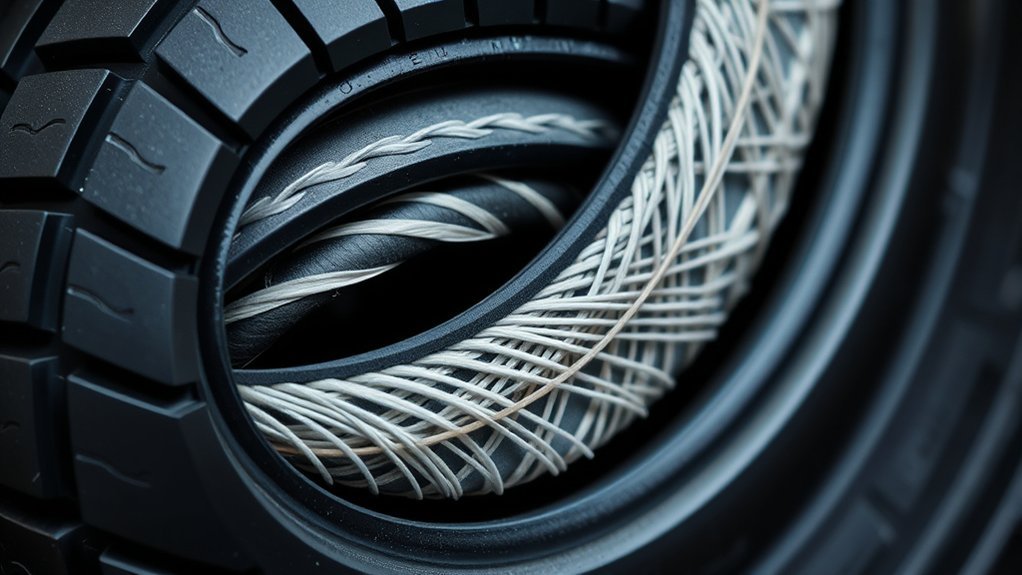
Textile cords form much of the tire’s flexible skeleton. They are coated in rubber so they bond into the tire structure. Common cord materials include polyester, rayon, nylon, and aramid.
Textile Cord Materials
Each cord type brings a different balance of strength, flexibility, heat behavior, and weight:
- Polyester: Common in passenger tires because it offers good strength and ride comfort.
- Nylon: Often used where fatigue resistance and impact tolerance matter.
- Rayon: Valued for dimensional stability in some tire constructions.
- Aramid: Very strong and heat resistant, often used in demanding reinforcement applications.
Cord Reinforcement Function
Textile cords help the tire carry load and keep its shape while still allowing controlled flex. That flex is important. A tire that is too stiff can ride harshly and lose contact over rough surfaces; a tire that flexes too much can overheat, wear quickly, or handle poorly.
| Cord type | Common role | Driver benefit |
|---|---|---|
| Polyester | Body ply support | Comfort and stable handling |
| Nylon | Cap ply or reinforcement | Heat and fatigue resistance |
| Rayon | Dimensional stability | Consistent shape control |
| Aramid | High-strength reinforcement | Strong response with lower weight |
Radial vs. Bias Tire Construction
Radial and bias tires differ in how their internal ply cords are arranged. Under U.S. tire definitions, a radial ply tire has cords that extend to the beads at substantially 90 degrees to the centerline of the tread. A bias ply tire uses cords laid at alternating angles substantially less than 90 degrees.
- Radial tires: The body cords run bead to bead, and the tread area is usually stabilized by belts. This lets the sidewall flex while the tread stays more stable.
- Bias tires: The plies cross diagonally. This can make the tire feel tougher in some low-speed, off-road, agricultural, trailer, or vintage applications, but it is less common for modern passenger vehicles.
- Steel-belted radial tires: These are common on passenger cars because they balance ride comfort, steering stability, treadwear, and efficiency.
For most modern cars, SUVs, and light trucks used on highways, radial construction is the standard choice. Bias-ply tires still have roles in specialized use cases, but they are not the normal choice for everyday passenger-car driving.
How Tire Tread Is Built for Grip
The tread is the part of the tire most drivers notice, but it is more than a pattern cut into rubber. Tread performance comes from both the rubber compound and the tread design.
Several tread features affect grip:
- Grooves: Move water away from the contact patch and reduce hydroplaning risk.
- Sipes: Small cuts that create biting edges for wet, snowy, or icy surfaces.
- Tread blocks: Provide contact area and mechanical grip.
- Void ratio: The amount of open space in the tread. More void can help mud or snow traction, while less void can increase dry-road contact.
- Compound softness: Softer compounds may grip better in some conditions but can wear faster.
High-performance summer tires often use larger rubber contact areas and specialized compounds for warm dry and wet roads. Winter tires use compounds that stay flexible in cold weather, plus more sipes and biting edges. All-season tires aim for a compromise across a wider temperature range.
How Tire Materials Affect Safety and Fuel Economy
Tire materials directly affect braking, steering, ride comfort, tread life, and fuel economy. The same tire cannot maximize every trait at once, so engineers balance trade-offs.
Grip and Wet Traction
Wet traction depends on tread compound, tread pattern, tire condition, and inflation pressure. Silica-rich tread compounds can help wet grip and rolling efficiency when the compound is designed correctly. Grooves and sipes help channel water away so rubber can contact the road.
That does not mean any tire with silica will automatically outperform every tire without it. The full design matters: compound recipe, tread depth, tread shape, vehicle load, road temperature, and tire age all affect real-world grip.
Rolling Resistance and Efficiency
Rolling resistance is the energy a tire loses as it flexes and recovers while rolling. Lower rolling resistance can improve fuel economy or electric-vehicle range, but the tire still needs enough grip, durability, and heat resistance to be safe.
FuelEconomy.gov says keeping tires inflated to the proper pressure can improve gas mileage by 0.6% on average and up to 3% in some cases. It also notes that under-inflated tires can lower gas mileage by about 0.2% for every 1 psi drop in the average pressure of all tires.
Warning: Do not use the maximum pressure printed on the tire sidewall as your normal inflation target. Use the vehicle manufacturer’s recommended cold tire pressure, usually found on the driver-side door placard or in the owner’s manual.
The National Highway Traffic Safety Administration also emphasizes proper tire pressure, vehicle load limits, road-hazard avoidance, and regular inspections as key steps for reducing tire failure risk.
How Tire Materials Vary by Tire Type
Different tires use different material priorities. That is why two tires that look similar can feel completely different on the road.
| Tire type | Material focus | Typical goal |
|---|---|---|
| All-season | Balanced rubber blend, moderate siping, durable tread | Year-round usability in mild climates |
| Summer / performance | Grip-focused compound and stable tread blocks | Strong warm-weather handling and braking |
| Winter | Cold-flexible compound, more sipes, larger biting edges | Traction on snow, ice, and cold pavement |
| Touring | Comfort-focused construction and long-wear compound | Quiet ride and tread life |
| Electric vehicle | Low rolling resistance, reinforced load support, noise control | Range, durability, and quiet operation |
| Light truck / SUV | Stronger carcass, load-rated materials, tougher sidewalls | Load carrying, durability, and impact resistance |
How Tires Are Manufactured
Tire manufacturing turns raw materials into a finished tire through several controlled steps. The exact process varies by manufacturer, but the basic flow is similar.
- Mixing: Natural rubber, synthetic rubber, fillers, oils, resins, sulfur, and other additives are mixed into rubber compounds.
- Component preparation: Rubber is shaped into tread, sidewall, inner liner, bead filler, and other parts. Steel and textile cords are coated with rubber.
- Tire building: Components are assembled on a tire-building drum into an uncured “green tire.”
- Curing / vulcanization: Heat and pressure mold the tire, form the tread pattern, and create sulfur crosslinks that make the rubber elastic and durable.
- Inspection and testing: Tires are checked for uniformity, construction quality, appearance, and performance requirements.
Vulcanization is especially important. Before curing, rubber is soft and shapeable. After curing, it becomes elastic, stronger, and more stable under heat and load.
Sustainability and Tire Recycling
Tires are difficult to recycle because they are built to be tough. Vulcanized rubber is not like a plastic bottle that can simply be melted and reshaped. The rubber is chemically crosslinked, and the tire also contains steel, textile, fillers, and additives.
Common end-of-life tire routes include retreading where suitable, grinding into crumb rubber, using ground tire rubber in asphalt applications, recovering steel, pyrolysis, and research into devulcanization. The Federal Highway Administration notes that ground tire rubber can be used in asphalt paving applications when properly engineered.
Material innovation is also changing tire design. USTMA notes industry work on sustainable materials, including alternative natural rubber sources such as guayule and dandelion rubber. These developments do not remove the need for safe tire performance, but they show how tire materials are evolving.
Quick Checks for Tire Safety and Performance
The materials inside a tire only work properly when the tire is used and maintained correctly. A premium tire can still perform poorly if it is underinflated, overloaded, damaged, or worn out.
- Check pressure monthly: Use the vehicle placard pressure, not the tire sidewall maximum.
- Inspect tread depth: Replace tires when they are legally worn or no longer safe for your driving conditions.
- Look for sidewall damage: Bulges, deep cuts, cracks, and exposed cords need professional inspection.
- Watch for uneven wear: It can point to alignment, suspension, rotation, or inflation problems.
- Respect load ratings: Overloading makes tires flex more, heat up, and wear faster.
- Rotate as recommended: Rotation helps equalize wear when done according to the vehicle or tire maker’s guidance.
Note: Tire material quality matters, but maintenance matters too. Correct pressure, load control, alignment, and tread inspection help the tire’s materials do their job.
Frequently Asked Questions
Are tires still made from trees?
Yes, many tires still use natural rubber from rubber trees. But tires are not made only from tree rubber. They also use synthetic rubber, steel, textile cords, carbon black, silica, oils, resins, sulfur, and other additives.
Can you melt down rubber and reuse it?
Not in the simple way you can melt some plastics. Tire rubber is vulcanized, which means it has chemical crosslinks that make it elastic and durable. Used tires are usually reused through methods such as retreading, grinding into crumb rubber, asphalt applications, devulcanization research, or pyrolysis.
Are car tires 100% rubber?
No. Rubber is a major material, but a tire also contains steel belts, bead wire, textile cords, carbon black, silica, sulfur, oils, resins, antioxidants, and other chemicals. These non-rubber materials help the tire hold shape, carry load, grip, and resist heat.
Do tires have metal inside?
Yes. Most modern passenger tires use steel in the belts beneath the tread and in the bead core that seats the tire on the wheel rim. Steel helps stabilize the tire, support load, and keep the tire attached to the rim.
What makes tires black?
Carbon black is a major reason tires are black. It is not only a colorant; it also reinforces rubber compounds and helps improve strength, abrasion resistance, and durability.
What part of a tire holds the air?
In a tubeless tire, the inner liner helps hold air. It is usually made from a low-permeability rubber compound, often based on butyl rubber. The bead area also helps seal the tire against the wheel rim.
Conclusion
A tire is a balanced composite, not a solid piece of rubber. Natural and synthetic rubbers provide grip and flexibility. Carbon black and silica reinforce the compounds. Steel belts and bead wire add strength and rim security. Textile cords support the tire’s shape. Oils, resins, sulfur, antioxidants, and other chemicals fine-tune the final performance.
That material balance is why tire choice matters. A good tire recipe can improve traction, comfort, tread life, fuel economy, load capacity, and safety. The best tire for you is not the one with the most of one material; it is the one engineered for your vehicle, climate, load, speed, and driving conditions.
Sources
- U.S. Tire Manufacturers Association — Tire Materials — supports tire material families, compounding, and sustainable-material context.
- Michelin — How Tires Are Made — supports ingredient complexity, material groups, tire building, and tread-design functions.
- Continental Tires — Tire Mixture — supports example material categories and tire component materials.
- NHTSA — Tire Safety — supports tire pressure, load, inspection, and tire-failure safety guidance.
- FuelEconomy.gov — Gas Mileage Tips — supports tire pressure and fuel-economy figures.
- Federal Highway Administration — Ground Tire Rubber — supports ground tire rubber and asphalt recycling applications.

Related Articles
What Does THE P Stand For on a Tire? Full Meaning Explained
I’ll explain what the “P” on a tire really means and why it could change how you choose your next set.
Read More
How to Use a Tubeless Tire Repair Kit: Complete Field Guide
Learn how to fix tubeless tire punctures fast with the right kit, because one small mistake can leave you stranded on the trail.
Read More
How to Tell a Tire’s Diameter: Easy Guide to Reading Tire Size
Want to decode tire sidewall numbers and find the right diameter, but wonder what those hidden digits really mean?
Read More