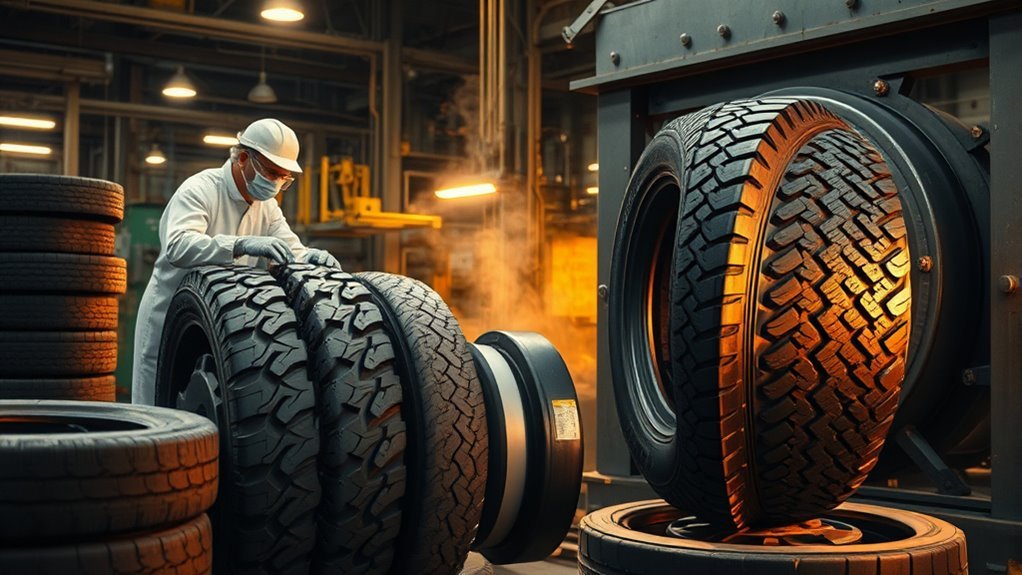
Tire manufacturing is a controlled, multi-step process that turns rubber, reinforcing materials, fillers, oils, and curing chemicals into a finished tire that can carry load, seal air, resist wear, and perform consistently at road speed. The basic sequence is mixing, component making, tire building, curing, inspection, and testing.
Quick Answer
Tires are made by mixing rubber with fillers, oils, sulfur, and other additives; forming parts such as tread, sidewalls, plies, beads, belts, and inner liner; assembling those parts into a green tire; curing it in a heated mold; then inspecting and testing it for defects, balance, uniformity, and compliance.
Key Takeaways
- A modern tire is built from several compounds and reinforcing parts, not from one type of rubber.
- Mixing controls grip, wear, rolling resistance, heat resistance, and aging behavior.
- Calendering and extrusion shape the main parts before assembly on a tire-building machine.
- Curing, also called vulcanization, bonds the tire and gives it its final tread pattern and sidewall markings.
- Final inspection can include visual checks, X-ray inspection, uniformity testing, balance testing, and regulatory marking checks.
How Tires Are Made: A Quick Process Roadmap
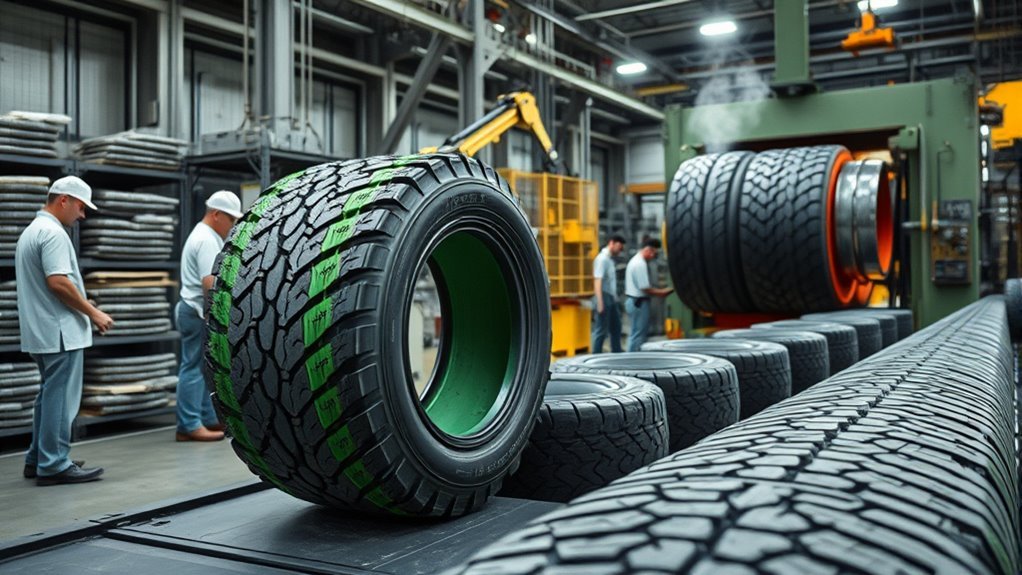
The tire manufacturing process usually follows six main stages:
- Raw material selection: Manufacturers select natural rubber, synthetic rubber, carbon black, silica, steel, textile cords, oils, resins, antioxidants, sulfur, and curing accelerators.
- Compound mixing: Rubber and additives are mixed in high-shear internal mixers to create compounds with specific properties for the tread, sidewall, inner liner, bead area, and other parts.
- Component manufacturing: The mixed compounds are calendered, extruded, coated, cut, and shaped into semi-finished tire parts.
- Green tire building: The uncured parts are assembled on a tire-building machine into the tire’s basic shape.
- Curing and vulcanization: The green tire is placed in a heated mold, where pressure and heat shape the tread and cross-link the rubber.
- Inspection and testing: Finished tires are checked for appearance, dimensions, structure, balance, uniformity, and required markings before shipment.
Major tire makers describe this as a sequence of compound production, component production, tire building, vulcanization, and quality control. The exact recipes, equipment settings, cycle times, and inspection criteria vary by tire type, brand, size, performance category, and plant.
Note: The word “green tire” does not mean environmentally friendly. In tire manufacturing, it means the tire has been assembled but has not yet been cured.
Raw Materials and Compound Formulation for Modern Tires
A tire is a carefully engineered composite. It must flex thousands of times per mile, carry vehicle weight, resist heat, hold air, grip wet and dry roads, and survive impacts from potholes, curbs, and debris. No single material can do all of that, so manufacturers use multiple compounds and reinforcement systems.
Common tire materials include:
| Component | Function | Design Target |
|---|---|---|
| Natural rubber | Elasticity, fatigue resistance, tear strength | Durability, flexibility, load carrying |
| Synthetic rubber | Heat resistance, grip tuning, rolling resistance control | Traction, fuel economy, wear balance |
| Carbon black and silica | Reinforcement and performance tuning | Wear resistance, stiffness, wet grip, rolling resistance |
| Steel and textile cords | Structural reinforcement | Strength, shape retention, stability |
| Oils, resins, and plasticizers | Processing and flexibility | Workability, grip, low-temperature behavior |
| Sulfur, zinc oxide, and accelerators | Vulcanization chemistry | Elasticity, heat resistance, durability |
| Antioxidants and antiozonants | Aging protection | Crack resistance, longer service life |
Bridgestone lists natural rubber, synthetic rubber, carbon black, silica, steel cord, textile cord, sulfur, and other chemicals among the main tire materials. Continental gives an example tire composition that includes rubber, fillers, reinforcing materials, plasticizers, vulcanization chemicals, and anti-aging agents, while noting that the exact mixture changes by tire design.
Formulation is where many trade-offs happen. A tread compound designed for long wear may not feel the same as a soft performance compound. A low-rolling-resistance compound can improve efficiency, but it still must meet grip, braking, heat, and durability targets. That is why one tire can contain several different rubber compounds, each placed where its properties matter most.
Mixing and Prep: Turning Rubber, Fillers, and Additives Into Compounds
Mixing is the first major manufacturing step. It turns raw rubber, fillers, oils, and chemicals into uniform compounds that can be processed into tire parts. Poor mixing can create weak spots, uneven stiffness, heat buildup, poor wear, or inconsistent performance, so this stage is tightly controlled.
[Products Worth Considering]

Monitor tire tread wear with a smart, color-coded depth gauge that shows clear condition ranges at a glance. The bar is range marked for fast, easy readings, helping you maintain safer traction and performance. Each gauge is portable with a pocket clip, and the set includes 20 units for daily use and sharing.

This metal-free wheel and tire cleaning brush uses dense, fluffy synthetic wool to safely clean rims, spokes, fenders, and engine areas without worrying about damaging surfaces. Its flexible, comfortable design helps you reach detailed areas while maintaining durability, and the extra absorbent fibers work well with wheel spray cleaners for faster cleanup. Reusable and washable performance helps prevent grime and build-up for cleaner vehicles and easier maintenance at home.

Make hard-to-reach areas easier to access with the MAXXHAUL truck tire service step featuring an adjustable width and height. The foldable design stores compactly, while the serrated non-slip platform provides secure footing for tire-related maintenance. It fits most stock tire sizes up to 31-inch diameter with a 300-lb capacity.
Compound Formulation Basics
Each tire part uses a compound designed for its job. The tread needs traction and wear resistance. The sidewall needs flexibility, ozone resistance, and impact tolerance. The inner liner needs low air permeability. The bead area needs strength and stiffness so the tire seats securely on the rim.
Manufacturers choose polymers, filler type, filler loading, oils, resins, curing agents, and protective additives based on the tire’s performance goals. Carbon black is often used for reinforcement and wear resistance, while silica is commonly used in modern tread compounds to help tune wet grip and rolling resistance.
High-Shear Mixing
High-shear internal mixers, often called Banbury-style mixers, knead the ingredients under pressure. The goal is to disperse fillers evenly through the rubber and create a consistent compound from batch to batch.
During mixing, operators and control systems monitor:
- Batch weight: The correct amount of each ingredient must be added.
- Rotor speed and torque: These show how the compound is shearing and dispersing.
- Temperature: Heat helps mixing but must be controlled to avoid premature curing or material damage.
- Mixing time: Under-mixing can leave poor dispersion; over-mixing can damage the compound.
- Batch traceability: Each batch is tracked so quality issues can be traced back to materials, settings, and process conditions.
Pro Tip: In tire manufacturing, “more mixing” is not automatically better. The best result comes from the right ingredient sequence, temperature profile, rotor speed, and discharge point for that specific compound.
Sheet Cooling and Storage
After mixing, the hot compound is usually discharged and formed into sheets or slabs using mills or calender rolls. These sheets are cooled, marked, and stored under controlled conditions until they are needed for extrusion, calendering, or cutting.
Storage control matters because rubber compounds can change with heat, humidity, light, contamination, and time. Plants commonly manage compounds by batch number, date, compound code, and approved storage window so the right material reaches the right production line.
Making Tire Parts: Treads, Sidewalls, Cords, Beads, and Liners
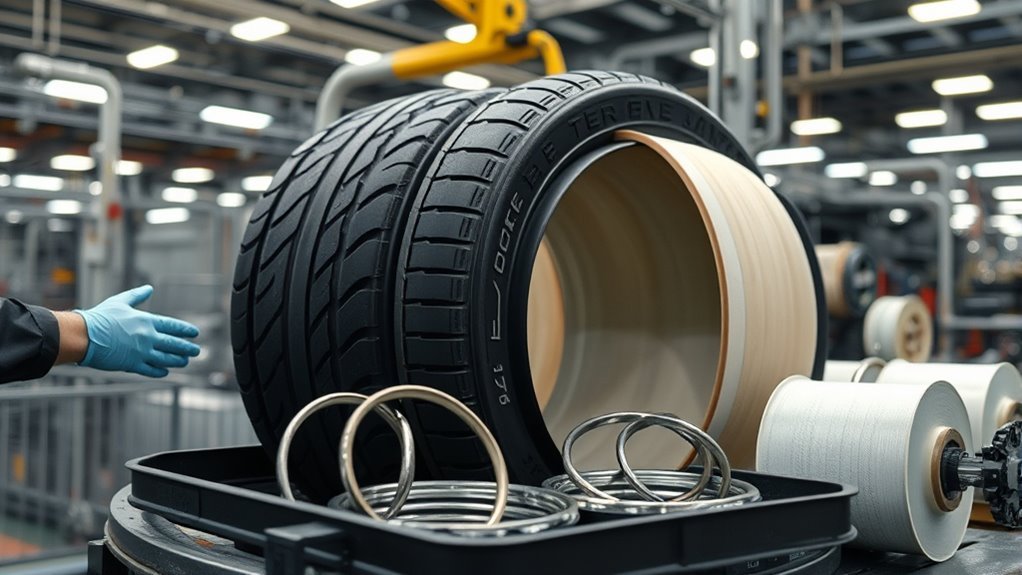
Once compounds are ready, the factory turns them into semi-finished tire parts. Each part must meet dimensional tolerances before it can be assembled into a green tire.
[Products Worth Considering]

Accurately measure tire tread depth with a calibrated gauge marked from 0 to 1 inch in 1/32 inch increments. The color-coded bar helps you quickly identify tread condition ranges, supporting safe driving for trucks, motorcycles, automobiles, and passenger vehicles.

The Chemical Guys Gerbil Wheel & Rim Brush is designed to safely clean wheels, rims, exhaust tips, tires, and engine bay components without scratching delicate finishes. Its soft natural bristles help lift brake dust, grime, and buildup while conforming to tight spaces and intricate contours. A comfort grip handle delivers control for extended detailing sessions.

Keep your tires properly inflated with this analog VONDIOR tire pressure gauge, designed for fast, easy readings without batteries. The swiveling, two-axis hose and large glow dial help you measure at any tire angle with instant visibility. Built with a protective rubber shield, it supports durable, low-maintenance use for cars and trucks.
Tread and Sidewall Extrusion
Extrusion forces warm rubber through shaped dies to create continuous profiles. Treads, sidewalls, bead fillers, and other shaped rubber parts are commonly made this way. The extruder controls width, thickness, profile shape, temperature, and surface quality.
The tread is especially important because it contacts the road. Its compound and final pattern affect braking, handling, noise, water evacuation, wear, and rolling resistance. The sidewall protects the tire body and carries important markings, but it also needs enough flexibility to bend repeatedly without cracking.
Calendered Plies, Belts, and Inner Liners
Calendering passes rubber through large rollers to create thin sheets or to coat reinforcing cords with rubber. Textile body plies and steel belts are made by embedding cords in rubber at controlled angles and spacing.
The inner liner is a thin, low-permeability rubber layer, commonly based on butyl rubber or halobutyl rubber, that helps tubeless tires hold air. Its thickness and continuity are critical because liner defects can lead to slow air loss.
Bead Making
The bead is the reinforced ring that locks the tire to the wheel rim. Bead wire is wound into loops, coated with rubber, and shaped so the finished tire can seal against the rim and resist forces from inflation pressure, braking, cornering, and impacts.
Tire Building: Assembling the Green Tire Step by Step
Tire building brings all semi-finished parts together. A tire-building machine places the components in a precise sequence, aligns them, and forms the uncured tire shape.
A typical passenger tire build includes these steps:
- Inner liner placement: The air-retaining liner is wrapped around the building drum.
- Body ply placement: Textile plies are added to create the tire carcass.
- Bead placement: Bead assemblies are positioned at both sides of the drum.
- Turn-up: Ply edges are wrapped around the beads to anchor the structure.
- Sidewall placement: Sidewall strips are added and aligned.
- Shaping: The carcass is expanded into a toroidal tire shape.
- Belt and cap ply placement: Steel belts and, when used, cap plies are applied under the tread area.
- Tread placement: The tread strip is wrapped around the crown of the tire.
- Stitching and inspection: Rollers press the layers together and operators or sensors check alignment, splice quality, and visible defects.
The result is a green tire. At this point, it looks like a tire, but the rubber is still uncured and the tread pattern has not yet been molded into its final form.
Warning: Tire building is not a do-it-yourself repair process. Tires are safety-critical engineered products made with specialized equipment, controlled materials, pressure systems, and inspection procedures.
Curing (Vulcanization): Shaping and Bonding the Final Tire
Curing is the stage that turns the green tire into a finished tire. The green tire is placed in a mold inside a curing press. Heat and pressure push the rubber into the mold details, forming the tread pattern, sidewall lettering, size markings, and other molded features.
At the same time, vulcanization changes the rubber chemically. Sulfur and accelerators help create cross-links between polymer chains. These cross-links give the tire its elastic, durable behavior: flexible enough to deform, but strong enough to recover its shape and resist heat and wear.
| Curing Parameter | Why It Matters | Typical Control Goal |
|---|---|---|
| Temperature | Activates vulcanization chemistry | Controlled by tire size, compound, and plant specification |
| Pressure | Forces the tire against the mold | Full tread and sidewall detail without distortion |
| Time | Allows the cure to reach the required state | Matched to tire construction and compound thickness |
| Mold condition | Controls surface finish and markings | Clean vents, accurate tread geometry, readable sidewall text |
| Cooling and handling | Protects shape and surface quality after cure | Stable dimensions and no handling damage |
Cure time is not one universal number. A small passenger-car tire cures differently from a large truck, agricultural, or off-road tire. Manufacturers set the cure recipe based on compound chemistry, tire size, mold design, and required performance.
Inspection, Testing, and Quality Control Before Shipment
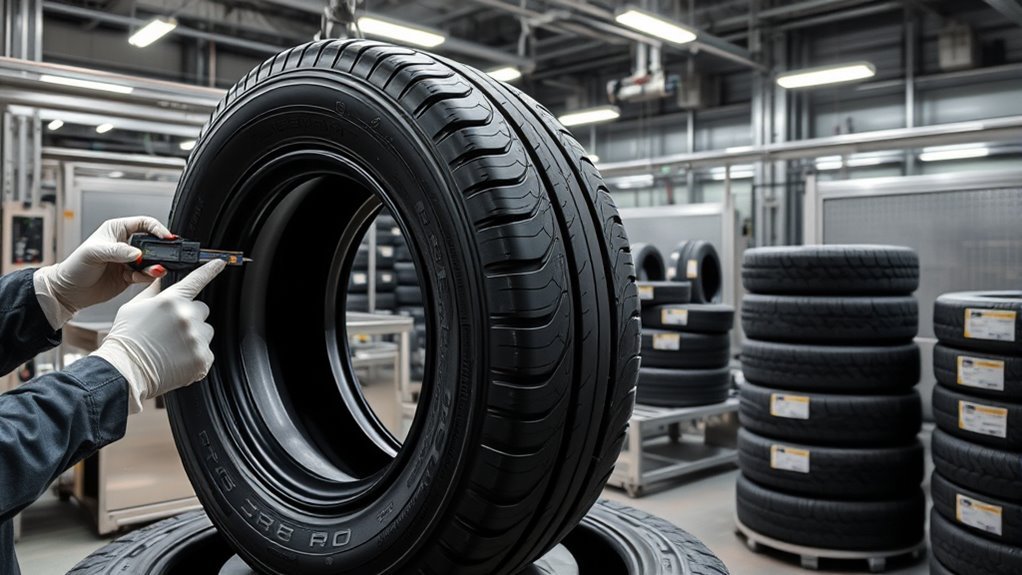
After curing, each tire goes through finishing and inspection. The exact quality-control plan depends on the manufacturer, tire category, and regulatory market, but the goal is always the same: catch defects before the tire reaches a vehicle.
[Products Worth Considering]

Chemical Guys Tire Kicker Sprayable Extra Glossy Tire Shine restores a deep, wet look on tires, rubber, vinyl, and plastic trim. It delivers a rich showroom shine that enhances color and luster while helping protect against fading, cracking, and discoloration. The spray application dries to the touch with a streak-free finish and no greasy sling, for fast results on cars, trucks, motorcycles, RVs, and boats.

Cristal Products Untouchable Tire Shine Spray delivers a deep, wet-look gloss that enhances your vehicle’s tires. It’s quick-drying and spreads smoothly for consistent, streak-free coverage, while forming a protective coating against UV rays, road grime, and weather. Suitable for all tire types, it helps restore dull, faded tires to a showroom-quality finish.

Slip the Powerbuilt tire step over your vehicle’s tire to reach roof racks, engine bays, truck boxes, and more without overreaching. Its adjustable, universal design fits tires with a cross tread width up to 13 inches, including car, truck, RV, and semi tires. The non-slip cheesegrater surface and anti-slip tape provide secure grip while the open design lets mud and debris pass through. Fold-flat storage with rubber bumpers helps keep your tire and the step protected between uses.
Visual and X-Ray Inspection
Visual inspection checks the outer surface and molded details. Inspectors look for defects such as trapped air, cracks, open splices, bead damage, missing markings, exposed cord, damaged sidewalls, or incomplete tread details. They may also trim excess rubber flash or vent spews left from the mold.
X-ray inspection is used to examine internal structure that cannot be verified by sight alone. It can reveal belt placement problems, ply distortion, foreign material, separations, or other internal irregularities.
- Surface scan: Inspect bead, sidewall, tread, markings, and mold finish.
- Internal scan: Check plies, belts, bead areas, and liner continuity where X-ray inspection is used.
- Documentation: Record passes, rejections, rework, and corrective actions.
Uniformity and Balance Testing
Uniformity testing measures how consistently the tire behaves as it rotates under load. It can check radial force variation, lateral force variation, conicity, runout, and other measurements that affect vibration, steering pull, and ride quality.
Balance testing checks mass distribution. A tire that is too heavy in one area can cause vibration, uneven wear, and poor ride comfort. Depending on the result, the tire may be corrected, sorted for a specific use, or rejected.
Regulatory and Marking Checks
Finished tires also need correct markings for the market where they will be sold. In the United States, applicable Federal Motor Vehicle Safety Standards are listed in 49 CFR Part 571. For example, U.S. tire sidewalls use DOT marking to indicate certification to applicable federal standards and include a tire identification number under related requirements.
In many international markets, tires may also need approvals under UN regulations such as UN Regulation No. 117, which covers tire approval related to rolling sound emissions, wet adhesion, and rolling resistance, depending on tire class and application.
What Can Go Wrong During Tire Manufacturing?
Because tires are built from many layers, small process errors can create major quality problems. Common manufacturing risks include:
- Poor filler dispersion: Can reduce wear resistance, strength, or heat performance.
- Incorrect compound: A wrong batch or mixed-up compound can affect grip, aging, or curing behavior.
- Bad splice alignment: Can create imbalance, weak spots, or visible defects.
- Ply or belt misplacement: Can affect ride, strength, and uniformity.
- Air trapped between layers: Can lead to separations or blisters.
- Under-cure or over-cure: Can affect durability, elasticity, heat resistance, and dimensional stability.
- Damaged beads: Can compromise rim seating and air retention.
That is why traceability, sensor checks, operator inspection, laboratory testing, and final quality-control systems are central to tire production.
Sustainability and Environmental Controls in Tire Manufacturing
Tire manufacturing can involve energy use, rubber scrap, process fumes, particulate matter, wastewater, and hazardous air pollutants. Modern plants manage these risks through ventilation, material controls, emissions controls, solvent management, recycling programs, scrap reduction, and process optimization.
The U.S. Environmental Protection Agency regulates rubber tire manufacturing under National Emission Standards for Hazardous Air Pollutants. The EPA notes that a 2024 amendment package was later revoked under the Congressional Review Act in 2025, so manufacturers and readers should rely on the currently enforceable rule text and official EPA updates rather than outdated summaries.
End-of-life tires are also part of the sustainability picture. The U.S. Tire Manufacturers Association reports that end-of-life tires are used in markets such as tire-derived fuel, ground rubber, rubber-modified asphalt, and other applications. Recycling and recovery programs help reduce stockpiles and recover value from scrap tires, although the best option depends on local regulations, processing capacity, and market demand.
A safe tire is not just molded rubber. It is a layered, tested, traceable product where chemistry, geometry, reinforcement, curing, and inspection all have to work together.
Frequently Asked Questions
How long does a tire last once in use?
Many tires wear out after about 25,000 to 50,000 miles, but service life depends on tire design, driving style, load, alignment, inflation pressure, climate, road surface, and maintenance. Tire age matters too. NHTSA recommends checking tire aging information, and many manufacturers advise replacing tires that are too old even if tread remains.
Are tires recyclable, and how are they reused?
Yes. End-of-life tires can be processed into ground rubber, crumb rubber, rubber-modified asphalt, molded products, tire-derived fuel, civil engineering materials, and recovered raw materials. Availability depends on local recycling infrastructure and regulations.
What safety standards must tires meet internationally?
Requirements vary by market and tire type. In the United States, tires must meet applicable Federal Motor Vehicle Safety Standards in 49 CFR Part 571. In many other markets, UN regulations such as UN Regulation No. 30, No. 54, and No. 117 may apply depending on tire category, size, load, speed, rolling resistance, wet grip, and noise requirements.
How are run-flat tires manufactured differently?
Many run-flat tires use reinforced sidewalls that can temporarily support the vehicle after pressure loss. Their compounds, sidewall inserts, bead area, and curing requirements are designed to handle extra heat and load during limited zero-pressure operation. Some systems use support rings instead, depending on the tire and wheel design.
Can tire manufacturing cause environmental pollution?
Yes. Tire manufacturing can create emissions, process fumes, rubber scrap, wastewater, and energy-related impacts. Plants reduce these risks with emissions controls, ventilation, closed handling systems, scrap recycling, cleaner energy, process monitoring, and compliance with environmental regulations.
Why do tires need sulfur?
Sulfur is used in vulcanization. During curing, sulfur helps form cross-links between rubber polymer chains. Those cross-links improve elasticity, strength, heat resistance, and durability compared with uncured rubber.
What is the difference between calendering and extrusion?
Calendering uses rollers to make rubber sheets or coat textile and steel cords with rubber. Extrusion pushes rubber through a shaped die to create profiles such as tread strips, sidewalls, bead fillers, and other shaped components.
Conclusion
Tire manufacturing starts with carefully selected raw materials and compound formulas, then moves through mixing, extrusion, calendering, bead making, green tire building, curing, and final inspection. Each stage affects safety and performance. When the process is controlled correctly, the finished tire leaves the plant with the right shape, structure, markings, balance, durability, and road performance for its intended use.
Sources
- Continental Tires — Tire Production — supports the overall tire production stages: materials, compounds, components, building, vulcanization, and quality control.
- Yokohama Tire — Manufacturing Processes — supports mixing, calendaring, extrusion, component manufacturing, tire building, curing, and inspection steps.
- Bridgestone — Tire Materials — supports the list of rubber, chemical, and structural materials used in tires.
- eCFR — 49 CFR Part 571, Federal Motor Vehicle Safety Standards — supports U.S. tire regulatory references and DOT certification context.
- UNECE — UN Regulation No. 117 — supports international tire approval references for rolling sound emissions, wet adhesion, and rolling resistance.
- U.S. EPA — Rubber Tire Manufacturing NESHAP — supports environmental controls and hazardous air pollutant regulation context.