
Tire Weight and Fuel Economy: How It Affects Your Toyota RAV4
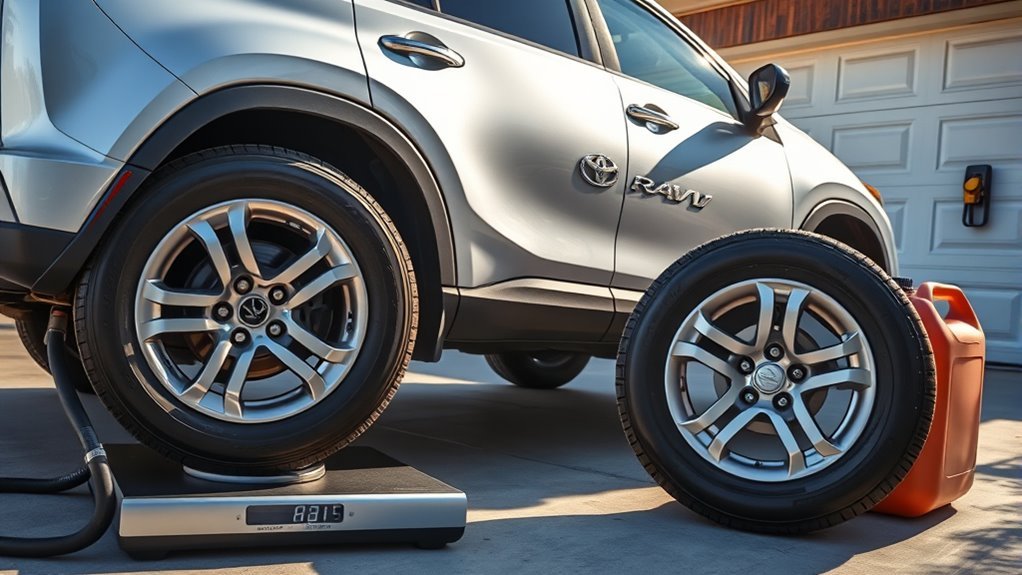
You’ll lose noticeable MPG on your RAV4 when heavier tires raise rotational mass and rolling resistance: expect roughly 1% fuel‑economy loss per extra 10 lb per tire, with winter or all‑terrain tires cutting efficiency 10–30% in real conditions and underinflation adding small penalties. Urban stop‑start amplifies losses versus steady highway driving. Weigh candidate tires, compare tread and rolling‑resistance data, and maintain cold PSI and alignment to reclaim efficiency—more specifics and calculations follow.
Quick Answer: How Tire Weight Affects RAV4 MPG
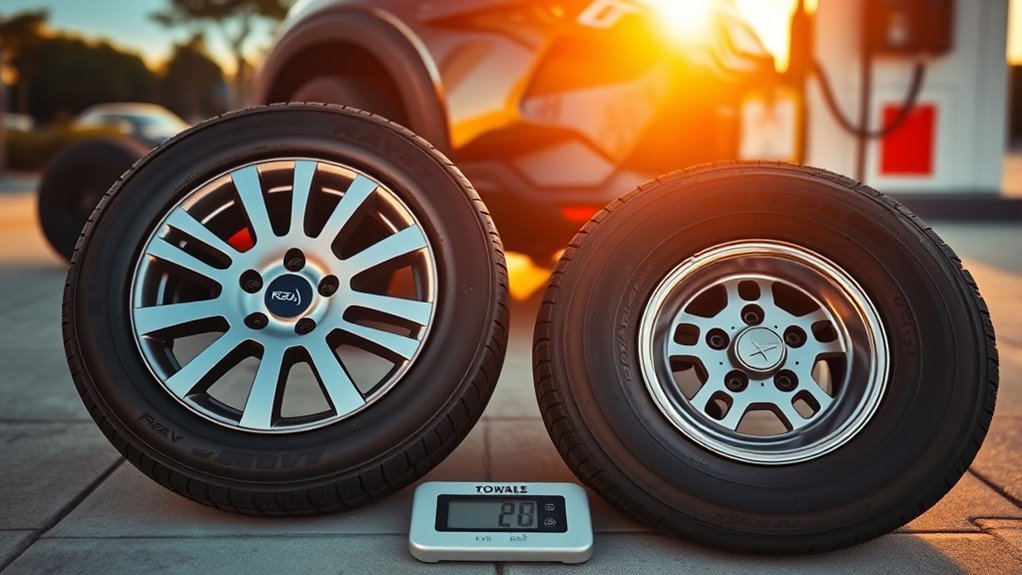
Because heavier tires raise rolling resistance and rotational inertia, you’ll typically see RAV4 fuel economy drop — commonly by about 10% and in some cases over 30% with heavy all‑terrain or winter tires in cold conditions. You’ll observe that tire design directly governs how mass distributes and how tread pattern interacts with pavement; denser compound and aggressive lugs increase drag and energy loss per revolution. Cold ambient temperatures amplify these effects: stiffer rubber and denser air raise consumption further. You can reclaim efficiency by selecting lighter, fuel-efficient tires and maintaining ideal inflation; proper pressure can recover roughly 0.5% MPG and reduce additional losses from added mass. Combine tire selection with conservative driving and routine maintenance to maximize liberation from fuel dependency. Use measured comparisons—percent MPG change across tire models and temperatures—to guide choices rather than marketing claims, and prioritize designs that lower rolling resistance and rotational inertia for quantifiable fuel efficiency gains.
Why Rotating Mass and Rolling Resistance Matter for MPG
You should consider both rotational mass and rolling resistance because they directly change the energy your RAV4 uses during acceleration, cruising, and braking. Increasing tire mass raises the inertial load and fuel required to accelerate, while higher rolling resistance from tire-road friction can cut MPG by roughly 10–30% on certain tire types. Selecting lower-mass, low-rolling-resistance tires and keeping proper pressure can measurably improve fuel economy—owners report MPG gains and pressure maintenance alone can yield about a 0.5% improvement.
Rotational Mass Effects
When you accelerate or cruise, a tire’s rotational mass and rolling resistance determine how much engine energy is needed to change and sustain wheel speed, so heavier tires and higher-resistance tread directly reduce MPG. You’ll see measurable effects: heavier rims/tires increase energy to accelerate; changing tire composition alters mass distribution and moment of inertia. Adjusting driving habits and selecting lighter tires frees you from avoidable consumption.
| Parameter | Effect | Typical impact |
|---|---|---|
| Rotational mass | Increases energy to accelerate | ± several % MPG |
| Rolling resistance | Higher in aggressive tread | 10–30% worse vs. standard |
| Tire pressure | Reduces rolling resistance | ~0.5% MPG improvement |
| Composition swap | Lighter tires improve MPG | User-reported gains |
Rolling Resistance Impact
Having covered how rotational mass affects acceleration, we now focus on rolling resistance and its direct effect on steady-state fuel use. You should know rolling resistance is a primary drag on MPG: higher resistance tires force the engine to expend more energy to maintain speed. Tire material and tread design drive resistance; all-terrain and winter patterns can lower fuel economy by 10–30% on a RAV4. Tire weight compounds the effect—heavier tires increase hysteresis losses and energy demand, particularly in hybrids. Brand choice yields measurable MPG variance. You can regain efficiency by maintaining correct pressure; improving pressure cuts rolling resistance and yields roughly a 0.5% L/100 km improvement. Select low-resistance tires to reduce consumption and operating cost.
How Much Heavier Tires Typically Lower Fuel Economy (Real‑World Ranges)
Expect a measurable penalty: roughly 1–3% fuel-economy loss for each extra 10 pounds per tire, with your MPG hit scaling linearly in many cases. Real-world reports show shifts to heavier all-terrain or winter tires can cut fuel economy by about 10–30% depending on weight increase, tread, and driving mix. Variability is high—urban stop-and-go amplifies the effect while steady highway driving mutes it—so use these ranges to estimate likely MPG change for your RAV4.
Typical Weight Penalty
A 1–3% fuel-economy penalty per additional pound per tire is a useful rule of thumb: in practice that translates to roughly 0.5–1 MPG lost for typical passenger vehicles when you fit heavier tires. You should expect real‑world ranges larger when switching to all‑terrain or winter tires; reported drops span 10–30% depending on tire material and weight distribution across axles. The cumulative mass raises rolling resistance and rotational inertia, hitting hybrids like the RAV4 harder. Cold‑season examples show 38–40 MPG falling to ~33–34 MPG with heavier winter rubber. Keep tire pressure ideal—underinflation can add up to ~0.5% extra penalty in L/100km. Use these benchmarks to choose tires that align with your liberation goals: performance, durability, or efficiency.
MPG Drop Estimates
You’ve seen typical penalties from added tire mass; now quantify how those losses show up in everyday MPG. Heavier tires raise rolling resistance and reduce efficiency: estimate ~1% MPG loss per 10 lb extra per tire. Seasonal changes and lower tire pressure in cold weather amplify that effect, especially for winter-specific compounds.
- All-terrain/winter swaps: expect 10%–30% lower MPG versus standard tires.
- Per-tire weight rule: ~1% MPG loss per 10 lb extra — four tires compound linearly for long-term fuel use.
- RAV4 Hybrid example: 38–40 MPG (warm, standard tires) → ~33–34 MPG with winter tires; highlights combined weight, compound, and seasonal changes impact.
Choose tires balancing mass, rolling resistance, and your freedom to roam.
Real‑World Variability
Although results vary with vehicle type and conditions, heavier tires typically shave off measurable MPG in real-world driving: added mass of about 5–10 lb per tire commonly translates to roughly 1–2 MPG lost (≈1% per 10 lb per tire), while some drivers report 10%–30% drops when switching to aggressive winter or all‑terrain rubber under cold, low‑pressure conditions.
You’ll see variability from driving style, speed, and RAV4 drivetrain. The aggregate 20–40 lb increase raises rolling resistance and curb weight, cutting highway efficiency most. Embrace tire technology that minimizes mass and rolling resistance; consider seasonal considerations when selecting winter rubber. Lighter, efficient tires restore MPG. Use the table below to compare typical impacts.
| Scenario | Weight Δ per Tire | Typical MPG Δ |
|---|---|---|
| Light upgrade | 0–2 lb | 0–0.5 MPG |
| Moderate | 5–10 lb | 1–2 MPG |
| Heavy/all‑terrain | 10+ lb | 2–6+ MPG |
How Tire Type and Tread Affect MPG (Winter, All‑Terrain, All‑Season)
When you fit winter tires or aggressive all‑terrain treads, expect fuel economy to drop because those designs raise rolling resistance; your choice of tire composition and tread pattern directly alters MPG. Winter rubber and deep siping improve grip but typically reduce efficiency by 10–30% versus all‑season compounds. All‑terrain designs add voids and blocky tread for traction off‑road, increasing rolling drag on pavement and lowering fuel economy. All‑season tires aim for a balance, yielding better MPG than winter or AT in neutral conditions but trailing dedicated summer compounds.
- Winter tires — high siping and softer composition; MPG down 10–30% in cold conditions.
- All‑terrain — aggressive tread pattern and larger voids; notable MPG penalty on paved roads.
- All‑season — moderate composition and tread; compromise between traction and efficiency.
Use this data to reclaim control: select tires matched to your climate and driving needs to minimize unnecessary fuel penalties while maintaining safety.
Measure Tire Weight and Calculate Expected MPG Change
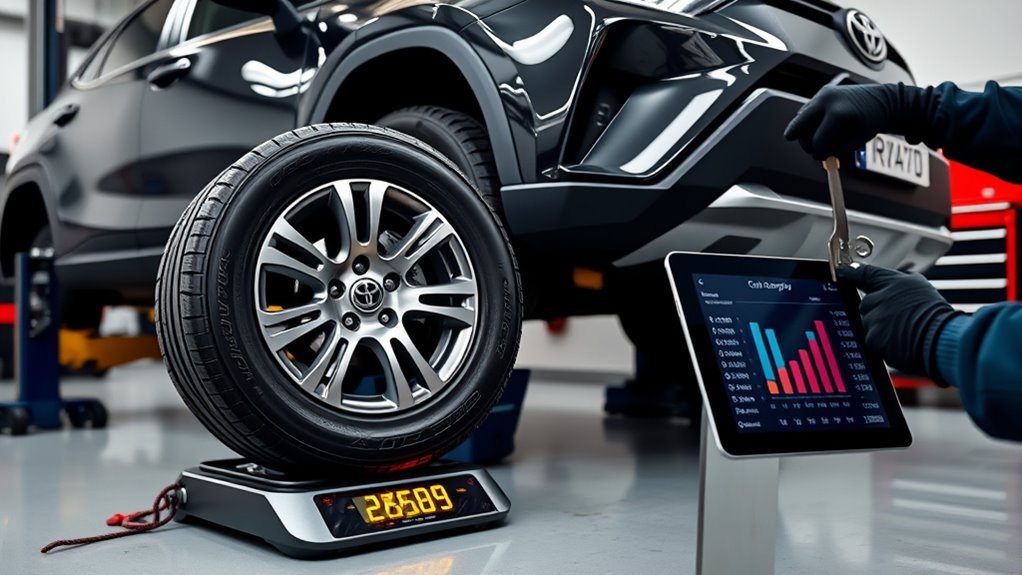
Start by weighing your current and candidate tires accurately—use a calibrated scale and record each tire’s mass to the nearest 0.1 lb (0.05 kg)—because even small weight differences compound across four wheels and affect rolling resistance and fuel use. For a precise tire weight comparison, note the per-wheel delta (ΔW) and multiply by four. Use baseline MPG (MPG0) from your RAV4’s typical driving cycle. Apply MPG calculation techniques: estimate percent MPG change ≈ k * (ΔW_total / vehicle_curb_weight). Empirical k ranges from 0.10–0.30 (10–30% MPG sensitivity) depending on tire type and conditions; choose k based on whether tires are all-terrain/winter (higher k). Compute expected MPG1 = MPG0 × (1 − percent_change). Example: ΔW_total = 40 lb, curb ≈ 3500 lb, k=0.15 → percent_change ≈ 0.15*(40/3500)=0.001714 → ~0.17% loss. Record results, iterate with different k values for conservative and aggressive projections to reclaim control of your consumption.
Maintenance to Offset Heavier Tires: Pressure, Alignment, Checks
Because heavier tires raise rolling resistance and inertia, you’ll need a disciplined maintenance routine—precisely: keep tire pressures at the manufacturer’s recommended cold PSI (and consider +1 PSI increments where safe), check alignment every 6–12 months or after impacts, inspect tread depth and sidewalls for damage, rotate tires every 5,000–7,500 miles, and balance as needed. You’ll use targeted actions to reclaim efficiency and freedom from needless fuel loss. Follow these measurable steps:
- Monitor tire inflation: check cold PSI weekly; each +1 PSI can recover ~0.5% fuel economy versus underinflation.
- Schedule alignment checks every 6–12 months and after potholes/curbs to prevent uneven wear and added rolling resistance.
- Conduct tread inspection and tire rotation at 5,000–7,500 miles, and balance when vibrations appear to maintain uniform wear and minimize drag.
Be methodical: log PSI, alignment dates, tread depths, and rotations. That data lets you optimize maintenance intervals, preserve MPG, and keep your RAV4 responsive without surrendering range to heavier tires.
Choosing RAV4 Tires: Balance Weight, Grip, and Efficiency
Although tires are a small component of your RAV4, their mass and tread design directly affect rolling resistance and can cut MPG by a measurable margin, so choose with data: prioritize tire selection that minimizes weight without sacrificing necessary grip. You’ll quantify trade-offs—heavier all-terrain or winter tires can raise rolling resistance and reduce fuel economy by 10–30% versus lighter, all-weather designs. Evaluate tread pattern, compound, and published rolling resistance coefficients; compare models like Michelin CrossClimate 2, which aim for versatility and lower consumption than specialized winter options. Balance grip and efficiency by targeting the lowest mass and resistance that still meets your traction needs; aggressive treads improve off-road or snowy control but increase consumption. Track pressure, alignment, and wear to realize predicted MPG gains. Make decisions that free you from needless fuel expense: select tires based on measured performance trade offs, manufacturer data, and the driving conditions you truly need, not on marketing alone.
How Wheels, Roof Racks, and Carriers Change RAV4 MPG

You’ve already seen how tire mass and tread affect rolling resistance and MPG; wheels, roof racks, and carriers add another layer of measurable impact. You’ll want to assess three main factors that change your RAV4’s fuel use:
- Wheel mass and wheel designs — heavier wheels raise rolling resistance, reducing MPG; choosing lightweight alloys can recover ~0.5% MPG per optimization step.
- Roof aerodynamics — installing a roof rack can create drag that cuts efficiency by 5–25% depending on speed and profile.
- Cargo weight on racks or hitch carriers — added mass further lowers MPG, often up to 10% or more under load.
Quantify changes: combine heavier wheels, high-drag racks, and loaded carriers and expect cumulative losses. Mitigate by selecting low-mass wheels, streamlined crossbars, and minimizing rooftop cargo. You’ll liberate range and reduce fuel costs through targeted weight and aerodynamic choices grounded in measured percentage impacts.
Cost‑Benefit Checklist: When to Prioritize Economy vs. Traction
When choosing between economy and traction for your RAV4, weigh quantified fuel penalties against safety gains: winter tires can improve grip in snow but typically cut fuel economy 10–30%. You should list mission-critical needs: daily commuting mileage, exposure to winter conditions, and acceptable MPG loss. Quantify outcomes—estimate annual fuel savings lost by switching to winter or all-terrain tires vs. potential crash-risk reduction from superior tire performance. Include maintenance levers: proper inflation can restore ~0.5% efficiency per tire; seasonal swaps concentrate traction where needed. For traction balance, prioritize winter tires if temperatures regularly drop below ~7°C and roads see snow/ice; prioritize economy if you drive long highway distances in mild climates. All-terrain options compromise MPG via higher rolling resistance—model expected consumption change before purchase. Make a decision rubric: (1) safety imperative → traction, (2) high-mileage economy focus → low-rolling-resistance tires, (3) mixed use → seasonal changeover. This framework frees you to optimize fuel savings without sacrificing necessary grip.
Frequently Asked Questions
Why Is My RAV4 Consuming Too Much Fuel?
Your RAV4’s high fuel use stems from poor tire pressure, aggressive driving habits, reduced engine efficiency, and lax maintenance practices; fix pressure, tune engine, change behavior, and follow service schedules to regain control and maximize MPG.
Conclusion
Think of swapping to heavier tires like strapping a backpack filled with rocks onto your RAV4: every extra 10 lb per corner can cut ~0.5–1.0% off highway MPG. You’ll trade a few tenths of a gallon per tank for better traction or durability. Check tire mass, rolling resistance ratings, and maintain correct pressure/alignment to reclaim efficiency. Prioritize economy when commuting; pick grip and ruggedness if your routes demand it.

Related Articles

Upsizing Wheels on a Toyota RAV4: Pros, Cons, and Considerations
Boost your Toyota RAV4's performance with larger wheels, but discover the hidden trade-offs that could impact your ride before you decide.
Read More
Can I Change Tire Size on My Toyota RAV4? Rules and Recommendations
Are you considering changing the tire size on your Toyota RAV4? Discover the essential rules and recommendations before making a decision.
Read More
What to Do If the TPMS Light Comes On in Your RAV4
Understand the steps to take when the TPMS light illuminates in your RAV4, as overlooking it could lead to serious tire problems.
Read More