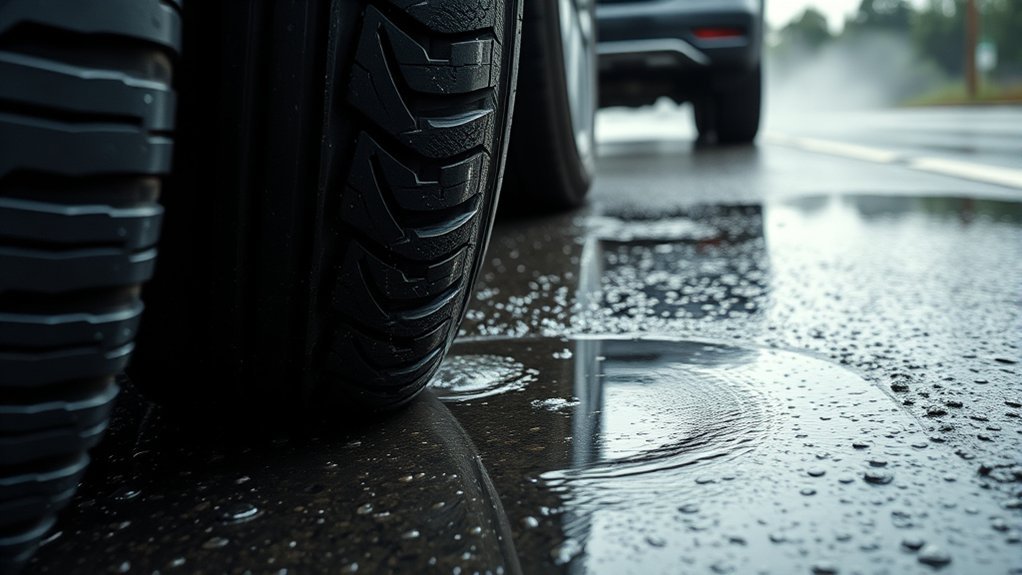
Tire tread depth is one of the biggest factors in how well your tires clear water and maintain traction in rain or slush. As the grooves become shallower, hydroplaning resistance and wet braking performance decline. Check every tire regularly with a tread-depth gauge, penny, quarter, or built-in wear bars. For U.S. passenger vehicles, NHTSA says tires should be replaced at 2/32 inch, while 4/32 inch is a smarter replacement point when wet-road performance matters.
Quick Answer
Deeper tire tread gives water and slush more space to escape from under the tire, helping preserve road contact. Wet traction drops noticeably as tread wears. Start planning replacement around 4/32 inch for frequent rain, and replace tires at 2/32 inch under NHTSA guidance or sooner if they are damaged, unevenly worn, or otherwise unsafe.
Key Takeaways
- Tread depth matters most when your tires must move water or slush away from the contact patch.
- Many new passenger tires begin around 10/32 to 11/32 inch, although truck, SUV, winter, and specialty tires may be deeper.
- At 4/32 inch, wet braking and handling can already be substantially worse than with new tires.
- NHTSA says tires should be replaced when tread reaches 2/32 inch; state legal requirements can vary.
- A tread-depth gauge is more precise than a coin test, and you should measure several locations across every tire.
- Tread depth is not the whole safety picture. Tire pressure, rubber condition, age, tread design, damage, temperature, and road surface also affect grip.
What Is Tire Tread Depth?
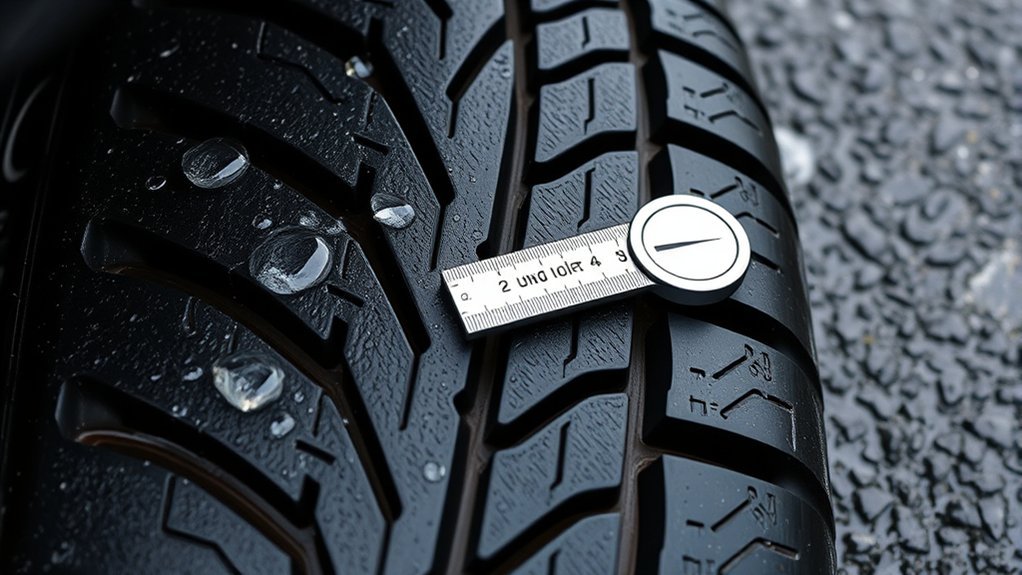
Tire tread depth is the distance from the top of the tread surface to the bottom of a main tread groove. In the United States, it is usually measured in thirty-seconds of an inch, such as 8/32, 4/32, or 2/32 inch.
Tread depth tells you how much usable groove remains, but it should be evaluated together with tire condition, pressure, age, and wear pattern.
Many new passenger tires start at about 10/32 or 11/32 inch. Some truck, SUV, all-terrain, and winter tires begin with deeper tread, so there is no single starting depth for every tire. Bridgestone recommends checking the specifications for the actual tire rather than assuming every new tire begins at the same measurement.
At the other end of the scale, the National Highway Traffic Safety Administration says tires are not safe and should be replaced when tread has worn to 2/32 inch. Many states use 2/32 inch as a minimum for passenger vehicles, but legal requirements are not identical everywhere.
The practical wet-weather threshold is higher. AAA recommends beginning tire replacement around 4/32 inch because its testing found significant wet braking and handling deterioration at that depth.
Tire Tread Depth Chart
| Tread Depth | What It Usually Means | Recommended Action |
| 10/32–11/32″ | Common range for many new passenger tires | Record the starting depth so you can track wear. |
| 6/32″ or more | Substantial tread remains | Continue routine inspections and proper inflation. |
| 4/32–5/32″ | Wet-weather margin is declining | Begin planning replacement, especially if you drive frequently in rain. |
| 3/32″ | Very little wet-weather margin remains | Replace promptly rather than waiting for 2/32. |
| 2/32″ or less | NHTSA replacement threshold; treadwear bars are normally flush | Replace the tire. Check applicable state law as well. |
Note: These depths are practical passenger-vehicle guidance, not a universal legal chart. Commercial vehicles and some state or seasonal traction rules can use different minimums.
[Products Worth Considering]

The ETENWOLF T600 digital tire pressure gauge delivers precise, manually calibrated readings to ANSI B40.7 Grade 2A standards with ±0.5% PSI accuracy. Its 360° rotating nozzle and display hold make it easy to check pressures from any angle, while a bleed button helps dial tires to the perfect level. With a 0–250 PSI range and support for PSI, BAR, and KPA, it’s a convenient tool for maintaining tire performance across many vehicles and seasons.

The SAFELIFE dial tire tread depth gauge measures tread depth in 1/32 inch increments with clear, easy-to-read 2-inch dial face. Color zones using a traffic light system help you quickly judge whether tread is low, marginal, or ample for safer driving. Built with a durable zinc cast body and a metal detect probe for precise, comfortable use across cars, motorcycles, trucks, and buses.

Monitor tire tread wear with a smart, color-coded depth gauge that shows clear condition ranges at a glance. The bar is range marked for fast, easy readings, helping you maintain safer traction and performance. Each gauge is portable with a pocket clip, and the set includes 20 units for daily use and sharing.
Why Tread Depth Affects Traction
Tire grooves give water, slush, and loose material somewhere to move as the tire rolls over the road. When those grooves become shallow, there is less volume available to evacuate water from the contact patch.
That is why tread depth has such a strong effect on wet-road traction and hydroplaning resistance. If water cannot escape quickly enough, the tire can lose some or all of its direct contact with the road surface.
Tread blocks, grooves, and sipes also create edges that help the tire work on loose or slippery surfaces. As they wear down, some of those features become less effective.
However, deeper tread does not automatically mean better grip in every situation. Rubber compound, tread design, inflation pressure, road temperature, surface condition, tire age, and vehicle setup also matter. A properly designed tire with adequate tread can still perform poorly if it is badly underinflated, damaged, or unsuitable for the conditions.
How Tread Depth Improves Wet-Weather Safety
Wet pavement is where the effect of tread wear becomes easiest to see. Deeper grooves can move more water away from beneath the tread, helping the rubber maintain contact with the road during braking, turning, and lane changes.
AAA tested new all-season tires against tires artificially worn to 4/32 inch on wet pavement at highway speeds. In its 2018 passenger-car testing, the 4/32-inch tires averaged about 87 feet more stopping distance from 60 mph than the new tires. The worn-tire vehicle was still traveling about 38.8 mph at the point where the average new tire had already stopped.
In AAA’s 2018 test, passenger-car tires worn to 4/32 inch took about 87 additional feet to stop from 60 mph on wet pavement compared with the new tires tested.
The full AAA All-Season Tire Testing report calculated roughly a 42% increase in stopping distance for the tested passenger-car tires. Its light-truck test found about an 86-foot difference and a 44% increase.
Those figures should not be treated as a guaranteed stopping-distance difference for every tire or vehicle. Tire model, pavement, water depth, temperature, braking system, vehicle weight, speed, and other factors change real-world results. The important finding is the direction of the effect: wet braking and handling can deteriorate substantially before the tread reaches 2/32 inch.
Warning: Do not assume a tire is suitable for heavy rain simply because its tread is still above 2/32 inch. That measurement is a minimum replacement threshold, not a guarantee of strong wet-weather performance.
How Tread Depth Affects Snow and Slush
Snow and slush also demand space within the tread pattern. As grooves become shallower, the tire has less ability to manage slush and loose snow, and its biting edges become less pronounced.
Tread depth alone does not determine winter performance. Winter tires use specialized compounds, sipes, and tread patterns designed to remain effective in cold conditions. An all-season tire with deeper tread is therefore not automatically equal to a dedicated winter tire on snow or ice.
If winter traction matters where you drive, do not wait until the tire reaches the basic 2/32-inch replacement point. Follow the tire manufacturer’s guidance and any state or local winter traction requirements that apply to your route.
How to Check Tire Tread Depth
Measuring tread depth takes only a few minutes. A dedicated tread-depth gauge gives the clearest reading, while a penny or quarter provides a quick threshold check.
At a Glance
| Time Required | About 5 minutes for all four tires |
| Difficulty | Easy |
| Tools Needed | Tread-depth gauge preferred; penny or quarter for a quick check |
| Cost | Free with coins; inexpensive if using a basic tread-depth gauge |
Measuring tread depth at several points across every tire is more useful than checking one groove in one location.
- Check all four tires: Look at the inner, center, and outer portions of each tread. Repeat the measurement at several points around the tire because wear may not be even.
- Use a tread-depth gauge for precision: Place the probe into a main tread groove, press the gauge base flat against the tread surface, and read the measurement in 32nds of an inch or millimeters. Avoid placing the probe directly on a wear bar.
- Use the penny test for the 2/32 threshold: Insert a penny into a groove with Lincoln’s head pointing down. If you can see the top of Lincoln’s head, the tread is approximately at or below the replacement threshold.
- Use the quarter test for the 4/32 threshold: Insert a quarter with Washington’s head pointing down. If the entire top of his head is visible, the tread is around 4/32 inch or less and the wet-weather safety margin is becoming limited.
- Inspect the treadwear bars: Tires have raised wear indicators in the grooves. When the surrounding tread becomes flush with these bars, approximately 2/32 inch remains.
Bridgestone recommends checking several areas of each tire because one shoulder or section may wear faster than another. You can review its tread-depth checking guidance for examples of the penny, quarter, gauge, and wear-bar methods.
Pro Tip: Record the lowest reading from each tire rather than averaging away a worn spot. A tire with 6/32 inch in the center but only 2/32 inch on an edge still needs attention.
[Products Worth Considering]

Measure tire tread depth quickly and accurately with this LUMITECO dial gauge that reads in 1/32" increments up to 14/32". The color-coded green/yellow/red zones make it easy to judge tire wear and know when replacement is needed. A rugged, compact design with a protective pouch helps keep the gauge ready for use on cars, trucks, motorcycles, and more.

Accurately measure tire tread depth with a calibrated gauge marked from 0 to 1 inch in 1/32 inch increments. The color-coded bar helps you quickly identify tread condition ranges, supporting safe driving for trucks, motorcycles, automobiles, and passenger vehicles.

Measure tyre tread depth precisely with a digital gauge that reads in both MM and inches, helping you monitor safe driving conditions. The large LCD screen is easy to operate, and the compact tool fits for cars, trucks, and motorcycles. It provides high accuracy with a 0-25.4mm range and includes a 1-year warranty for added peace of mind.
What Uneven Tread Wear Can Tell You
Tread depth should not be judged from one point alone. Uneven wear can reveal a maintenance or mechanical problem even when much of the tire still looks healthy.
- Both outer shoulders wearing quickly: commonly associated with prolonged underinflation or heavy loading.
- Center wearing faster than the shoulders: can be associated with excessive inflation for the vehicle’s actual operating conditions.
- One edge wearing faster: can point to an alignment or suspension issue.
- Cupped or scalloped sections: may indicate suspension, balance, or other mechanical problems that should be inspected.
If one area is much shallower than the rest, have the tire and vehicle inspected rather than assuming the deeper grooves make the tire safe.
When to Replace Tires for Safety
For ordinary U.S. passenger-vehicle safety guidance, replace a tire when any tread area reaches approximately 2/32 inch. NHTSA also advises replacement when a tire has serious physical damage or other conditions that make it unsafe.
If you regularly drive in rain, waiting for 2/32 inch gives away a substantial amount of wet-weather performance. AAA recommends beginning replacement at 4/32 inch, where its wet testing already showed major deterioration compared with new tires.
At 3/32 inch, there is very little usable tread between the tire and the 2/32 replacement threshold. It is sensible to arrange replacement promptly rather than trying to extract the last fraction of tread, especially during a rainy season.
You should also replace or professionally inspect a tire regardless of tread depth if you find:
- exposed cords, belts, or body-ply material;
- tread or sidewall separation;
- a bulge, bubble, deep cut, or serious cracking;
- repeated air loss or a leak that cannot be safely repaired;
- severe uneven wear; or
- age-related deterioration identified by the tire or vehicle manufacturer.
NHTSA notes that some vehicle and tire manufacturers recommend replacement after roughly six to ten years regardless of remaining tread, so tread depth should never be the only condition you check.
Note: Federal rules are different for certain commercial vehicles. Under 49 CFR §393.75, applicable front tires on buses, trucks, and truck tractors must have at least 4/32 inch in a major tread groove, while other covered tire positions generally require at least 2/32 inch.
[Products Worth Considering]

This tire inflator with pressure gauge delivers long-lasting performance with a durable rubber-protected gauge and sturdy build. The longer hose and 360 swivel air chuck help you seal the valve securely and keep your hands free while measuring, inflating, or deflating. It’s battery-free for reliable use and provides ±2 PSI accuracy in the mid-range for most typical tires, with universal compatibility for 1/4 NPT compressor outputs.

The Big Rig Defense Tire Thumper is a truck tire pressure checker that lets you quickly check multiple tires by giving them a firm whack. Listen for a reassuring thump and feel the stick bounce when a tire is fully inflated, helping you get back on the road safely. It features a comfortable, glove-friendly handle and a secure wrist strap for confident use on busy routes.

ETENWOLF’s tire pressure gauge helps you quickly and accurately check tire PSI across cars, trucks, motorcycles, bikes, and more. It’s manually calibrated to ANSI B40.1 Grade A for reliable readings, includes a large glow dial for easy nighttime viewing, and features a 360-degree swivel chuck for use at any valve angle. The gauge also works consistently in extreme hot or cold weather.
What Else Affects Tire Grip?
Tread depth is important, but two tires with the same measured depth can perform differently. Consider these factors as well:
- Tread design: Groove layout, tread blocks, and sipes affect how a tire manages water, snow, and loose surfaces.
- Rubber compound: Different compounds respond differently to heat, cold, wet pavement, and aging.
- Inflation pressure: Incorrect pressure can change the tire’s contact with the road and accelerate uneven wear.
- Tire type: Summer, all-season, all-weather, all-terrain, and winter tires are designed for different conditions.
- Temperature: Rubber behavior changes with temperature, which is one reason winter-specific compounds can outperform ordinary tires in the cold.
- Road surface and water depth: Standing water, polished pavement, snow, ice, gravel, and contaminants can all reduce available traction.
- Tire condition and age: Cracks, separation, damage, or hardened rubber can matter even when tread depth appears acceptable.
For that reason, a tread gauge should be treated as one inspection tool rather than a complete tire-safety test.
Sources
- National Highway Traffic Safety Administration — TireWise — 2/32-inch replacement guidance, treadwear indicators, tire damage, age, and inspection guidance.
- AAA — Tread Lightly: Worn Tires Put Drivers at Risk — 4/32-inch wet braking and handling findings and replacement recommendation.
- AAA — All-Season Tire Testing — full wet braking methodology and passenger-car/light-truck test results.
- Bridgestone — How to Check Tire Tread Depth — typical new tread, penny test, quarter test, gauge use, and wear bars.
- Electronic Code of Federal Regulations — 49 CFR §393.75 — commercial-vehicle tread-depth requirements.
- Tire Rack — Common Tire Sizes — explains the commonly cited 3% overall-diameter guideline for replacement tire sizing.
Frequently Asked Questions
Is a 3/32 Tire Tread Safe?
A tire at 3/32 inch is above NHTSA’s 2/32-inch replacement threshold, but its wet-weather margin is already limited. AAA recommends replacement around 4/32 inch for wet-road safety, so at 3/32 inch you should arrange replacement promptly, especially if you regularly drive in rain or slush.
How Does Tread Affect Grip?
Tread grooves help move water and slush away from the contact patch, while tread blocks and sipes add edges that work on loose or slippery surfaces. As the tread becomes shallower, water evacuation and wet traction decline. Rubber compound, tire pressure, temperature, and road conditions also affect grip.
Can Tread Depth on Tires Lead to Safety Issues?
Yes. Shallow tread reduces the tire’s ability to move water and slush away, which can increase hydroplaning risk and lengthen wet stopping distances. Very low tread can also reduce available traction during cornering and emergency maneuvers.
What Is the 3% Rule for Tires?
The commonly cited 3% tire rule is about replacement tire sizing, not tread depth. For passenger cars, it is a rule of thumb that replacement tire overall diameter should stay close to the original diameter so speedometer and vehicle-system calibration are not significantly changed. It does not mean a tire should be replaced because it reaches 3/32 inch of tread.
Is 4/32 Inch of Tread Still Good?
A tire at 4/32 inch still has more tread than the 2/32-inch NHTSA replacement threshold, but wet performance has already declined substantially compared with a new tire. AAA recommends beginning replacement at 4/32 inch, particularly for drivers who regularly encounter rain.
Can a Tire Need Replacement Even If the Tread Is Above 2/32 Inch?
Yes. Replace or professionally inspect a tire if it has exposed cords, separation, bulges, severe cracking, serious cuts, persistent air loss, or severe uneven wear. Tire age can also matter, so follow the replacement guidance from your vehicle and tire manufacturers.
Conclusion
Tire tread depth has a major effect on wet-road safety because the grooves must move water away before the rubber can maintain dependable contact with the pavement. A gauge gives the most useful measurement, while the penny and quarter tests provide quick checks at roughly 2/32 and 4/32 inch.
Do not treat 2/32 inch as a target to reach before shopping. AAA’s 2018 testing found that passenger-car tires already worn to 4/32 inch took about 87 feet farther to stop from 60 mph on wet pavement than the new tires tested. Check tread regularly, start planning around 4/32 inch when wet driving matters, and replace at 2/32 inch or sooner when wear, damage, age, or driving conditions make replacement the safer choice.