Tire noise in a Toyota Tacoma depends on more than the tire brand. Tread pattern, tire category, inflation pressure, wear, pavement, speed, and the truck’s wheel and suspension condition all affect what you hear. A mild hum may be normal for an all-terrain tire, but a new thump, growl, squeal, or vibration needs attention.
Quick Answer
Highway and truck-touring tires are usually the quietest Tacoma choices. All-terrain tires produce more noticeable hum, while mud-terrain and studded winter tires are typically louder. For the best result, use the correct size and load rating, set cold pressure to the door-jamb placard, rotate on schedule, and investigate any sudden change in sound.
Key Takeaways
- Tire category matters: highway-focused tires generally make less tread noise than aggressive all-terrain or mud-terrain designs.
- Uneven wear is a common cause of tires becoming louder over time.
- Use the pressure listed on your Tacoma’s tire-information placard, not the maximum pressure molded into the tire sidewall.
- A noise that changes while turning, braking, or accelerating may come from a wheel bearing, brake, CV joint, or driveline part rather than the tire itself.
- Never choose a quieter tire at the expense of the required size, load index, speed rating, or terrain and weather capability.
Understanding Tire Noise Levels on a Toyota Tacoma
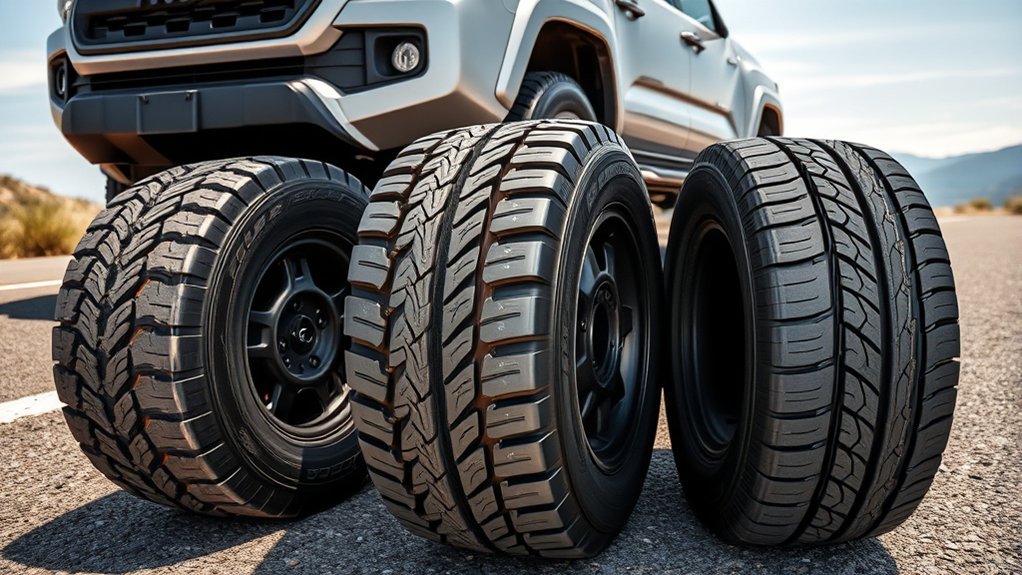
Your Tacoma’s tires create sound as the tread contacts the road, flexes, and releases air from its grooves. The cabin can also amplify certain frequencies. Studded winter and mud-terrain tires commonly sound louder because their tread and surface-contact features are built for traction rather than silence. Highway-focused tires usually use smaller blocks, closer spacing, and pattern sequencing to reduce repetitive sound.
All-terrain tires sit between those categories. They can provide useful dirt, gravel, and light-trail capability while remaining comfortable on pavement, but the exact noise level varies by model, size, load range, tread depth, and road surface. A heavy-duty LT tire may also feel firmer and transmit more vibration than a comparable P-metric tire.
Maintenance affects noise as much as the original design. Michelin notes that loud tire noise is commonly associated with uneven or irregular wear. Regular pressure checks, rotation, inspection, tire alignment and balancing can help prevent wear patterns that create humming or roaring.
Note: Published tire noise figures are not always directly comparable. Test methods, tire size, pavement, speed, temperature, vehicle insulation, and tread wear can differ, so avoid treating a single decibel number as a guaranteed in-cabin result for every Tacoma.
Common Tire Noise Issues in Your Tacoma
Start by describing the sound, noting when it appears, and checking whether it changes with speed, steering, braking, or road surface. This simple process helps separate normal tread noise from a tire defect or mechanical problem. Regular tire pressure monitoring is also important because underinflation can increase heat, flexing, wear, and vibration.
Common Causes of Tire Noise
- Aggressive tread: Large, widely spaced blocks can create a steady hum, especially on coarse pavement.
- Uneven or cupped wear: Worn high and low spots often create a rhythmic hum or roar that rises with speed.
- Incorrect inflation: Pressure that is too low or too high can change the contact patch and increase harshness or irregular wear.
- Wheel imbalance: Imbalance usually causes vibration and may add a repeating sound at certain speeds.
- Alignment or suspension wear: Toe, camber, worn shocks, or loose components can create irregular tread wear and noise.
- Embedded debris or damage: Stones, screws, tread separation, bulges, and flat spots may cause clicking, tapping, or thumping.
- Non-tire components: Wheel bearings, brakes, CV joints, and driveline parts can imitate tire noise.
Diagnosing Noise Symptoms
| Sound or Symptom | Possible Causes | First Check |
|---|---|---|
| Steady hum that rises with speed | Normal aggressive tread, cupping, uneven wear, or wheel bearing | Inspect tread by sight and touch; note whether the sound changes in a gentle turn |
| Rhythmic thump or “womp-womp” | Flat spot, separated belt, bulge, severe cupping, or embedded object | Stop safely and inspect the tread and sidewalls |
| Squeal in turns | Low pressure, excessive speed, alignment issue, or slippery surface | Check cold pressure and inspect for uneven shoulder wear |
| Clicking while turning | Stone in tread, brake contact, or a CV joint or steering component | Inspect the tread; arrange a professional inspection if clicking remains |
| Noise with steering-wheel or seat vibration | Imbalance, damaged wheel, tire damage, or driveline issue | Reduce speed and have the wheel and tire assembly inspected |
Warning: Stop driving as soon as it is safe if you notice a new bulge, visible tread separation, rapid pressure loss, severe vibration, exposed cords, or a heavy repeating thump. These signs can indicate tire damage that may lead to sudden failure.
Solutions for Reducing Noise
Use your Tacoma’s maintenance guide, the tire maker’s recommendations, and actual wear condition rather than applying one interval to every model year and tire. The following schedule is a practical inspection framework.
| Action | Benefit | When to Do It |
|---|---|---|
| Check Cold Tire Pressure | Supports the intended contact patch and limits irregular wear | At least monthly and before long trips |
| Rotate Tires | Promotes more even wear | At the interval in your Tacoma maintenance guide or tire warranty |
| Inspect Tread and Sidewalls | Finds stones, punctures, bulges, cracks, and abnormal wear | Monthly and whenever the sound changes |
| Balance Wheel and Tire Assemblies | Reduces speed-related vibration | When vibration appears, after certain repairs, or as advised by a technician |
| Check Alignment and Suspension | Helps prevent cupping and one-sided wear | When wear is uneven, steering pulls, or the truck hits a major pothole or curb |
| Replace Damaged or Worn Tires | Restores safety, traction, and smoother operation | When damage, legal tread limits, or manufacturer replacement criteria require it |
What Causes Tire Noise in Your Tacoma?
Tire noise comes from several interacting factors. The tread pattern is important, but the road, speed, construction, wheel size, load rating, wear, and cabin insulation can change the result. Choosing tires with appropriate noise-reducing capabilities can help, but only after fitment and safety requirements are satisfied.
Tire Tread Design Impact
Open grooves and large blocks help clear mud, snow, or loose material, but they also move and release more air as the tire rolls. That can create a more noticeable pattern hum. Manufacturers reduce this effect by varying block sizes, changing pitch sequence, stabilizing shoulder blocks, and shaping grooves to interrupt repeating frequencies.
Tread depth matters too. A new aggressive tire may sound different from the same model after thousands of miles. As the tread wears unevenly, noise can increase even if the tire was quiet when new.
Road Surface Influence
Coarse concrete, grooved pavement, chip seal, and rough asphalt can make the same tire sound much louder than it does on smooth asphalt. Water can also change the sound as grooves move it away from the contact patch. Before blaming the tire, compare the noise on several safe road surfaces at similar speeds.
Speed and Friction Effects
Tread noise often becomes more noticeable as speed rises because the blocks contact the road more frequently and airflow through the pattern increases. However, engine, wind, bearing, and driveline noise also change with speed. Do not assume a speed-related hum is automatically caused by the tires.
Tire Construction, Size, and Load Rating
A Tacoma may use different tire sizes and recommended pressures depending on model year, trim, wheel, and equipment. Wider tires, larger wheel diameters, stiff LT constructions, and high load ranges can transmit more impact and vibration than a softer highway tire, although design quality can offset some of that difference.
Always match the size, load index, speed rating, and type required for your exact truck. Toyota’s published specifications show that even within one Tacoma model year, approved sizes and cold pressures can vary by configuration. Check the driver-door placard and owner’s manual before buying.
Comparing Tire Types: Noise Levels Explained
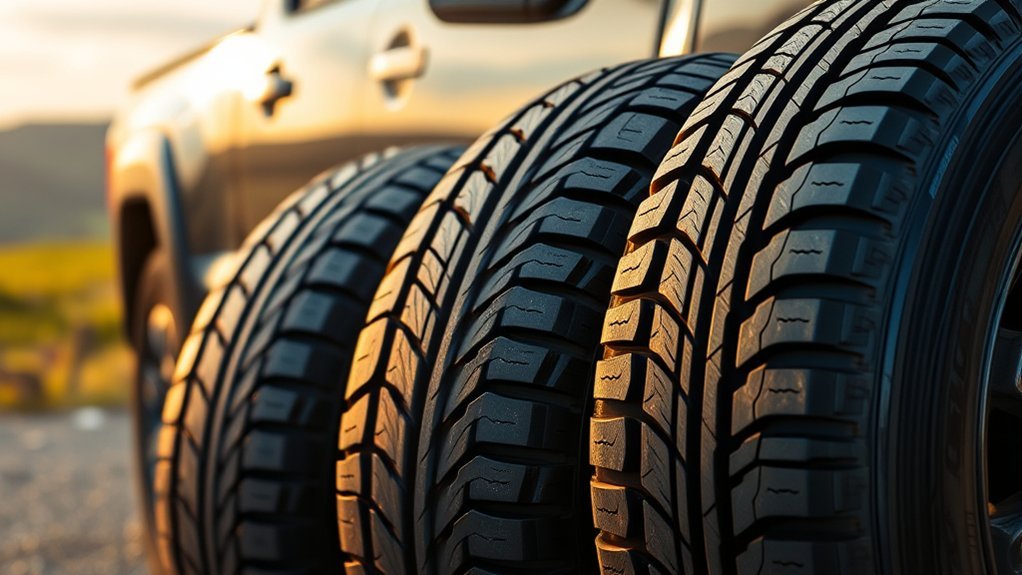
The table below gives a general expectation, not a laboratory ranking. A well-designed all-terrain tire may be quieter than an older or unevenly worn highway tire.
| Tire Type | Typical Noise Tendency | Best Use |
|---|---|---|
| Studded Winter | High on bare pavement | Severe winter conditions where studs are permitted and appropriate |
| Mud-Terrain | High | Deep mud, rocks, and frequent off-road use |
| All-Terrain | Moderate, model-dependent | Mixed pavement, gravel, trails, and light off-road use |
| Highway All-Season or H/T | Low to moderate | Commuting, towing on pavement, and long highway trips |
Studded winter and mud-terrain tires trade some refinement for traction in specialized conditions. All-terrain tires balance capability and on-road manners. Highway-focused truck tires usually prioritize comfort, stable wear, and lower tread noise. Selecting for ride comfort and stability can improve daily driving, but wet grip, snow capability, load capacity, and durability remain equally important.
All-Terrain vs. Off-Road Tires: Which Is Quieter for Your Tacoma?
All-terrain tires are generally quieter than dedicated mud-terrain or extreme off-road tires. Their tread blocks are usually smaller and more tightly arranged, and many models include features intended to limit pattern noise. Hankook, for example, describes staged block edges, tie bars, and an aero shoulder design on the Dynapro AT2 RF11 to reduce road noise while retaining off-road traction.
More aggressive tires use larger voids and stronger biting edges to clear loose material. Those features can create a louder hum on pavement. The difference is not a fixed 5 to 10 dB(A), because results change with tire size, pavement, speed, tread depth, vehicle, and test method.
If most of your miles are on pavement with occasional dirt roads, an all-terrain or highway-terrain tire is usually the better comfort choice. Proper inflation and prompt repair also help control tire noise levels by preventing damage and irregular wear. If you regularly drive deep mud, sharp rock, or difficult trails, accept some extra noise in exchange for the needed construction and traction.
[Products Worth Considering]

Monitor tire tread wear with a smart, color-coded depth gauge that shows clear condition ranges at a glance. The bar is range marked for fast, easy readings, helping you maintain safer traction and performance. Each gauge is portable with a pocket clip, and the set includes 20 units for daily use and sharing.

These aluminum alloy tire valve stem caps with an O-ring seal help protect valve stems from corrosion while adding a clean, stylish look to your vehicle. The universal fit works across cars, trucks, motorcycles, bicycles, and more, making them an easy upgrade for everyday driving and off-road use. Installation is quick, and the included four-pack keeps all your tires dressed and protected.

Measure tire tread depth quickly and accurately with this LUMITECO dial gauge that reads in 1/32" increments up to 14/32". The color-coded green/yellow/red zones make it easy to judge tire wear and know when replacement is needed. A rugged, compact design with a protective pouch helps keep the gauge ready for use on cars, trucks, motorcycles, and more.
Touring Tires for a Quiet Driving Experience
Passenger touring tires such as the Michelin Primacy Tour A/S and Bridgestone Turanza QuietTrack are designed around comfort and low noise, but they are not universal Tacoma replacements. Many Tacoma trims require truck or SUV sizes and load ratings that these passenger-touring lines may not offer. Use them only when the manufacturer’s fitment tool confirms the exact year, trim, size, and required rating.
For most Tacoma owners seeking a quieter ride, a highway-terrain or truck/SUV all-season tire is the more practical category. Benefits can include:
- Lower pattern noise: Tighter tread spacing and pitch sequencing can reduce repetitive hum.
- Smoother ride: Highway-focused construction often absorbs small road impacts better than a heavy off-road tire.
- More even wear: A stable road-focused footprint may resist the irregular wear that makes tires louder.
- Good road manners: These tires are designed for commuting, highway travel, and normal paved-road use.
Do not rely on a claimed “10 dB” improvement unless the manufacturer provides a directly comparable test for your size and conditions. Focus instead on verified fitment, independent or standardized test context, and low noise characteristics documented for the specific model.
[Products Worth Considering]

Steelman white tire marking crayons provide high-contrast, semi-permanent marks for repairing and inspecting tires and equipment. They write on wet or dry, smooth or coarse surfaces including rubber, metal, glass, and wood, making them ideal for puncture location and damage outlining. The lead- and zinc-free crayons resist weather and fading yet wipe away when you no longer need the marks.

Accurately measure tire tread depth with a calibrated gauge marked from 0 to 1 inch in 1/32 inch increments. The color-coded bar helps you quickly identify tread condition ranges, supporting safe driving for trucks, motorcycles, automobiles, and passenger vehicles.

The SAFELIFE dial tire tread depth gauge measures tread depth in 1/32 inch increments with clear, easy-to-read 2-inch dial face. Color zones using a traffic light system help you quickly judge whether tread is low, marginal, or ample for safer driving. Built with a durable zinc cast body and a metal detect probe for precise, comfortable use across cars, motorcycles, trucks, and buses.
What Role Does Tire Design Play in Noise Reduction?
Tire makers control noise through tread geometry, block stiffness, groove shape, casing construction, and rubber compounds. A quiet tire must still evacuate water, maintain traction, carry the required load, resist heat, and wear evenly. No single feature guarantees silence.
Tread Pattern Optimization
- Variable-pitch blocks spread sound across different frequencies instead of producing one strong repeating tone.
- Tie bars and block supports limit excess tread movement that can create vibration and irregular wear.
- Shoulder shaping can reduce the amount of open air pumping through the outer tread.
- Groove details can break up sound waves while maintaining water evacuation and traction.
Some asymmetrical tread designs use different inner and outer zones to balance wet grip, cornering stability, wear, and noise.
Material Composition Benefits
Rubber compound and casing stiffness affect how much vibration reaches the truck. Softer compounds may absorb small impacts well, but tread life, heat resistance, steering response, and load capacity must also be considered. Some premium tires use internal acoustic foam, although availability depends on the model and size and it should not be assumed for every tire line.
The most dependable route to a quiet ride is a tire engineered for your driving pattern, installed in the correct size and rating, then kept evenly worn through pressure, rotation, balance, and alignment care.
Diagnosing and Addressing Unusual Tire Noises
Use a repeatable process instead of guessing from the sound alone:
- Choose a safe location. Park on level ground, set the parking brake, and let the tires cool before checking pressure.
- Inspect all four tires. Look for stones, screws, cuts, bulges, cracks, exposed cords, flat spots, and tread separation.
- Check cold pressure. Use the value on the driver-door placard or in the owner’s manual, not the maximum sidewall number.
- Feel the tread carefully. Feathering, scalloping, or alternating high and low spots can point to alignment, balance, or suspension problems.
- Note when the sound changes. Record speed, pavement, steering direction, braking, acceleration, vibration location, and recent impacts.
- Arrange inspection when needed. Persistent humming, clicking, grinding, or vibration may require a tire shop or qualified technician.
Humming can come from uneven wear or a wheel bearing. Squealing may involve pressure, alignment, speed, or the road surface. A repeating thump can indicate debris, a flat spot, or serious tire damage. Clicking during a turn can come from a stone, brake contact, or a CV or steering component. Checking tire balance is useful when the noise arrives with speed-related vibration.
Pro Tip: Take a short phone recording from the passenger seat and note the speed, road type, and whether you were turning or braking. The recording will not diagnose the problem, but it can help a technician reproduce an intermittent sound.
Tips to Reduce Tire Noise Over Time
- Check pressure monthly when cold. NHTSA recommends checking all tires, including the spare, at least once a month and using the vehicle manufacturer’s recommended pressure.
- Rotate according to the correct schedule. Tacoma maintenance needs vary by model year and use. Follow Toyota’s maintenance guide and the tire warranty rather than assuming one interval fits every truck.
- Correct uneven wear early. Alignment, balance, worn shocks, loose parts, and driving conditions can create noise-producing patterns.
- Remove trapped stones carefully. Do not pull out a screw or nail unless you are prepared for the tire to lose air and be repaired correctly.
- Avoid overloading. Stay within the truck and tire load limits because excess load increases heat and deflection.
- Replace damaged or unsuitable tires. A quiet tire is not a safe bargain if it has the wrong rating, old rubber, structural damage, or poor weather capability.
Higher-quality construction and thoughtful tread design can improve comfort, but tire quality on noise levels is only one part of the result. Installation quality, pressure, wheel condition, alignment, and wear remain critical.
Top Quiet Tires for Your Tacoma
No tire is the quietest for every Tacoma. Fitment changes by year, trim, wheel size, suspension setup, and required load rating. Start with the tire-information placard, then confirm the exact vehicle in the tire maker’s fitment tool.
[Products Worth Considering]

AUTOWN’s 68-piece tire repair kit helps you fix punctures and plug flats quickly and effectively. It includes a T-handle and spiral probe tool for easy insertion, while the steel patch and plug materials are designed for strong adhesion and long-lasting airtight performance. The compact case makes it convenient for roadside repairs across a wide range of vehicles.

This heavy-duty tire pressure gauge combines measurement, inflation, and deflation in one compact tool for quick roadside and garage use. Its dual-head chuck helps reach inner and outer dual-wheel positions, while the clear indicator bar makes readings easy to see. Built for durability, it supports a wide pressure range and works across cars, trucks, RVs, SUVs, and motorcycles.

This digital tire pressure gauge with built-in inflator helps you accurately check and adjust tire pressure for safer driving and better fuel efficiency. It supports multiple units (PSI, KPA, BAR, KG/CM²) and reads within 1% for reliable results. The 3-in-1 design inflates, deflates, and measures, with a quick-connect air chuck and compatible hose setup for cars, trucks, SUVs, RVs, and motorcycles.
Stronger Quiet-Tire Candidates by Use
- Michelin Defender LTX M/S 2: A highway all-season truck and SUV tire. Michelin’s vehicle selector lists it for specific current Tacoma configurations and describes it as offering comfort and a quiet drive. It is a strong starting point for mostly paved-road use when your exact size is listed.
- Continental TerrainContact H/T: A highway-terrain option positioned for durability, paved-road control, and low noise. Verify current availability and exact Tacoma fitment in your market.
- Hankook Dynapro AT2 RF11: A quieter-leaning all-terrain choice with staged block edges, tie bars, and shoulder features designed to reduce road noise. It suits owners who need more dirt and gravel capability than a highway tire provides.
- Continental TerrainContact A/T: An all-terrain tire whose official design claims focus on balancing off-road durability, wet grip, and lower noise on paved roads. Confirm size and rating for your Tacoma.
Fitment Notes for the Originally Listed Models
- Michelin Primacy Tour A/S: Known as a comfort-focused passenger touring tire, but it is not a broad Tacoma recommendation. Choose it only if Michelin confirms your exact Tacoma fitment and required load rating.
- Hankook Dynapro AT2 (RF11): A valid all-terrain candidate for many truck and SUV applications, with manufacturer-documented noise-control features. Verify the exact size and load range.
- Bridgestone Turanza QuietTrack: Designed as a quiet passenger touring tire, but many Tacoma configurations use sizes or load requirements outside this line. Do not substitute it merely for its noise-focused name.
Regular monthly pressure checks, timely rotation, and early correction of uneven wear will help any suitable tire remain quieter for longer.
Frequently Asked Questions
How do tire pressure levels affect noise?
Incorrect pressure can change the tire’s contact patch, flexing, ride harshness, and wear pattern. Check pressure when the tires are cold and use the value on your Tacoma’s driver-door tire placard. Do not use the maximum pressure molded into the sidewall as the normal target.
Are certain tire brands always quieter than others?
No. Noise depends on the specific model, size, construction, tread depth, road, vehicle, and maintenance. Compare suitable models within the same category and required rating instead of assuming every tire from one brand will be quieter.
Can tire rotation reduce noise?
Rotation helps tires wear more evenly, which can prevent some humming and roaring. It may not fully remove noise once severe cupping or irregular wear has developed. Follow the correct Toyota maintenance guide and tire-maker rotation pattern.
How does tire wear influence noise?
As tread wears, the block shape and stiffness change. Feathering, cupping, and alternating high and low spots can create a hum, roar, or repeating sound. A sudden change should be inspected rather than treated as normal aging.
Why does my Tacoma sound louder on concrete?
Coarse or grooved concrete can excite more tread vibration and air movement than smooth asphalt. Compare the noise on different safe surfaces. If it remains loud everywhere or comes with vibration, inspect the tires and wheel components.
When should tire noise be treated as urgent?
Treat a new heavy thump, rapid pressure loss, severe vibration, bulge, exposed cord, visible tread separation, grinding, or major pulling as urgent. Reduce speed, stop safely, and arrange inspection or roadside help rather than continuing to drive.
Conclusion
A quieter Tacoma starts with the right tire category, not a marketing label alone. Highway-focused tires usually suit drivers who spend most of their time on pavement, while a well-designed all-terrain tire can provide a reasonable balance for mixed use. Confirm fitment and load rating, use the placard pressure, rotate on schedule, and correct uneven wear early. Most importantly, investigate any sudden or severe sound instead of assuming it is normal tread noise.
Sources
- National Highway Traffic Safety Administration: TireWise — cold-pressure checks, placard pressure, tire inspection, rotation, balance, and alignment guidance.
- Toyota: 2026 Tacoma Manuals and Warranty Information — official owner’s manual and maintenance-guide access.
- Michelin USA FAQs — irregular or uneven wear as a common cause of loud tire noise.
- Michelin USA Tacoma Tire Selector — example Tacoma fitment and quiet-drive positioning for Defender LTX M/S 2.
- Hankook Dynapro AT2 RF11 — tread features intended to reduce road noise while retaining all-terrain capability.
- Continental TerrainContact A/T — official explanation of noise blockers, pattern shifting, and all-terrain design.