
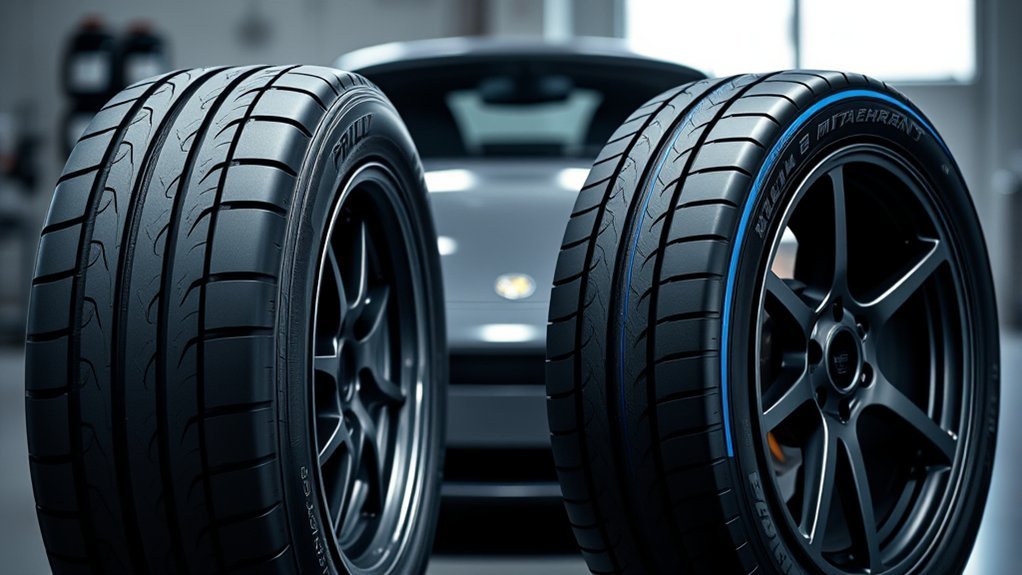
Pirelli vs Michelin is not simply a choice between performance and long tread life. Both companies sell performance, touring, all-season, and specialty tires, so the better choice depends more on the specific tire model than the logo on its sidewall. Compare tires that fit the same vehicle, size, season, and performance category before deciding.
Quick Answer
For Pirelli vs Michelin, choose the tire model before the brand. Michelin has strong long-mileage touring options, while Pirelli offers performance-focused and touring choices with competitive warranties. Neither brand wins every category. Match tire type, size, load and speed rating, climate, ride comfort, and expected mileage to your vehicle and driving.
Last checked: October 1, 2026. Dates and figures were verified against official sources.
Key Takeaways
- Mileage warranties vary widely within both brands, so they should be checked by exact tire model rather than brand.
- Michelin and Pirelli both make performance tires as well as quieter, longer-wearing touring tires.
- Michelin Acoustic Technology and Pirelli PNCS are available only on selected tires; they are not features of every tire from either brand.
- Lower rolling resistance can improve fuel economy or EV range, but rolling resistance varies by tire model.
- Correct fitment, load rating, speed rating, climate, and tire category matter more than choosing a brand by reputation alone.
Which Tire Brand Fits Your Driving Style?

The right brand depends on which Michelin and Pirelli models actually fit your driving needs. Both companies cover daily touring and high-performance driving, so it is more accurate to compare equivalent tire families than to label one entire brand as comfortable and the other as sporty.
| Priority | Michelin | Pirelli |
|---|---|---|
| Daily commuting | Strong touring choices with an emphasis on mileage and comfort | Touring choices are also available with high-mileage warranties and quieter tread designs |
| Sporty driving | Pilot Sport range targets grip, braking, and steering precision | P Zero range targets ultra-high-performance handling and response |
| Ride comfort | Touring tires and selected Acoustic-equipped fitments target low cabin noise | Touring tires and selected PNCS-equipped fitments target low cabin noise |
| Long-term value | Some touring models carry very long treadwear warranties | Current touring models can also carry long treadwear warranties |
If you drive a sports sedan or performance car, compare equivalent Pilot Sport and P Zero models rather than assuming Pirelli automatically provides more grip. If you commute or drive long highway distances, compare touring models from both brands for noise, treadwear warranty, wet performance, and ride quality.
Climate matters just as much. A summer performance tire, an all-season tire, and an all-weather tire are designed for different conditions even when they carry the same brand name.
Pirelli vs Michelin Tread Life
Michelin has several strong long-mileage products, but it is no longer accurate to say that Pirelli tires generally carry only 45,000- to 65,000-mile warranties. Current U.S. replacement models from both brands span different warranty levels depending on their intended use.
A mileage warranty is also not a prediction of exactly how long your tires will last. Alignment, inflation pressure, rotation, vehicle weight, road surface, driving style, and whether the vehicle uses staggered tire sizes can all change real-world wear.
Tread Life Comparison
For tread life, compare tires within the same category. A long-mileage touring tire is designed around different priorities than an ultra-high-performance tire, so comparing their warranty numbers alone can give you the wrong impression about either brand.
Michelin’s Defender2 shows how far its touring lineup can lean toward longevity. Pirelli also offers high-mileage touring products, while its P Zero range and Michelin’s Pilot Sport range put more emphasis on performance.
UTQG treadwear grades can help you understand relative wear rates, but they are not guaranteed mileage figures. A higher treadwear number does not tell you exactly how many road miles a tire will deliver on your vehicle.
Longevity And Durability
Real tire longevity depends on the tire’s design and how it is used. Softer performance compounds and aggressive driving can increase wear, while correct inflation, alignment, rotation, and smoother driving can help a tire use its tread more evenly.
This is why a performance-focused Pirelli may wear faster than a touring Michelin in one comparison, while a high-mileage Pirelli touring tire may carry a longer warranty than a Michelin performance tire in another.
Do not judge durability by brand alone. Compare treadwear warranty, tire category, UTQG information where applicable, load rating, and the maintenance requirements for the exact tire you plan to buy.
Mileage Warranty Coverage
Current U.S. mileage warranties show how much the numbers can vary within each company. These figures are warranty limits for specific replacement tires, not guaranteed service life or direct test results.
| Brand and Model | Type | U.S. Limited Treadwear Warranty |
|---|---|---|
| Michelin Defender2 | All-season touring | 80,000 miles |
| Michelin Pilot Sport All-Season 4 | Performance all-season | Up to 45,000 miles |
| Pirelli P Zero AS Plus 3 | Ultra-high-performance all-season | 50,000 miles |
| Pirelli Scorpion AS 4 | SUV and crossover touring all-season | 70,000 miles |
The useful lesson is that warranty coverage follows the tire model and category. Michelin can offer the higher number in one touring comparison, while a Pirelli performance all-season tire can carry more mileage coverage than a Michelin performance all-season example.
Pirelli vs Michelin Grip and Handling
Neither brand has a universal grip or handling advantage. Pirelli’s P Zero family has a strong ultra-high-performance focus, while Michelin’s Pilot Sport family also targets precise steering, strong braking, and high cornering grip.
| Brand | Performance Family | Typical Priority |
|---|---|---|
| Pirelli | P Zero | Steering response, handling, braking |
| Michelin | Pilot Sport | Grip, steering precision, braking |
| Both | Touring and all-season ranges | Broader balance of comfort, mileage, and traction |
If you want a performance tire, compare equivalent products in the same size and season. A P Zero AS Plus 3 should be judged against other ultra-high-performance all-season tires, not against a Michelin Defender2 touring tire.
The same applies to Michelin Pilot Sport 4S. Its performance mission is very different from that of a long-mileage touring tire, so its steering feel, grip, comfort, and tread life should be evaluated against comparable summer performance tires.
Wet grip also cannot be reduced to the brand name. Tread pattern, compound, tread depth, temperature, tire width, and the specific vehicle all influence how a tire behaves in rain.
Which Tire Is Better for Comfort and Noise?
There is no reliable brand-wide winner for comfort and noise because both Michelin and Pirelli sell quiet touring tires as well as firmer performance tires. The specific tire, vehicle, wheel size, road surface, and pressure can change what you hear and feel in the cabin.
Michelin Acoustic Technology uses polyurethane foam inside selected tires to reduce cavity resonance. Michelin says the technology reduced perceived cabin noise by about 20% in a specific internal test, and it notes that Acoustic-equipped tires are developed for selected original-equipment applications.
Pirelli Noise Cancelling System, or PNCS, also uses sound-absorbing foam inside selected tires. Pirelli says PNCS can reduce cavity noise by about 2–3 dB and describes that as roughly halving perceived noise.
Those manufacturer figures are not a direct head-to-head test because the companies use different tires, vehicles, and test methods. They do show that both brands actively engineer selected products for lower cabin noise.
For everyday comfort, compare the exact touring or grand-touring models available for your vehicle. A performance tire with stiffer construction and more responsive steering can feel firmer even if it comes from the same manufacturer as a very comfortable touring tire.
Which Tire Saves More Fuel?
Fuel economy depends on the rolling resistance of the specific tire rather than the brand alone. Both Michelin and Pirelli offer products designed to reduce energy loss, so choosing the lower-rolling-resistance model matters more than choosing one manufacturer across its entire lineup.
According to NHTSA’s TireWise guidance, a 10% reduction in tire rolling resistance is estimated to improve vehicle fuel economy by about 1–2%. Low-rolling-resistance tires can also help extend electric-vehicle range.
Michelin’s Energy Saver products emphasize efficiency, while Pirelli also offers low-rolling-resistance designs, including tires developed for electric vehicles. However, a performance tire from either company may use a different balance of grip, response, wear, and efficiency.
Tire pressure matters too. An efficient tire cannot deliver its intended performance if it is consistently underinflated, so use the vehicle manufacturer’s cold-pressure specification rather than the maximum pressure printed on the tire sidewall.
Michelin’s sustainability program is a separate issue from fuel economy. Under its Michelin in Motion 2030 strategy, the company targets 40% renewable or recycled materials in tires by 2030. That materials target should not be treated as proof that every Michelin tire has lower rolling resistance than a comparable Pirelli.
Pirelli vs Michelin Prices and Warranties
There is no dependable brand-wide price winner because tire prices change with size, load rating, speed rating, model, retailer, and vehicle fitment. Comparing a small touring tire with a large ultra-high-performance tire can make either brand look artificially cheaper or more expensive.
For a useful price comparison, match the same tire size and category first. Then compare the installed price, treadwear warranty, road-hazard coverage if offered, and any required maintenance records or rotation conditions.
The current warranty examples above also show why the old idea that Pirelli simply offers shorter coverage does not hold across the lineup. Michelin Defender2 reaches 80,000 miles, but Pirelli Scorpion AS 4 reaches 70,000 miles, and warranty relationships change again in performance categories.
A longer warranty can improve value, but it is not the same as guaranteed tread life. Your real cost depends on how long the tire lasts on your vehicle and whether you meet the warranty’s terms.
Which Tire Is Better for You?
The better tire is the model that matches your vehicle and priorities. Start with correct fitment and tire category, then compare performance, comfort, tread life, efficiency, and price among equivalent Michelin and Pirelli choices.
This approach is more useful than choosing Michelin automatically for mileage or Pirelli automatically for performance because both manufacturers now cover a much wider range of driving needs.
Driving Style Matters
Your driving style should narrow the tire category before it narrows the brand. A relaxed commuter, an all-weather driver, and someone who regularly uses a sports car’s cornering ability need different tire characteristics.
- Confirm the correct tire size, load rating, speed rating, and suitable season category for your vehicle.
- Decide whether your main priority is long wear and comfort, all-weather versatility, low rolling resistance, or sharper performance.
- Compare Michelin and Pirelli models from that same category rather than comparing unrelated tire families.
If you enjoy responsive steering, both P Zero and Pilot Sport products deserve consideration. If mileage and ride comfort matter more, compare the touring products from both brands and pay close attention to the specific treadwear warranty.
Budget And Value
Value is the relationship between what you pay and what the tire delivers on your vehicle. A higher purchase price can still make sense if the tire lasts longer or better fits your needs, while a cheaper tire can be the better value if its performance and service life are adequate.
Do not calculate value from the warranty mileage alone. A simple comparison is the installed price divided by the realistic service mileage you expect, while also considering wet grip, comfort, seasonal capability, and whether the tire’s performance matches how you drive.
Because prices vary by size and retailer, there is no responsible single dollar range that proves Michelin or Pirelli is cheaper for every buyer.
Comfort Or Performance
Comfort and performance are not exclusive to one brand. Michelin sells highly responsive Pilot Sport tires and Pirelli sells touring tires designed around mileage and quietness, so you can find both characteristics in either lineup.
- For commuting and highway travel, start with touring or grand-touring models and compare ride quality, noise, and treadwear coverage.
- For sporty driving, compare equivalent ultra-high-performance models for steering response, braking, and wet and dry grip.
- For mixed weather, choose the correct seasonal category before comparing the brands.
The most useful comparison is therefore Michelin model versus Pirelli model, not Michelin brand versus Pirelli brand in isolation.
Note: Tire fitment is a safety issue. Use the size and cold inflation pressure listed by the vehicle manufacturer, and make sure replacement tires meet the required load and speed ratings. If you are changing tire size or specification, have a qualified tire professional confirm the fitment.
Frequently Asked Questions
Are Pirelli Better Than Michelin?
Pirelli is not universally better than Michelin, and Michelin is not universally better than Pirelli. Both brands make touring and performance tires, so the result changes with the models being compared. Match the tire category, vehicle fitment, climate, and driving priorities before choosing between them.
What Are the Top 3 Best Tire Brands?
There is no authoritative universal top-three list for every type of tire. Michelin, Pirelli, Continental, Bridgestone, and Vredestein can all perform strongly in particular categories, but test results change with tire type, size, weather, and the performance measure being tested.
What Is the #1 Rated Tire?
There is no single #1-rated tire for every vehicle and condition. Tire tests separate summer, winter, all-season, all-weather, touring, and performance products because a tire that leads one category may not be designed to lead another. Compare current tests for the exact type and size you need.
What Tire Brand Is Better Than Michelin?
No tire brand is better than Michelin in every category. A Pirelli, Continental, Bridgestone, or Vredestein model can outperform a Michelin in a particular test or suit a specific vehicle better, while another Michelin may lead elsewhere. The meaningful comparison is between equivalent tire models.
Conclusion
Pirelli and Michelin both make excellent tires, but neither brand owns every advantage. Compare equivalent models for your vehicle, climate, driving style, warranty, comfort, and price, then choose the tire whose specific strengths match how you actually drive.
Sources
- National Highway Traffic Safety Administration TireWise: UTQG, tire fitment, maintenance, and rolling-resistance guidance.
- Michelin Defender2: 80,000-mile limited treadwear warranty.
- Michelin Pilot Sport All-Season 4: performance positioning and mileage warranty.
- Pirelli P Zero AS Plus 3: ultra-high-performance positioning and 50,000-mile limited treadwear warranty.
- Pirelli Scorpion AS 4: touring positioning and 70,000-mile limited treadwear warranty.
- Michelin Acoustic Technology: foam-based cabin-noise technology and manufacturer test details.
- Pirelli Noise Cancelling System: PNCS construction and manufacturer noise-reduction claims.
- Michelin in Motion 2030: Michelin’s target for renewable or recycled materials.

