
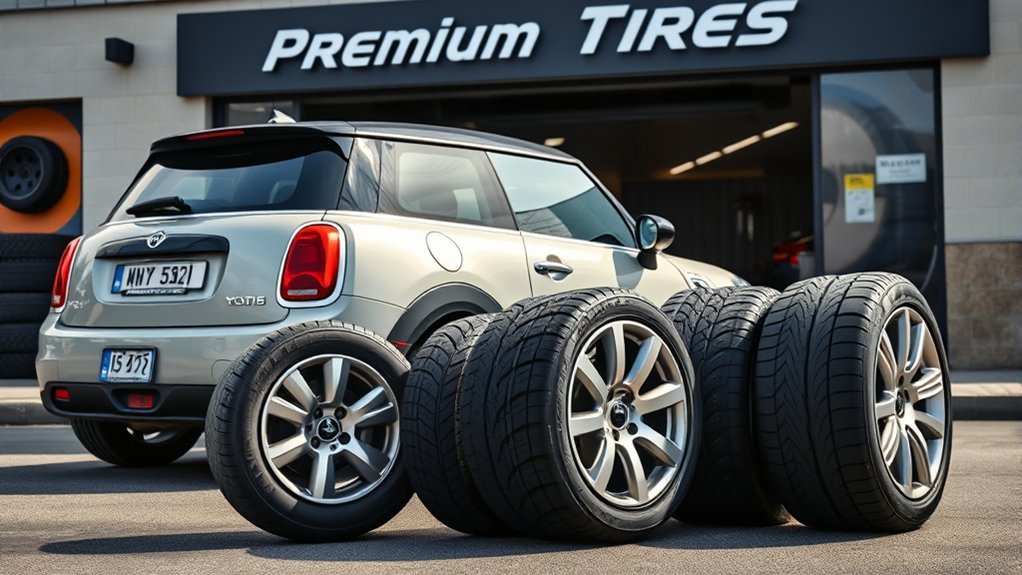
Mini Cooper tire costs can range widely because MINI has used many wheel sizes, tire specifications, and performance packages across different generations. For a practical U.S. budget, expect many replacement tires to fall around $100 to $300+ per tire before installation, with premium, run-flat, winter, and performance choices sometimes costing more. Always shop by your exact model year and door-placard specification rather than by “Mini Cooper” alone.
Quick Answer
Mini Cooper tires commonly cost about $100 to $300+ each before installation, depending on model year, size, tire type, and whether you choose run-flat or performance tires. A set of four may therefore cost roughly $400 to $1,200+ for tires alone, while installation often adds about $20 to $50 per tire.
Key Takeaways
- Mini Cooper tire cost depends more on your exact model year, tire size, load and speed rating, and tire category than on the MINI badge alone.
- Older Coopers commonly use sizes such as 175/65R15, 195/55R16, and 205/45R17, while 2026 Cooper S and JCW variants can use 215/45R17 or 215/40R18.
- A realistic tire-only budget is roughly $400 to $1,200+ for four tires, before mounting, balancing, taxes, and optional services.
- Installation frequently adds about $20 to $50 per tire, although run-flat, low-profile, mobile, TPMS, and specialty-wheel service may cost more.
- Replace a tire at 2/32 inch of tread or sooner for serious damage, and follow the vehicle and tire manufacturer’s age guidance rather than using one universal age limit.
Note: Price ranges in this guide are planning estimates based on the U.S. replacement-tire market as of September 4, 2026. Exact prices can change with size, brand, inventory, rebates, location, and installation package.
Mini Cooper Tire Cost by Model

Mini Cooper tire costs vary by model because each version can use different wheel diameters, load ratings, speed ratings, and performance specifications.
A standard Cooper usually gives you more lower-cost choices than a Cooper S or John Cooper Works model equipped with larger, performance-oriented wheels. The Countryman can also cost more because its larger SUV-size tires use different dimensions and load requirements.
The Clubman still matters to owners shopping for replacement tires on used MINIs, but it is no longer part of MINI USA’s current new-vehicle lineup. The current lineup centers on the Cooper 2 Door, Cooper 4 Door, Convertible, Countryman, and their related variants.
| MINI type | Typical tire-only planning budget | Why cost varies |
|---|---|---|
| Cooper / older base models | $100-$220+ each | Smaller sizes often offer more value-oriented choices |
| Cooper S | $140-$300+ each | More performance-oriented 17- and 18-inch fitments |
| John Cooper Works | $150-$320+ each | Performance compounds and higher-speed specifications can raise price |
| Countryman | $105-$335+ each | Larger SUV-size tires and 18- to 20-inch wheel options |
| Clubman / legacy models | $130-$300+ each | Price depends heavily on model year, trim, and remaining size availability |
Economy-focused all-season options usually cost less than premium performance or specialty winter tires, but purchase price is only part of the value equation. Treadwear warranty, wet braking, ride comfort, road noise, seasonal capability, and expected ownership period all matter.
The cheapest tire is not automatically the lowest-cost tire to own. A longer-lasting tire with better wet grip may offer better value even when its purchase price is higher.
If you switch between summer and winter tires, include the cost of a second set, seasonal mounting, balancing, and storage if you do not store them yourself.
Labor, alignment, disposal, TPMS service, and specialty mounting can also affect the final bill. Compare installed, out-the-door prices rather than tire prices alone.
Mini Cooper Tire Sizes You’ll See Most
MINI has used many tire sizes over the years, so there is no single “Mini Cooper tire size.” Older Hardtops and Convertibles commonly appear with 175/65R15, 195/55R16, 205/45R17, and 205/40R18 fitments. Current models can be different.
For example, Goodyear’s 2026 MINI fitment catalog lists 215/45R17 and 215/40R18 fitments for 2026 Cooper S and JCW variants. Always verify your individual vehicle because wheel packages can change the required size.
| Size | Example use | Context |
|---|---|---|
| 175/65R15 | Older Cooper/Convertible applications | Legacy smaller-wheel fitment |
| 195/55R16 | Many older Cooper applications | Common comfort-oriented size |
| 205/45R17 | Many previous-generation sport packages | Common older 17-inch fitment |
| 205/40R18 | Previous-generation S/JCW applications | Low-profile legacy fitment |
| 215/45R17 | 2026 Cooper S/JCW examples | Current-generation fitment on listed variants |
| 215/40R18 | 2026 Cooper S/JCW examples | Current 18-inch option on listed variants |
| 225/40R18 | Some older Clubman/JCW applications | Do not assume it fits a current JCW |
Warning: Never buy a tire only because its wheel diameter matches. Confirm the complete size, load index, speed rating, wheel fitment, and any vehicle-specific requirements using the driver-door placard, owner’s manual, or a vehicle-specific tire catalog.
A size such as 215/45R17 contains three important measurements: 215 is the nominal section width in millimeters, 45 is the sidewall aspect ratio, and 17 is the wheel diameter in inches. The letters and numbers that follow the size identify construction, load index, speed rating, and other specifications.
When comparing brands, compare tires with compatible specifications rather than choosing only by price. If you change wheel size, confirm the new combination is approved for the vehicle and does not create clearance, load-capacity, handling, or speedometer problems.
How Mini Cooper Tire Prices Vary
Mini Cooper tire prices change with model, size, construction, season, performance level, warranty, and brand. Larger or less-common sizes often cost more, but wheel diameter alone does not determine the price.
A premium 17-inch performance tire can cost more than some 18-inch touring tires. Likewise, an inexpensive conventional tire may cost much less than a run-flat in the same nominal size.
Model Differences
Standard Cooper models often have more value-oriented choices, while Cooper S and John Cooper Works models tend to use tires designed for sharper handling and higher performance.
- Cooper: often offers the widest selection of everyday all-season or touring options.
- Cooper S: commonly uses larger wheels and performance-oriented tires.
- John Cooper Works: may require higher-performance specifications that increase cost.
- Countryman: uses larger crossover/SUV sizes that can carry a higher per-tire price.
- Clubman: remains relevant for used vehicles, but fitment must be selected by model year and trim.
Match the factory specification first, then compare tires within that fitment. This prevents you from paying for a tire that cannot safely or properly be used on your MINI.
Tire Size Impact
Wider and low-profile tires often carry higher replacement prices because they may use more specialized construction and are frequently sold in performance-oriented categories.
Older 15- and 16-inch MINI fitments can provide relatively inexpensive choices, while current 17- and 18-inch Cooper fitments and larger Countryman sizes can raise the total. Availability matters too: an uncommon size may cost more simply because fewer competing models are offered.
Do not confuse lower purchase cost with longer tread life. Tire longevity depends on the tire’s design and compound, proper inflation, alignment, rotation, road conditions, vehicle setup, climate, and driving style.
Performance Tire Premium
Performance tires frequently cost more because their compounds, casing, and tread design are optimized for steering response, braking, and cornering rather than maximum tread life or lowest purchase price.
- Higher dry-grip capability
- Quicker steering response
- Potentially shorter warm-weather braking distances
- Often firmer ride characteristics
- Potentially shorter tread life than touring-focused alternatives
Ultra-high-performance all-season tires try to balance year-round use with responsive handling. Summer tires prioritize warm-weather performance and should not be treated as winter tires.
If you mostly commute and prioritize comfort, tread life, and cost, a touring or everyday all-season tire may make more sense than the most aggressive performance option available.
Mini Cooper Tire Cost by Size
Tire cost generally rises as you move into larger, lower-profile, performance, run-flat, or less-common fitments, but there is plenty of overlap between categories.
The table below is best used as a planning guide, not a quote.
Common Tire Sizes
Across different MINI generations you may encounter 15-, 16-, 17-, 18-, 19-, and even 20-inch wheel packages. Always begin with the complete size on the placard or vehicle-specific fitment catalog.
- 175/65R15: seen on some older Cooper applications.
- 195/55R16: common on many previous-generation Cooper models.
- 205/45R17: common on various previous-generation sportier applications.
- 205/40R18: used on some earlier S and JCW configurations.
- 215/45R17: listed for current 2026 Cooper S and JCW variants.
- 215/40R18: another current 2026 Cooper S/JCW option on listed variants.
Run-flat construction is a separate feature, not a tire size. A size may be available in conventional and run-flat versions, depending on manufacturer and vehicle requirements.
Price Range by Size
| Category | Planning price per tire | Approx. four-tire total before installation |
|---|---|---|
| Older 15-16 inch Cooper fitments | $100-$220+ | $400-$880+ |
| 17-inch Cooper fitments | $140-$250+ | $560-$1,000+ |
| 18-inch Cooper fitments | $150-$300+ | $600-$1,200+ |
| Larger Countryman fitments | $105-$335+ | $420-$1,340+ |
| Run-flat / specialty performance | $200-$350+ | $800-$1,400+ |
These ranges overlap because brand, tire family, load rating, speed rating, season, rebates, and inventory can outweigh wheel diameter.
Proper maintenance can protect the money you spend. Correct inflation, alignment when needed, and appropriate rotation can reduce irregular wear and help you use more of the tire’s available tread life.
Best Budget Mini Cooper Tires
If you are shopping for a Mini Cooper on a budget, look beyond the lowest sticker price. The better value is usually a properly fitted tire that combines acceptable wet braking, predictable handling, useful tread life, and a warranty that suits how long you plan to keep the car.
Good budget categories include:
- Everyday all-season tires: useful for moderate climates and routine commuting.
- Touring tires: usually designed around comfort, lower noise, and tread life.
- Value-performance all-season tires: a compromise for drivers who want sharper steering without moving to an expensive max-performance tire.
- OEM-size replacements: keeping the original approved size avoids the extra cost and complications of unnecessary wheel changes.
Check the full service description, not just the size. A tire must meet the vehicle’s load and speed requirements.
For mostly city and highway driving in a moderate climate, a quality all-season or touring tire often provides better value than buying a specialized summer tire simply because your MINI has sporty handling.
Premium Mini Cooper Tire Options
Premium MINI tires from manufacturers such as Michelin, Continental, Pirelli, Bridgestone, and Goodyear can cost more because many models target stronger wet grip, braking, steering response, refinement, or specialized seasonal performance.
Depending on the model, features may include silica-rich compounds, asymmetric tread patterns, reinforced structures, low-rolling-resistance technology, or run-flat construction.
Premium does not automatically mean “best” for every owner. A summer performance tire may deliver excellent warm-weather response but be unsuitable for freezing conditions, while a premium touring tire may sacrifice some steering sharpness for lower noise and longer tread life.
Choose the category that matches your climate and driving rather than buying solely by brand reputation.
Run-Flat vs Conventional Mini Cooper Tires
Many MINI owners encounter run-flat tires, but you should not assume that every MINI must use them. MINI advises owners to check the specific vehicle owner’s manual for run-flat information.
Run-flats are designed to support limited mobility after a loss of pressure, which can be valuable on a vehicle without a spare. The tradeoffs can include a higher purchase price, firmer ride, fewer choices in some sizes, and more limited repair options after the tire has been driven while deflated.
| Factor | Run-flat tire | Conventional tire |
|---|---|---|
| After a pressure loss | May provide limited continued mobility when used according to manufacturer instructions | Normally requires stopping and repairing/replacing the tire |
| Price | Often higher | Usually more choices at lower prices |
| Ride | Can feel firmer | Often offers more comfort-oriented choices |
| Replacement choices | More limited in some sizes | Usually broader |
Note: If you change from run-flat to conventional tires, confirm that the setup is appropriate for your exact MINI and decide how you will handle a puncture if the vehicle does not carry a spare.
Choosing All-Season, Summer, or Winter Tires
Your climate can affect both tire cost and the number of sets you need.
- All-season: convenient for drivers who want one set for moderate year-round conditions.
- Summer: designed for warm-weather dry and wet performance, not freezing or snowy conditions.
- Winter: designed to remain useful in cold temperatures and improve winter traction compared with summer-focused rubber.
A second seasonal set costs more upfront, especially if you buy dedicated wheels, but it also divides annual mileage between two sets. Compare total ownership cost rather than the purchase price of one tire.
How Much Tire Installation Costs
After choosing your tires, budget for mounting and balancing. A reasonable U.S. planning range is roughly $20 to $50 per tire for many passenger-car installations, although the exact price depends on the shop and service package.
At $20 to $50 per tire, basic installation can add roughly $80 to $200 to a four-tire purchase before taxes and other optional services.
Your final bill can rise for low-profile or run-flat tires, large wheels, TPMS service, road-force balancing, mobile installation, disposal charges, or other specialty work.
- Mounting
- Balancing
- Valve stems or TPMS service kits when required
- Old-tire disposal
- Optional road-hazard coverage
- Alignment when needed
Pro Tip: Ask every shop for the complete out-the-door price for four tires, including mounting, balancing, TPMS-related charges, disposal, taxes, and any required fees. A cheaper tire quote can become the more expensive deal after add-ons.
How to Save on Mini Cooper Tire Replacement
You can lower Mini Cooper tire replacement costs without buying unsuitable tires.
- Compare the exact same size and specification. A cheaper listing is not a true comparison if its load rating, speed rating, construction, or seasonal category differs.
- Compare installed prices. Include mounting, balancing, TPMS service, disposal, taxes, and road-hazard coverage.
- Check manufacturer rebates. Tire makers regularly run promotions that can change which brand offers the best value.
- Consider touring or all-season tires. If you do not need maximum warm-weather performance, they may lower purchase and ownership costs.
- Review treadwear warranties. A longer warranty may add value for high-mileage drivers, but read the rotation and maintenance requirements.
- Maintain correct pressure. Use the vehicle placard pressure rather than the maximum pressure molded on the tire sidewall.
- Correct alignment problems. Uneven wear can destroy an otherwise good set of tires early.
Holiday sales and seasonal promotions may reduce the purchase price, but do not delay replacement when a tire is damaged or at its wear limit simply to wait for a sale.
When to Replace Mini Cooper Tires
Replace Mini Cooper tires based on tread depth, damage, performance, and age—not mileage alone.
The National Highway Traffic Safety Administration says tires should be replaced when tread is worn to 2/32 inch. Tires may need replacement earlier if they have serious cuts, bulges, exposed cords, persistent air loss, impact damage, or unsafe irregular wear.
- Measure tread depth across several points on every tire.
- Inspect sidewalls and tread for cracks, cuts, bulges, punctures, or exposed material.
- Watch for new vibration, pulling, noise, or uneven wear.
- Check the DOT Tire Identification Number to determine tire age.
- Follow the vehicle and tire manufacturer’s age recommendations.
There is no single universal six-year replacement rule for every passenger tire. NHTSA notes that manufacturer recommendations can range from six to ten years. As one example, Michelin recommends annual professional inspection after five years of service and replacement by ten years from manufacture.
The last four digits of the DOT code identify the week and year of manufacture. For example, “2524” indicates a tire made in the 25th week of 2024.
Warning: A tire can require immediate replacement even when it has plenty of tread. Bulges, exposed cords, severe impact damage, deep cracking, or other structural damage should be inspected by a qualified tire professional.
Tire Rotation and Maintenance
Rotation helps even out tread wear when the vehicle and tire configuration allows it. Follow your MINI owner’s manual first. As a general guideline, Michelin says many manufacturers recommend rotation around every 6,000 to 8,000 miles.
Some staggered setups cannot be rotated front to rear because the front and rear tires are different sizes. Directional tires may also limit rotation patterns.
Check inflation when the tires are cold and use the pressure specified for your vehicle. Do not use the maximum pressure printed on the tire sidewall as the normal inflation target.
Should You Replace One, Two, or Four Mini Tires?
Replacing only one tire can be acceptable in some situations, particularly when the other tires are nearly new and the replacement closely matches the existing tire in size, type, construction, and tread depth.
If the other tire on the same axle has substantial wear, replacing the pair is often the better way to maintain more balanced traction. All-wheel-drive systems can also have limits on allowable tread-depth differences, so Countryman ALL4 owners should check the owner’s manual or ask a qualified tire professional before replacing only one tire.
Avoid mixing substantially different tread patterns, seasonal categories, or performance levels simply to save money. Matching all four tires provides the most predictable handling when practical.
Frequently Asked Questions
How Often Should I Rotate Mini Cooper Tires?
Follow the schedule in your MINI owner’s manual and your tire warranty. As a general guideline, Michelin says many manufacturers recommend rotation every 6,000 to 8,000 miles. Staggered or directional setups may require a different pattern or may limit rotation options.
Are Run-Flat Tires Worth It for Mini Coopers?
Run-flats can be worthwhile if you value limited mobility after a pressure loss, particularly when your MINI has no spare. Their tradeoffs can include higher prices, firmer ride quality, fewer replacement choices, and restricted repairability after being driven while deflated.
Do Mini Cooper Tires Affect Fuel Economy?
Yes. Inflation pressure, rolling resistance, alignment, tread design, and tire size can affect energy use. Keep the tires at the cold pressure shown on the vehicle placard and correct alignment or wear problems rather than inflating above the recommended pressure.
Can I Mix Different Tire Brands on a Mini Cooper?
It is best to keep tires closely matched in size, construction, seasonal category, performance characteristics, and tread depth. If you cannot replace all four, consult your owner’s manual and tire professional about the safest matching strategy for your drivetrain and remaining tread.
Does Tire Warranty Cover Road Damage?
Usually not under a standard workmanship or treadwear warranty. Potholes, nails, debris, and impact damage are commonly handled through separate road-hazard coverage. Read the specific tire manufacturer’s warranty before buying.
Do All Mini Coopers Need Run-Flat Tires?
No universal rule applies to every MINI model and model year. Check the tire specification, owner’s manual, current tire setup, and whether the vehicle has another puncture-mobility solution before changing between run-flat and conventional tires.
Can I Replace Just One Tire on a Mini Cooper?
Sometimes, especially when the other tires are almost new and the replacement closely matches them. If tread-depth differences are large, replacing a pair or all four may provide more predictable handling. Check additional requirements for ALL4 models before replacing only one tire.
What Tire Pressure Should I Use on a Mini Cooper?
Use the cold-tire pressure specified on your MINI’s tire-information placard or in the vehicle documentation for your exact configuration. Do not use the maximum pressure printed on the tire sidewall as the normal operating pressure.
Conclusion
A “Mini” badge does not guarantee a mini tire bill. Your actual Mini Cooper tire cost depends on the model year, exact fitment, tire category, performance level, and installation package. Older 15- and 16-inch Cooper fitments can be relatively inexpensive, while current performance or larger Countryman sizes can push a four-tire purchase beyond $1,000.
Start with the door placard, compare like-for-like tires, request the complete installed price, and choose a tire that matches your climate and driving. Most importantly, do not postpone replacement when tread reaches its limit or a tire shows serious damage.
Sources
- National Highway Traffic Safety Administration — TireWise — tread depth, tire age, pressure, inspection, and tire-safety guidance.
- MINI USA — Original Tires — MINI-approved tire and run-flat guidance.
- MINI USA — Current Model Lineup — current U.S. MINI model context.
- Goodyear — 2026 MINI Cooper Tire Fitments — current 2026 Cooper S and JCW tire-size examples.
- Michelin — Tire Rotation Guide — rotation intervals and maintenance guidance.
- Michelin — When to Replace Tires — age, inspection, damage, and replacement guidance.

