
Metric vs Inch Tire Size Conversion: Simple Formula

Converting a metric tire size to inches is mostly a geometry problem: decode the width, aspect ratio, and wheel diameter, then calculate the sidewall height and overall diameter. The result helps you compare sizes, estimate speedometer change, and screen possible swaps before you confirm fitment with the vehicle placard, owner’s manual, wheel specs, and tire manufacturer data.
Quick Answer
To convert a metric tire size to inches, use: overall diameter = rim diameter + 2 × (section width × aspect ratio ÷ 100 ÷ 25.4). For example, a 205/55R16 is about 24.9 inches tall, 8.1 inches wide, and has a sidewall height of about 4.4 inches.
Key Takeaways
- The first number in a metric tire size is section width in millimeters; the second is sidewall height as a percentage of that width.
- Use 25.4 to convert millimeters to inches because one inch is exactly 25.4 mm.
- Calculated diameter is an estimate; real mounted tire dimensions vary by brand, model, rim width, load, and inflation pressure.
- A larger tire makes actual road speed higher than the indicated speed unless the vehicle is recalibrated.
- Never approve a tire swap from diameter alone; confirm load rating, speed rating, rim width, clearance, and the vehicle manufacturer’s recommended sizes.
At a Glance
| Time Required | 2–5 minutes per tire size |
| Difficulty | Easy if you know the tire code |
| Tools Needed | Calculator, tire size code, owner’s manual or tire placard |
| Cost | Free |
Tire Size Conversion Formula (Metric → Inches)

A metric tire size such as 315/75R16 gives you three numbers for the conversion:
- 315 = section width in millimeters
- 75 = aspect ratio, meaning the sidewall height is 75% of the section width
- 16 = wheel/rim diameter in inches
Use this formula to calculate overall tire diameter in inches:
Overall diameter = rim diameter + 2 × (section width × aspect ratio ÷ 100 ÷ 25.4)
The 25.4 conversion factor is exact: the National Institute of Standards and Technology defines one inch as exactly 25.4 millimeters. Tire makers also define the aspect ratio as sidewall height compared with section width, which is why the aspect ratio must be divided by 100 before the calculation.
Example for 315/75R16:
- Sidewall height in millimeters: 315 × 75 ÷ 100 = 236.25 mm
- Sidewall height in inches: 236.25 ÷ 25.4 = 9.30 in
- Overall diameter: 16 + 2 × 9.30 = 34.60 in
- Width in inches: 315 ÷ 25.4 = 12.40 in
So a 315/75R16 is approximately 34.6 inches tall by 12.4 inches wide. It is often discussed as a “35-inch” tire, but the calculated value is slightly smaller before brand-specific measurement differences.
Note: Calculated size is not always the same as a manufacturer’s published measured size. Tread design, casing shape, measuring rim width, inflation pressure, and load can change the real mounted diameter.
How to Read a Metric Tire Size
Before converting, decode the tire marking. Tire manufacturers such as Michelin and Bridgestone explain that a tire size code identifies the tire’s dimensions and construction.
| Code Part | Example: 205/55R16 91V | Meaning |
|---|---|---|
| Section width | 205 | Nominal tire width in millimeters |
| Aspect ratio | 55 | Sidewall height is 55% of tire width |
| Construction | R | Radial construction |
| Wheel diameter | 16 | Wheel/rim diameter in inches |
| Load index | 91 | Maximum load rating when properly inflated |
| Speed rating | V | Maximum speed capability under specified conditions |
Warning: The load index and speed rating are not optional details. Replacement tires should meet or exceed the vehicle manufacturer’s required ratings unless the vehicle maker or a qualified tire professional confirms otherwise.
How Aspect Ratio Affects Sidewall and Height
The aspect ratio expresses sidewall height as a percentage of tread width. If the tire width stays the same, a higher aspect ratio creates a taller sidewall and a larger overall diameter. A lower aspect ratio creates a shorter sidewall and usually a firmer, lower-profile tire.
| Aspect Ratio | Sidewall Height on 225 mm Width | Sidewall Height in Inches |
|---|---|---|
| 70 | 157.5 mm | 6.20 in |
| 60 | 135.0 mm | 5.31 in |
| 55 | 123.8 mm | 4.87 in |
Changing aspect ratio can affect ride comfort, steering response, gearing, clearance, and speedometer accuracy. Always compare the final diameter and confirm the new size is suitable for the wheel and vehicle.
Convert a 205/55R16 to Inches (Step-By-Step)
A 205/55R16 tire has a 205 mm section width, 55% aspect ratio, and 16-inch wheel diameter. Here is the correct step-by-step conversion.
Tire Diameter Calculation
- Find sidewall height in millimeters: 205 × 55 ÷ 100 = 112.75 mm
- Convert sidewall to inches: 112.75 ÷ 25.4 = 4.44 in
- Double the sidewall: 4.44 × 2 = 8.88 in
- Add the wheel diameter: 8.88 + 16 = 24.88 in
A 205/55R16 is therefore about 24.9 inches tall.
Converting Width To Inches
To convert the section width, divide millimeters by 25.4:
205 ÷ 25.4 = 8.07 inches
| Parameter | Metric | Inches |
|---|---|---|
| Section width | 205 mm | 8.07 in |
| Sidewall height | 112.75 mm | 4.44 in |
| Wheel diameter | 406.4 mm | 16.00 in |
| Overall diameter | 631.9 mm | 24.88 in |
Pro Tip: Round final tire diameter to one decimal place for comparison, but keep extra decimals while calculating speedometer change.
Convert Inches Back to Metric: Quick Reverse Steps
Flotation or inch tire sizes, such as 31×10.50R15 or 35×12.50R16, list overall diameter first, then width, then rim diameter. They do not directly list the aspect ratio, so you have to estimate it.
Use these reverse formulas:
- Width in mm: width in inches × 25.4
- Sidewall height in inches: (overall diameter − rim diameter) ÷ 2
- Aspect ratio estimate: sidewall height ÷ width in inches × 100
Example for 31×10.50R15:
- Width: 10.50 × 25.4 = 266.7 mm
- Sidewall height: (31 − 15) ÷ 2 = 8.0 in
- Aspect ratio: 8.0 ÷ 10.50 × 100 = 76.2
That means the mathematical equivalent is close to 267/76R15. Since tire sizes are sold in standardized steps, shoppers often compare it with 265/75R15, but the exact published dimensions should still be checked.
| Inch Size | Math-Based Approximation | Common Comparison Size | Important Note |
|---|---|---|---|
| 31×10.50R15 | 267/76R15 | 265/75R15 | Close, but compare actual specs |
| 33×12.50R15 | 318/72R15 | 315/70R15 | Width is close; diameter varies by model |
| 35×12.50R16 | 318/76R16 | 315/75R16 | Often discussed as a 35-inch-class size |
Calculate Diameter, Circumference, and Revs Per Mile
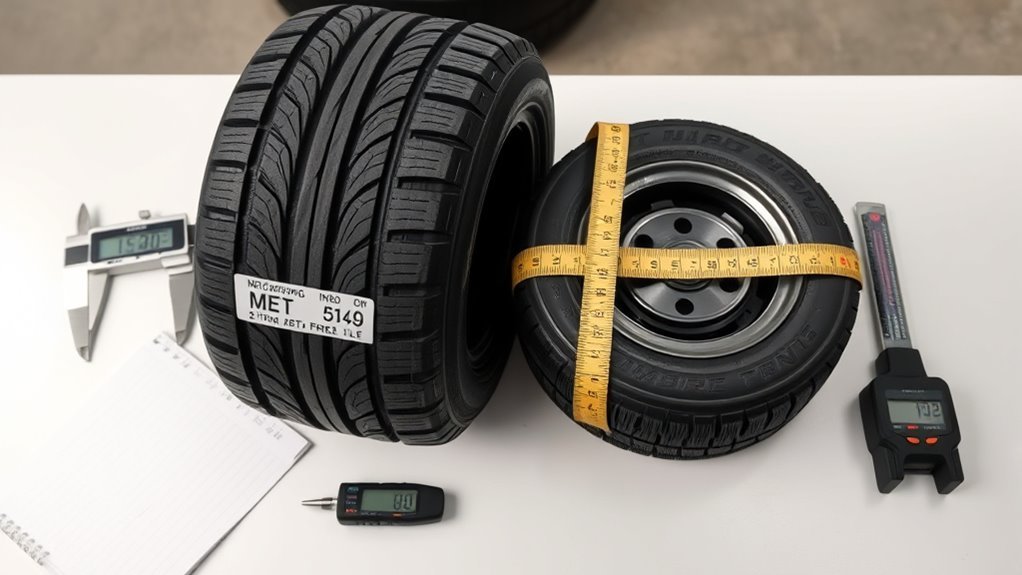
Once you know overall diameter, you can calculate circumference and estimated revolutions per mile.
- Circumference: diameter × π
- Revolutions per mile: 63,360 ÷ circumference in inches
Example for 255/75R16:
- Sidewall height: 255 × 75 ÷ 100 ÷ 25.4 = 7.53 in
- Overall diameter: 16 + 2 × 7.53 = 31.06 in
- Circumference: 31.06 × π = 97.6 in
- Revs per mile: 63,360 ÷ 97.6 = about 649
These values are estimates for comparison. Tire manufacturers may publish a different revolutions-per-mile value after testing the tire at a specified load, pressure, and rim width.
How Changing Tire Size Affects Your Speedometer
If you install a larger-diameter tire, the vehicle travels farther with each wheel revolution. If the speedometer is still calibrated for the original tire, it will usually show a lower speed than you are actually traveling. A smaller tire does the opposite.
Use this formula:
Actual speed = indicated speed × (new tire diameter ÷ original tire diameter)
Example: if the original tire is 28.3 inches tall and the new tire is 29.0 inches tall, the change is about 2.5%. At an indicated 60 mph, actual speed is about 61.5 mph.
| Change | Speedometer Effect | What to Do |
|---|---|---|
| Larger diameter | Actual speed is higher than indicated | Recalibrate if needed |
| Smaller diameter | Actual speed is lower than indicated | Check speed and odometer error |
| Different front/rear sizes | May affect ABS, traction control, AWD, or stability systems | Follow vehicle manufacturer guidance |
Common Manufacturer Mismatches and Non-Standard Inch Sizes
Metric and inch tire labels are often rounded. A “35-inch” tire may calculate or measure closer to 34.5 inches, and two tires with the same nominal size may have different published dimensions. That is why a size conversion is a starting point, not the final buying decision.
Manufacturer Size Labeling
Metric sizes and inch-style sizes describe tires differently:
- Metric sizes show section width, aspect ratio, construction, and rim diameter.
- Inch/flotation sizes usually show approximate overall diameter, section width, and rim diameter.
- Published manufacturer specs may include measured overall diameter, section width, tread width, recommended rim width range, load index, speed rating, and revolutions per mile.
Before buying, compare the manufacturer’s published data for the exact tire model, not just the size printed on the sidewall.
Nonstandard Inch Equivalents
Some inch sizes do not have a perfect metric counterpart. For example, 31×10.50R15 mathematically lands near 267/76R15, which is why 265/75R15 is often used as a close comparison. But a close comparison is not a guarantee of equal diameter, tread width, clearance, or load capacity.
For off-road and truck sizes, check these items carefully:
- Overall diameter
- Section width and tread width
- Recommended rim width range
- Load range or load index
- Speed rating
- Clearance at full steering lock and suspension compression
Practical Swaps: Finding Equivalents Without Guesswork
Staying within about one inch of the original diameter can be a useful first screen for many passenger and light-truck comparisons, but it is not a universal safety rule. The safer approach is to compare diameter percentage, load rating, rim compatibility, and vehicle manufacturer recommendations together.
Use this checklist before choosing a replacement size:
- Find the original size on the Tire and Loading Information Label or in the owner’s manual.
- Calculate the new tire’s overall diameter and compare the percentage difference.
- Confirm the new size fits the wheel’s approved rim-width range.
- Confirm load index or load range meets or exceeds the required specification.
- Confirm speed rating is appropriate for the vehicle and use case.
- Check clearance around fenders, suspension, brake components, and steering travel.
- Consider ABS, ESC, TPMS, AWD/4WD, gearing, and speedometer calibration.
- Compare manufacturer-published specs for the exact tire model.
Warning: The National Highway Traffic Safety Administration advises replacing tires with the same size as the original tires or another size recommended by the vehicle manufacturer. If you are unsure, consult a qualified tire dealer before driving on the new size.
Quick Tools, Charts, and a Conversion Cheat-Sheet
Use this cheat sheet for fast tire conversions:
| Task | Formula | Example |
|---|---|---|
| Width mm to inches | width ÷ 25.4 | 285 ÷ 25.4 = 11.22 in |
| Sidewall height | width × aspect ratio ÷ 100 ÷ 25.4 | 285 × 55 ÷ 100 ÷ 25.4 = 6.17 in |
| Overall diameter | rim + 2 × sidewall | 22 + 2 × 6.17 = 34.34 in |
| Circumference | diameter × π | 34.34 × π = 107.9 in |
| Revs per mile | 63,360 ÷ circumference | 63,360 ÷ 107.9 = 587 |
Troubleshooting Errors and Safety Checks Before Buying
Most tire conversion mistakes come from using the aspect ratio incorrectly, comparing nominal labels instead of measured specs, or forgetting the safety requirements beyond diameter.
Check these items before you buy:
- Formula error: Use aspect ratio ÷ 100, not the whole number by itself.
- Wrong wheel size: The final number after R must match the wheel diameter exactly.
- Load mismatch: Do not choose a tire with insufficient load capacity.
- Speed rating mismatch: Confirm the rating suits the vehicle and driving conditions.
- Rim-width mismatch: Confirm the tire is approved for your wheel width.
- Clearance issue: Check fenders, suspension, brake parts, and steering lock.
- Pressure mistake: Use the vehicle placard or owner’s manual for recommended cold inflation pressure, not the maximum pressure molded on the tire sidewall.
- Tread or damage issue: Reject tires with cuts, bulges, exposed cord, severe cracking, or tread worn to 2/32 inch.
NHTSA recommends checking tire pressure when tires are cold, checking tread regularly, and using the vehicle’s Tire and Loading Information Label or owner’s manual for the correct tire size and pressure.
Common Metric Tire Sizes Converted to Inches
| Metric Size | Approx. Width | Approx. Sidewall | Approx. Diameter | Approx. Revs/Mile |
|---|---|---|---|---|
| 205/55R16 | 8.07 in | 4.44 in | 24.88 in | 811 |
| 255/75R16 | 10.04 in | 7.53 in | 31.06 in | 649 |
| 285/75R16 | 11.22 in | 8.42 in | 32.83 in | 614 |
| 315/75R16 | 12.40 in | 9.30 in | 34.60 in | 583 |
| 285/55R22 | 11.22 in | 6.17 in | 34.34 in | 587 |
| 315/50R20 | 12.40 in | 6.20 in | 32.40 in | 622 |
Frequently Asked Questions
How do you convert a metric tire size to inches?
Convert the width by dividing millimeters by 25.4. Then calculate sidewall height with width × aspect ratio ÷ 100 ÷ 25.4. Double the sidewall height and add the rim diameter to get overall diameter in inches.
What size is 285/55R22 in inches?
A 285/55R22 is about 34.3 inches tall and 11.2 inches wide. Its sidewall height is about 6.2 inches. Actual manufacturer dimensions may vary slightly by tire model.
What size is 315/50R20 in inches?
A 315/50R20 is about 32.4 inches tall and 12.4 inches wide. The sidewall height is about 6.2 inches.
What is 31×10.50R15 in metric?
Mathematically, 31×10.50R15 is close to 267/76R15. In common tire sizing, 265/75R15 is often used as a nearby comparison, but you should compare actual manufacturer specs before buying.
Is a metric conversion the same as the tire’s real measured size?
Not always. The conversion gives a calculated size. Real measured diameter and width can vary by brand, tire model, tread design, rim width, inflation pressure, and load.
Can I use any tire size that is within one inch of the original?
No. A one-inch diameter difference is only a rough comparison point. You still need to confirm the vehicle manufacturer’s approved sizes, load rating, speed rating, rim width, clearance, and system compatibility.
Conclusion
Metric tire conversion is simple once you use the correct formula: calculate sidewall height from width and aspect ratio, double it, then add the rim diameter. The numbers help you compare width, overall diameter, circumference, revs per mile, and speedometer change. But tire buying should never rely on math alone. Confirm the size against the vehicle placard, owner’s manual, wheel specifications, manufacturer-published tire data, and clearance checks before making the swap.
Sources
- National Institute of Standards and Technology — SI Units: Length — backs the exact 1 inch = 25.4 mm conversion factor.
- Michelin — Tire Markings Explained — backs tire code definitions, aspect ratio, wheel diameter, load rating, speed rating, and pressure-marking guidance.
- Bridgestone — Tire Sizes, Measurements & Wheel Diameter — backs tire size code interpretation and wheel diameter definitions.
- NHTSA TireWise — backs tire pressure, tread, replacement-size, placard, and tire safety guidance.

Related Articles

What Does THE P Stand For on a Tire? Full Meaning Explained
I’ll explain what the “P” on a tire really means and why it could change how you choose your next set.
Read More
How to Use a Tubeless Tire Repair Kit: Complete Field Guide
Learn how to fix tubeless tire punctures fast with the right kit, because one small mistake can leave you stranded on the trail.
Read More
How to Tell a Tire’s Diameter: Easy Guide to Reading Tire Size
Want to decode tire sidewall numbers and find the right diameter, but wonder what those hidden digits really mean?
Read More