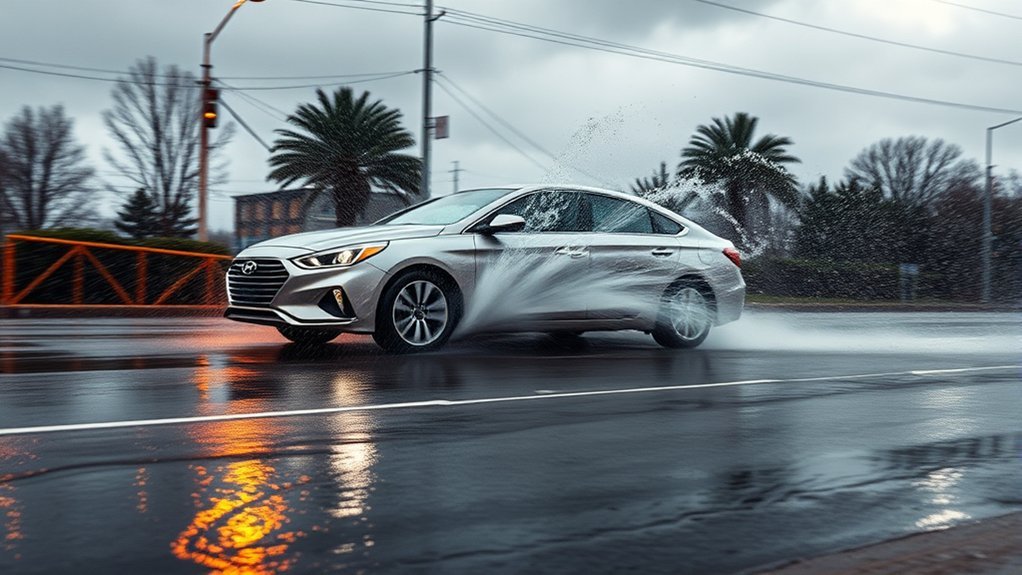
Hydroplaning in your Hyundai Sonata happens when water builds between the tires and the road, causing the tires to lose grip. The biggest things you can control are tire tread depth, cold tire pressure, tire condition, and speed in heavy rain. No tire can eliminate hydroplaning risk, but regular checks and smoother wet-road driving can greatly reduce it.
Quick Answer
To prevent hydroplaning in a Hyundai Sonata, keep tires inflated to the cold PSI on the driver-door placard, replace tires before wet traction becomes weak, slow down in rain, avoid cruise control, and steer smoothly around standing water. If hydroplaning starts, ease off the accelerator and keep the wheel steady.
Key Takeaways
- Use the tire pressure listed on your Sonata’s driver-door tire placard or owner’s manual, not the maximum PSI printed on the tire sidewall.
- For wet-road safety, start planning tire replacement around 4/32 inch of tread; 2/32 inch is the worn-out/legal-minimum danger zone in many U.S. contexts.
- Avoid cruise control in rain so you can lift off the accelerator quickly if the tires start to lose grip.
- If the car hydroplanes, do not slam the brakes or jerk the wheel. Ease off the gas, look where you want to go, and steer gently once traction returns.
At a Glance
| Time Required | 5–10 minutes for a driveway tire check; 30–60 minutes for a shop inspection or tire rotation |
| Difficulty | Easy for pressure and tread checks; professional help recommended for alignment, balancing, or tire replacement |
| Tools Needed | Tire pressure gauge, tread-depth gauge or quarter, flashlight, and your Sonata owner’s manual or tire placard |
| Cost | $0–$15 for basic check tools; tire replacement, alignment, or balancing varies by tire size and service shop |
Understanding Hydroplaning in Your Hyundai Sonata
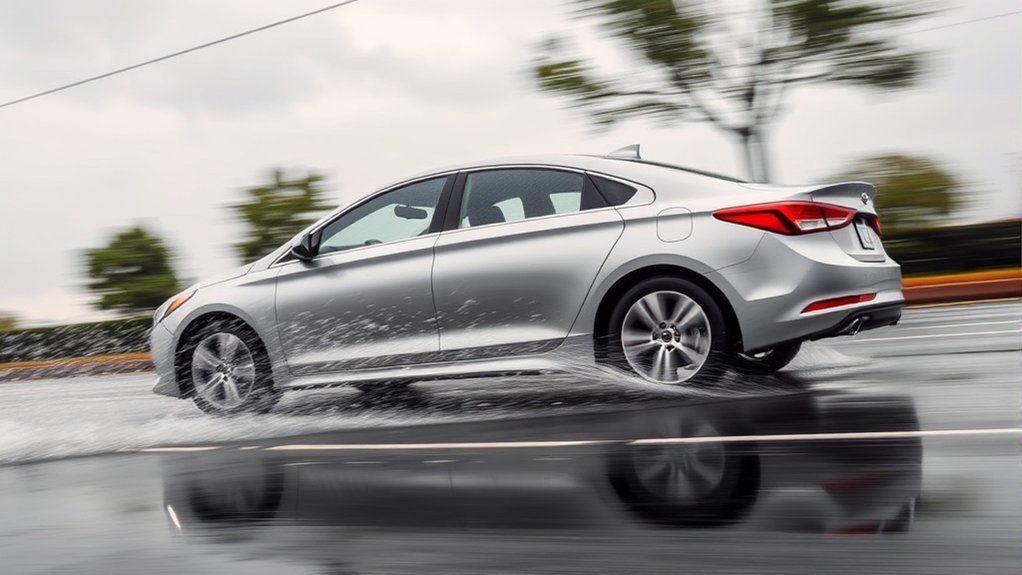
Hydroplaning happens when the tire tread cannot move water away fast enough. Instead of gripping pavement, the tire rides on a thin layer of water. When that happens, steering, braking, and acceleration response can feel light, delayed, or almost disconnected.
The risk is not limited to old cars or bald tires. According to AAA wet-weather driving guidance, even new tires can lose some road contact at speeds as low as 35 mph when there is enough water on the road. That is why speed, tread depth, tire pressure, and road conditions all matter together.
Warning: All-wheel drive, traction control, ABS, and new tires can help with vehicle control, but they cannot cancel the laws of physics. If there is standing water on the road, slow down before you reach it.
Key Causes of Hydroplaning
Your Sonata is more likely to hydroplane when several risk factors stack together. The most common causes are:
- Too much speed for the water depth: The faster the tire rolls, the less time the tread has to push water aside.
- Low tread depth: Shallow grooves cannot evacuate water as well as deeper tread.
- Incorrect tire pressure: Under-inflation and over-inflation can reduce tire life, hurt handling, and affect the tire’s contact patch.
- Standing water or poor drainage: Puddles, rutted lanes, clogged drains, and low road edges raise hydroplaning risk.
- Sudden driver inputs: Hard braking, sharp steering, and sudden acceleration can make a wet-road slide worse.
Why Tire Tread Depth Matters
Tread grooves are water channels. When the tread is deep enough, those grooves help move water away from the contact patch so rubber can keep touching pavement. As tread wears down, the tire has less room to move water, so wet braking, cornering, and hydroplaning resistance drop.
The legal minimum in many U.S. contexts is commonly treated as 2/32 inch, but that is not the point where wet performance first becomes risky. AAA all-season tire testing found that tires worn to 4/32 inch had much longer wet stopping distances and lower wet-road cornering grip than new tires. For a Sonata driven in rainy areas, 4/32 inch is a smart point to start shopping, not a finish line to ignore.
[Products Worth Considering]

Monitor tire tread wear with a smart, color-coded depth gauge that shows clear condition ranges at a glance. The bar is range marked for fast, easy readings, helping you maintain safer traction and performance. Each gauge is portable with a pocket clip, and the set includes 20 units for daily use and sharing.

Measure tire tread depth quickly and accurately with this LUMITECO dial gauge that reads in 1/32" increments up to 14/32". The color-coded green/yellow/red zones make it easy to judge tire wear and know when replacement is needed. A rugged, compact design with a protective pouch helps keep the gauge ready for use on cars, trucks, motorcycles, and more.

Accurately measure tire tread depth with a calibrated gauge marked from 0 to 1 inch in 1/32 inch increments. The color-coded bar helps you quickly identify tread condition ranges, supporting safe driving for trucks, motorcycles, automobiles, and passenger vehicles.
Tread Depth Action Guide
- 6/32 inch or more: Generally better wet-weather margin, assuming the tire is not aged, damaged, or unevenly worn.
- 5/32 to 4/32 inch: Use caution in heavy rain and start planning replacement, especially if you drive highways often.
- 3/32 inch: Wet-weather performance is weak. Replace soon.
- 2/32 inch or less: Treat the tire as worn out and unsafe for rain.
How to Check Tread Depth
The most accurate tool is a tread-depth gauge. Place it into the main grooves across several points on each tire, because tires can wear unevenly from alignment, pressure, or suspension issues.
For a quick wet-weather check, use a quarter with Washington’s head facing down into the groove. If the top of Washington’s head is visible, the tread is around 4/32 inch or less, and it is time to plan replacement for rainy driving. Also look for built-in treadwear bars. If the tread is level with those bars, the tire is at the worn-out stage.
Wet-road safety drops before a tire looks completely bald. For rain, 4/32 inch is the practical warning point; 2/32 inch is the danger zone.
Maintaining Proper Tire Pressure Year-Round
Correct tire pressure helps your Sonata ride, handle, stop, and wear its tires properly. Do not guess the number. Do not use the maximum PSI printed on the tire sidewall as your normal driving pressure. Use the cold tire pressure listed on the driver-side door placard or in the owner’s manual.
NHTSA tire safety guidance says tire pressure should be measured when tires are cold, meaning the vehicle has not been driven for at least three hours. Hyundai also warns in its recommended cold tire inflation pressure guidance that under-inflation or over-inflation can reduce tire life, hurt handling, and increase the risk of tire failure.
[Products Worth Considering]

The SAFELIFE dial tire tread depth gauge measures tread depth in 1/32 inch increments with clear, easy-to-read 2-inch dial face. Color zones using a traffic light system help you quickly judge whether tread is low, marginal, or ample for safer driving. Built with a durable zinc cast body and a metal detect probe for precise, comfortable use across cars, motorcycles, trucks, and buses.

Milton S-921 pencil tire pressure gauge helps you maintain optimal tire pressure for passenger cars with accurate readings in PSI and kPa. It features a built-in deflator valve for convenient pressure adjustments, plus a single chuck head and nylon indicator bar for easy use on the go. Built from durable plated brass and designed for reliable performance, it’s a practical road trip and cold-weather maintenance tool.

Measure tyre tread depth precisely with a digital gauge that reads in both MM and inches, helping you monitor safe driving conditions. The large LCD screen is easy to operate, and the compact tool fits for cars, trucks, and motorcycles. It provides high accuracy with a 0-25.4mm range and includes a 1-year warranty for added peace of mind.
Monthly Pressure Checks
Check all four tires at least once a month and before long trips. A tire can look normal and still be several PSI low, so use a gauge instead of relying on appearance. If your Sonata has a spare tire, check it too.
- Park the car for at least three hours so the tires are cold.
- Find the recommended PSI on the driver-door tire placard.
- Remove the valve cap and press the gauge firmly onto the valve stem.
- Add or release air until the reading matches the placard.
- Recheck the pressure and reinstall the valve cap.
Seasonal Pressure Changes
Tire pressure changes with temperature. Cold weather usually lowers pressure, while warm weather and driving heat can raise the reading. That is why the cold-pressure check matters. Do not bleed air from a warm tire just because the reading is higher after driving; wait for a cold reading and adjust to the placard number.
Pro Tip: Keep a small digital tire gauge in the glove box and check pressure on the same day each month. Pair it with a tread check so you catch pressure loss, uneven wear, and damage early.
Choosing Tires to Prevent Hydroplaning in Wet Conditions
The right tire for a Hyundai Sonata depends on your trim, wheel size, climate, and driving style. For wet-road safety, look for tires with strong wet traction ratings, wide circumferential grooves, and tread patterns designed to channel water away from the contact patch.
For many Sonata drivers, a quality touring all-season tire is a good everyday choice. If you drive in frequent heavy rain, prioritize wet braking and hydroplaning resistance over the cheapest price. If you drive in winter conditions, remember that all-season tires are not the same as winter tires; snow and ice performance require a different tread compound and design.
Always match the tire size, load rating, and speed rating required for your Sonata. The driver-door placard and owner’s manual are the starting points. A qualified tire shop or Hyundai service department can confirm fitment if your current wheels or tire sizes are not original.
[Products Worth Considering]

The Topeak SmartGauge D2 delivers precise digital tire pressure readings for bikes, motorcycles, and sports equipment up to 250 psi (17 bar). Its rotating SmartHead works with both Presta and Schrader valves, so you can check pressure quickly without adapters. The LCD display makes it easy to read results in psi, bar, or kg/cm² with an included CR2032 battery for immediate use.

TireJect Off-Road Tire Sealant Kit provides 5-in-1 sealing to help fix tread punctures up to 3/8", sidewall punctures up to 3/8", bead leaks, slow leaks, and minor dry rot on low-speed tires. It permanently seals with liquid rubber, recycled tire particles, and Aramid fibers, making it ideal for flats caused by thorns, nails, and screws. The included dispensing cap attaches to the valve stem for a no-mess installation, along with a metal valve core remover tool and valve stem cap. This kit is for off-road use only.

ETENWOLF T300 is a calibrated digital tire pressure gauge for accurate readings from 3 to 200 PSI across light and heavy-duty vehicles. It includes thermal compensation for reliable performance in extreme cold or heat, with an auto shut-off to extend battery life and an LED for easier reading. The sturdy design supports rugged everyday use, making it ideal for pickups, RVs, and industrial applications.
Driving Safely in the Rain: Tips to Prevent Hydroplaning
Good tires help, but driving behavior matters just as much. The goal in rain is to reduce the amount of water the tires must clear and avoid sudden inputs that break traction.
- Slow down before standing water: Lift off the accelerator early instead of braking hard at the puddle.
- Avoid cruise control: You need full control of throttle response in wet conditions.
- Increase following distance: Wet stops take longer, especially with worn tires.
- Drive in the tracks of the vehicle ahead: Those tracks may have less standing water, but only do this if it is safe and visibility is good.
- Avoid outer lanes with pooled water: Water often collects near road edges and ruts.
- Make smooth inputs: Turn, brake, and accelerate gently.
Note: The posted speed limit is for normal conditions. In heavy rain, a safe speed may be much lower than the limit, even on familiar roads.
What Should You Do If Your Hyundai Sonata Hydroplanes?
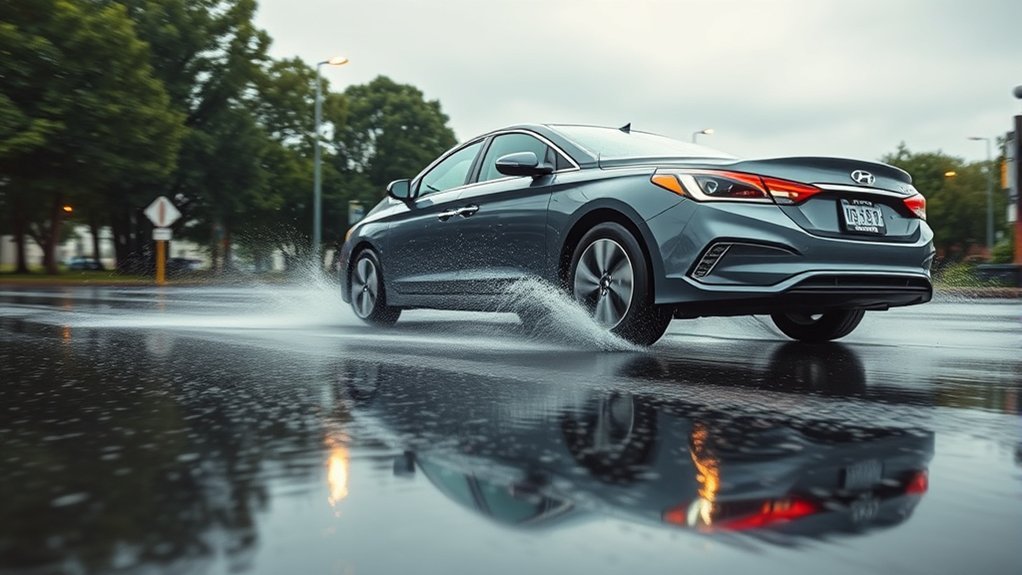
If your Sonata starts to hydroplane, the steering may suddenly feel light, the engine sound may change, or the car may feel like it is floating. Stay calm and focus on getting the tires back in contact with the road.
- Ease off the accelerator. Let the car slow naturally. Do not press harder on the gas.
- Keep the steering wheel steady. Point the front of the car where you want to go, but avoid sharp corrections.
- Do not slam the brakes. Abrupt braking can make the slide worse. If braking is needed after traction returns, brake smoothly.
- Wait for grip to return. You will feel the steering become heavier and more responsive.
- Correct gently. Once the tires reconnect, steer back into your lane with small movements.
- Slow down and reassess. If you are shaken or the road is flooded, pull over somewhere safe.
Routine Tire Maintenance for Your Hyundai Sonata
Routine tire care is the best way to reduce hydroplaning risk before the storm starts. Build this checklist into your normal Sonata maintenance routine:
- Monthly: Check cold tire pressure, tread depth, sidewall damage, punctures, bulges, and uneven wear.
- Before road trips: Recheck pressure, inspect tread, and look for cuts or nails.
- At rotation intervals: Follow your owner’s manual. Hyundai’s tire rotation guidance for the referenced manual page lists 7,500 miles or sooner if irregular wear develops.
- When wear is uneven: Have alignment, balancing, suspension, and tire pressure checked.
- When tread reaches 4/32 inch: Start shopping if you drive in rain often.
- When tread reaches 2/32 inch or damage appears: Replace the tire instead of stretching its life.
If a tire repeatedly loses air, do not keep topping it off without inspection. A nail, bead leak, valve-stem issue, cracked wheel, or old tire can create a safety problem.
Frequently Asked Questions
What is the most common cause of hydroplaning in a Hyundai Sonata?
The most common cause is driving too fast for the amount of water on the road. Worn tread, incorrect tire pressure, standing water, and sudden steering or braking can make the problem worse.
What tire pressure should I use for my Hyundai Sonata in rain?
Use the cold tire pressure printed on your Sonata’s driver-door tire placard or listed in your owner’s manual. Do not use the maximum PSI printed on the tire sidewall as your normal driving pressure.
Is 4/32 inch tread depth safe for wet roads?
It is a caution point, not a comfort point. At 4/32 inch, wet braking and cornering performance can be meaningfully reduced compared with new tires, so rainy-climate drivers should begin planning replacement.
Can new tires still hydroplane?
Yes. New tires lower the risk, but they do not eliminate it. Enough speed, water depth, and poor drainage can still cause partial or full hydroplaning, so slow down in heavy rain.
Should I brake if my Sonata starts hydroplaning?
Do not slam the brakes. First ease off the accelerator and keep the steering steady. Once the tires regain grip, brake smoothly if you need to slow down more.
Conclusion
Hydroplaning prevention starts before the rain. Keep your Hyundai Sonata’s tires inflated to the correct cold pressure, check tread depth every month, replace worn tires before wet grip disappears, and slow down when water is on the road. If hydroplaning happens anyway, stay calm, ease off the accelerator, avoid sudden braking or steering, and let the tires regain contact before making gentle corrections.
Sources
- NHTSA TireWise Tire Safety — cold tire pressure, monthly tire checks, treadwear, and tire safety basics
- Hyundai Recommended Cold Tire Inflation Pressures — Hyundai guidance on pressure, handling, tire wear, and under/over-inflation risks
- Hyundai Tire Rotation Guidance — rotation interval and uneven-wear inspection guidance
- AAA Wet Weather Driving Tips — cruise control, speed reduction, water displacement, and hydroplaning risk
- AAA All-Season Tire Testing — wet stopping and handling performance at 4/32 inch tread depth
- Bridgestone Hydroplaning Guide — hydroplaning causes, water depth, speed, tread depth, and vehicle factors