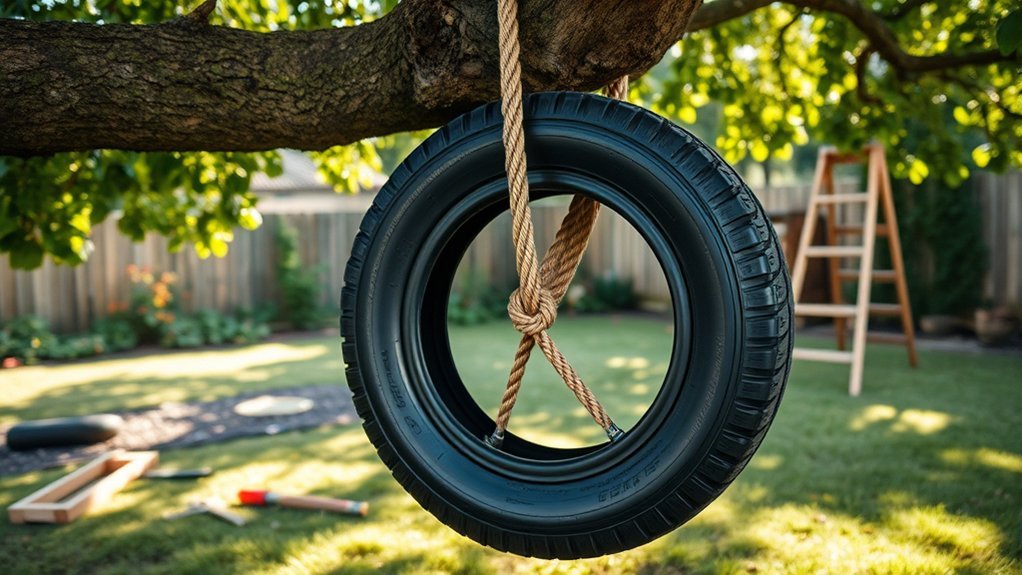
A tire swing looks simple, but the safe version depends on the right tire, a sound support point, rated hardware, drainage, clear space, and regular inspection. Use these steps for a backyard tire swing only, and have a qualified arborist or installer check the tree and hanging hardware if you are not completely sure the support can handle repeated swinging loads.
Quick Answer
To make a tire swing, choose a clean passenger tire with no cracks or exposed steel belts, drill drainage holes in the underside, attach rated rope or chain with secure hardware, hang it from a healthy support, set the tire 12–18 inches above protective surfacing, and inspect every connection before use.
Key Takeaways
- Use a clean passenger tire, not a heavy truck tire, and replace any tire with cracks, sharp wire, or deep damage.
- Drill drainage holes in the lowest underside of the tire so rainwater cannot sit inside.
- Use rated rope, chain, straps, swivels, eye bolts, washers, lock nuts, and closed hooks; avoid unrated hardware.
- Set the bottom of the tire about 12–18 inches above shock-absorbing protective surfacing.
- Keep the swing path clear, test the swing gently before riding, and inspect the tire, tree, rope, chain, and hardware often.
At a Glance
| Time Required | 1–2 hours for the swing, plus time to prepare protective surfacing |
| Difficulty | Moderate; use professional help for tree assessment or permanent support hardware |
| Tools Needed | Drill, 1/2-inch bit, measuring tape, ladder, wrench set, gloves, eye protection, and rated hanging hardware |
| Cost | About $40–$120 for hardware and rope or chain, not including protective surfacing or professional inspection |
Warning: Do not hang a tire swing from a dead, cracked, diseased, overextended, or storm-damaged limb. Keep it away from power lines, fences, driveways, hard surfaces, rocks, stumps, and other play equipment. Children should be supervised whenever they use the swing.
Choose the Right Tire for Your Swing
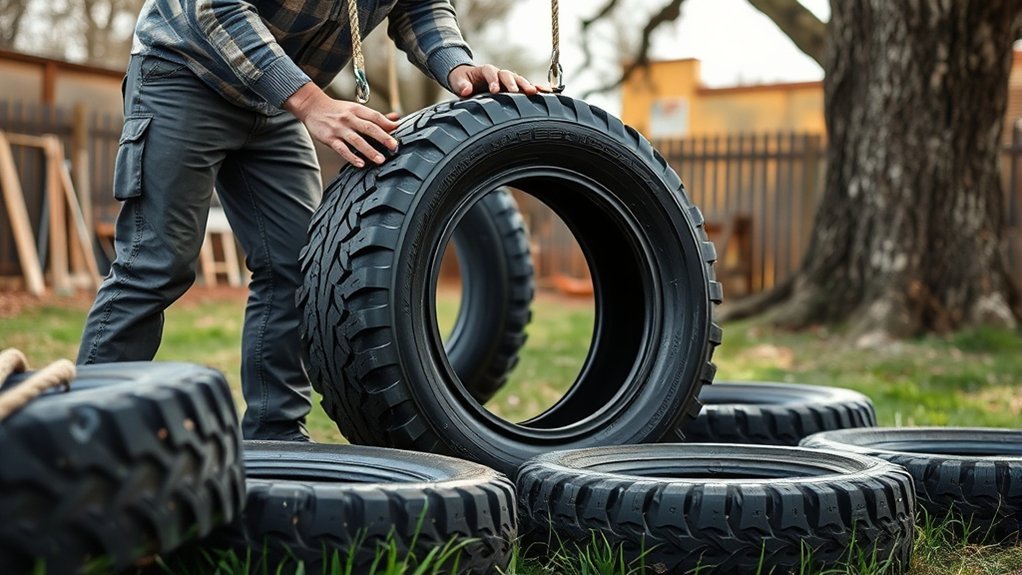
Start with one clean, rimless passenger tire. A standard passenger tire is usually easier to lift, drill, clean, and control than a heavy truck tire. Avoid oversized truck tires for children because a heavy tire can hit harder if it swings into someone.
Inspect the tire before you build anything. Do not use it if you see deep cracks, exposed steel belts, sharp wire, large sidewall damage, dry rot, oily residue, or a strong chemical smell. Run a gloved hand around the inside and outside edges to check for sharp spots.
A tire between about 24 and 30 inches in outside diameter works well for many backyard swings. Use a smaller tire for younger children and a larger tire only when the support, hardware, and clear space are suitable for the rider. The tire should be sturdy, smooth enough to sit on, and easy to clean.
Note: A used tire can leave black marks on clothing. Scrub it with mild soap and water, rinse it well, and let it dry completely before drilling or hanging.
[Products Worth Considering]

A fun climbing and balance swing for outdoor play, featuring a circular disc kids can stand or sit on, plus platforms to help them climb. The thick braided rope is easy to grip and supports skill-building through repeated swings and careful balance. It’s designed for quick installation and includes an adjustable rope length and a tree strap for a perfect fit.

Replace worn tires quickly with this universal 4.80/4.00-8 tire and inner tube set designed for wheelbarrows and outdoor utility carts. The ribbed tread helps reduce turf damage while the natural rubber construction supports longer service life. Compatible with 15.5-inch outer diameter, 4-inch width, and 8-inch rim diameter wheels, it uses a straight TR-13 valve stem for easy installation. For best results, inflate with a manual pump and do not exceed 25 PSI.
This flat-free TICONN wheelbarrow tire features durable polyurethane foam construction that never needs inflation, helping prevent punctures and reducing maintenance on rough outdoor terrain. With a 300 lb max load capacity and stable steel rim design, it supports safer transport for yard work and hauling tasks. An adapter kit with ball bearings and nylon spacers is included for easier fit and customization across common wheelbarrow and cart axle setups.
Gather Tire Swing Tools and Hardware
Gather every tool and part before you start. A safe tire swing depends on rated parts that work together, not on random rope, open hooks, or old hardware from a drawer.
[Products Worth Considering]

This all-in-one air compressor accessories kit includes a tire inflator with gauge for car tires and a combined air chuck setup for easier inflation. It also features a durable 1/4 inch polyurethane air hose for connecting compressors to air tools, plus a heavy-duty blow gun and industrial hose fittings for cleaning and routine projects. Ideal for keeping your air system ready for inflating, cleaning, and quick-connect tool use.

The Big Rig Defense Tire Thumper is a truck tire pressure checker that lets you quickly check multiple tires by giving them a firm whack. Listen for a reassuring thump and feel the stick bounce when a tire is fully inflated, helping you get back on the road safely. It features a comfortable, glove-friendly handle and a secure wrist strap for confident use on busy routes.

Steelman white tire marking crayons provide high-contrast, semi-permanent marks for repairing and inspecting tires and equipment. They write on wet or dry, smooth or coarse surfaces including rubber, metal, glass, and wood, making them ideal for puncture location and damage outlining. The lead- and zinc-free crayons resist weather and fading yet wipe away when you no longer need the marks.
Essential Tools
- Drill with a 1/2-inch bit for drainage holes
- Smaller drill bit sized to your eye-bolt shafts, if you are installing eye bolts through the tire
- Measuring tape or string for even spacing
- Wrench or socket set for nuts and lock nuts
- Sturdy ladder, used on level ground with a helper nearby
- Work gloves and eye protection
- Bucket, brush, mild soap, and hose for cleaning the tire
Hardware Checklist
- Rated tree swing straps, rated rope, or galvanized chain
- Heavy-duty swivel rated for swing use, especially for a horizontal tire swing
- Eye bolts sized for the tire, plus fender washers, lock washers, and lock nuts
- Closed S-hooks, quick links, or locking carabiners rated for the expected load
- Protective surfacing such as engineered wood fiber, wood chips, shredded rubber mulch, sand, pea gravel, or safety-tested rubber mats
For home playground equipment and purchased swing kits, look for products labeled to applicable standards such as ASTM F1148 for home playground equipment. A DIY tire swing is not automatically standards-compliant just because you use strong parts, so follow manufacturer ratings and inspect often.
Pro Tip: Buy all hanging parts from the same swing-hardware system when possible. Mixed hardware can create weak links, side loading, or hooks that do not close properly.
Drill the Tire for Drainage
Drainage holes keep rainwater from collecting inside the tire. Standing water adds weight, attracts insects, creates odor, and can hide damage.
Drainage Hole Placement
Place the tire in the same position it will hang. Mark the lowest underside of the tire, then drill four to six drainage holes around that bottom area. Space them evenly so water can escape from more than one point.
For a horizontal tire swing, drill the holes in the underside of the tire where water would pool. For a simple vertical tire swing, drill the holes along the lower sidewall. Keep drainage holes away from any eye-bolt holes or rope holes so you do not weaken the attachment points.
Proper Drill Bit Size
A 1/2-inch bit is a practical size for drainage holes because it lets water and small debris pass through without removing too much rubber. Drill slowly, keep your hands clear of the bit, and wear eye protection. After drilling, pull away loose rubber scraps so the openings stay clear.
| Tool | Purpose | Safety Check |
|---|---|---|
| 1/2-inch drill bit | Creates drainage holes | Do not drill near hardware holes |
| Even spacing | Helps the tire drain from several points | Keep holes on the underside |
| Gloves and eye protection | Protects hands and eyes while drilling | Clear rubber scraps afterward |
Preventing Water Buildup
After every heavy rain, tilt the tire and check that water drains freely. If the holes clog with leaves, mud, or rubber shavings, clear them before anyone rides. The CPSC Public Playground Safety Handbook specifically notes that tires used for play should not collect water and debris and that tire swings should have drainage holes in the underside.
Choose a Safe Tree Limb or Support
The support is the most important part of the swing. A tire, rope, and hardware can be strong, but the swing is not safe if the tree limb is weak.
Choose a mature, healthy hardwood tree with a strong limb that grows from a sound branch union. The limb should be free from cracks, peeling bark, fungus, dead sections, insect damage, hollow spots, and old storm damage. A limb that is unusually long, heavy, or stretched far from the trunk can be more likely to fail under load.
A common backyard starting point is to look for a limb around 8 inches in diameter or larger, but diameter alone does not prove safety. Tree species, decay, branch angle, union strength, distance from the trunk, rider weight, and swinging motion all matter. If you are unsure, consult an ISA Certified Arborist or another qualified tree-care professional. Purdue Extension notes that weak branch structure and overextended limbs can increase failure risk and that qualified arborists should evaluate structural concerns.
Do not attach a tire swing to a limb over concrete, asphalt, packed dirt, roots, rocks, or landscaping borders. The area below and around the swing should be level enough for protective surfacing and clear enough for the full swing path.
[Products Worth Considering]

Replace worn pool cleaner tires with this all-purpose C10 tire set made to fit compatible Polaris automatic pool cleaners. The tires are designed for maximum traction while helping protect your pool finish, and they match Polaris OEM size and material. Each pack includes three new tires in sealed bags.

Add style while helping protect your tire valve stems with handmade crystal rhinestone caps and a durable plastic insert. These caps resist corrosion and help keep out rain, snow, and muddy water, extending tire life. Textured non-slip design makes them easy to grip for quick install and removal when checking tire pressure.
A concentrated tire and tube mounting compound designed to help simplify mounting rubber tires and tubes on passenger, semi truck, construction, and OTR applications. Its ultra-thick formula packs beads effectively and includes rust inhibitors to help protect against corrosion during use.
Hang the Tire Swing From a Tree Limb
Before climbing a ladder, decide whether you are making a horizontal multi-axis tire swing or a simpler vertical tire swing. A horizontal tire swing usually uses three attachment points on the tire, three chains or cables, and a swivel so it can move and rotate. A vertical tire swing may use one main rope or chain, but it offers less seating stability and still needs rated hardware and safe clearance.
- Mark the hanging point. Choose a point on the limb that gives the tire a clear swing path and keeps it away from the trunk.
- Protect the tree. Use wide, rated tree swing straps or professionally installed tree hardware. Avoid tying a thin rope directly around the limb because it can cut into bark and shift under load.
- Attach the tire. For a horizontal tire swing, mark three holes 120 degrees apart on the upper sidewall, drill holes sized for the eye bolts, and secure each eye bolt with fender washers, lock washers, and lock nuts. For a vertical tire swing, use a rated rope or chain attachment that cannot slip through the tire.
- Add the swivel. A tire swing that rotates should use a rated swivel between the tire chains and the upper hanger so the chains do not twist and bind.
- Set the height. Adjust the rope or chain so the bottom of the tire sits about 12–18 inches above the protective surface.
The CPSC Outdoor Home Playground Safety Handbook advises locating 360-degree tire swings away from other play equipment and structures. Keep the tire swing in its own clear zone rather than placing it beside a slide, sandbox, fence, or another swing.
Secure the Rope or Chain
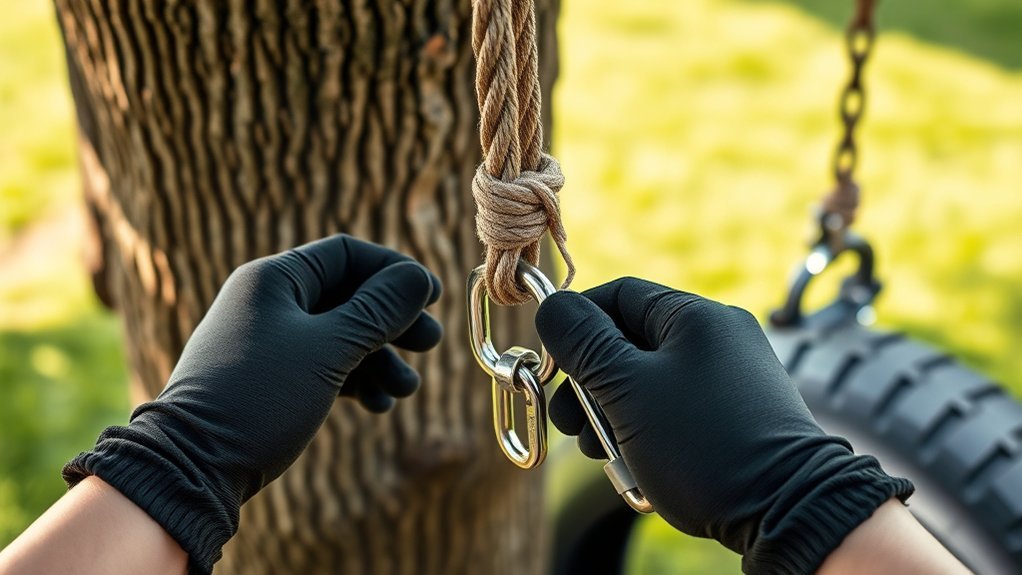
Use rope, chain, straps, carabiners, quick links, S-hooks, eye bolts, and swivels that are rated for swing use. The rating should comfortably exceed the expected rider weight because swinging creates dynamic force. Never rely on decorative rope, clothesline, pet leash clips, rusty chain, open hooks, or unknown hardware.
If you use rope, choose a strong outdoor rope that does not untwist into loose strands or loops. Tie secure knots such as a double bowline only if you know how to dress, tighten, and inspect the knot. Leave a tail, and check the knot often for slippage.
If you use chain, use corrosion-resistant chain with links that fit the connectors correctly. Close S-hooks fully or use locking connectors so clothing, fingers, or hardware cannot catch in an open gap. The CPSC home handbook warns that open hooks and protruding hardware can create laceration and entanglement hazards, so keep all hardware tight, closed, and smooth.
Warning: Do not let bolt ends, sharp wire, open hooks, or chain ends stick out where a rider can scrape skin or snag clothing. File, cover, close, or replace unsafe hardware before the swing is used.
Check Safety, Height, and Clearance
Set the bottom of the tire about 12–18 inches above the protective surface. This height lets many riders get on and off without dragging the tire on the ground. For a tire swing, do not set the bottom lower than 12 inches above the protective surface.
Clearance matters in every direction because a tire swing can move forward, backward, sideways, and around. For tire swings, the CPSC home handbook recommends protective surfacing in a circle with a radius equal to the length of the suspending chain or rope plus 6 feet. In simple terms, a longer hanging rope needs a wider clear zone.
Use shock-absorbing protective surfacing under and around the swing. HealthyChildren.org from the American Academy of Pediatrics recommends energy-absorbing surfaces such as safety-tested mats or loose-fill materials and notes that loose-fill materials should be maintained to a depth of at least 9 inches. Grass and packed dirt are not reliable protective surfaces because they can compact and lose shock absorption.
- Keep the swing away from fences, walls, sheds, trunks, poles, rocks, roots, and driveways.
- Do not place a tire swing in front of a slide or near another active play area.
- Remove toys, tools, sticks, and yard debris from the use zone.
- Check overhead clearance for branches, wires, and anything the rider could hit.
- Keep young children and bystanders out of the swing path.
Test the Tire Swing Before First Use
Do not let a child be the first test load. After installation, test the tire swing slowly and deliberately.
- Pull down on the tire. Watch for movement at the limb, strap, rope, chain, swivel, and tire hardware.
- Add a static test load. Use sandbags, weight plates, or another controlled load close to the expected rider weight. Keep people out of the swing path.
- Push gently. Move the tire a few inches in each direction and check for rubbing, twisting, slipping, or clicking hardware.
- Re-tighten. Tighten nuts and connectors again after the first test because hardware can settle under load.
- Do a final walkaround. Check clearance, surfacing, drainage holes, and all attachment points before the first ride.
Note: A tire swing should be used by one rider at a time unless the swing hardware and support are specifically designed and rated for more. More riders add weight and unpredictable movement.
Inspect and Maintain Your Tire Swing
Once the tire swing is installed, safety depends on maintenance. Inspect it before the first ride of the day, after storms, and at least monthly during the season.
- Tire: Look for cracks, tears, exposed steel belts, sharp edges, trapped water, and loose rubber.
- Drainage holes: Make sure every hole is open and draining.
- Rope: Replace it if you see fraying, flattening, mildew damage, sun damage, or slipping knots.
- Chain: Replace rusty, bent, stretched, or worn links.
- Hardware: Tighten nuts, close hooks, inspect washers, and replace corroded connectors.
- Swivel: Confirm it rotates smoothly and has no grinding, cracking, or looseness.
- Tree: Check the limb and trunk for cracks, deadwood, fungus, bark loss, or movement at the attachment point.
- Surfacing: Rake loose-fill material back into place and restore the proper depth.
Remove the swing during severe weather seasons if your area gets heavy storms, ice, or high winds. Store rope and removable hardware indoors when the swing will not be used for a long time.
Frequently Asked Questions
How high should a tire swing be off the ground?
Set the bottom of the tire about 12–18 inches above the protective surface. Do not set it lower than 12 inches, and do not hang it so high that riders have to jump down. The exact height should match the rider’s size, the swing path, and the depth of protective surfacing.
How thick should a branch be for a tire swing?
A strong branch is more than a measurement. As a conservative backyard starting point, look for a healthy hardwood limb around 8 inches in diameter or larger, but also check species, decay, cracks, branch union, and how far the limb extends from the trunk. Ask a qualified arborist to inspect the tree if there is any doubt.
What is the best size tire for a tire swing?
A clean passenger tire about 24–30 inches in outside diameter works well for many backyard tire swings. Use a smaller tire for young children and avoid heavy truck tires. Never use a tire with exposed steel belts, sharp wire, deep cracks, or major sidewall damage.
Where should I drill holes for a tire swing?
Drill drainage holes in the lowest underside of the tire so water can escape. For a horizontal tire swing, place three eye-bolt holes evenly around the upper sidewall, about 120 degrees apart, and keep them separate from the drainage holes. Use washers and lock nuts on every eye bolt.
Is rope or chain better for a tire swing?
Both can work if they are rated for outdoor swing use and installed correctly. Rope is softer and easier to handle, but it can fray, stretch, or slip if knots are poor. Chain lasts longer, but it can rust, pinch, or injure hands if it is not covered or maintained.
Do I need protective surfacing under a tire swing?
Yes. Use shock-absorbing surfacing such as engineered wood fiber, wood chips, shredded rubber mulch, sand, pea gravel, or safety-tested rubber mats. For loose-fill material, maintain enough depth so it does not compact or expose hard ground below.
Can I hang a tire swing from one rope?
A one-rope vertical tire swing is possible, but it is less stable than a horizontal tire swing with three attachment points and a swivel. Use only rated rope and hardware, tie secure knots, keep the tire low enough for safe mounting, and inspect the rope before each use.
Conclusion
A good tire swing is not just a tire on a rope. Choose a sound tire, drill drainage holes, use rated hardware, hang it from a safe support, add protective surfacing, and test it before anyone rides. After that, keep checking it. A few minutes of inspection can prevent loose hardware, hidden water, cracked rubber, or a weak limb from turning backyard fun into a hazard.
Sources
- U.S. Consumer Product Safety Commission, Outdoor Home Playground Safety Handbook — home swing placement, protective surfacing, hardware, and maintenance guidance
- U.S. Consumer Product Safety Commission, Public Playground Safety Handbook, July 2025 — tire swing drainage, multi-axis swing clearance, and use-zone guidance
- HealthyChildren.org, American Academy of Pediatrics, Safety Tips for Home Playground Equipment — supervision, surfacing, clothing, and general playground safety
- ASTM F1148, Standard Consumer Safety Performance Specification for Home Playground Equipment — safety-performance standard for home playground equipment
- Purdue Extension, Large Tree Cabling and Bracing — tree structure, weak branch unions, overextended limbs, and arborist evaluation