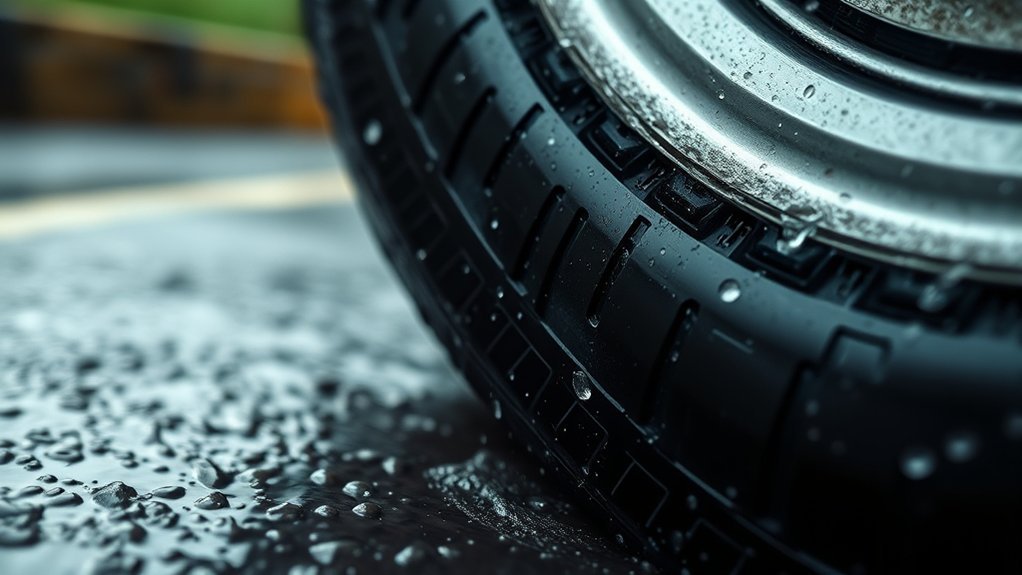
Tire tread patterns improve grip by controlling how the tire meets the road and how quickly it clears water, slush, and loose debris. Grooves create drainage paths, tread blocks provide stable contact areas, and sipes add small biting edges. The pattern matters, but so do tread depth, rubber compound, tire pressure, temperature, speed, and road conditions.
Quick Answer
Tire tread patterns improve grip by balancing road contact with spaces that move water and debris away from the tire. Grooves help resist hydroplaning, tread blocks support braking and cornering, and sipes create extra edges for wet, snowy, or icy surfaces. The best design depends on your driving conditions.
Key Takeaways
- Grooves and voids give water somewhere to escape, helping the tire maintain contact with wet pavement.
- Tread blocks and ribs support acceleration, braking, steering response, and cornering stability.
- Sipes add small biting edges that can improve wet, snow, and ice traction.
- Symmetrical, asymmetrical, and directional patterns make different compromises between drainage, handling, noise, wear, and rotation flexibility.
- Tread depth matters greatly in rain, but tread pattern alone cannot prevent hydroplaning or compensate for excessive speed, improper inflation, or unsuitable tires.
How Tire Tread Patterns Improve Grip
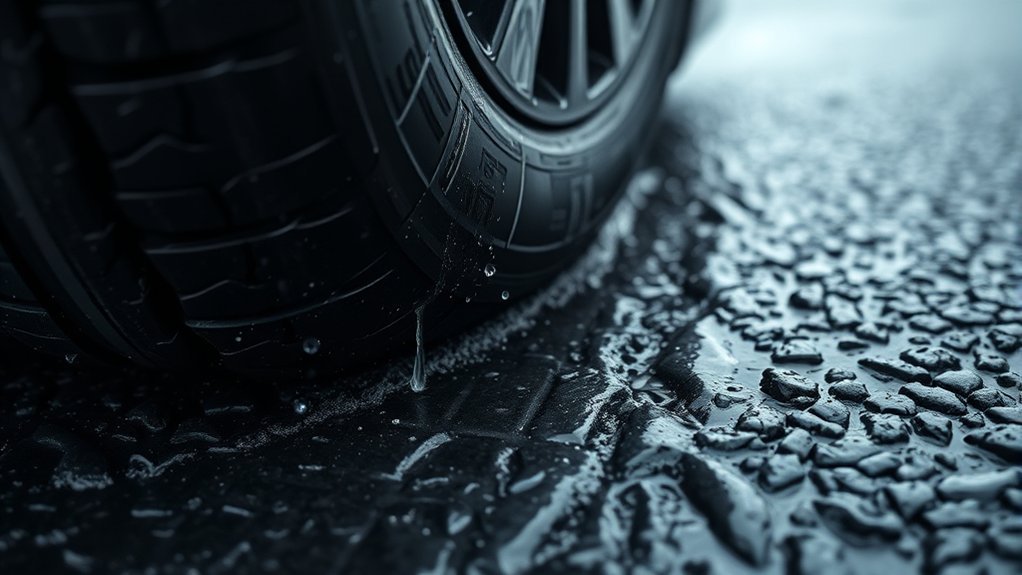
Tire tread patterns improve grip by organizing the rubber that contacts the pavement and the spaces that surround it. According to Michelin, groove ratio, tread layout, sipes, profile, and tread-block design can all affect wet or dry performance.
The solid parts of the tread provide the contact needed to transmit braking, acceleration, and cornering forces. Larger or more rigid tread blocks can improve stability in some applications because they reduce tread movement, sometimes called tread squirm. However, a tire also needs enough open space to handle rain, snow, or loose material.
That is why tire engineering involves tradeoffs. A nearly solid tread can provide a large contact area on a dry racing surface, while a road tire needs grooves to deal with water and changing conditions.
What Each Part of the Tread Does
| Tread blocks | Raised rubber sections that contact the road and help transmit braking, acceleration, and cornering forces. |
| Ribs | Rows of tread running around the tire that can support straight-line stability and steering response. |
| Grooves | Channels between tread sections that provide space for water, slush, and other material to move away from the contact patch. |
| Voids | Open areas in the tread. A larger void ratio can improve evacuation but reduces the amount of rubber directly contacting the road. |
| Sipes | Small slits in tread blocks that create additional edges and help manage thin films of water, snow, and ice. |
Sipes are especially important in many winter and all-season designs. They create numerous small edges that help the tread interact with slick surfaces. However, adding many cuts can make a tread block less rigid unless the tire uses features such as interlocking or three-dimensional sipes.
How Tire Tread Patterns Move Water Away
On a wet road, the tire must move water away quickly enough for the tread to maintain useful contact with the pavement. Circumferential grooves provide channels around the tire, while lateral grooves can direct water toward the shoulders and out of the footprint.
A higher groove or void ratio generally gives the tire more space to manage water. The tradeoff is that every groove also removes some rubber that could otherwise contact a dry road. Engineers therefore balance drainage against tread-block stability and contact area.
Directional tread patterns commonly use V-shaped channels. Bridgestone explains that this layout is designed to move water efficiently from beneath the contact patch and can improve hydroplaning resistance at higher speeds.
Warning: No tread pattern makes a vehicle immune to hydroplaning. Standing-water depth, vehicle speed, tread depth, tire pressure, tire design, road texture, and other conditions all affect how much contact the tire can maintain. Slow down when water is collecting on the road.
Tread depth becomes increasingly important as a tire wears because shallow grooves have less capacity to manage water. That is one reason a tire can still have visible tread yet perform much worse in heavy rain than it did when new.
Why Tire Tread Patterns Handle Wet and Dry Roads Differently
Wet and dry pavement demand different things from a tread. On a dry road, designers usually want stable tread blocks and plenty of rubber in contact with the surface. On a wet road, the tire also needs enough channels and voids to move water away.
Michelin’s tire-design guidance describes this tradeoff directly: increasing groove area can improve water evacuation, while reducing the percentage of grooves leaves more rubber available for dry-road contact.
Asymmetrical tread is one way manufacturers balance those demands. The inner and outer portions use different layouts. The inner area often emphasizes water evacuation, while larger outer shoulder blocks can improve stability during dry cornering.
Sipes create another compromise. They add useful edges on wet, snowy, or icy surfaces, but cutting a large number of slits into a block can reduce its rigidity. Modern designs may use interlocking sipes or other shapes to control that movement.
Note: Tread pattern is only one part of tire performance. Rubber compound, casing construction, tread depth, tire category, temperature range, and the manufacturer’s complete design can be just as important. A directional all-season tire, for example, should not automatically be treated as equivalent to a dedicated winter tire.
[Products Worth Considering]

Accurately measure tire tread depth with a calibrated gauge marked from 0 to 1 inch in 1/32 inch increments. The color-coded bar helps you quickly identify tread condition ranges, supporting safe driving for trucks, motorcycles, automobiles, and passenger vehicles.

Measure tire tread depth quickly and accurately with this LUMITECO dial gauge that reads in 1/32" increments up to 14/32". The color-coded green/yellow/red zones make it easy to judge tire wear and know when replacement is needed. A rugged, compact design with a protective pouch helps keep the gauge ready for use on cars, trucks, motorcycles, and more.

Monitor tire tread wear with a smart, color-coded depth gauge that shows clear condition ranges at a glance. The bar is range marked for fast, easy readings, helping you maintain safer traction and performance. Each gauge is portable with a pocket clip, and the set includes 20 units for daily use and sharing.
Which Tire Tread Pattern Fits Your Driving Conditions
The best tread pattern depends on where and how you drive. There is no single layout that is best for every vehicle or road condition.
- Symmetrical tread: A practical choice for many everyday passenger tires. The same basic pattern appears across the tread, which can support smooth operation, predictable wear, and flexible rotation options.
- Asymmetrical tread: Useful when the tire needs different functions across its width. The inside may emphasize drainage while the outside uses larger tread blocks for dry handling and cornering stability.
- Directional tread: Often uses a V-shaped pattern designed to operate in one rotation direction. It can be effective at moving water or slush, but correct mounting direction is essential.
- Specialized winter or off-road tread: These designs use combinations of grooves, sipes, blocks, and voids suited to snow, ice, mud, dirt, or loose terrain. Their performance also depends heavily on the rubber compound and complete tire construction.
[Products Worth Considering]

The SAFELIFE dial tire tread depth gauge measures tread depth in 1/32 inch increments with clear, easy-to-read 2-inch dial face. Color zones using a traffic light system help you quickly judge whether tread is low, marginal, or ample for safer driving. Built with a durable zinc cast body and a metal detect probe for precise, comfortable use across cars, motorcycles, trucks, and buses.

Milton S-921 pencil tire pressure gauge helps you maintain optimal tire pressure for passenger cars with accurate readings in PSI and kPa. It features a built-in deflator valve for convenient pressure adjustments, plus a single chuck head and nylon indicator bar for easy use on the go. Built from durable plated brass and designed for reliable performance, it’s a practical road trip and cold-weather maintenance tool.

Measure tyre tread depth precisely with a digital gauge that reads in both MM and inches, helping you monitor safe driving conditions. The large LCD screen is easy to operate, and the compact tool fits for cars, trucks, and motorcycles. It provides high accuracy with a 0-25.4mm range and includes a 1-year warranty for added peace of mind.
Symmetrical vs. Asymmetrical vs. Directional Tread
| Pattern | Typical Strength | What to Know |
|---|---|---|
| Symmetrical | Comfort, predictable wear, rotation flexibility | Common on passenger and touring tires; the final wet/dry performance still varies by tire model. |
| Asymmetrical | Balancing wet evacuation with dry cornering | Sidewalls normally identify the correct inside and outside orientation. |
| Directional | Water or slush evacuation | Must rotate in the marked direction, which limits normal rotation choices. |
Mounting and Rotation Matter
Correct installation is part of tread performance. A directional tire has an arrow on its sidewall showing its intended rotation direction. Once mounted, it is normally rotated front-to-rear on the same side unless it is removed from the wheel and remounted.
An asymmetrical tire normally has markings such as Inside and Outside. Those markings must remain correctly oriented when the tire is installed. An asymmetrical tire is not automatically directional; unless the tire also has a directional marking, it does not have to rotate in only one direction.
Always follow the vehicle and tire manufacturer’s rotation instructions because staggered wheel sizes, directional designs, and other vehicle configurations can change the permitted pattern.
How Tread Depth and Wear Affect Performance
Tread depth has a major effect on wet-road performance because the grooves need enough remaining volume to handle water. New tread depth varies by tire model, so the original specification for your tire is a better reference than assuming every new tire begins with the same measurement.
The National Highway Traffic Safety Administration says tires should be replaced when tread reaches 2/32 inch. Tires have treadwear indicators, often called wear bars, that become flush with the tread at approximately that depth.
However, reaching the wear bars is not the point at which wet performance first begins to deteriorate. In AAA testing of all-season tires, tires worn to 4/32 inch performed substantially worse in wet braking and handling than new versions of the tested tires.
AAA’s testing found that its new test tires stopped nearly 90 feet sooner on average than comparable tires worn to 4/32 inch during wet 60-to-0-mph braking tests.
That result does not make 4/32 inch a universal replacement rule for every tire or driver. It shows why motorists who regularly encounter heavy rain may want a larger tread-depth safety margin rather than waiting until the tread reaches the wear bars.
Pro Tip: Check tread depth in several grooves and at several positions around each tire. A tread-depth gauge gives a clearer measurement than checking only one spot, and comparing locations can reveal irregular wear before the tire reaches its wear bars.
Also inspect for uneven wear. According to the U.S. Tire Manufacturers Association, misalignment can contribute to rapid or irregular tread wear. Incorrect inflation, missed rotations, worn suspension components, and other mechanical problems may also contribute depending on the wear pattern.
If one shoulder, the center, or isolated patches are wearing much faster than the rest of the tread, have the cause diagnosed instead of judging the tire only by its deepest groove.
[Products Worth Considering]
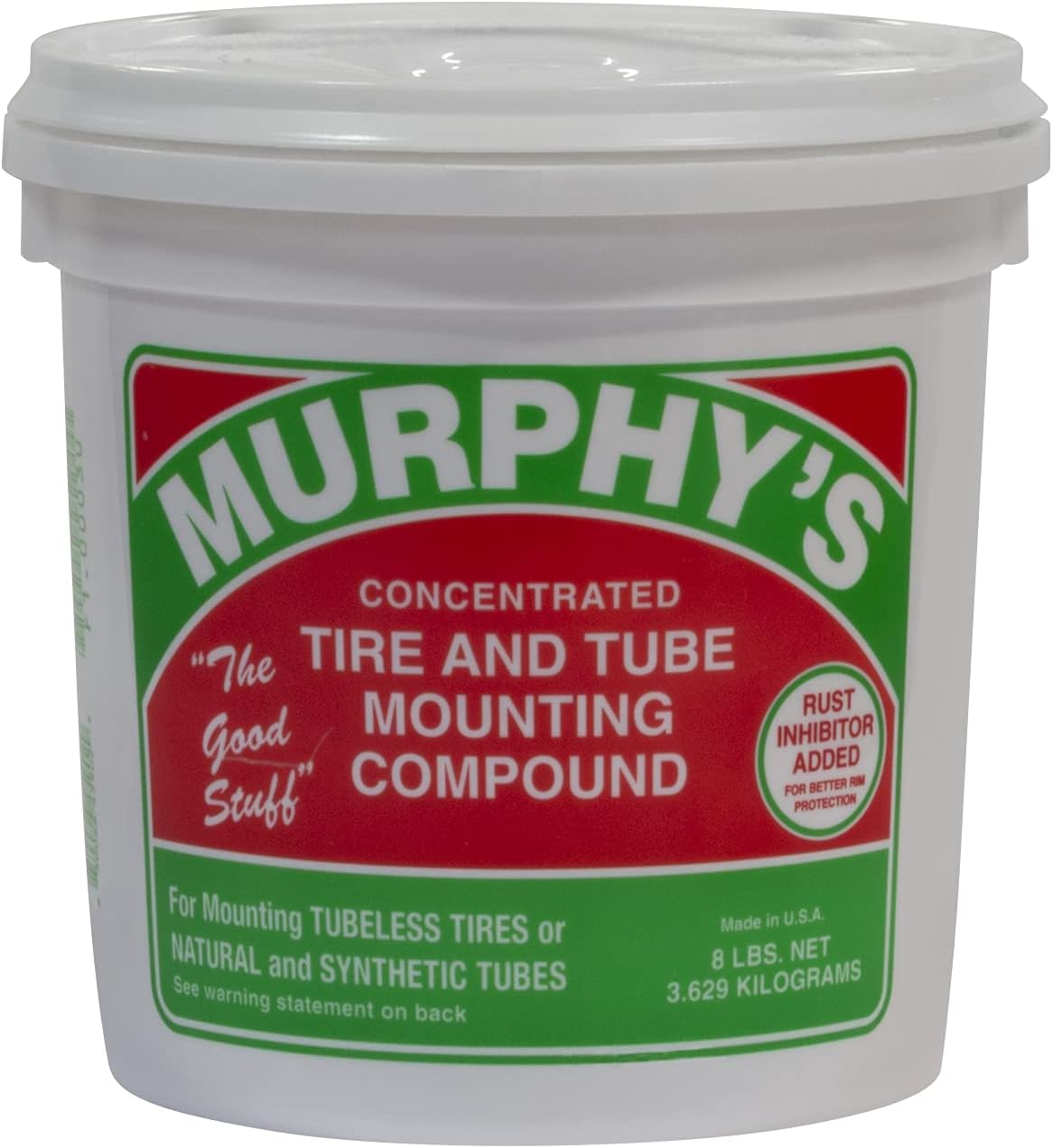
A concentrated tire and tube mounting compound designed to help simplify mounting rubber tires and tubes on passenger, semi truck, construction, and OTR applications. Its ultra-thick formula packs beads effectively and includes rust inhibitors to help protect against corrosion during use.

TIRESHIELD PRO RV tire covers in a set of four deliver year-round protection against UV rays, cracking, fading, water, and snow. The StormLock-System helps keep the covers securely fastened through high wind, while heavy-duty, double-stitched construction supports long-lasting performance. Designed for universal fit, they’re intended for RV, camper, truck, car, and trailer tires within the 26–28.75 inch diameter range, with easy wipe-clean care and storage in the included bag.

Adam’s Pro Tire Hex Grip applicators are molded foam sponges designed for precise, even tire dressing application. The ergonomic grip helps you spread product without overapplying, reducing sling that can splash onto paint and helping keep your hands clean during wheel and trim detailing. They’re durable, washable, and reusable for repeated detailing sessions.
What Else Affects Tire Grip Besides Tread Pattern?
Tread design matters, but it works as part of a complete tire-and-vehicle system. Two tires with similar-looking grooves can perform differently because their compounds, internal construction, tread depth, and intended operating temperatures are different.
- Rubber compound: Determines how flexible and adhesive the tread remains across different temperatures.
- Tire pressure: Incorrect inflation changes the tire’s footprint, heat generation, wear, and handling.
- Temperature: Rubber compounds are engineered for specific temperature ranges. A summer compound can become less effective in cold weather, while a dedicated winter compound is designed to remain more useful at low temperatures.
- Vehicle speed: Higher speed gives the tire less time to move water away and increases the consequences of losing grip.
- Water depth and road texture: Deeper standing water and smooth pavement can make maintaining contact more difficult.
- Tire condition: Aging, damage, irregular wear, and reduced tread depth can all alter performance.
This is why you should choose a complete tire designed for your vehicle, climate, and driving conditions rather than buying solely by the appearance of its tread.
Frequently Asked Questions
How Are Tire Tread Patterns Designed and Tested for Performance?
Manufacturers use computer modeling, prototype tires, laboratory equipment, and vehicle testing to evaluate characteristics such as wet braking, hydroplaning resistance, dry handling, snow traction, noise, rolling resistance, and wear. The final tread is designed together with the tire’s compound and construction rather than as an isolated feature.
What Materials Affect Tread Flexibility and Road Contact?
The tread uses a carefully formulated rubber compound containing natural or synthetic rubber plus ingredients such as silica, carbon black, oils, resins, and curing materials. Manufacturers change these formulations to balance wet grip, temperature performance, rolling resistance, wear, and other characteristics.
Do Tread Patterns Influence Tire Noise and Ride Comfort?
Yes. Block size, spacing, groove arrangement, stiffness, and the sequence in which tread blocks contact the road can change the sound a tire produces. Manufacturers often vary block shapes and spacing to prevent one strong repeating tone, although tire construction and road surface also affect noise and comfort.
Can Tread Design Affect Fuel Efficiency?
Yes, but tread pattern is only one factor in rolling resistance. Tread compound, block movement, tire construction, inflation pressure, size, and vehicle load also affect how much energy the tire loses as it rolls. A low-rolling-resistance tire is engineered as a complete system rather than simply using one particular tread shape.
How Do Temperature Changes Impact Tread Grip?
Temperature changes the behavior of rubber. Compounds designed for warm conditions may become less flexible when temperatures fall, while winter-tire compounds are formulated for colder weather. Excessive heat can also change tire behavior and accelerate wear, which is why tire category and compound matter alongside the visible tread pattern.
Is Directional Tread Always Better in Rain?
No. Directional V-shaped grooves can be very effective at evacuating water, but overall wet performance also depends on tread depth, compound, tire construction, pressure, speed, and the exact tire design. A well-engineered asymmetrical tire can also provide excellent wet traction.
Can You Mix Different Tread Patterns on the Same Vehicle?
Avoid mixing substantially different tires unless the vehicle or tire manufacturer specifically allows the combination. Differences in tread design, tread depth, size, construction, or performance category can change handling. This is particularly important on AWD and 4WD vehicles, which may also have strict limits on circumference differences.
How Can You Tell When Tire Tread Is Too Worn?
Check several grooves with a tread-depth gauge and inspect the built-in wear bars. NHTSA recommends replacing a tire when tread reaches 2/32 inch. Drivers who frequently encounter heavy rain may choose to replace earlier because wet braking and hydroplaning resistance can decline substantially as tread wears.
Conclusion
Tire tread is a balance between competing needs. Grooves and voids make room for water and debris, while solid tread blocks provide stable road contact. Sipes add useful edges on slippery surfaces, but block stiffness still matters for steering and dry handling.
Choose a tire for the complete conditions you expect—not just because its tread looks aggressive. Then monitor inflation, tread depth, wear patterns, and mounting direction. As tread wears, especially in rainy conditions, the performance margin can shrink long before the tire looks completely bald.
Sources
- National Highway Traffic Safety Administration — TireWise — tire tread, treadwear indicators, inspection, and 2/32-inch replacement guidance.
- U.S. Tire Manufacturers Association — Tire Care Essentials — tread inspection, wear bars, tire rotation, inflation, and alignment guidance.
- Michelin — How Tire Design Affects Performance — grooves, tread blocks, sipes, wet drainage, and dry-grip design tradeoffs.
- Bridgestone — Tire Tread Patterns — symmetrical, asymmetrical, and directional tread designs and mounting considerations.
- AAA — All-Season Tire Testing — controlled testing of wet braking and handling with tires worn to 4/32 inch.