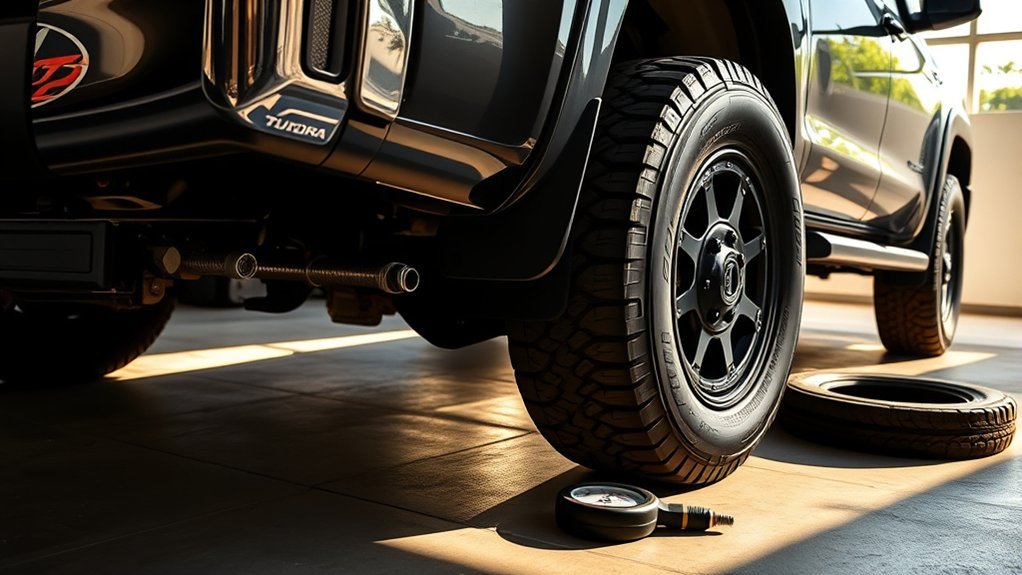
You should rotate the tires on your Toyota Tundra every 5,000 miles or six months, whichever comes first. That interval matches Toyota’s scheduled maintenance timing and helps keep tread wear even across a heavy pickup that may tow, haul, drive off-road, or spend long hours on highways. The right rotation pattern depends on your tire type, tire size, and the instructions in your owner’s manual.
Quick Answer
Rotate Toyota Tundra tires every 5,000 miles or six months, whichever comes first. Use the rotation pattern in your owner’s manual first. If your tires are directional, keep them on the same side. If they are non-directional and the same size, your service shop may use a cross pattern.
Key Takeaways
- Toyota Tundra tire rotation is best done every 5,000 miles or six months.
- Towing and hauling do not create a universal tire-pressure increase. Use the driver-door tire label or owner’s manual for cold pressure.
- Directional tires usually rotate front-to-back on the same side. Non-directional, same-size tires may use a cross pattern if the owner’s manual allows it.
- Replace tires instead of rotating them if tread reaches 2/32 inch, if cords show, or if you see bulges, cracks, severe cuts, or repeated air loss.
At a Glance
| Time Required | About 15 to 30 minutes at a shop; longer for careful DIY work |
| Difficulty | Easy at a tire shop; moderate for DIY because a Tundra is heavy |
| Tools Needed | Owner’s manual, floor jack rated for the truck, jack stands, lug wrench, torque wrench, tire-pressure gauge, tread-depth gauge |
| Cost | Shop-dependent; often bundled with scheduled maintenance |
Why Tire Rotation Is Crucial for Your Toyota Tundra’s Safety and Performance

Tire rotation means moving each tire to a different position so the set wears more evenly. On a Toyota Tundra, that matters because each tire position deals with different forces. Front tires handle steering and braking loads. Rear tires carry much of the weight when you tow, haul, or load the bed.
Regular rotation helps maintain more even tread depth across all four tires. That supports better traction, steadier braking, smoother handling, and longer tire life. It also gives you a scheduled chance to inspect each tire for cuts, nails, bulges, low tread, sidewall damage, and uneven wear.
The Toyota 2024 Tundra Warranty & Maintenance Guide lists scheduled maintenance every 5,000 miles or six months and includes tire rotation in the 5,000-mile service. That makes rotation a normal part of Tundra ownership, not an optional add-on.
Tire Rotation Intervals: What You Need to Know
For most Toyota Tundra owners, the best tire rotation interval is every 5,000 miles or six months, whichever comes first. If you drive 5,000 miles before six months, rotate at 5,000 miles. If six months passes before you reach 5,000 miles, rotate at six months.
This schedule is especially useful if your truck sees any of these conditions:
- Frequent towing
- Heavy payloads in the bed
- Off-road or gravel-road driving
- Stop-and-go city driving
- Long highway trips in hot weather
- Uneven wear showing on one tire position
If you notice uneven wear before the next 5,000-mile interval, do not wait. Have the tires inspected sooner. Rotation can help with normal position-based wear, but it cannot fix a bad alignment, worn suspension part, bent wheel, or damaged tire.
Pro Tip: Check tread depth and tire pressure at the same time you rotate. Write down each tire’s position and tread depth so you can spot repeated wear patterns before they become expensive.
Which Tire Rotation Pattern Should You Use on a Toyota Tundra?
Always start with your Toyota owner’s manual and the tire manufacturer’s instructions. The correct pattern depends on whether your tires are directional or non-directional, whether all four tires are the same size, and whether your spare is a matching full-size tire.
| Tire Setup | Common Rotation Pattern | What to Check First |
|---|---|---|
| Directional tires | Front-to-back on the same side | Look for sidewall arrows showing the rolling direction |
| Non-directional tires, same size | Owner’s manual pattern; many RWD and 4WD setups use a rearward-cross pattern | Confirm Toyota and tire-maker guidance |
| Different front and rear sizes | Usually side-to-side only, if allowed | Confirm that rotation is allowed |
| Temporary spare | Do not include it in normal rotation | Use only as an emergency spare |
| Matching full-size spare | May be included only if the manual, wheel, tire, and TPMS setup allow it | Ask a Toyota dealer or tire professional if unsure |
A front-to-back same-side pattern is not wrong for all Tundras, but it is not universal. It is mainly used when the tires are directional. If your tires are non-directional and all four are the same size, a cross pattern may help even out shoulder wear, but only if the manual and tire design allow it.
[Products Worth Considering]

Measure tire tread depth quickly and accurately with this LUMITECO dial gauge that reads in 1/32" increments up to 14/32". The color-coded green/yellow/red zones make it easy to judge tire wear and know when replacement is needed. A rugged, compact design with a protective pouch helps keep the gauge ready for use on cars, trucks, motorcycles, and more.

The Trivd Frol 1/2" air impact wrench delivers high performance torque up to 1500 ft-lbs with a twin hammer impact mechanism for strong, balanced blows. It features an ergonomic grip, compact lightweight design, and quick-stop control with 3 forward speeds up to 8000 RPM plus a reverse speed. Built for demanding automotive repair and tire shop work, the rear exhaust helps keep debris away from the surface.

The Dr.Roc spare tire tool kit helps you release, lower, or raise your spare tire with reliable extension tools and a lug nut wrench. It is made from rustproof automotive-grade steel and includes an organized carry case for convenient storage. Designed for compatibility with select GM models from the late 1990s through 2019, it uses upgraded extension components to install and remove spare tires with less hassle.
How Does Towing Affect Your Tire Wear?
Towing changes how weight sits on the truck. More tongue weight and cargo load can put extra stress on the rear tires, rear suspension, and wheel bearings. This can make rear tire wear show up faster, especially if the truck is overloaded, the trailer tongue weight is too high, or tire pressure is neglected.
Do not use a universal pressure increase like “add 5 psi” or “add 10 psi” just because you are towing. The safer method is to check the cold tire pressure shown on the Tire and Loading Information Label on the driver’s doorjamb or in your owner’s manual. The NHTSA TireWise guide also explains that the correct pressure is the vehicle manufacturer’s listed pressure, not the maximum pressure molded on the tire sidewall.
Warning: Never exceed the truck’s payload rating, tire load rating, gross axle weight rating, or the cold inflation pressure guidance in the owner’s manual and door label. Overloading or guessing tire pressure can cause heat buildup, poor handling, uneven wear, and tire failure.
Towing Checklist Before a Long Trip
- Check all four tires cold before driving.
- Check the spare tire pressure too.
- Inspect tread depth across the inner, center, and outer tread.
- Look for sidewall cracks, cuts, bulges, nails, or exposed cords.
- Confirm the trailer tongue weight and payload are within the truck’s ratings.
- Inspect the rear tires again after the trip for heat damage or new uneven wear.
Uneven Wear Patterns Explained
Uneven tire wear is a clue. It tells you how the truck, tires, alignment, pressure, and load are working together. If the rear tires wear faster after towing, the truck may be carrying heavy loads often. If one edge of a tire wears faster, alignment or suspension may be involved. If the center wears faster, pressure may be too high. If both shoulders wear faster, pressure may be too low or the truck may be overloaded.
| Wear Pattern | Possible Cause | Best Next Step |
|---|---|---|
| One tire wears faster than the others | Alignment, suspension, tire damage, or missed rotations | Inspect before rotating; align if needed |
| Both shoulders worn | Low pressure or heavy load | Check cold pressure and load limits |
| Center tread worn | Overinflation or wrong pressure for the setup | Set pressure by the door label or manual |
| Cupping or scalloping | Worn shocks, balance issue, suspension wear | Have suspension and balance checked |
How to Rotate Tires on a Toyota Tundra
If you are not comfortable lifting a full-size pickup, have a Toyota dealer or tire shop rotate the tires. If you do it yourself, use the exact lift points and torque specification in your owner’s manual.
- Park safely: Use a flat surface, set the parking brake, and chock the wheels that stay on the ground.
- Confirm the pattern: Check the owner’s manual and tire sidewalls before moving any tire.
- Loosen lug nuts slightly: Break them loose before lifting, but do not remove them yet.
- Lift and support the truck: Use a jack rated for the Tundra and support the truck with properly rated jack stands.
- Move the tires: Follow the correct pattern for your tire type and drivetrain.
- Hand-start lug nuts: Thread each lug nut by hand to avoid cross-threading.
- Lower and torque: Tighten the lug nuts in a star pattern using the Toyota torque specification from the owner’s manual.
- Set cold pressure: Adjust all tires to the cold pressure listed on the driver-door label or manual.
- Check TPMS: Drive normally and confirm the tire-pressure display updates and no warning light remains.
Signs Your Tires Need Rotation or Replacement
Rotation is helpful for normal wear differences, but it is not a cure for unsafe tires. Inspect each tire closely during every rotation.
Uneven Tire Wear
Uneven wear can show up as one tire wearing faster, one edge wearing more than the other, cupping, feathering, or a visible tread-depth difference across the tire set. If the same corner keeps wearing faster after rotation, schedule an alignment and suspension inspection.
Rotation may help if the wear is mild and the tire is otherwise safe. Replacement or repair may be needed if the tire has structural damage, exposed cords, sidewall bubbles, or repeated air loss.
Low Tread Depth
Tread depth matters because tread channels move water away from the contact patch. The NHTSA says tires are not safe and should be replaced when tread reaches 2/32 inch. You can use a tread-depth gauge or the penny test. If you can see the top of Lincoln’s head when the penny is placed upside down in the tread, the tire should be replaced.
| Tire Condition | What It Means | Action |
|---|---|---|
| Even tread above 4/32 inch | Normal service range for many drivers | Rotate on schedule and keep monitoring |
| Uneven tread depth | Possible alignment, pressure, balance, or load issue | Inspect and correct the cause before relying on rotation |
| 2/32 inch or less | Unsafe tread depth | Replace the tire |
| Bulge, exposed cord, deep cut, or sidewall crack | Possible tire structure damage | Do not rotate as a fix; have the tire replaced or inspected immediately |
Best Practices for Tire Rotation on a Toyota Tundra
Good tire rotation is more than moving wheels around. Use the rotation as a full tire-health check.
- Rotate every 5,000 miles or six months: This matches Toyota’s scheduled maintenance timing.
- Use the correct pattern: Follow the owner’s manual and tire sidewall direction arrows.
- Measure tread depth: Check the inner, center, and outer tread on each tire.
- Check pressure cold: Use the driver-door label or owner’s manual, not the tire sidewall maximum.
- Inspect for damage: Look for nails, cracks, bulges, cuts, and exposed cords.
- Balance if needed: If you feel vibration, ask for tire balancing during service.
- Align if wear repeats: Rotation will not fix an alignment or suspension problem.
Comparing Side-to-Side vs. Front-to-Back Tire Rotation Techniques
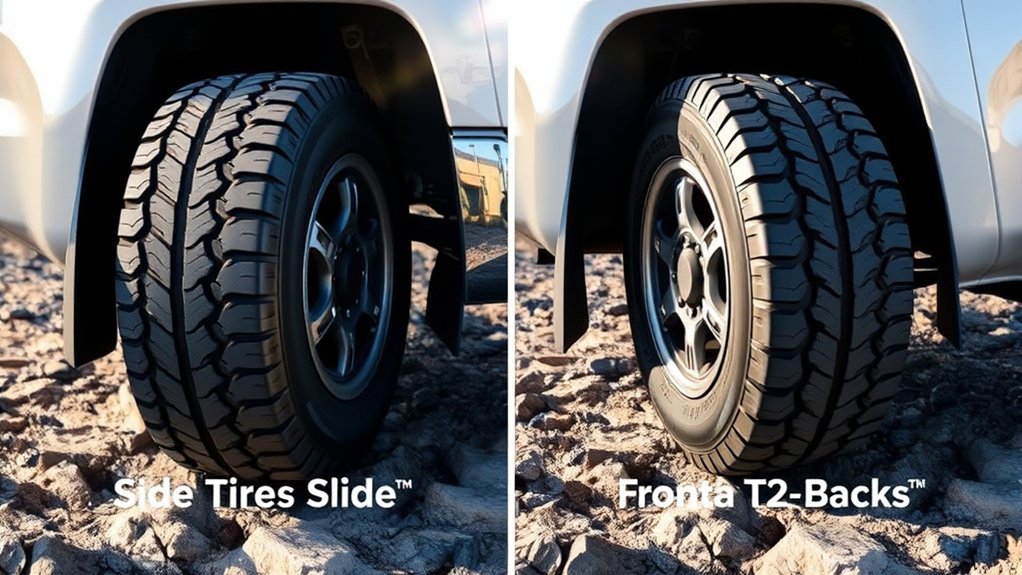
Side-to-side and front-to-back rotation are not interchangeable. The best choice depends on tire design.
Front-to-back on the same side is commonly used for directional tires because those tires are designed to roll in one direction. Moving a directional tire to the other side without remounting it can make the tread face the wrong direction.
Side-to-side may be used for certain staggered tire setups where front and rear tires are different sizes, but only if the tires are non-directional and the manufacturer allows it.
Cross rotation can be used on many non-directional, same-size tire sets. For rear-wheel-drive and some 4WD setups, tire-industry guidance often uses a rearward-cross pattern. Still, the Toyota owner’s manual and tire manufacturer instructions come first.
How Tire Quality Influences Rotation Frequency and Performance
Tire quality affects how evenly the tread wears, but it does not erase the need for rotation. A high-quality all-terrain, highway-terrain, or all-season tire can still wear unevenly if the truck tows often, runs low on pressure, has alignment issues, or carries heavy loads.
Pay attention to these factors:
- Tire load rating: Use tires with the correct size and load rating for your Tundra.
- Tread type: Aggressive all-terrain tread may show different wear than highway tread.
- Driving use: Towing, hauling, gravel, and off-road use can increase wear.
- Inflation pressure: Incorrect pressure can cause center or shoulder wear.
- Alignment and balance: Mechanical issues can ruin tires even if they are rotated on time.
[Products Worth Considering]

The SAFELIFE dial tire tread depth gauge measures tread depth in 1/32 inch increments with clear, easy-to-read 2-inch dial face. Color zones using a traffic light system help you quickly judge whether tread is low, marginal, or ample for safer driving. Built with a durable zinc cast body and a metal detect probe for precise, comfortable use across cars, motorcycles, trucks, and buses.

Monitor tire tread wear with a smart, color-coded depth gauge that shows clear condition ranges at a glance. The bar is range marked for fast, easy readings, helping you maintain safer traction and performance. Each gauge is portable with a pocket clip, and the set includes 20 units for daily use and sharing.

These aluminum alloy tire valve stem caps with an O-ring seal help protect valve stems from corrosion while adding a clean, stylish look to your vehicle. The universal fit works across cars, trucks, motorcycles, bicycles, and more, making them an easy upgrade for everyday driving and off-road use. Installation is quick, and the included four-pack keeps all your tires dressed and protected.
Top Mistakes to Avoid for Effective Tire Rotation
Avoid these common mistakes if you want the rotation to actually protect your tires:
- Waiting 10,000 miles every time: That is too long for many Tundra owners, especially if you tow, haul, or drive on rough roads.
- Ignoring the six-month interval: Low-mileage trucks still need scheduled tire checks.
- Using the wrong pattern: Directional tires, staggered sizes, and some spare setups need special handling.
- Skipping pressure checks: Rotation without a cold pressure check leaves a major wear factor untouched.
- Rotating damaged tires: A tire with a bulge, exposed cord, or deep sidewall cut needs inspection or replacement, not a new position.
- Forgetting lug torque: Always torque lug nuts to the Toyota specification in the owner’s manual.
When to Replace Tires Instead of Rotating Them

Sometimes rotation is the wrong move. If a tire is unsafe, moving it to a different corner of the truck only moves the problem.
Replace or professionally inspect the tire if you see:
- Tread at 2/32 inch or less: This is the minimum safety threshold for replacement.
- Visible treadwear bars: If the tread is level with the bars, the tire is worn out.
- Bulges or bubbles: These can signal internal damage.
- Exposed cords: Do not drive on a tire with exposed structure.
- Deep cuts or sidewall cracks: Sidewall damage can weaken the tire.
- Repeated air loss: A slow leak needs repair or replacement.
- Severe vibration: Stop and inspect the tire, wheel, and suspension.
- Old tires: Tire age matters even when tread remains. Check the DOT date code and follow Toyota and tire-maker replacement guidance.
[Products Worth Considering]

These universal tire valve stem caps help protect valve cores from dust, debris, and moisture while helping maintain stable tire pressure. The corrosion-resistant metal construction and sealed design provide reliable protection in road grime, mud, and winter conditions. Twist-on installation makes them quick to fit on cars, SUVs, trucks, and motorcycles.
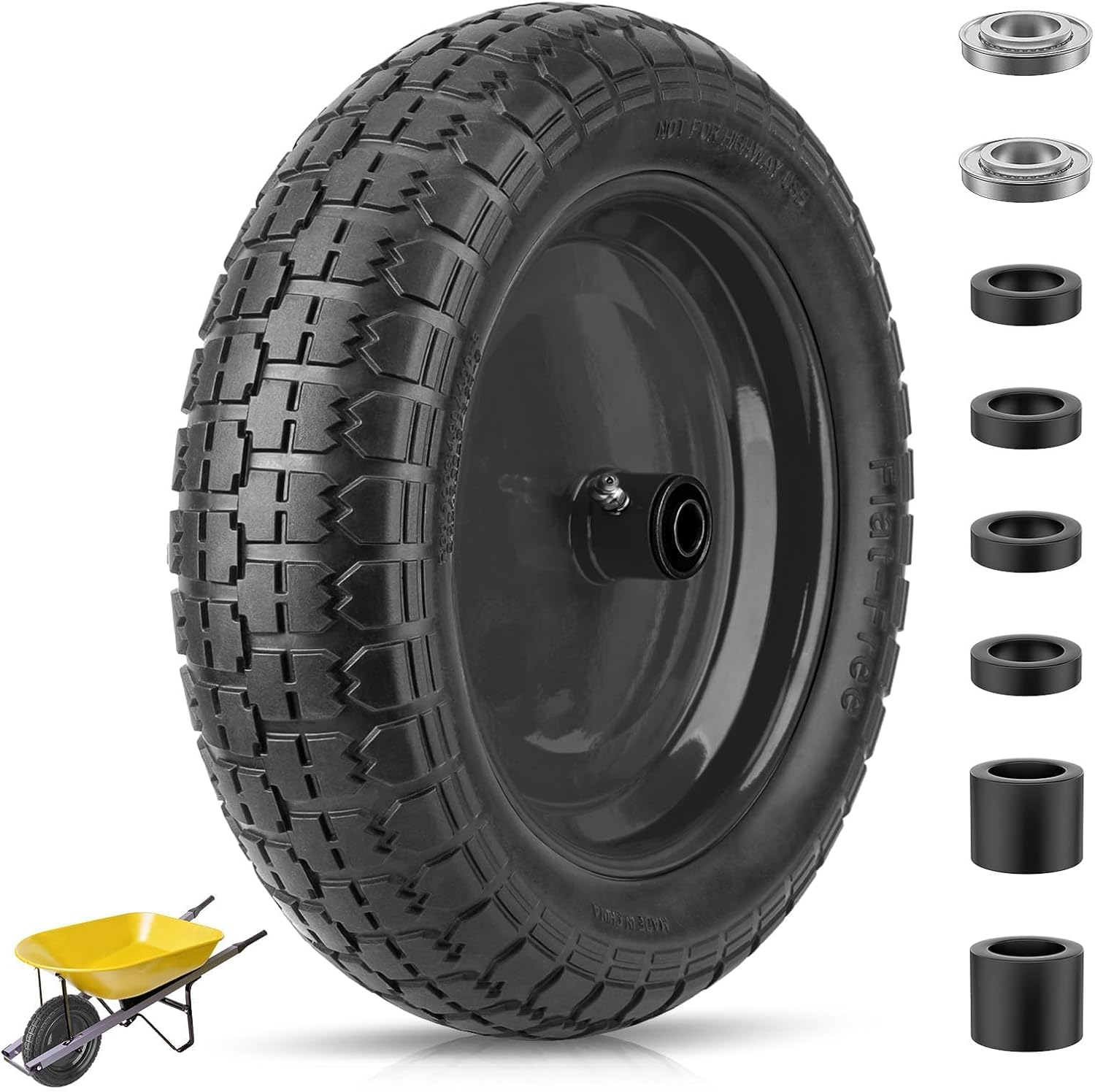
This flat-free TICONN wheelbarrow tire features durable polyurethane foam construction that never needs inflation, helping prevent punctures and reducing maintenance on rough outdoor terrain. With a 300 lb max load capacity and stable steel rim design, it supports safer transport for yard work and hauling tasks. An adapter kit with ball bearings and nylon spacers is included for easier fit and customization across common wheelbarrow and cart axle setups.

Upgrade your wheels with MIKKUPPA M12x1.5 mag seat lug nuts built for secure, corrosion-resistant performance. These closed-end chrome lug nuts are a direct replacement for select Toyota models, including Camry, Corolla, RAV4, Sienna, Avalon, Highlander, Matrix, Venza, and Prius. Triple-chromium plating and cold-forged, heat-treated steel help deliver strength for daily driving and replacement needs.
Frequently Asked Questions
How often should you rotate tires on a Toyota Tundra?
Rotate Toyota Tundra tires every 5,000 miles or six months, whichever comes first. Rotate sooner if you see uneven wear, vibration, or unusual tread patterns before the next scheduled service.
Is it okay to rotate Toyota Tundra tires every 10,000 miles?
A 10,000-mile interval is not ideal for most Toyota Tundra owners. Toyota’s scheduled maintenance timing is every 5,000 miles or six months, and that service includes tire rotation. Waiting 10,000 miles may allow uneven wear to get worse.
What tire rotation pattern is best for a Toyota Tundra?
Use the pattern in your owner’s manual first. If your tires are directional, they usually move front-to-back on the same side. If your tires are non-directional and the same size, a cross pattern may be used if Toyota and the tire manufacturer allow it.
Should I increase Toyota Tundra tire pressure when towing?
Do not guess or use a universal psi increase. Check the cold tire pressure on the driver-door Tire and Loading Information Label or in the owner’s manual. Also confirm that the truck, trailer, and tires are within their load ratings.
Should the spare tire be included in Toyota Tundra tire rotation?
Do not include a temporary spare in normal rotation. A matching full-size spare may be included only if the owner’s manual, tire size, wheel type, and TPMS setup allow it. Ask a Toyota dealer or tire professional if you are unsure.
Conclusion
Rotating your Toyota Tundra tires every 5,000 miles or six months is one of the simplest ways to protect tire life, traction, and handling. The key is using the right pattern for your tire type, checking cold pressure from the door label or manual, and inspecting tread and sidewalls during every service. If a tire is damaged, too old, or worn to 2/32 inch, replace it instead of rotating it.
Sources
- Toyota 2024 Tundra Warranty & Maintenance Guide — supports the 5,000-mile or six-month scheduled maintenance interval and tire-rotation service item.
- NHTSA TireWise Tire Safety — supports tire-pressure, tread-depth, TPMS, tire aging, and rotation safety guidance.
- Bridgestone Tire Rotation Guide — supports rotation pattern differences for directional, non-directional, same-size, staggered, and spare tire setups.