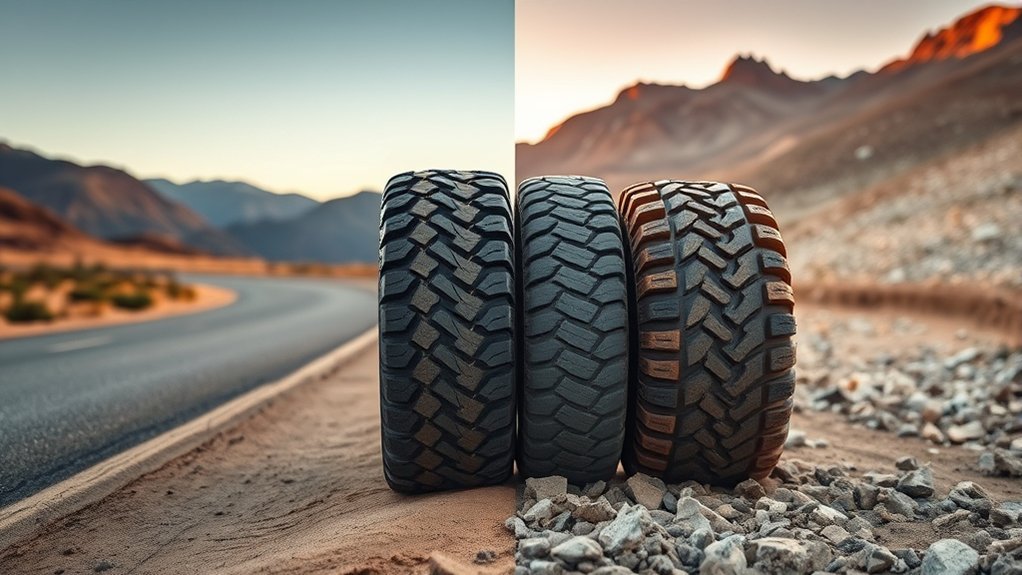
AT and MT tires are built for different priorities. If your truck spends most of its time on pavement but still sees gravel, dirt roads, campsites, or mild trails, an all-terrain tire usually gives you the better balance. Mud-terrain tires make more sense when deep mud, rocks, ruts, and difficult off-road terrain are a regular part of how you drive.
Quick Answer
Choose A/T tires for mostly paved driving with occasional gravel, dirt, snow, or mild trails. Choose M/T tires when deep mud, rocks, and difficult off-road terrain matter more than highway noise, fuel economy, and tread life. Always compare the actual tire model, winter rating, size, and load capacity before buying.
Key Takeaways
- A/T tires are usually the better daily-driver choice when you split time between pavement and light-to-moderate off-road use.
- M/T tires typically provide stronger traction in deep mud, loose soil, rocks, and rutted trails.
- A/T tires are generally quieter and often provide better highway tread life than aggressive M/T tires, although results vary by model.
- Do not assume every A/T tire is good for severe winter driving. Look for the Three-Peak Mountain Snowflake (3PMSF) symbol when snow performance matters.
- Tire size, weight, load capacity, pressure, and construction can affect comfort, MPG, braking, handling, and durability.
- R/T or rugged-terrain tires can provide a useful middle ground when an A/T is not aggressive enough but an M/T is more tire than you need.
AT vs MT Tires: Key Differences
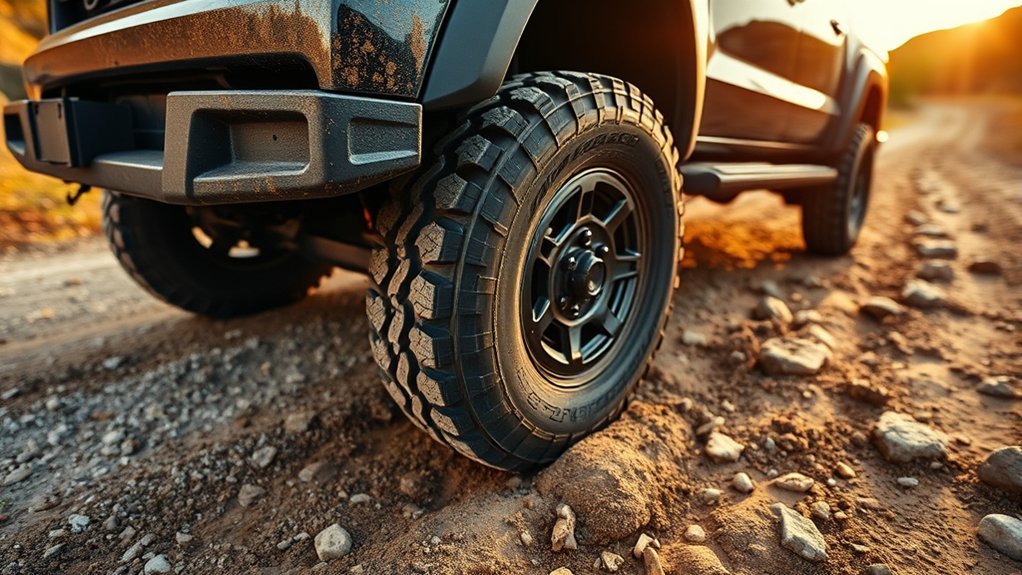
All-terrain (A/T) tires are designed to balance paved-road manners with useful traction on gravel, dirt, and moderate trails. Mud-terrain (M/T) tires move the compromise farther toward off-road performance, using more aggressive tread features for mud, rocks, loose soil, and rough terrain.
| Feature | A/T Tire | M/T Tire |
| Best use | Daily driving plus light-to-moderate off-road use | Frequent mud, rocks, ruts, and demanding trails |
| Tread design | Usually tighter blocks, moderate voids, and more road-focused siping | Typically larger blocks, wider voids, and aggressive shoulders |
| Road noise | Usually lower | Usually higher |
| Deep mud | Capable, but can clog sooner in severe mud | Usually stronger because the open tread can clear mud more effectively |
| Highway tread life | Often longer | Often shorter with frequent pavement use |
| Winter use | Varies; some models carry 3PMSF | Varies widely; check the actual winter rating |
The biggest visual difference is the tread pattern. A/T tires generally use a denser arrangement of tread blocks and more siping to balance paved-road grip with loose-surface traction. M/T tires typically use larger tread blocks, wider gaps, and aggressive shoulder features that can dig into soft terrain and release mud.
Those design choices affect road manners. Most A/T tires feel calmer and quieter during normal commuting and highway travel. M/T tires can create more vibration and tread noise because their large blocks repeatedly contact the road surface.
However, tire category is only a starting point. Modern A/T tires can be extremely aggressive, while some newer M/T designs include features intended to improve paved-road behavior. Compare the specifications and testing of the exact models you are considering rather than assuming every tire in one category performs the same way.
When AT Tires Make More Sense
A/T tires make more sense when you need one set of tires for everyday driving and occasional off-road use. They can provide useful traction on pavement, gravel, dirt roads, light mud, and moderate trails without making your truck feel like a dedicated trail rig.
For most drivers who commute during the week and explore dirt roads or mild trails on weekends, A/T tires provide the more practical balance.
A/T tires also tend to use more road-oriented tread features than M/T tires, which can help with ride comfort, noise, and paved-road handling. Some models are specifically engineered for strong wet and severe-snow performance as well.
- Choose A/T if you drive mostly on pavement and occasionally leave the road.
- Choose A/T if highway comfort and lower tread noise matter to you.
- Choose A/T if you want useful gravel, dirt, and mild-trail capability without going to a full M/T design.
- Consider a 3PMSF-rated A/T if you need better snow capability from a year-round truck tire.
For daily driving, an A/T tire usually offers the most useful mix of traction, comfort, durability, and versatility.
When MT Tires Are Worth It
Mud-terrain tires are worth considering when your truck regularly encounters deep mud, loose soil, sharp rocks, rutted tracks, or technical trails where an ordinary all-terrain tread reaches its limits.
M/T designs commonly use large tread blocks and open voids that allow the tire to bite into soft surfaces and release mud. For example, BFGoodrich describes its Mud-Terrain T/A KM3 as using large tread blocks and mud-clearing features specifically for difficult off-road conditions.
Many purpose-built M/T tires also include tougher shoulder or sidewall construction to resist trail damage. That does not mean every M/T is automatically more durable in every sense. An M/T may offer excellent resistance to cuts and impacts off-road while still wearing more quickly than a road-oriented A/T during long highway use.
The main trade-offs are usually more tread noise, a firmer or rougher road feel, potentially higher rolling resistance and weight, and less emphasis on paved-road refinement.
Pro Tip: If you only encounter deep mud or difficult rocks a few times per year, an aggressive A/T or rugged-terrain tire may give you enough trail ability without the everyday compromises of a full M/T.
AT vs MT Tires for Rain, Snow, and Mud
Weather performance is one area where you should avoid choosing by the A/T or M/T label alone. Tread depth, siping, rubber compound, tire pressure, tread wear, and the exact tire model can all affect traction.
Rain
Many road-oriented A/T tires use more siping and smaller tread elements than aggressive M/T tires, which can help provide more predictable grip on wet pavement. However, that is not a guarantee that every A/T will stop or corner better than every M/T.
NHTSA’s TireWise guidance notes that wet-pavement traction is a measurable tire-performance characteristic. When wet-road safety is important, compare the actual tire’s specifications and independent testing rather than relying only on its category.
Snow
Do not assume an A/T tire is automatically a winter tire. Some all-terrain models carry the Three-Peak Mountain Snowflake (3PMSF) symbol, meaning they meet a defined severe-snow traction requirement. Other A/T tires do not.
A current example is the BFGoodrich All-Terrain T/A KO3, which is marketed with a 3PMSF severe-snow rating. That rating belongs to the individual tire model, not to the A/T category as a whole.
Note: If you regularly drive on ice, packed snow, or in prolonged freezing conditions, dedicated winter tires can provide stronger cold-weather performance than relying on the A/T or M/T label alone. Michelin specifically identifies winter tires as purpose-built for snow, ice, slush, and severe cold.
Mud
Deep mud is where M/T tires normally have the clearest advantage. Their open tread patterns and large voids are designed to dig into soft ground and release mud instead of allowing the tread to become packed.
A/T tires can handle dirt, shallow mud, and many normal trails, but they can reach their limit sooner in deep, sticky mud or heavily rutted terrain.
How AT and MT Tires Compare in Noise, MPG, and Tread Life
For a truck that spends most of its life on pavement, A/T tires usually provide the easier daily-driving experience. M/T tires make their biggest sacrifices in areas such as road noise, rolling efficiency, and long-term highway wear.
[Products Worth Considering]

Accurately measure tire tread depth with a calibrated gauge marked from 0 to 1 inch in 1/32 inch increments. The color-coded bar helps you quickly identify tread condition ranges, supporting safe driving for trucks, motorcycles, automobiles, and passenger vehicles.

The Big Rig Defense Tire Thumper is a truck tire pressure checker that lets you quickly check multiple tires by giving them a firm whack. Listen for a reassuring thump and feel the stick bounce when a tire is fully inflated, helping you get back on the road safely. It features a comfortable, glove-friendly handle and a secure wrist strap for confident use on busy routes.
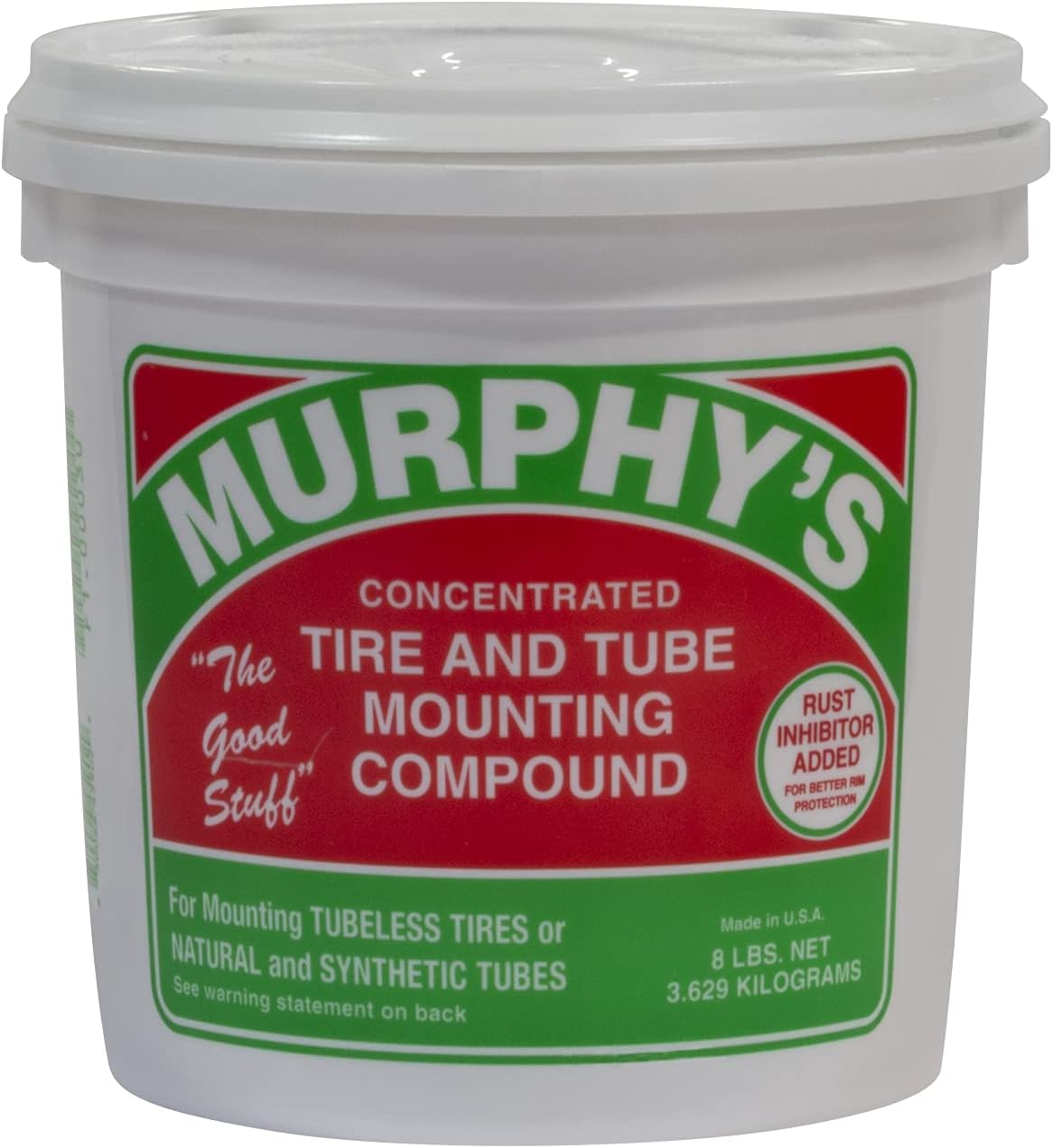
A concentrated tire and tube mounting compound designed to help simplify mounting rubber tires and tubes on passenger, semi truck, construction, and OTR applications. Its ultra-thick formula packs beads effectively and includes rust inhibitors to help protect against corrosion during use.
Road Noise Levels
All-terrain tires are generally quieter on paved roads because their tread blocks are usually smaller and more closely spaced than those on a full mud-terrain design.
M/T tires have larger blocks and wider voids, which can create more tread-pattern noise as speed increases. The difference is often most noticeable on smooth highways during long trips.
- A/T: generally better suited to commuting and highway travel.
- M/T: generally louder, especially with very open or aggressive tread patterns.
- Actual result: varies by tire model, tread wear, vehicle insulation, inflation, and road surface.
MPG and Tread Life
A/T tires often make more sense for fuel economy and highway tread life, but you should not assume that the letters “A/T” automatically guarantee better MPG.
Tire weight, diameter, construction, tread compound, inflation, and rolling resistance all influence how much energy your truck needs to keep moving. NHTSA explains that tire design affects rolling resistance and estimates that a 10% reduction in rolling resistance can improve vehicle fuel economy by about 1% to 2%.
An aggressive M/T is often heavier and designed with more tread movement than a road-focused tire, so switching to one can reduce fuel economy in some applications. Oversizing the tire can add another penalty because it may increase weight and change gearing and rotating mass.
On pavement, A/T tires also commonly provide longer tread life than aggressive M/T tires. But do not confuse that with off-road toughness: some M/T tires are engineered specifically to withstand severe rock and trail abuse.
Cost and Warranties
M/T tires often carry a higher purchase price in comparable sizes, but there is no universal price rule. Brand, wheel diameter, LT construction, load range, tire size, warranty, and availability can matter more than the A/T or M/T label.
Also compare mileage warranties. Some A/T models include substantial treadwear warranties, while purpose-built M/T tires may offer shorter mileage coverage or no mileage warranty at all. Compare the exact products rather than estimating ownership cost from category alone.
What About Rugged-Terrain (R/T) Tires?
Rugged-terrain tires, sometimes called R/T or hybrid tires, sit between traditional A/T and M/T designs. They usually have more aggressive shoulders and larger tread voids than a typical A/T but retain more road-friendly tread features than a full mud-terrain tire.
R/T tires can make sense if you:
- drive on pavement regularly but want more mud clearing than a mild A/T provides;
- frequently travel on rocks, ruts, forest roads, or rough job sites;
- want an aggressive appearance without accepting every compromise of a full M/T; or
- use your truck for overlanding where both long highway distances and difficult trails are common.
Just like A/T and M/T tires, the R/T label is not a standardized guarantee of noise, snow performance, durability, or wet grip. Compare individual models carefully.
[Products Worth Considering]
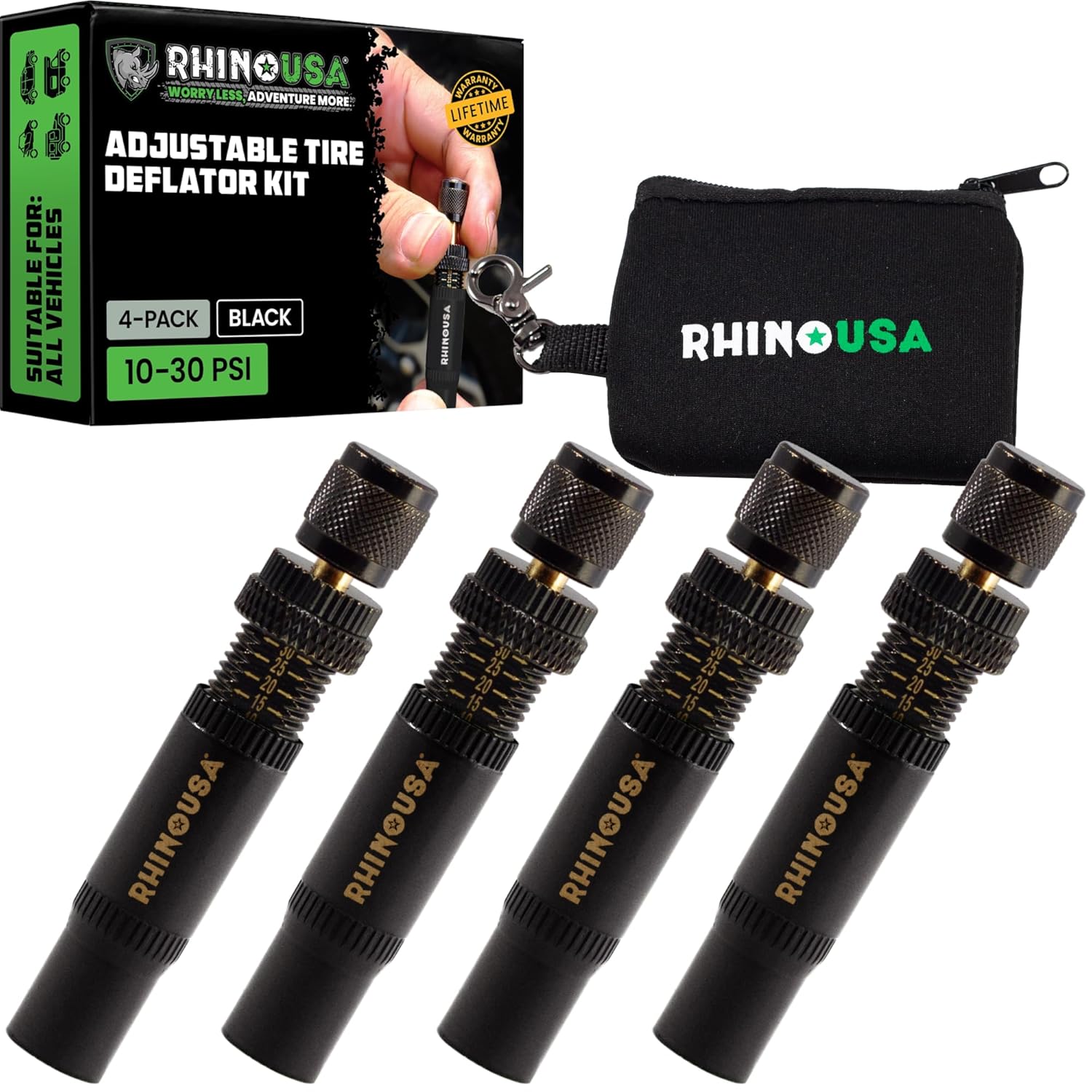
Use the Rhino USA adjustable tire deflators to air down all four tires at once by screwing one deflator onto each valve stem, letting you step away while the tires reach your preset pressure. Each deflator independently adjusts across a 10–30 PSI range with laser-etched indicators for quick setup and verification, making it ideal for beach, sand, and rocky off-road trails.

This ALL-TOP auto-stop tire deflator valve kit lets you air down off-road tires quickly without watching pressure, automatically stopping when your preset PSI is reached. Each valve is individually calibrated for reliable performance with an acceptable +/- 2 PSI tolerance. The adjustable deflator range covers 10 to 30 PSI and includes four valves plus valve caps and a zipper pouch for easy setup on trucks, SUVs, RVs, UTVs, and powersports.

Upgrade your ride with a 2-pack set of 26x1.95 folding mountain bike tires built for dependable traction on mud, rocks, and trail surfaces. A reinforced puncture-resistant layer helps protect against sharp debris, while included butyl inner tubes provide strong sealing and shock absorption. Ready for fast swaps with included tire levers and universal sizing for most bikes.
How to Choose the Right Tire for Your Truck
Start with where the truck actually spends its time. Do not choose an M/T simply because its tread looks more aggressive, and do not assume a mild A/T can handle every trail.
[Products Worth Considering]

Add style while helping protect your tire valve stems with handmade crystal rhinestone caps and a durable plastic insert. These caps resist corrosion and help keep out rain, snow, and muddy water, extending tire life. Textured non-slip design makes them easy to grip for quick install and removal when checking tire pressure.

Keep your tires properly inflated with this analog VONDIOR tire pressure gauge, designed for fast, easy readings without batteries. The swiveling, two-axis hose and large glow dial help you measure at any tire angle with instant visibility. Built with a protective rubber shield, it supports durable, low-maintenance use for cars and trucks.

The SAFELIFE dial tire tread depth gauge measures tread depth in 1/32 inch increments with clear, easy-to-read 2-inch dial face. Color zones using a traffic light system help you quickly judge whether tread is low, marginal, or ample for safer driving. Built with a durable zinc cast body and a metal detect probe for precise, comfortable use across cars, motorcycles, trucks, and buses.
Driving Conditions
Your normal driving conditions should carry the most weight in the decision.
- Mostly pavement with occasional dirt or gravel: choose A/T.
- Pavement plus frequent rough trails: consider an aggressive A/T or R/T.
- Deep mud, rock crawling, and difficult off-road terrain: choose M/T.
- Frequent severe winter weather: prioritize 3PMSF-rated options and consider dedicated winter tires where appropriate.
For most daily drivers, A/T tires provide the practical middle ground. For a truck built primarily around trail capability, M/T tires can justify their additional road compromises.
Tire Performance Needs
Think beyond traction alone. Your tire also affects steering feel, braking, ride comfort, noise, fuel use, towing stability, and replacement cost.
If your truck tows or carries heavy loads, make sure the replacement tire has adequate load capacity. If you frequently travel long highway distances, pay closer attention to treadwear warranty, road noise, weight, and wet performance.
If you regularly air down for technical off-road driving, sidewall construction and casing strength become more important. Follow the tire manufacturer’s instructions and reinflate to the correct road pressure before returning to normal highway use.
Size, Load Rating, and Fitment
The right tread type is only useful if the tire is suitable for your truck. Check the tire size, load capacity, speed rating, wheel width, suspension clearance, and overall diameter before changing from the factory specification.
NHTSA recommends checking the owner’s manual or Tire and Loading Information Label on the vehicle when determining the correct tire size.
Warning: Do not install an oversized, under-rated, or incorrectly inflated tire just to gain a more aggressive tread. Incorrect fitment can affect clearance, steering, braking, vehicle loading, and safety. Use the vehicle placard and tire manufacturer’s specifications, and have uncertain fitment checked by a qualified tire professional.
Also remember that adding a much larger or heavier tire can change acceleration, braking feel, fuel economy, and steering response even when the tire physically fits.
Frequently Asked Questions
Should I get A/T or M/T tires?
Choose A/T tires if your truck spends most of its time on pavement with occasional dirt, gravel, or moderate trails. Choose M/T tires when deep mud, rocks, ruts, and demanding off-road driving are frequent enough to justify extra noise and reduced road refinement.
Do A/T tires last longer than M/T tires?
A/T tires often provide longer tread life when most of your mileage is on pavement, but the result depends on the tire model, compound, alignment, pressure, rotation schedule, vehicle weight, and driving style. An M/T may still offer tougher construction for severe off-road use.
Are R/T tires good for daily driving?
Yes. Many rugged-terrain or R/T tires are designed as a middle ground between A/T and M/T tires. They can provide more aggressive off-road traction than a mild A/T while remaining more comfortable on pavement than a full M/T, although noise and ride quality still vary by model.
What are the drawbacks of M/T tires?
Common drawbacks include more highway noise, a rougher road feel, potentially shorter pavement tread life, and possible fuel-economy losses from added weight or rolling resistance. Wet and winter performance also vary widely, so check the specifications and testing of the exact M/T model.
Are A/T tires good in snow?
Some are. Look for the Three-Peak Mountain Snowflake symbol if severe-snow traction matters. The A/T label by itself does not prove winter performance, and dedicated winter tires remain the stronger choice for frequent ice, packed snow, and prolonged severe cold.
Do M/T tires reduce gas mileage?
They can, especially when the replacement tire is heavier, larger, or has greater rolling resistance than the tire it replaces. The amount varies by vehicle and tire model, so an M/T designation alone cannot predict a specific MPG loss.
Conclusion
So, which tire is best for your truck? If you mostly commute, tow, take highway trips, and occasionally drive gravel roads or moderate trails, A/T tires usually make the most sense. They provide useful off-road ability without giving up as much road comfort, noise control, or tread life.
If deep mud, rocks, ruts, and difficult trails are a regular part of your driving, M/T tires can provide the extra bite and toughness you need. The trade-off is usually more road noise and less emphasis on highway efficiency and refinement.
Most importantly, choose the actual tire model based on your terrain, climate, size, load requirements, winter rating, and vehicle specifications. The letters A/T or M/T tell you the tire’s general purpose, but they do not tell you everything about how it will perform.
Sources
- National Highway Traffic Safety Administration — TireWise — tire sizing, wet traction ratings, rolling resistance, and tire-safety guidance.
- Michelin — Differences in Types of Seasonal Tires — winter, all-season, all-terrain, and seasonal performance guidance.
- BFGoodrich — All-Terrain T/A KO3 — example of a modern 3PMSF-rated all-terrain tire and its construction.
- BFGoodrich — Mud-Terrain T/A KM3 — mud-clearing tread, off-road traction, and purpose-built M/T construction.
- Bridgestone — All-Terrain Tires — all-terrain traction, road-noise, wet/snow handling, and wear characteristics.