Disclosure: As an Amazon Associate, we earn from qualifying purchases. If you click a link on this page and make a purchase, we may receive a small commission at no extra cost to you.
Choosing an all-terrain tire means balancing road comfort, loose-surface grip, load capacity, and long-term cost. The Armstrong Tru-Trac AT in 215/70R16 aims to cover daily pavement and light off-road use without moving into a heavier mud-terrain design. Its main strengths are an XL load rating, 13/32-inch tread depth, and a 60,000-mile treadwear warranty. Its main limitation is that it is an all-season all-terrain tire, not a dedicated severe-winter tire or a substitute for careful vehicle-specific fitment.
Armstrong Tru-Trac AT Specifications
| Specification | Detail |
|---|---|
| Brand | Armstrong |
| Model | Tru-Trac AT, part number 1200057893 |
| Product type | All-season, all-terrain radial tire |
| Size | 215/70R16 |
| Load and speed rating | 104T, XL load range, 4-ply rated |
| Maximum load | About 1,984 pounds per tire; the manufacturer size table rounds this to 1,985 pounds |
| Overall diameter | About 27.8 inches; some retail listings round to 27.9 inches |
| Section width | 215 mm nominal size; manufacturer table lists 8.9 inches measured |
| Recommended measuring rim | 6.5 inches |
| Tread depth | 13/32 inch, approximately 10.32 mm |
| Tread design | Symmetric, non-directional |
| Maximum inflation pressure | 50 PSI, not the recommended pressure for every vehicle |
| UTQG | 560 A B |
| Package | One tire only; wheel is not included |
| Warranty | 60,000-mile treadwear coverage plus Armstrong limited-warranty benefits, subject to eligibility and maintenance terms |
Editorial note: Performance comments in this review are based on verified specifications, tread-design features, and warranty terms. They do not represent an independent instrumented road test.
What Is the Armstrong Tru-Trac AT?
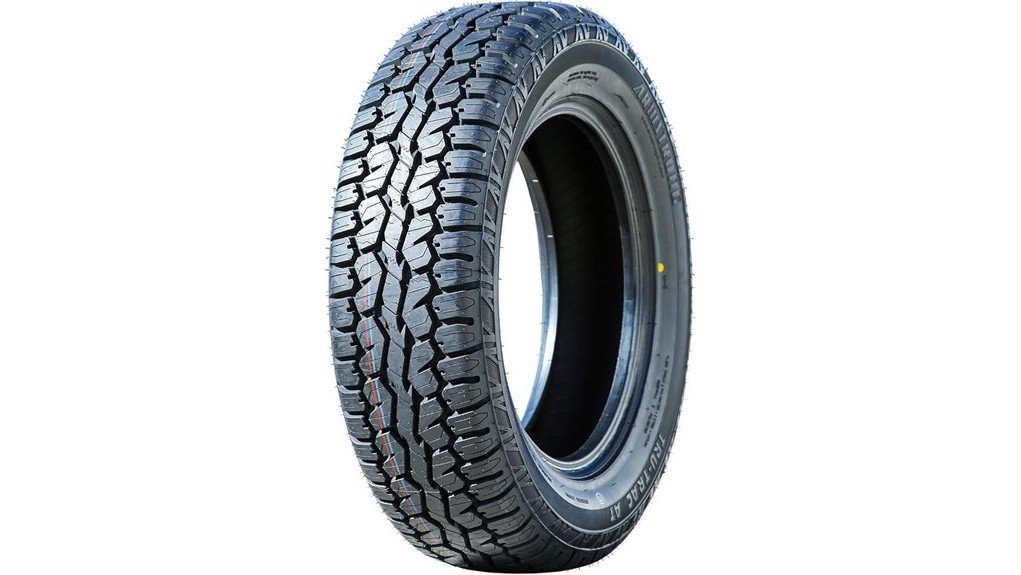
The Armstrong Tru-Trac AT is a radial replacement tire for compatible trucks, SUVs, crossovers, and Jeeps. This listing is for the 215/70R16 104T XL version, which combines a 16-inch wheel size with extra-load capacity and a non-directional all-terrain pattern.
Its design uses four zigzag circumferential grooves, interlocking center blocks, a rugged casing, and connecting bridges between shoulder blocks. Armstrong says these features are intended to support grip across varied surfaces, improve steering response, reduce block movement, and limit irregular wear. The tire makes the most sense for mixed road use rather than deep mud, rock crawling, or dedicated winter service.
Key Takeaways
- The 215/70R16 104T XL specification supports about 1,984 pounds per tire when properly fitted and inflated.
- A 13/32-inch tread depth gives you more tread volume than many road-focused touring tires in this size.
- The symmetric, non-directional pattern allows flexible cross-rotation when your vehicle and wheel setup permit it.
- The tire is sold individually, so a complete four-tire replacement requires a quantity of four.
- The 60,000-mile treadwear warranty depends on proper maintenance, including documented rotation intervals.
Who Should Buy It?
Best For
- Compatible SUVs and light trucks that regularly see pavement, gravel, dirt roads, or mild trails.
- Drivers who need the 104 load index and XL construction rather than a lower-capacity standard-load tire.
- Value-focused buyers who want a 60,000-mile treadwear warranty and flexible rotation pattern.
Skip If
- Your vehicle placard, owner’s manual, or wheel specifications do not approve 215/70R16 104T XL tires.
- You want the quietest possible highway ride or primarily drive on smooth pavement.
- You need a dedicated severe-snow tire or verified Three-Peak Mountain Snowflake certification.
Armstrong Tru-Trac AT On-Road Comfort and Handling
On pavement, the Tru-Trac AT’s interlocking center blocks and shoulder-block bridges are designed to control block movement. That matters because large, flexible tread blocks can feel vague under steering input and can wear unevenly if they move too much.
The 104T XL casing also gives this size more load capacity than many standard-load 215/70R16 tires. That extra capacity can be useful on a properly matched vehicle, but it does not automatically improve comfort. Ride quality depends on the vehicle, wheel width, suspension, load, and correct cold inflation pressure.
Road noise should be judged against other all-terrain tires, not touring tires. The pattern is less aggressive than a mud-terrain design, but its open grooves and deeper tread can still produce more audible tread sound than a highway-terrain tire.
Armstrong Tru-Trac AT Off-Road Grip
The four zigzag circumferential grooves and interlocking blocks give the tread multiple biting edges for gravel, packed dirt, and loose road surfaces. The 13/32-inch depth also provides useful void space for moving water and loose material through the tread.
This is still a moderate all-terrain tire. It is better suited to forest roads, campsites, unpaved access roads, and occasional light mud than to deep mud, sharp-rock crawling, or repeated low-pressure trail use. The product listing does not position it as a mud-terrain tire, and the XL 4-ply rating should not be confused with a heavy-duty Load Range E light-truck casing.
Wet and Winter Performance
The manufacturer gives the Tru-Trac AT a UTQG traction grade of A, and the tread’s four main grooves are designed to maintain channels through the contact area. Those details support everyday wet-road use, but they do not guarantee short stopping distances in every vehicle or temperature.
For winter driving, treat this model as an all-season all-terrain tire. The current listing does not state a Three-Peak Mountain Snowflake certification for this size. In frequent ice, packed snow, or prolonged subfreezing weather, a dedicated winter tire or a verified 3PMSF all-terrain option is the safer comparison.
Will the Armstrong Tru-Trac AT Fit Your Vehicle?
A matching wheel diameter is only the first fitment check. Your vehicle must also accept the tire’s overall diameter, section width, load index, speed rating, and XL construction without rubbing or creating clearance problems. Confirm the original tire label in the driver’s door jamb, the owner’s manual, and a professional fitment guide before ordering.
The 215/70R16 size is about 27.8 inches tall and is measured on a 6.5-inch rim. A change from your original size can affect speedometer accuracy, gearing, clearance, handling, and driver-assistance systems. Do not assume that a tire fits simply because it mounts on a 16-inch wheel.
Before You Buy: The listed 50 PSI is the tire’s maximum inflation pressure, not a universal target. Use the vehicle manufacturer’s recommended cold pressure unless a qualified tire professional specifies otherwise for an approved application.
How It Performs in Real Use
For Daily Commuting
The symmetric center section should provide more stable road manners than a highly open mud-terrain pattern. You should still expect some all-terrain tread sound, especially as the tread wears or on coarse pavement.
For Gravel and Dirt Roads
The deeper tread, zigzag grooves, and multiple block edges are well suited to loose gravel and packed dirt. The XL load rating is useful when the vehicle is carrying passengers or gear, provided total axle and tire limits are respected.
For Weekend Trail Access
For campsites, trailheads, and mild unpaved routes, the Tru-Trac AT offers more tread void and surface bite than a conventional highway tire. It is not the best match for repeated deep-mud use or terrain that calls for a stronger LT casing and more aggressive sidewall protection.
For Long-Term Ownership
The non-directional pattern can support flexible rotation, while shoulder-block bridges are intended to reduce irregular wear. Actual tread life will depend on alignment, pressure, rotation, load, driving style, and road conditions.
Fit, Maintenance, and Usage Tips
- Verify all five fitment factors: size, load index, speed rating, wheel width, and clearance.
- Order the correct quantity: the Amazon listing is for one tire, not a set of four and not a wheel-and-tire package.
- Use professional installation: mounting, balancing, valve inspection, and torque checks should be handled by a qualified shop.
- Check pressure when cold: follow the vehicle placard rather than inflating automatically to the 50 PSI sidewall maximum.
- Keep rotation records: Armstrong’s mileage-warranty terms call for rotation every 5,000 to 6,000 miles, subject to the full warranty conditions.
- Inspect wear regularly: uneven shoulders, vibration, or pulling can point to pressure, balance, suspension, or alignment issues.
Pro Tip: Photograph your installation invoice and each rotation receipt. Clear records make it easier to show that you followed the maintenance terms if you later file a treadwear claim.
Pros and Cons
Pros
- 104 load index and XL rating provide about 1,984 pounds of capacity per tire.
- 13/32-inch tread depth supports mixed-surface use and long-term wear potential.
- Non-directional pattern allows more rotation options on compatible setups.
- Four zigzag grooves and interlocking blocks target both road stability and loose-surface grip.
- 60,000-mile treadwear coverage adds value when maintenance terms are followed.
Cons
- All-terrain tread can be louder than a highway-terrain or touring tire.
- No severe-snow certification is stated for this 215/70R16 listing.
- The tire is sold individually, and warranty benefits have maintenance requirements and exclusions.
Armstrong Tru-Trac AT Tread Life and Warranty
Armstrong lists a 60,000-mile mileage warranty for the Tru-Trac AT and a six-year limited workmanship-and-materials warranty. Its broader TUFF 360 program also describes road-hazard, roadside-assistance, and 30-day return benefits for eligible purchases, but coverage depends on the purchase channel, location, use, documentation, tread condition, and other terms.
The mileage warranty is prorated rather than a promise that every driver will receive 60,000 miles. Armstrong’s published terms require regular rotation, even wear, proof of purchase, and service records. Commercial use, off-road use, staggered fitments, and other situations may reduce or exclude parts of the coverage, so read the current warranty before treating it as a deciding factor.
Is It Worth the Price?
The Tru-Trac AT is positioned as a value-focused all-terrain tire. It offers strong value for the price when you need the 104T XL specification, moderate off-pavement capability, and a mileage warranty without paying for a premium brand name.
It is a smart buy for everyday mixed use, especially when your driving is mostly paved roads with regular gravel or dirt-road travel. It is not the best fit if you prioritize near-touring-tire quietness, severe-winter certification, or heavy-duty off-road construction.
How It Compares to Alternatives
The Toyo Open Country A/T III is a well-established all-terrain alternative available in 215/70R16 and is worth comparing when you want a more premium option. The General Grabber APT also comes in this size, but its 215/70R16 versions use a lower 100 load index, so it is not a direct replacement when your vehicle requires the Armstrong’s 104 XL capacity.
For mostly paved driving, the Armstrong Tru-Trac HT is the more road-focused comparison. The Tru-Trac AT makes the most sense when you want extra tread depth and mixed-surface capability while staying within the verified 215/70R16 104T XL specification.
Frequently Asked Questions
Does the Armstrong Tru-Trac AT fit every vehicle with 16-inch wheels?
No. The wheel diameter must match, but you also need approval for the 215/70R16 size, 104 load index, T speed rating, XL construction, overall diameter, and clearance. Check the door-jamb placard, owner’s manual, and a professional fitment source.
Is 50 PSI the correct pressure for this tire?
Not necessarily. Fifty PSI is the listed maximum pressure for this tire, while the correct cold inflation pressure normally comes from the vehicle manufacturer. Do not use the sidewall maximum as your default setting.
Is the Amazon listing for one tire or a full set?
It is for one tire only, and a wheel is not included. Confirm the quantity in your cart before ordering four tires.
Is the Tru-Trac AT good for snow and ice?
It is an all-season all-terrain tire, but this listing does not state a Three-Peak Mountain Snowflake certification. It may handle light snow better than a basic summer tire, but dedicated winter tires remain the stronger choice for frequent ice and severe winter conditions.
How noisy is the Armstrong Tru-Trac AT on the highway?
Its tread includes block-stabilizing features intended to control movement and irregular wear. Even so, the deeper all-terrain pattern can create more road sound than a highway-terrain tire, especially on coarse pavement or as the tread ages.
Can you use it on a light-duty commercial van?
Only when the vehicle maker and a qualified tire professional approve the exact size and ratings for that axle load and duty cycle. Also review the warranty because some benefits exclude or limit commercial use.
How often should you rotate the Tru-Trac AT?
Armstrong’s mileage-warranty terms specify rotation every 5,000 to 6,000 miles. Follow the vehicle manufacturer’s pattern and restrictions, and keep dated service records.
What is the biggest buying mistake to avoid?
Do not buy by wheel diameter alone. Confirm the complete size, load and speed ratings, clearance, quantity, and recommended pressure before installation.
The Bottom Line
The Armstrong Tru-Trac AT 215/70R16 is a sensible choice for compatible SUVs and light trucks that need 104T XL capacity, flexible rotation, and moderate all-terrain ability at a value-focused level. Skip it when you need severe-winter certification, heavy-duty trail construction, or the lowest possible highway noise. Its strongest points are its useful specification and 60,000-mile warranty, while its main tradeoff is that it remains a general-purpose all-terrain tire rather than a specialist.