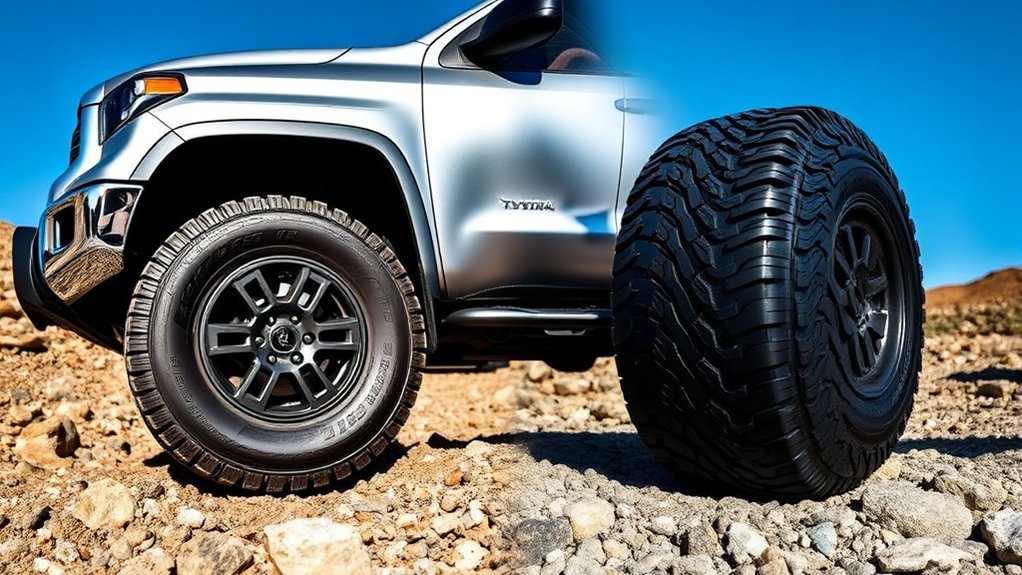
Choosing between all-terrain and all-season tires for your Toyota Tundra comes down to where you drive, what you carry, and the weather you face. All-terrain tires add useful grip and durability on gravel, dirt, rutted roads, and some snow. Highway-focused all-season tires usually deliver a quieter ride, sharper paved-road manners, and lower rolling resistance.
Last updated: July 17, 2026
Quick Answer
Choose all-terrain tires if your Tundra regularly travels on gravel, dirt, job sites, trails, or unplowed roads. Choose highway all-season tires if most miles are on pavement and you value quietness, wet-road control, tread life, and fuel economy. For frequent ice or severe winter weather, use dedicated winter tires.
Key Takeaways
- All-terrain tires favor loose-surface traction and tougher construction; all-season tires favor paved-road comfort and efficiency.
- Neither category guarantees strong ice performance. Check the exact tire’s test results and winter markings.
- A three-peak mountain snowflake symbol confirms a minimum packed-snow acceleration standard, not complete snow, braking, cornering, or ice superiority.
- Match the Tundra’s specified tire size, load capacity, and speed rating before comparing tread patterns.
- Drivers who tow or haul should prioritize load capacity, heat control, inflation, and stability over appearance.
All-Terrain vs. All-Season: Key Benefits and Drawbacks
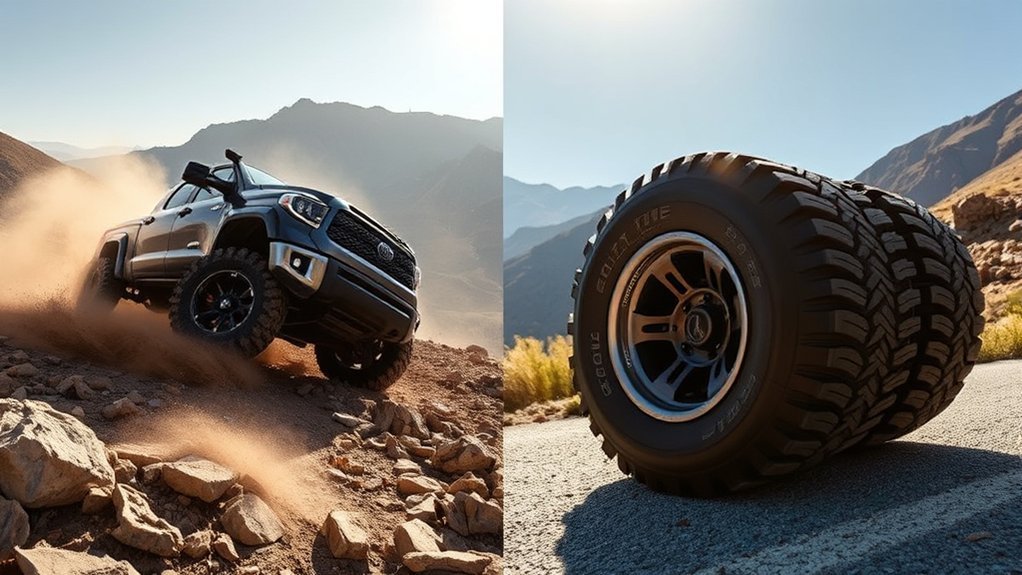
The National Highway Traffic Safety Administration describes all-terrain tires as a compromise between paved-road driving and off-road capability. Their larger tread blocks, wider voids, and stronger casing options can improve grip on gravel, dirt, loose soil, and uneven surfaces. The tradeoff may include more tread noise, heavier steering, a firmer ride, and higher rolling resistance.
Highway all-season tires use a more road-focused tread pattern. They generally provide more continuous rubber contact, smaller tread voids, and more siping for everyday wet and light-snow conditions. That design usually favors stable highway tracking, lower noise, and predictable braking on pavement. Performance still varies widely between individual models, so the category label alone should not decide your purchase.
| Factor | All-Terrain Tires | Highway All-Season Tires |
|---|---|---|
| Best use | Mixed pavement, gravel, dirt, job sites, and light trails | Commuting, highway travel, towing on pavement, and urban driving |
| Road noise | Often higher, especially with aggressive tread blocks | Usually lower |
| Fuel economy | May decrease because of weight and rolling resistance | Usually better when the tire has lower rolling resistance |
| Loose-surface grip | Generally stronger | Limited on mud, loose gravel, and rutted ground |
| Wet pavement | Depends heavily on model and tread wear | Often more road-focused, but model testing still matters |
| Winter use | Some models carry 3PMSF; ice performance is not guaranteed | Standard models suit light snow; some all-weather models carry 3PMSF |
Why All-Season Tires Excel in Daily Driving
Enhanced On-Road Performance
If your Tundra spends nearly all its time on paved roads, a highway all-season tire is usually the more balanced choice. Its tread is designed around braking, steering response, water evacuation, ride comfort, and even wear. You will often notice less vibration and tread hum than you would with a more aggressive all-terrain design.
Wet performance cannot be judged by the words “all-season” alone. Compare independent wet-braking and hydroplaning tests for the exact size and model you plan to buy. Tread depth, temperature, inflation, vehicle load, and wear can change the result.
Better Fuel Efficiency
Tire weight, construction, tread movement, inflation, and rubber compound all affect rolling resistance. A less aggressive highway tire may use less energy than a heavy all-terrain tire, but there is no universal mileage penalty that applies to every Tundra and every tire.
NHTSA reports that a 10% reduction in tire rolling resistance generally improves vehicle fuel economy by about 1% to 2%, not 10%.
Wheel size, tire diameter, vehicle speed, payload, alignment, and driving style can create a larger change than the category name. Compare tires in the same size and load specification for a fair evaluation.
Versatile Weather Handling
All-season tires are intended for a broad mix of dry roads, rain, and light winter conditions. They are convenient for moderate climates because you can leave one set on the truck year-round. However, standard all-season tires are not designed to replace dedicated winter tires during frequent freezing temperatures, packed snow, or ice.
Performance in Snow, Ice, Off-Road, and Highway Conditions
Performance in Snow Conditions
An aggressive all-terrain tread can clear loose snow and find traction in deeper, softer conditions. A road-focused all-season may feel more stable on plowed pavement. Neither statement applies to every tire, and neither means an all-terrain tire is automatically safer on packed snow or ice.
For severe winter driving, look for the three-peak mountain snowflake mark and review model-specific testing. Transport Canada recommends winter tires on all four wheels for cold, snowy, or icy conditions because their compounds and tread designs are made for low-temperature traction.
Warning: The 3PMSF symbol does not certify ice grip, wet braking, snow braking, or cornering. It identifies a minimum acceleration-traction result on packed snow. Dedicated winter tires remain the safer choice for frequent ice and severe cold.
Understanding 3PMSF and M+S Markings
The M+S marking is based mainly on tread geometry and does not prove a specific winter-performance result. The three-peak mountain snowflake symbol is performance-based, but its test scope is limited. Some all-terrain tires and some all-weather or all-season tires carry 3PMSF, while others do not.
Use the marking as one screening tool, not a complete rating. A tire can qualify for 3PMSF yet still differ greatly from another model in snow braking, slush control, wet grip, ride quality, and ice traction.
Off-Road Capabilities Comparison
All-terrain tires are the clear choice when you regularly drive on gravel, rocks, dirt, ruts, fields, or construction sites. Their tread voids can bite into loose surfaces, and many models use stronger sidewall or casing designs to resist damage. They are not mud-terrain tires, so deep mud and extreme rock crawling may still require a more specialized option.
All-season tires can handle maintained gravel roads and occasional dry grass, but their tighter tread pattern may pack with mud and struggle in deep loose material. If your “off-road” use is limited to a graded driveway or campground road, a highway all-season may still be enough.
Highway Handling Differences
Highway all-season tires usually provide the smoother and quieter experience on long paved trips. Their tread blocks flex less, which can improve steering precision and reduce noise. All-terrain tires can still behave well on pavement, especially newer mild A/T designs, but aggressive models are more likely to hum and feel heavier.
For towing, straight-line stability, heat management, and correct load capacity matter more than the A/T or A/S label. Never choose a lower load index or load-carrying capacity than Toyota specifies for your truck.
Tundra Tire Fitment, Load, and Towing Requirements
Tundra tire sizes and specifications vary by model year, trim, wheel package, drivetrain, and market. Start with your driver-side Tire and Loading Information label and the correct Toyota owner’s manual. The Toyota manuals portal lets you select the exact year and model.
The U.S. Tire Manufacturers Association advises replacement tires to meet the recommended size, load index, and speed-rating designation, and not to have less load-carrying capacity than the original specification.
- Tire size: Match the approved width, aspect ratio, construction, and wheel diameter unless a qualified professional verifies an alternative fitment.
- Load index or load range: Confirm that each tire can support the truck, passengers, cargo, accessories, and trailer tongue weight at the required pressure.
- Speed rating: Do not reduce the rating without guidance from Toyota or a qualified tire professional.
- P-metric versus LT: LT tires may offer stronger load or damage resistance, but they can add weight and ride firmness. The correct choice depends on the exact truck and load requirement.
- Overall diameter: A major size change can affect clearance, gearing, speedometer accuracy, braking, driver-assistance systems, and spare-tire compatibility.
Warning: Never use the maximum pressure printed on the tire sidewall as your normal target. Use Toyota’s specified cold pressure for the approved tire setup, unless Toyota or the tire manufacturer provides a different documented requirement for an approved conversion.
[Products Worth Considering]

TIRESHIELD PRO RV tire covers in a set of four deliver year-round protection against UV rays, cracking, fading, water, and snow. The StormLock-System helps keep the covers securely fastened through high wind, while heavy-duty, double-stitched construction supports long-lasting performance. Designed for universal fit, they’re intended for RV, camper, truck, car, and trailer tires within the 26–28.75 inch diameter range, with easy wipe-clean care and storage in the included bag.

These universal tire valve stem caps help protect valve cores from dust, debris, and moisture while helping maintain stable tire pressure. The corrosion-resistant metal construction and sealed design provide reliable protection in road grime, mud, and winter conditions. Twist-on installation makes them quick to fit on cars, SUVs, trucks, and motorcycles.

Measure tire tread depth quickly and accurately with this LUMITECO dial gauge that reads in 1/32" increments up to 14/32". The color-coded green/yellow/red zones make it easy to judge tire wear and know when replacement is needed. A rugged, compact design with a protective pouch helps keep the gauge ready for use on cars, trucks, motorcycles, and more.
Are All-Terrain Tires Worth the Investment? Cost Considerations
All-terrain tires are worth the extra expense when their off-pavement traction, stronger construction, or severe-snow rating solves a problem you actually have. They are harder to justify when the truck rarely leaves pavement and you mainly want an aggressive appearance.
Do not compare purchase price alone. Include installation, balancing, alignment, expected tread life, road-hazard coverage, fuel use, seasonal storage, and the cost of replacing a damaged tire. Prices change by size, load rating, retailer, and region, so a fixed “cost per tire” claim quickly becomes outdated.
A dedicated winter set may cost more upfront, but it can provide better control in sustained cold, snow, and ice while preserving the tread on your warm-season set. In a mild climate, a capable highway all-season may be the lower-cost long-term choice.
[Products Worth Considering]

The 22800 wheel stud installer makes replacing wheel studs quick and secure, saving time and effort during tire service. It uses a ratchet or impact wrench to pull new studs firmly into place, helping when existing studs are too long. Compatible with most automotive wheels and light-duty truck wheel studs, it’s designed for easy, tool-assisted installation.

Accurately measure tire tread depth with a calibrated gauge marked from 0 to 1 inch in 1/32 inch increments. The color-coded bar helps you quickly identify tread condition ranges, supporting safe driving for trucks, motorcycles, automobiles, and passenger vehicles.

The Kurgo Seasonal Tire Tote helps protect your car interior, clothes, and garage from tire grime, brake dust, and residue during seasonal tire changes. Its universal design fits most passenger tires between 22" and 31" in diameter, making storage and transport simpler with less mess. Built for rugged, repeated use, it’s machine washable for easy care and comes with a lifetime warranty.
How Real-World Tundra Use Changes the Choice
Tundra owners often have very different priorities. A contractor driving through unfinished sites needs different traction and casing strength than a commuter towing a boat on highways. Choose the use case closest to yours:
- Mostly highway and city driving: Start with a highway all-season tire in the correct specification.
- Regular gravel, dirt, ranch, or job-site travel: A mild or moderate all-terrain tire is usually the better compromise.
- Frequent rocks, ruts, or remote trails: Prioritize stronger construction, sidewall protection, and proven off-road performance.
- Heavy towing or payload: Prioritize correct load capacity, stable construction, inflation, and heat management.
- Cold winters with packed snow or ice: Use four dedicated winter tires when conditions justify them.
- Occasional snow in a moderate climate: Consider a well-tested 3PMSF all-weather or all-terrain tire, while remembering the symbol’s limits.
How to Choose the Best Tire for Your Lifestyle and Budget
Use this order of priorities so appearance does not override safety or fitment:
- Confirm fitment: Check the door placard and owner’s manual for size and cold pressure.
- Confirm capacity: Match or exceed the specified load capacity and use an appropriate speed rating.
- List your real driving split: Estimate the percentage of pavement, gravel, trails, snow, and towing.
- Choose the category: Select highway all-season, all-weather, all-terrain, or dedicated winter based on that use.
- Compare exact models: Review wet braking, snow performance, noise, treadwear warranty terms, weight, and rolling resistance.
- Check practical details: Verify wheel clearance, spare compatibility, availability, repairability, and replacement cost.
Pro Tip: Write down your driving mix before shopping. If at least 80% to 90% of your miles are paved, start with a highway all-season comparison. Move to all-terrain only when loose-surface access, durability, or snow capability provides a clear benefit.
[Products Worth Considering]

Secure your vehicle during transport with this 4-pack of heavy-duty tire tie down straps designed for trailers and hauling. The ratchet system with flat hooks and D-rings helps you tension the straps quickly, while the wheel-friendly design protects tires. With high break strength and corrosion-resistant hardware, these straps provide reliable, confidence-inspiring tie-down security for cars, trucks, and UTVs.

Monitor tire tread wear with a smart, color-coded depth gauge that shows clear condition ranges at a glance. The bar is range marked for fast, easy readings, helping you maintain safer traction and performance. Each gauge is portable with a pocket clip, and the set includes 20 units for daily use and sharing.

Keep your tires properly inflated with this analog VONDIOR tire pressure gauge, designed for fast, easy readings without batteries. The swiveling, two-axis hose and large glow dial help you measure at any tire angle with instant visibility. Built with a protective rubber shield, it supports durable, low-maintenance use for cars and trucks.
Maintenance That Affects Performance and Cost
Good maintenance can matter as much as the category you choose. According to USTMA tire-care guidance, you should check cold pressure at least monthly and before long trips, heavy loads, or trailer towing. Rotate tires according to Toyota’s schedule and inspect tread, alignment, and damage.
- Use an accurate gauge and set pressure when the tires are cold.
- Do not rely on TPMS as your routine pressure check.
- Rotate using the pattern and interval specified for your Tundra and tire setup.
- Correct alignment if the truck pulls or develops uneven wear.
- Inspect for cuts, bulges, cracking, punctures, and embedded objects after off-road travel.
- Recheck pressure when temperatures change significantly or before towing.
Note: More aggressive tread does not compensate for low pressure, insufficient load capacity, worn tread, or poor alignment. Those conditions can reduce control and shorten tire life in either category.
Frequently Asked Questions
What are the best tires to put on a Toyota Tundra?
The best tire is one that fits your exact model year, trim, wheel size, load requirement, climate, and driving pattern. Highway all-season tires suit mostly paved use; all-terrain tires suit regular gravel or off-road use; dedicated winter tires suit frequent cold, snow, and ice. Compare exact models rather than choosing by brand alone.
Is there a downside to all-terrain tires?
Possible downsides include more road noise, extra weight, firmer ride quality, higher rolling resistance, and less precise paved-road handling. The size of each tradeoff depends on the exact model. Mild all-terrain tires may feel close to highway tires, while aggressive designs create a larger compromise.
Are all-terrain tires better than all-season tires in snow?
They can be better in loose or deep snow, but the category does not guarantee better packed-snow or ice performance. Look for 3PMSF certification and model-specific tests. For frequent ice or severe winter conditions, four dedicated winter tires are usually the safer option.
Do all-terrain tires reduce Tundra fuel economy?
They may reduce fuel economy if they are heavier, wider, larger in diameter, or higher in rolling resistance than the tires they replace. The change varies by tire and setup. Correct pressure, alignment, wheel weight, speed, and driving style also affect the result.
Does a Toyota Tundra need LT tires?
Not every Tundra needs an LT replacement tire. Use the specification on the truck’s placard and owner’s manual as your starting point. LT tires may help in some towing, hauling, or off-road situations, but they can add weight and stiffness. A qualified tire professional should verify any change in tire type or load system.
Can I install a larger tire size on my Tundra?
A larger tire may fit some Tundra configurations, but it can affect clearance, speedometer accuracy, gearing, braking, fuel economy, spare fitment, and electronic systems. Verify the complete wheel-and-tire setup with Toyota guidance and a qualified installer before changing the original size.
Sources
- National Highway Traffic Safety Administration: TireWise — tire categories, replacement sizing, inflation, tread, rotation, and rolling resistance.
- U.S. Tire Manufacturers Association: Replacing Tires — size, load index, speed rating, and replacement guidance.
- U.S. Tire Manufacturers Association: Tire Care Essentials — pressure, tread, rotation, alignment, towing, and heavy-load checks.
- Transport Canada: Using Winter Tires — winter tire selection, 3PMSF marking, and cold-weather guidance.
- Toyota Owners: Manuals and Warranties — model-year-specific Tundra owner’s manuals and vehicle guidance.
Conclusion
Choose a highway all-season tire when your Tundra is mainly a paved-road commuter, tow vehicle, or family truck. Choose an all-terrain tire when gravel, dirt, job sites, trails, or unplowed roads are a regular part of your driving. In severe winter weather, neither label replaces the benefit of a dedicated winter tire.
Before buying, confirm the exact size, load capacity, speed rating, and cold inflation pressure for your truck. Then compare real test results for wet braking, snow traction, noise, and tread life. That process will produce a safer and more useful choice than selecting a tire by appearance or category name alone.