
How To Fit Bigger Tires on a Stock Toyota Tacoma
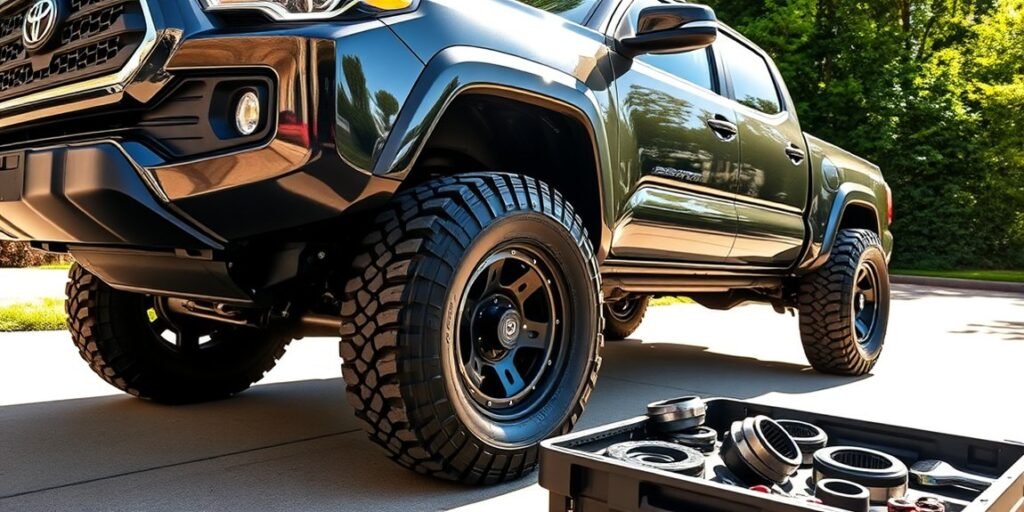
Fitting bigger tires on a Toyota Tacoma can improve ground clearance, trail grip, and stance, but the right size depends on your Tacoma generation, trim, wheel offset, tire width, and how much rubbing you are willing to fix. A tire that clears while parked can still rub at full steering lock, under braking, or when the suspension compresses off-road.
Quick Answer
For a stock Tacoma, the safest tire upgrade depends on generation. Many 2016–2023 trucks stay near 31.6 inches without major trimming, while many 2024+ trucks can run about 33-inch tires with factory-offset wheels. True 35-inch tires usually need careful offset, lift, trimming, alignment, and a full rub test.
Key Takeaways
- Check your door-jamb tire placard first. Match or exceed the original load index and speed rating before changing sizes.
- A mild upgrade is usually the best daily-driver choice. Bigger tires add weight, can reduce fuel economy, and can affect braking, steering, and speedometer accuracy.
- On 2024+ Tacomas, 35-inch tires are possible on some builds, but they are not a simple “stock truck” upgrade.
- After installing larger tires, check for rubbing at full lock, get an alignment, verify tire pressure cold, and re-torque lug nuts after the first drive cycle.
At a Glance
| Time Required | 30–60 minutes to measure and test fit; 2–4 hours for tire installation, trimming, and alignment checks |
| Difficulty | Easy for a mild tire-size upgrade; moderate to advanced for 34–35-inch setups |
| Tools Needed | Tape measure, flashlight, tire-pressure gauge, torque wrench, jack stands, socket set, marker, trim tool or utility knife if trimming is needed |
| Cost | About $0–$150 for measurement, trimming, and alignment checks; $900–$1,800+ for tires; more if wheels, lift, or shop labor are added |
Before You Buy: Identify Your Tacoma Generation
The biggest mistake is treating every Tacoma the same. A 2016–2023 Tacoma and a 2024+ Tacoma do not have the same wheel-well layout, factory tire sizes, or clearance limits. Current Toyota owner information for the 2026 Tacoma lists factory tire options such as 245/70R17, 265/70R17, and 265/65R18, while many older Tacomas used 16-inch or 17-inch factory tire packages.
Note: Always confirm the size on your door-jamb placard and the tire currently mounted on your truck. Trim, cab style, drivetrain, factory wheel package, and previous owner modifications can change what fits.
| Tacoma generation | Common starting point | Why it matters |
|---|---|---|
| 2016–2023 Tacoma | Often 16- or 17-inch factory wheels depending on trim | Larger tires tend to contact mud flaps, fender liners, and cab-mount areas sooner. |
| 2024+ Tacoma | 17- or 18-inch factory wheels depending on trim | The newer platform has more tire clearance, but wheel offset and tire width still matter. |
[Products Worth Considering]

This VEVOR tire bead breaker uses a slide-hammer impact and wedge tip to separate tire beads from rims quickly and efficiently without damaging hub surfaces. The long handle and sturdy steel construction help reduce user strain while providing reliable, portable tire changing for cars, trucks, and more. Ideal for home mechanics and repair shops handling multiple vehicle tire sizes.

The JACO FlowPro Tire Inflator measures, inflates, and airs down tires up to 100 PSI with battery-free operation and ±2% accuracy after calibration. It features a glowing pressure dial for night visibility, a heavy-duty steel build with a hybrid hose, and a precision push-to-inflate thumb trigger. The patented Lightning Air Chuck locks on for a secure seal, and the kit includes quick-connect hardware for easy inline use with your air compressor.

The Kurgo Seasonal Tire Tote helps protect your car interior, clothes, and garage from tire grime, brake dust, and residue during seasonal tire changes. Its universal design fits most passenger tires between 22" and 31" in diameter, making storage and transport simpler with less mess. Built for rugged, repeated use, it’s machine washable for easy care and comes with a lifetime warranty.
What Tire Size Fits a Stock Toyota Tacoma?
The best “bigger tire” is the largest size that clears during real driving, not just while parked. Tire brands also measure differently, so a listed 33-inch or 35-inch tire may be slightly shorter or taller once mounted.
| Setup | Practical tire target | Typical notes |
|---|---|---|
| Older Tacoma with 16-inch wheels | 265/75R16, about 31.6 inches | A common mild upgrade from 265/70R16. Usually better for daily driving than jumping straight to 33s or 35s. |
| Older Tacoma with 17-inch wheels | 265/70R17, about 31.6 inches | Keeps width moderate and reduces the chance of rubbing compared with wider tires. |
| 2024+ Tacoma with 17-inch wheels | 285/70R17, about 32.7 inches | Often treated as a strong stock-height target with factory-friendly offset, but still needs a rub test. |
| 2024+ Tacoma with 18-inch wheels | 275/70R18 or similar, about 33 inches | Works best when wheel offset stays close to factory and tire width is not excessive. |
| 35-inch tire setup | 35×11.50R17, 35×12.50R17, 295/65R18, or 285/70R18 | Not a blind stock upgrade. Expect offset planning, crash-plate clearance on 2024+ models, trimming, lift, and alignment. |
| 37-inch tire setup | Major custom build only | Not recommended for a stock Tacoma. This usually requires major lift, cutting, gearing, and steering/suspension upgrades. |
You can calculate approximate tire height from the size code. Tire Rack explains tire dimension calculations: the sidewall height comes from the width and aspect ratio, and the wheel diameter is then added to both sidewalls.
How to Measure and Test Tire Clearance Before You Buy
Before ordering tires, measure the space around the front tire because the front axle is where most rubbing happens. Check clearance at the rear of the wheel well, front bumper corner, mud flap, inner liner, sway-bar area, and upper control arm.
- Park the truck on level ground with the current tires inflated to the correct cold pressure.
- Turn the steering wheel fully left and measure the tightest areas around the right-front tire.
- Turn the steering wheel fully right and repeat on the left-front tire.
- Measure the distance from the tire to the upper control arm and inner fender liner.
- Compare your current tire diameter and width with the tire you want to install.
- If possible, test fit one front tire before mounting the full set.
- After installation, drive slowly in a safe area and check for rubbing while turning, braking, reversing, and going over uneven ground.
Warning: Do not cut frame, suspension, brake, wiring, airbag, or structural components for tire clearance. If you are unsure what a part does, stop and ask a qualified installer.
How to Fit Larger Tires on Your Tacoma
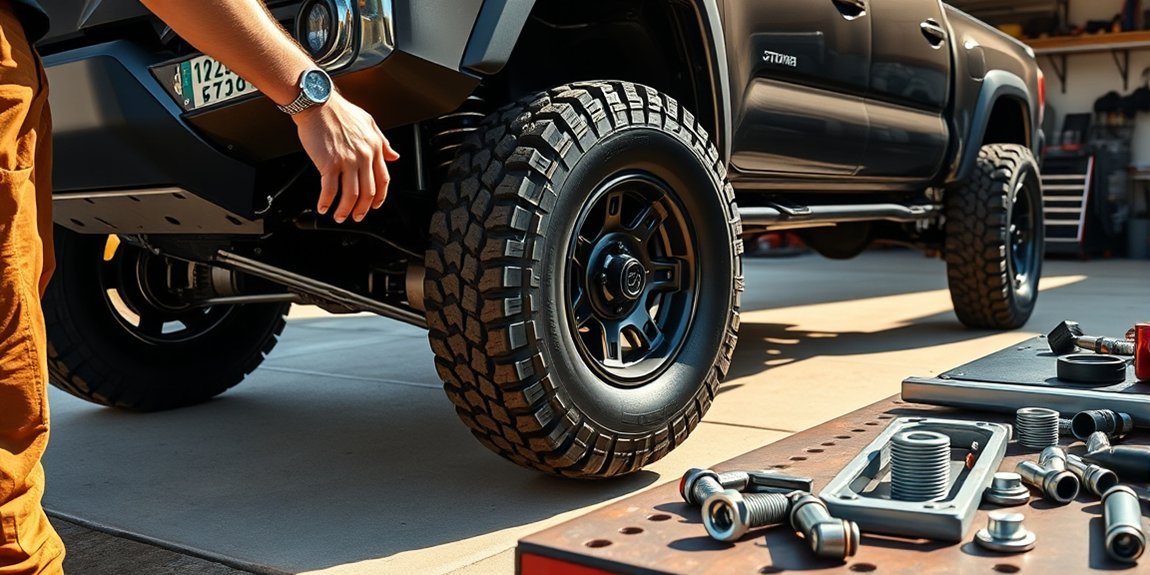
To fit larger tires on your Tacoma, start with the smallest changes that solve the clearance problem. A mild tire upgrade may need no cutting at all. A 34- or 35-inch setup may need a leveling kit or lift, crash-plate clearance on 2024+ models, minor bumper trimming, and a professional alignment.
- Confirm the factory tire size. Read the tire placard and check the current tire sidewall.
- Pick the tire diameter. Stay mild for daily driving; go larger only if you need trail clearance.
- Keep the width reasonable. Wider tires often rub before taller, narrower tires do.
- Choose wheel offset carefully. A low or negative offset pushes the tire outward and can create bumper and fender rub.
- Test fit before committing. Mount one front tire, turn lock-to-lock, and check compression clearance.
- Fix rubbing cleanly. Remove or adjust mud flaps, massage liners, or trim plastic before cutting painted bumper parts.
- Align the truck. Any lift, leveling kit, or meaningful tire-size change should be followed by an alignment.
Pro Tip: If you want a daily-driver Tacoma, choose the smallest tire that gives the look and clearance you need. It usually rides better, brakes better, and costs less than forcing the largest possible size.
Why Upgrade to Larger Tires?
Larger tires can raise the differential and frame slightly, improve approach over rocks and ruts, and give the truck a more aggressive stance. The trade-off is added rotating weight, possible fuel-economy loss, more road noise, slower acceleration, and extra stress on steering and suspension parts.
A tire that clears in the driveway is not automatically trail-ready. Full-lock steering, braking dive, and suspension compression are the real clearance tests.
| Tire Size | Approx. Height | Best use |
|---|---|---|
| 265/70R16 | 30.6 in. | Older factory-style baseline |
| 265/75R16 | 31.6 in. | Mild older-generation upgrade |
| 265/70R17 | 31.6 in. | Common modern factory/off-road size |
| 285/70R17 | 32.7 in. | Popular 33-inch-style upgrade |
| 35×12.50R17 | About 34.5–35 in. | Advanced lifted setup |
| 37-inch tire | About 36.5–37 in. | Major custom build, not stock fitment |
Essential Modifications for Bigger Tires
The modifications you need depend on tire size, wheel offset, and generation. Do not assume that a 2-inch leveling kit automatically clears every tire. A narrow 33-inch tire on factory-offset wheels may be simple, while a wide 35-inch tire on negative-offset wheels may rub the bumper, liner, and pinch areas.
1. Leveling Kit or Lift
A leveling kit raises the front of the truck to reduce factory rake. Toyota’s older eligible Tacoma TRD Lift Kit is listed as a 2-inch front and 1-inch rear lift on applicable MY18+ V6 4×4 models, but you must verify fitment for your exact year and trim. For 2024+ Tacomas, shop by VIN and use a kit made for the newer platform.
2. Wheel Offset and Width
Offset controls how far the wheel sits inward or outward. Lower offset can improve stance, but it often increases bumper and fender rub. For bigger tires, a moderate positive offset is usually easier to clear than an aggressive negative offset.
3. Mud Flap and Fender Liner Clearance
Mud flaps and plastic liners are common first contact points. Start with reversible changes before cutting painted bumper pieces.
4. Alignment
After a lift, leveling kit, or tire-size change, get a professional alignment. Correct caster can help move the tire away from the rear of the front wheel well and improve tracking.
How to Remove the Crash Plate for Clearance
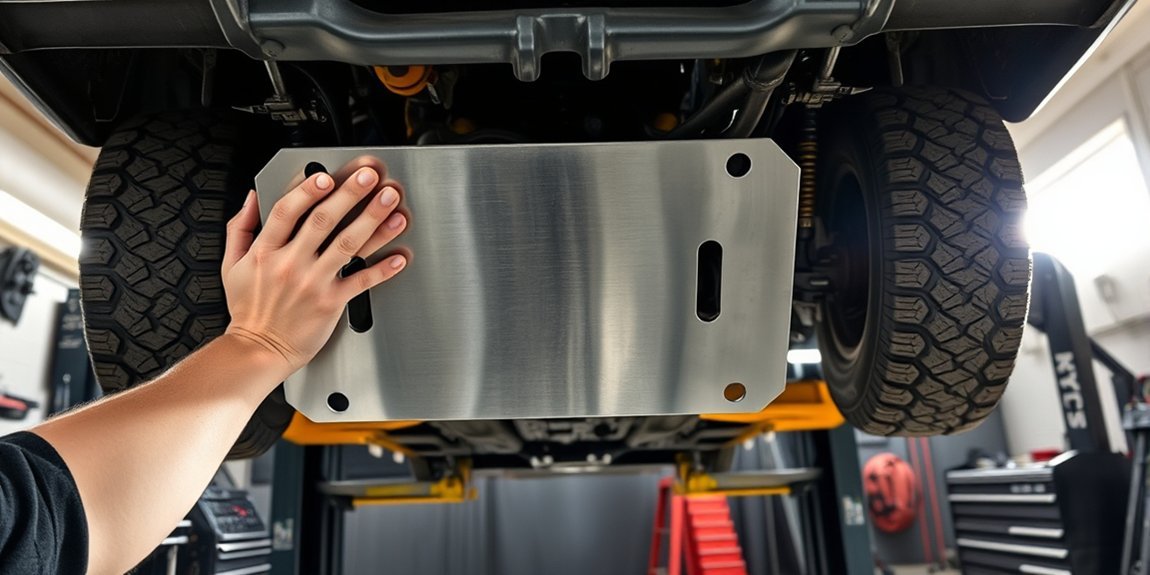
Some 2024+ Tacoma fitment setups use crash-plate removal to gain clearance near the rear of the front wheel well. This is different from cutting a cab mount on older trucks. If your truck does not have this removable plate, do not improvise by cutting metal.
Tools Required For Removal
| Tool | Purpose | Tip |
|---|---|---|
| Socket wrench | Removes the plate bolts | Use the correct socket size to avoid rounding bolts |
| 10mm socket or correct fitted socket | Fits many small body fasteners | Confirm bolt size on your truck before turning |
| Jack stands | Supports the vehicle safely | Never work under a truck supported only by a jack |
| Flashlight | Helps inspect tight areas | Check for wiring, brake lines, and debris before removal |
Step-By-Step Instructions
- Park on a flat surface, set the parking brake, and chock the rear wheels.
- Raise the front only if needed and support the truck with jack stands.
- Turn the steering wheel to create room in the wheel well.
- Locate the removable crash plate near the rear of the front wheel well, if your Tacoma is equipped with one.
- Remove the retaining bolts with the correct socket.
- Pull the plate away carefully and keep the hardware in a labeled bag.
- Test fit the tire, turn lock-to-lock, and check clearance again.
- Reinstall the plate if the tire clears without removal or if you return to a smaller tire.
Safety Precautions To Consider
Removing a bolt-on clearance plate is different from cutting structural metal. If the part appears welded, tied into the frame, or connected to another component, stop. Keep the removed parts in case you want to return the truck to factory condition.
Adjusting Your Front Bumper for Tire Fitment
The front bumper and lower valance are common rub points, especially with wide tires and low-offset wheels. Minor trimming may be enough, but cut slowly and test often. A “viper cut” can help some 35-inch setups, but it is not necessary for every tire upgrade.
- Mark the contact area with painter’s tape after the tire rubs lightly during testing.
- Remove only plastic that is actually causing contact.
- Keep bumper mounting points intact.
- Smooth sharp edges so they do not cut the tire.
- Repeat the rub test after each small trim.
Note: If your tires only rub during full compression off-road, a driveway test may not reveal the problem. Recheck after your first trail drive.
Tools Needed for Adjusting the Front Bumper
Use the right tools so the trim looks clean and does not weaken the bumper. A rushed cut can leave sharp edges, uneven gaps, and unnecessary damage.
- Painter’s tape and marker for cut lines
- Socket set for bumper or liner fasteners
- Utility knife or plastic trim tool for light liner work
- Oscillating tool or fine-tooth saw for thicker plastic
- Sandpaper or deburring tool to smooth edges
- Torque wrench for reinstalling wheels to spec
[Products Worth Considering]
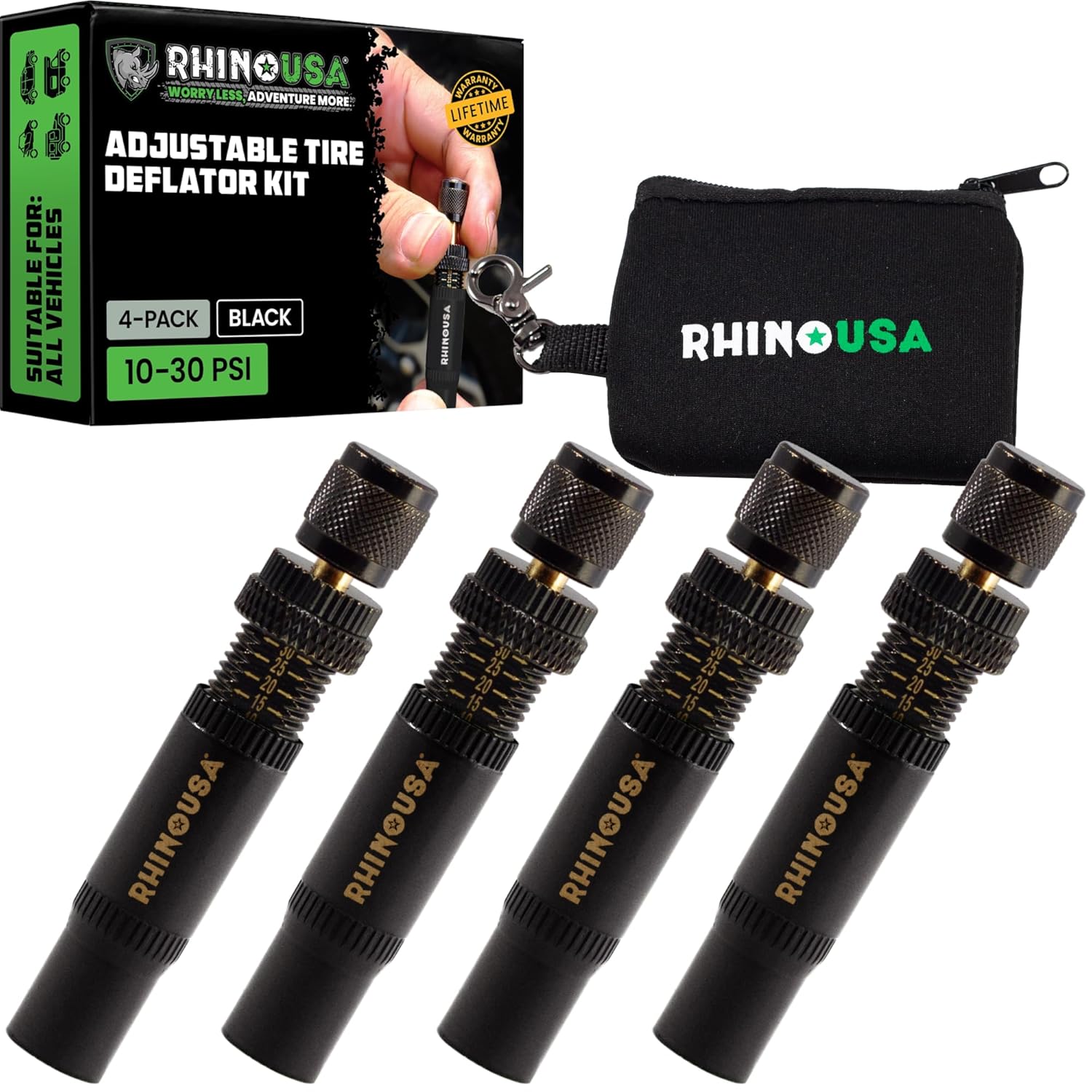
Use the Rhino USA adjustable tire deflators to air down all four tires at once by screwing one deflator onto each valve stem, letting you step away while the tires reach your preset pressure. Each deflator independently adjusts across a 10–30 PSI range with laser-etched indicators for quick setup and verification, making it ideal for beach, sand, and rocky off-road trails.

Camco Trailer Aid Plus tandem tire ramp lifts your trailer for quick, safe tire changes with ample clearance from its 5 1/2-inch lift. It helps you change a flat tire without unloading cargo, making roadside and routine maintenance more efficient. The heavy-duty, waterproof and rustproof polymer design supports up to 15,000 lb and is built for easy portability and storage.
Why Consider a Leveling Kit for Your Tacoma?
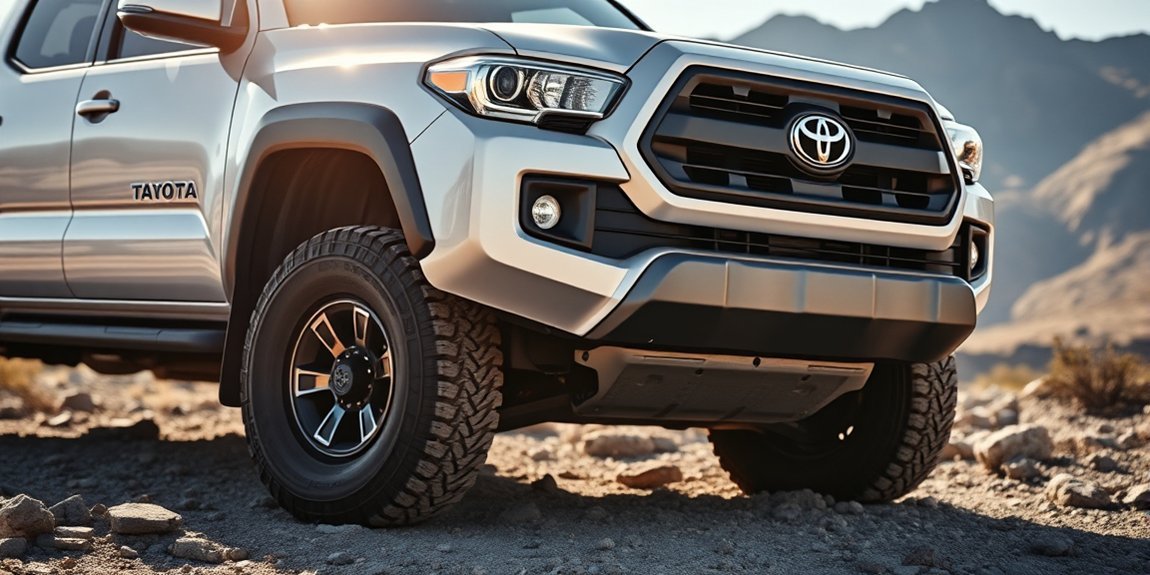
A leveling kit can improve the truck’s stance and create more room at the front wheel wells. It does not automatically solve every clearance issue, but it can help when paired with the right wheel offset and tire size.
Enhanced Off-Road Capability
More tire diameter can increase ground clearance under the axles and improve obstacle approach. A mild level can also improve the approach angle by raising the front of the truck slightly.
Improved Aesthetic Appeal
A leveled Tacoma usually looks more balanced because the front sits closer to the height of the rear. Wider all-terrain or mud-terrain tires can add a tougher stance, but extreme offset may cause rubbing and throw more debris onto the paint.
Adjustable Height Options
Coilovers, preload collars, and spacer-style leveling kits all change ride height differently. Coilovers offer more tuning, while spacer-style kits are usually cheaper. Choose parts that are made for your Tacoma generation and confirm compatibility with driver-assist systems.
Top Tire Size Recommendations
The best tire size depends on how you use the truck. A daily-driver Tacoma should prioritize safe clearance, load rating, braking, and ride quality. A trail-focused Tacoma can justify more trimming and lift.
| Goal | Recommended size range | Notes |
|---|---|---|
| Mild daily upgrade | 265/75R16 or 265/70R17 | Good balance of clearance, ride, cost, and low rubbing risk on many older trucks. |
| 2024+ stock-height upgrade | 285/70R17 or similar 33-inch range | Best with factory-friendly offset and a full rub test. |
| Leveled trail/daily setup | 285/75R17, 285/65R18, or similar 34-inch range | Often needs crash-plate clearance on 2024+ models and alignment after lift/level changes. |
| 35-inch trail build | 35×11.50R17, 35×12.50R17, 295/65R18, or 285/70R18 | Plan for lift, trimming, offset tuning, alignment, and possible power/fuel-economy trade-offs. |
Wheel Offset, Width, and Backspacing
Tire diameter is only part of fitment. Wheel offset and width decide where the tire sits in the wheel well.
- Positive offset: Pulls the wheel inward. This often clears the bumper better but may reduce clearance near the upper control arm.
- Zero offset: Moves the tire outward compared with many factory wheels. It can improve stance but may increase fender and bumper rub.
- Negative offset: Pushes the wheel farther outward. This looks aggressive but commonly requires more trimming.
- Wheel width: A wider wheel can make the same tire sit wider, which can create new rub points.
If you want the least hassle, stay close to factory wheel offset and avoid going too wide. If you want an aggressive stance, budget for trimming and more testing.
Post-Install Checklist
After the tires are installed, do not assume the job is finished. Bigger tires change how the truck feels and how the tire fits under load.
- Set cold tire pressure based on the tire, load, and professional guidance. Do not exceed the tire sidewall maximum.
- Torque lug nuts to Toyota’s specification for your model.
- Turn the steering from lock to lock and inspect every contact point.
- Drive slowly over a dip or driveway entrance and listen for rubbing.
- Get an alignment after lift, leveling, or suspension changes.
- Check whether the spare tire location can hold the new tire size.
- Confirm the TPMS sensors work correctly.
- Use GPS or a tire calculator to estimate speedometer error.
- Re-torque lug nuts after the first drive cycle and again after trail use.
User Experiences With Tire Upgrades
Tacoma owners report a wide range of results because no two setups are identical. A tire that clears on a stock wheel may rub on a negative-offset wheel. A tire that clears on the street may rub when the suspension compresses on a trail. A narrow 35-inch tire may clear better than a wide 35-inch tire.
The most reliable pattern is simple: mild upgrades create fewer problems, factory-friendly offset helps, and every bigger-tire setup needs a real rub test. Use owner photos and forum threads for ideas, but verify on your own truck before buying a full set.
What to Keep in Mind About Tire Safety?
Tire safety matters more than appearance. The National Highway Traffic Safety Administration highlights proper tire pressure, vehicle load limits, road-hazard avoidance, and regular tire inspection as key ways to reduce tire-failure risk. Replacement tires should also meet or exceed original-equipment load capacity; General Tire’s plus-sizing guidance says to check the door placard or owner’s manual for OE size, load, and recommended inflation pressure.
- Load rating: Match or exceed the original load index. Never downgrade load capacity.
- Speed rating: Match or exceed the OE rating unless a tire professional confirms the change is appropriate.
- Tire pressure: Check cold pressure regularly with a gauge. Do not rely only on appearance.
- Speedometer accuracy: Taller tires can make the speedometer read slower than your actual road speed.
- Handling and braking: Heavier tires can increase stopping distance and steering effort.
- Legal and warranty concerns: Some tire, wheel, lift, or trimming choices can affect inspection compliance or warranty conversations.
Frequently Asked Questions
Will larger tires affect my Tacoma’s fuel efficiency?
Yes. Larger all-terrain or mud-terrain tires are usually heavier and can increase rolling resistance. Expect possible fuel-economy loss, slower acceleration, and more road noise, especially with aggressive tread patterns.
Can I fit bigger tires without a lift kit?
Yes, if the upgrade is mild and the wheel offset is sensible. Many stock Tacomas can move up one practical size without a lift. Large 34- and 35-inch setups usually need more clearance, trimming, or lift depending on generation and tire width.
What is the maximum tire size for stock Tacoma rims?
It depends on rim diameter, rim width, generation, and trim. Older 16-inch Tacoma wheels commonly work well with 265/75R16. Many 17-inch setups use 265/70R17 or 285/70R17 depending on generation and clearance. Always confirm the tire manufacturer’s approved rim-width range.
How do bigger tires impact ride quality?
Bigger tires can feel heavier and may make the truck ride firmer or slower to respond. Tires with aggressive tread can add noise and vibration. However, a properly sized all-terrain tire with the correct pressure can still ride well for daily use.
Are there specific brands recommended for larger Tacoma tires?
Popular Tacoma tire brands include BFGoodrich, Falken, Goodyear, Nitto, Toyo, and Mickey Thompson. Choose by use case first: all-terrain for mixed daily/trail driving, mud-terrain for mud and rocks, and highway terrain for quiet commuting.
Do I need an alignment after installing bigger tires?
If you only change tire size and keep the same suspension, an alignment may not always be mandatory, but it is still smart to check. If you add a leveling kit, lift kit, new control arms, or suspension parts, get a professional alignment.
Will bigger tires make my speedometer inaccurate?
Usually, yes. A taller tire travels farther per rotation, so the speedometer may read lower than your actual speed. Use a tire-size calculator or GPS comparison, and ask a shop about recalibration if the difference is significant.
Conclusion
Upgrading your Tacoma to bigger tires is one of the most effective ways to improve stance and off-road confidence, but fitment has to be planned. Start with your generation, factory tire placard, and wheel offset. For daily use, a mild 31.6- to 33-inch setup is often the best balance. For 35s, plan for a more serious build with clearance work, alignment, safety checks, and realistic expectations.
Sources
- Toyota Owners — 2026 Tacoma maintenance data — factory tire-size context and model-specific specifications
- Toyota USA Newsroom — 2026 Toyota Tacoma — current Tacoma trim and tire-package context
- Toyota Genuine Tacoma TRD Lift Kit — Toyota-listed 2-inch front / 1-inch rear lift information for eligible models
- NHTSA Tire Safety brochure — tire pressure, load limits, inspection, and tire-failure prevention
- General Tire plus-sizing guidance — load capacity, OE placard, and replacement tire safety checks
- Tire Rack tire dimension guide — tire-size calculation and dimension basics

Related Articles
How Tire Weight Affects Toyota Tacoma Performance
How does tire weight influence your Toyota Tacoma's performance and efficiency? Discover the surprising effects that could change your driving experience.
Read More
Tire Noise Levels by Tire Type on a Toyota Tacoma
A comprehensive look at how tire types affect noise levels in your Toyota Tacoma reveals surprising insights that could enhance your driving experience.
Read More
How To Choose Tires for a Dual Use Toyota Tacoma
Unlock the secrets to selecting the perfect tires for your dual-use Toyota Tacoma, ensuring optimal performance and comfort on every adventure. Discover more inside!
Read More