
How To Rotate Tires on a Toyota Tacoma the Right Way
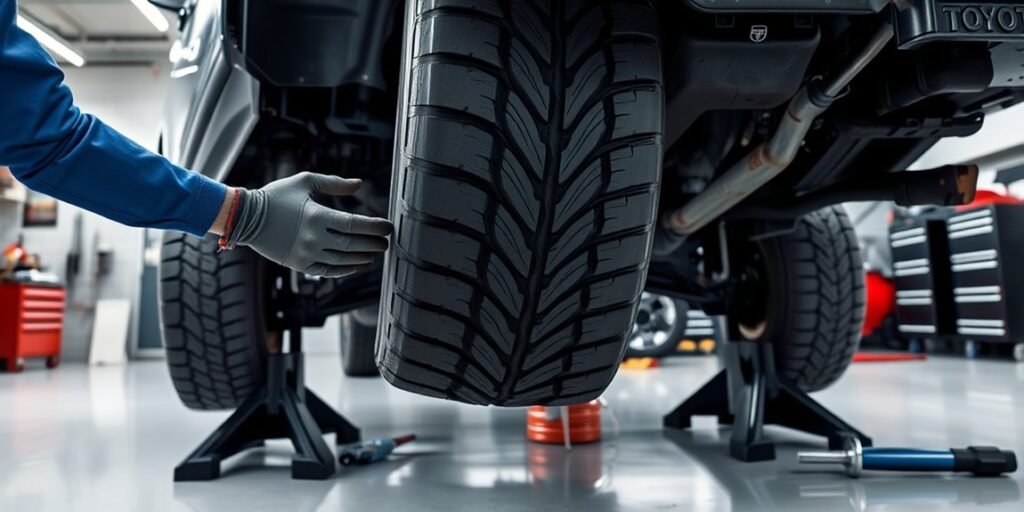
Rotating the tires on your Toyota Tacoma helps the tread wear more evenly, keeps the truck feeling stable, and gives you a chance to catch tire damage before it becomes a road problem. The job is straightforward, but the rotation pattern, lift points, lug-nut torque, and tire-pressure checks must match your Tacoma’s model year and tire setup.
Quick Answer
To rotate Toyota Tacoma tires, park on level ground, chock the wheels, loosen the lug nuts, lift the truck at the approved jack points, support it with jack stands, move the tires according to your owner’s manual, torque the lug nuts to the correct spec, then check cold tire pressure and test drive carefully.
Key Takeaways
- Use the rotation pattern in your Tacoma owner’s manual first; tire type and wheel setup can change the correct pattern.
- For many Tacoma maintenance schedules, tire rotation lines up with regular service intervals, often every 5,000 miles or six months.
- Directional tires usually move front-to-back on the same side unless they are dismounted and remounted.
- Never work under a Tacoma supported only by a jack; use wheel chocks and properly rated jack stands.
- After rotation, torque lug nuts to the correct model-year and wheel-specific spec, then set cold tire pressure from the door placard.
At a Glance
| Time Required | 30–60 minutes for most DIY rotations |
| Difficulty | Moderate; safe lifting and correct torque matter most |
| Tools Needed | Floor jack, rated jack stands, wheel chocks, lug wrench or breaker bar, torque wrench, tire pressure gauge, gloves, and chalk or tape |
| Cost | $0 if you already own the tools; otherwise tool rental, tool purchase, or shop labor varies |
What You Need to Know About Tire Rotation
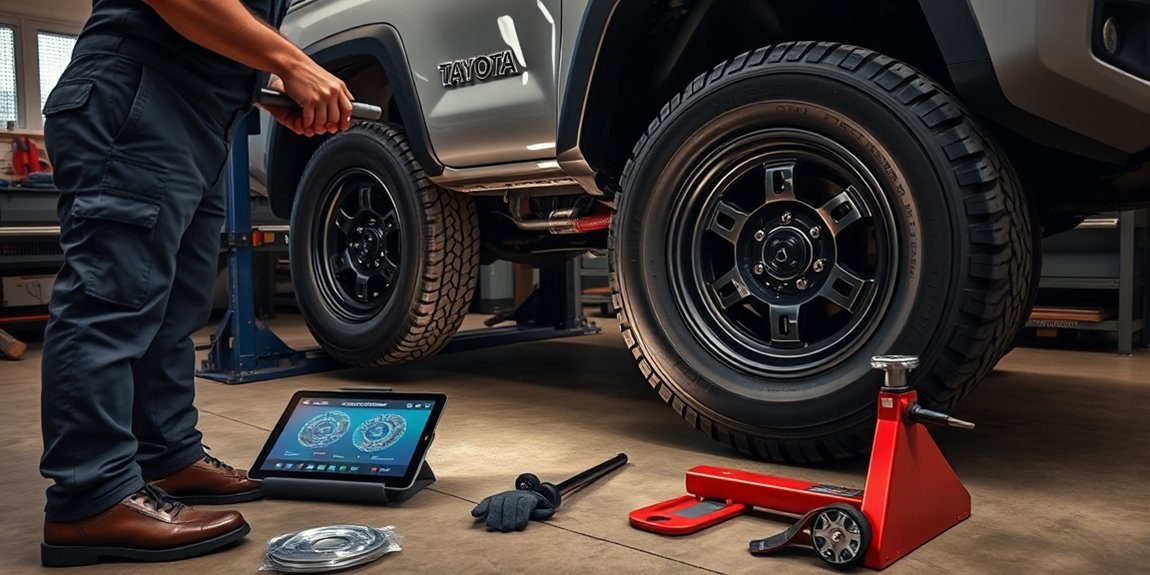
Tire rotation means moving each tire to a different position on the truck so one tire position does not wear out much faster than the others. On a Tacoma, the front tires handle steering and much of the braking load, while the rear tires handle drive torque, payload stress, towing loads, and trail traction. Rotating them helps spread that work across the full set.
For the 2025 Tacoma, Toyota’s Warranty & Maintenance Guide recommends scheduled maintenance every 5,000 miles or six months, whichever comes first, and lists tire rotation at those 5,000-mile intervals. Older or newer Tacoma model years may differ, so use your own maintenance guide as the final authority.
Rotation is also inspection time. Before the wheels go back on, check tread depth, tire pressure, sidewalls, valve stems, nails, cuts, bulges, and uneven wear. Toyota’s maintenance guide also says tires should be checked for damage and uneven wear when they are rotated.
[Products Worth Considering]

Universal magnetic jack pad with aluminum grooved design to protect vehicle pinch welds during lifting. Durable nylon pad inserts are upgraded and secured with screws to resist damage and keep in place. Designed to fit most single vehicle pinpoint welds for safer, stable jacking when changing tires, repairs, or performing oil changes.

Camco’s RV wheel chocks with an attached rope help keep your travel trailer securely in place for safer unhitching or parking. This 2-pack is compatible with wheels up to 26-inch diameter and features durable UV-resistant construction for reliable outdoor performance. The rope enables quick, safe removal so you can prepare for your next trip with less hassle.

This roadside assistance kit helps drivers and passengers in urgent situations after an accident or breakdown, providing practical support while waiting for help. It includes a lightweight, compact tire inflator for fast inflation of standard vehicle tires, plus reinforced jumper cable protection for safer handling. Ideal for winter weather, road trips, camping, and travel, with everything stowed neatly in a trunk bag.
Choose the Right Toyota Tacoma Tire Rotation Pattern
The correct tire rotation pattern depends on your Tacoma’s model year, tire type, wheel size, wheel offset, drivetrain, and whether the spare tire matches the other four tires. Do not use one universal pattern for every Tacoma.
| Setup | Best Pattern | What to Know |
|---|---|---|
| Owner’s manual pattern | Use the diagram in your Tacoma owner’s manual | This is the safest default because Toyota’s instructions can vary by model year and tire configuration. |
| Same-size, non-directional tires | Manual-specified pattern or rearward cross when allowed | A rearward cross moves rear tires straight to the front and crosses front tires to the opposite rear positions. Use it only if your manual and tire maker allow it. |
| Directional tires | Front-to-back on the same side | Directional tires have arrows or rotation markings on the sidewall. They must keep rolling the same direction unless remounted. |
| Different front/rear sizes or offsets | Limited rotation or professional service | Staggered or aftermarket setups may not allow a normal four-tire rotation. |
| Full-size matching spare | Use the five-tire pattern in the manual or tire-maker instructions | Only include the spare if it matches size, type, load rating, wheel fitment, and condition. Do not include a temporary spare. |
Note: If your Tacoma has aftermarket wheels, oversized tires, beadlock-style wheels, different offsets, or aggressive mud-terrain tires, follow the tire and wheel manufacturer’s guidance before using a standard pattern.
How to Rotate Your Tires Safely and Effectively

Gather your tools before lifting the truck. You will need a floor jack, properly rated jack stands, wheel chocks, a lug wrench or breaker bar, a torque wrench, a tire pressure gauge, gloves, and chalk or painter’s tape for marking tire positions.
Warning: Never work under a Tacoma supported only by a jack. Park on a flat, solid surface, chock the wheels, use the correct jack points, and support the truck with jack stands rated for the vehicle’s weight.
- Park safely. Choose a flat, solid surface. Shift into Park for an automatic or into gear for a manual, set the parking brake, and place wheel chocks at the tires that will stay on the ground first.
- Check tire type and pattern. Look for directional arrows, tire size differences, unusual wear, or aftermarket wheels. Confirm the rotation pattern in your Tacoma owner’s manual.
- Mark the tires. Use chalk or painter’s tape to label each tire as LF, RF, LR, and RR. This helps you track where each tire started.
- Loosen the lug nuts before lifting. Break each lug nut loose about a quarter turn while the tires still touch the ground. Do not remove the lug nuts yet.
- Lift the Tacoma correctly. Use the approved jacking points from your owner’s manual. Raise one corner or one end at a time, then lower the truck onto jack stands before removing a wheel.
- Remove and inspect each wheel. Check tread depth, inner and outer shoulders, sidewalls, valve stems, nails, cuts, bulges, cupping, feathering, and uneven wear.
- Move each tire to its new position. Follow the manual pattern. Directional tires usually move front-to-back on the same side. Same-size, non-directional tires may allow a rearward cross when the manual and tire maker permit it.
- Hand-thread the lug nuts. Put the wheel flat against the hub and start each lug nut by hand to avoid cross-threading.
- Snug the lug nuts in a star pattern. Tighten lightly while the truck is still supported so the wheel seats evenly.
- Lower the truck and torque the lug nuts. Once the tire touches the ground, use a torque wrench in a crisscross pattern. Use the torque value for your exact model year and wheel type, not a generic number from memory.
- Set cold tire pressure and test drive. Adjust pressure to the driver’s door placard when the tires are cold. Drive slowly at first and stop if you feel vibration, hear clicking, or notice pulling.
Pro Tip: Keep a simple tire log with date, mileage, tread depth, pressure, and each tire’s new position. It makes uneven wear easier to spot during the next rotation.
Why Tire Rotation Matters for Your Tacoma
Regular tire rotation helps your Tacoma’s tires wear more evenly. Even tread depth can improve stability during braking, cornering, rain, towing, and light off-road driving. It can also help you replace all four tires as a matched set instead of replacing one or two early because one position wore faster.
Rotation also gives you a scheduled chance to inspect the tires closely. A nail, sidewall bubble, inner-edge wear, or cupped tread may not be obvious during a quick walkaround, but it is much easier to see when the wheel is off the truck.
Treat tire rotation as both a tire-life task and a safety inspection. The rotation pattern matters, but the damage check matters just as much.
When to Rotate Your Tacoma’s Tires
For many Tacoma owners, the simplest rule is to rotate tires at the scheduled maintenance interval in the Toyota maintenance guide for your model year. For the 2025 Tacoma, Toyota lists scheduled maintenance every 5,000 miles or six months and includes tire rotation at the 5,000-mile intervals.
You may need to rotate sooner if you tow often, carry heavy loads, drive on gravel, run all-terrain or mud-terrain tires, spend time off-road, or notice a clear tread-depth difference between front and rear tires. You should also inspect the tires before long trips and after trail impacts, potholes, curb strikes, or heavy towing.
Signs Your Tires Need Rotation or Replacement
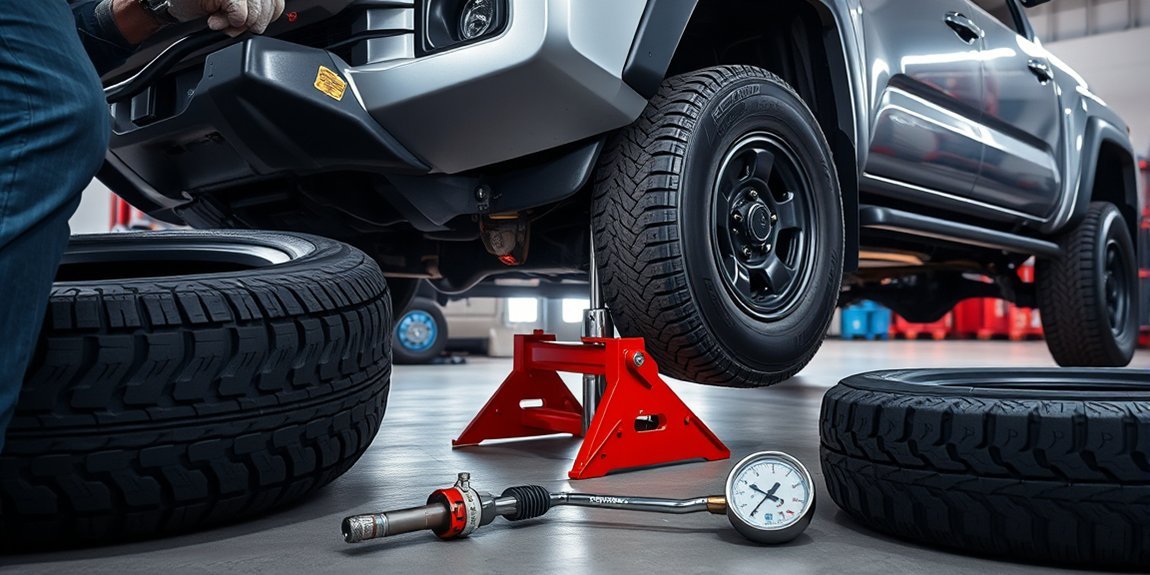
Rotation helps with normal position-based wear, but some tire problems need more than a rotation. Replace or professionally inspect a tire if you see deep cuts, exposed cords, sidewall bubbles, severe cracks, punctures near the sidewall, or tread worn to the wear bars.
Uneven Tread Wear
Uneven tread wear can show up as bald spots, feathering, cupping, inner-edge wear, outer-edge wear, or center wear. Rotation may help mild wear even out over time, but strong patterns usually point to low pressure, overinflation, alignment issues, imbalance, worn suspension parts, or heavy-load use.
Vibration While Driving
New vibration after a tire rotation is not normal. Common causes include mud or debris on the wheel, an imbalanced tire, uneven tread wear, a wheel that is not seated flat, incorrect lug-nut tightening, or a damaged tire. Stop and inspect the installation if vibration appears right after the job.
Cracking or Bulging Sidewalls
Cracks, bulges, bubbles, exposed cords, or sidewall cuts are warning signs. Do not rely on rotation to fix sidewall damage. Have the tire inspected by a tire professional and replace it if the damage is serious.
Low Tread Depth
The National Highway Traffic Safety Administration says tread should be at least 2/32 of an inch or greater on all tires. That is a minimum threshold, not a comfort target. If you drive in heavy rain, snow, mud, or off-road terrain, plan replacement before the tires reach the wear bars.
Tools You’ll Need for Tire Rotation
Having the right tools makes the job safer and cleaner. At minimum, use these:
- Lug wrench or breaker bar: Loosens lug nuts before lifting.
- Floor jack: Lifts the Tacoma at approved jack points. The emergency jack is for roadside tire changes, not ideal garage work.
- Jack stands: Support the vehicle securely after lifting.
- Wheel chocks: Help prevent the truck from rolling.
- Torque wrench: Tightens lug nuts to the correct specification after the wheels are installed.
- Tire pressure gauge: Checks cold tire pressure after rotation.
- Chalk or painter’s tape: Marks tire positions before moving them.
- Gloves and eye protection: Protect your hands and eyes from dirt, brake dust, and road debris.
[Products Worth Considering]

Keep RV, trailer, or truck dual-axle tires protected with waterproof, UV-resistant covers that help guard against sunlight, snow, rust, and dirt. The dual tire covers are easy to install with a rope/bungee fastener for a stable fit that won’t easily slip. Designed for 27–30 inch diameter wheels, they help maintain tire condition through harsh weather.

Secure your trailer or RV tires with a scissor-style wheel chock stabilizer that applies opposing force to help prevent wheel shift. It fits tight wheel gaps from 3.5 inches up to 12 inches and works for travel trailers, campers, fifth wheels, toy haulers, and heavy-duty trucks. The surface uses new electrophoretic technology to help prevent rust for reliable travel use.
Common Tire Rotation Misunderstandings and Solutions
Many tire-rotation problems come from assuming every truck uses the same pattern. Your Tacoma’s pattern can change depending on tire construction, wheel setup, and model year.
- Mistake: Using one pattern for every Tacoma. Solution: Check the owner’s manual first, then confirm tire sidewall markings.
- Mistake: Crossing directional tires. Solution: Keep directional tires on the same side unless they are demounted and remounted.
- Mistake: Guessing lug-nut torque. Solution: Use the model-year and wheel-specific torque specification from Toyota or the wheel manufacturer.
- Mistake: Skipping tire pressure. Solution: Set cold pressure to the driver’s door placard after the rotation.
- Mistake: Ignoring uneven wear. Solution: Check alignment, balance, pressure, suspension, and driving conditions if wear patterns are severe.
- Mistake: Including the spare without checking it. Solution: Only rotate in a full-size matching spare that is the same size, type, load rating, fitment, and condition.
Effective Techniques for Marking Tires Before Rotation
Marking the tires before removal keeps the job organized. Write each tire’s starting position on tape or chalk: LF for left front, RF for right front, LR for left rear, and RR for right rear. If the tires are directional, add an arrow showing the rolling direction.
After you rotate them, record the new positions, date, mileage, tread depth, and pressure. This small habit helps you spot whether one corner of the truck is wearing tires faster than the others.
When to Consult a Professional for Tire Rotation
Consult a tire shop, Toyota dealer, or qualified technician if you are unsure about the rotation pattern, do not have safe lifting equipment, find sidewall damage, see severe uneven wear, feel vibration after the rotation, or have aftermarket wheels with special lug nuts or unusual offsets.
You should also get professional help if the truck pulls to one side, the steering wheel is off-center, the tires show feathering or cupping, or you recently hit a curb, pothole, or trail obstacle. Those symptoms may need balancing, alignment, suspension inspection, or tire replacement rather than a simple rotation.
Frequently Asked Questions
How often should you rotate tires on a Toyota Tacoma?
Follow the maintenance guide for your exact model year. For the 2025 Tacoma, Toyota lists scheduled maintenance every 5,000 miles or six months and includes tire rotation at the 5,000-mile intervals. Rotate sooner if you tow, haul, off-road, or notice uneven wear.
What is the tire rotation pattern for a 4×4 Toyota Tacoma?
Use the pattern shown in your Tacoma owner’s manual. A rearward cross is common for many rear-wheel-drive and four-wheel-drive vehicles with same-size, non-directional tires, but some Tacoma manuals or tire setups may call for a different pattern. Directional tires usually stay on the same side and move front-to-back.
What should you not do when rotating Tacoma tires?
Do not work under a truck supported only by a jack, do not guess the rotation pattern, do not cross directional tires, do not use a universal lug-nut torque number, do not skip cold tire pressure, and do not ignore sidewall damage or severe uneven wear.
Do I need an alignment after every tire rotation?
No. A normal tire rotation does not require an alignment. Get an alignment check if your Tacoma pulls to one side, the steering wheel is off-center, tread wear is feathered or concentrated on one edge, or you hit a curb, pothole, or trail obstacle.
Can I include the spare tire in a Tacoma tire rotation?
Only include the spare if it is a full-size tire and wheel that matches the road tires in size, type, load rating, fitment, and condition. Do not rotate in a temporary spare, old cracked spare, different-size spare, or mismatched wheel.
What torque should Toyota Tacoma lug nuts be tightened to?
Use the torque specification for your exact Tacoma model year and wheel type. Do not assume one number applies to every Tacoma. Check your owner’s manual, Toyota service information, or the wheel manufacturer’s instructions if you have aftermarket wheels.
Conclusion
Rotating your Toyota Tacoma’s tires is one of the simplest ways to promote even tread wear, protect handling, and inspect the tires before small problems become expensive. The safest approach is to follow your owner’s manual pattern, lift the truck correctly, use jack stands, torque the lug nuts to the correct spec, and set cold tire pressure when you are done. Done on schedule, tire rotation keeps your Tacoma smoother, safer, and ready for daily driving, towing, hauling, or trail use.
Sources
- Toyota 2025 Tacoma Warranty & Maintenance Guide — official Tacoma maintenance interval, tire-rotation schedule, and tire-inspection guidance.
- Toyota Manuals and Warranties: 2025 Tacoma — official access point for Tacoma owner’s manuals and warranty guides.
- Toyota 2025 Tacoma Digital Manual: Tires — tire condition, treadwear, and tire-care reference.
- NHTSA TireWise — tire safety, pressure, maintenance, labeling, and recall guidance.
- Tire Industry Association: Tire Rotation — general tire-rotation pattern guidance for tire service and consumer safety.

Related Articles

How Tire Weight Affects Toyota Tacoma Performance
How does tire weight influence your Toyota Tacoma's performance and efficiency? Discover the surprising effects that could change your driving experience.
Read More
Tire Noise Levels by Tire Type on a Toyota Tacoma
A comprehensive look at how tire types affect noise levels in your Toyota Tacoma reveals surprising insights that could enhance your driving experience.
Read More
How To Choose Tires for a Dual Use Toyota Tacoma
Unlock the secrets to selecting the perfect tires for your dual-use Toyota Tacoma, ensuring optimal performance and comfort on every adventure. Discover more inside!
Read More