
Toyota Hilux Tire Pressure: Cold vs Hot Reading Differences
Your Toyota Hilux does not have one tire-pressure setting that is correct for every year, trim, tire size, and load. The safe setting is the cold inflation pressure printed on your vehicle’s tire-pressure label or listed in the exact owner’s manual. Checking that value with an accurate gauge helps protect tire life, handling, fuel use, and load-carrying performance.
Quick Answer
Check your Toyota Hilux tire pressure when the tires are cold and set it to the value on the vehicle’s pressure placard or exact owner’s manual—not a universal 32–35 PSI target and not the maximum molded on the tire. Do not bleed air from warm tires; recheck and adjust them cold.
Key Takeaways
- Use the pressure label on your Hilux or its exact owner’s manual because front, rear, normal-load, and full-load settings may differ.
- Measure pressure before driving or after the vehicle has been parked for at least three hours.
- Do not use the maximum pressure molded on the tire sidewall as the vehicle’s normal target.
- Do not release air from a warm tire simply because its reading is above the cold specification.
- Check all road tires and the spare regularly, and investigate any tire that repeatedly loses pressure.
At a Glance
| Time Required | About 5–10 minutes |
| Difficulty | Easy |
| Tools Needed | Accurate tire-pressure gauge and access to an air compressor |
| Cost | Usually no added cost if you already have access to a gauge and air source |
Find the Correct Toyota Hilux Tire Pressure First
Before adding or releasing air, find the specification for your exact Hilux. Toyota advises owners to look for the pressure label inside the driver’s door area or consult the vehicle’s owner’s manual. The label may show different pressures for the front and rear tires or for normal and fully loaded driving.
The current Hilux range includes several body styles, tire sizes, drivetrains, and load ratings. For that reason, a pressure quoted for another Hilux—even one that looks similar—may not apply to yours. Use the VIN, model year, original tire size, and market-specific manual when identifying the correct specification.
| Pressure information | How to use it |
|---|---|
| Vehicle pressure placard | Use this as the main cold-pressure specification for the listed tires and load conditions. |
| Exact owner’s manual | Use it to confirm axle, load, spare-tire, towing, and market-specific instructions. |
| Maximum pressure on the tire sidewall | Do not use this as the normal Hilux setting. It is tire-limit information, not the vehicle manufacturer’s target. |
| Pressure from another Hilux owner | Do not rely on it unless the vehicle, tires, axle settings, and load conditions are confirmed to match yours. |
Note: The PSI or kPa molded into a tire sidewall is not the normal inflation recommendation for your Hilux. Follow Toyota’s vehicle label or exact manual instead.
[Products Worth Considering]

EVOULTES heavy duty tire inflator with an integrated gauge delivers accurate pressure readings from 10–120 PSI, helping you inflate, deflate, and check tires in one tool. The 16.5-inch extended dual-head air chuck with swivel base reaches hard-to-access dual wheel valves on trucks and RVs. A brass trigger core and side-mounted air release valve make operation smooth, with standard 1/4" NPT threading and quick-connect compatibility for easy setup.

This portable cordless tire inflator delivers up to 160 PSI with fast 17 L/min airflow to help you quickly top up tires and get back on the road. It features dual power mode, running on a 21V rechargeable battery or a 12V DC adapter for convenient roadside use. An automatic shut-off with digital pressure gauge helps prevent overinflation, and a built-in LED light improves visibility in low-light conditions.

The JACO FlowPro Tire Inflator measures, inflates, and airs down tires up to 100 PSI with battery-free operation and ±2% accuracy after calibration. It features a glowing pressure dial for night visibility, a heavy-duty steel build with a hybrid hose, and a precision push-to-inflate thumb trigger. The patented Lightning Air Chuck locks on for a secure seal, and the kit includes quick-connect hardware for easy inline use with your air compressor.
Why Cold Tire Pressure Matters for Your Toyota Hilux
A cold reading gives you a consistent starting point. The National Highway Traffic Safety Administration defines cold tires as tires on a vehicle that has not been driven for at least three hours. Michelin also advises checking before driving or before the vehicle has traveled more than about 1 mile or 1.6 kilometres.
Driving flexes the tires and produces heat. As the air and tire warm, the measured pressure rises. That increase does not mean the tire was overinflated when cold, which is why the pressure label is based on a cold reading.
Check pressure in the morning when possible, before direct sun has warmed one side of the vehicle. If the left-side tires have been sitting in strong sunlight while the right-side tires are shaded, their readings may differ even before you drive.
Ambient temperature also affects pressure. As a rough guide, Michelin says tire pressure may change by about 1 PSI for each 10°F change in temperature. Treat this as a reminder to recheck the tires during a major weather change, not as a substitute for using a gauge.
The correct Hilux pressure is the manufacturer’s specified cold pressure—not a number copied from the tire sidewall or another vehicle.
How to Interpret Hot Tire Pressure
A tire that has been driven on will normally read higher than it did when cold. The size of the increase depends on driving speed, distance, ambient temperature, load, tire construction, road surface, and exposure to sunlight. There is no universal hot-pressure target or fixed number of PSI to subtract.
| Warm-pressure observation | Safe response |
|---|---|
| All tires read several PSI above the cold specification after driving | Do not bleed them down. Let the vehicle sit and recheck the pressure cold. |
| One warm tire is noticeably lower than the others | Inspect it for a puncture, valve leak, wheel damage, or another source of air loss. |
| A warm tire is still below the vehicle’s cold specification | It may be significantly underinflated. Add air as a temporary safety measure, then check and set it accurately when cold. |
| Pressure rises unusually fast or the tire feels excessively hot | Stop in a safe place and inspect for underinflation, overload, damage, brake drag, or another mechanical problem. |
Warning: Do not release air from a warm tire merely to make it match the cold placard value. Michelin advises against reducing hot-tire pressure because the tire may become underinflated after it cools.
What Affects Tire Pressure in Your Hilux?
Ambient Temperature
Colder air lowers the measured pressure, while warmer air raises it. Check the tires after a major seasonal temperature change and adjust them to Toyota’s cold specification. Do not wait for the tires to look flat because radial tires can be underinflated without appearing visibly low.
Normal Air Loss and Leaks
Tires lose small amounts of air over time. Faster or repeated loss may point to a puncture, leaking valve core, damaged valve stem, corroded wheel sealing surface, bent rim, or poor bead seal. A tire that repeatedly needs air should be inspected rather than continually topped up.
Payload and Towing
Passengers, cargo, accessories, trailer tongue weight, and a tray or canopy can change the load placed on each axle. Some Hilux labels or manuals provide a higher full-load setting, and the front and rear values may differ.
Do not add an arbitrary number of PSI just because the vehicle is carrying a heavy load. Use Toyota’s listed loaded-vehicle pressure and remain within the Hilux gross vehicle mass, axle limits, tire load ratings, and towing limits.
Tire and Wheel Changes
Aftermarket tires may use a different construction, load index, or size from the original equipment. The sidewall maximum still does not become the target pressure. Ask a qualified tire professional or Toyota dealer to confirm a safe cold pressure that supports the vehicle’s axle loads and handling requirements.
Altitude
A normal tire gauge measures pressure relative to the surrounding air. Routine altitude changes do not justify guessing a new pressure. Continue to use Toyota’s cold-pressure specification unless the owner’s manual or tire manufacturer provides different instructions for a specific use.
Off-Road Driving
Some drivers temporarily reduce pressure on sand or other off-road surfaces, but there is no universal Hilux off-road PSI. The safe value depends on tire construction, load, speed, wheel size, terrain, and the risk of the tire separating from the rim.
Toyota’s official off-road preparation guidance includes carrying a tire-pressure gauge and air compressor. Use a vehicle- and tire-specific plan, drive slowly at reduced pressure, avoid sharp steering inputs, and reinflate to the road specification before returning to sealed roads or higher speeds.
How Incorrect Tire Pressure Can Compromise Safety
Incorrect tire pressure can affect steering response, braking stability, tire temperature, tread wear, ride comfort, and load-carrying ability. The amount of change depends on the tire and operating conditions, so broad claims based on a single PSI figure should be avoided.
Impact on Traction
An underinflated tire flexes more than intended and may respond less precisely during steering or emergency maneuvers. An overinflated tire may produce a harsher ride and can be more vulnerable to impact damage. Either condition can interfere with the balance Toyota intended for the vehicle.
Pressure alone does not guarantee grip. Tread depth, tire age, compound, road surface, rain, mud, snow, load, and driving speed also matter. Maintaining the specified pressure gives the tire the best chance to operate as designed.
Heat, Damage, and Tire-Failure Risk
Underinflation causes extra sidewall flexing, which generates heat. Sustained heat can damage the tire’s internal structure and may contribute to tread separation or sudden failure, especially at higher speeds or under heavy loads. NHTSA identifies proper inflation as a key part of preventing tire problems.
Overloading can create similar stress even when the gauge reading appears correct. Before towing or carrying a heavy payload, confirm the axle loads, tire load ratings, and Toyota’s full-load pressure instructions.
Uneven Tire Wear
Underinflation is commonly linked with faster wear at the shoulders of the tread. Excessive pressure can contribute to faster center wear. However, uneven wear can also result from alignment, worn suspension parts, wheel imbalance, aggressive driving, or incorrect rotation.
Check pressure before assuming that alignment is the only cause. If the tread is wearing unevenly after the pressure has been corrected, arrange a tire and suspension inspection.
TPMS Warnings and Limitations
A tire-pressure monitoring system can warn you when pressure becomes significantly low, but it does not replace a manual gauge check. A warning may appear on a cold morning and disappear after driving as the tires warm. That still means the cold pressure should be checked.
If the TPMS light flashes before staying on, the system itself may have a fault. Check the owner’s manual and arrange service if the warning does not behave normally.
Best Practices for Maintaining Optimal Tire Pressure
- Check the tires cold: Measure before driving or after the Hilux has been parked for at least three hours.
- Use the vehicle specification: Follow the driver-door label or exact owner’s manual.
- Check regularly: Toyota Australia advises a visual check each week and a gauge check every two weeks or at least monthly.
- Check before long trips: Inspect pressure, tread, sidewalls, valves, and the spare before highway travel or remote-area driving.
- Account for load: Use Toyota’s full-load setting when the placard or manual calls for it.
- Use one reliable gauge: Different gauges can vary, so use the same good-quality gauge for consistent comparisons.
- Replace valve caps: Caps help keep dirt and moisture away from the valve.
- Investigate recurring loss: Do not treat repeated top-ups as normal maintenance.
Pro Tip: Record the four cold readings, outdoor temperature, and vehicle load in your phone. A pattern makes it easier to spot a slow leak or a tire that consistently differs from the others.
[Products Worth Considering]

The AstroAI L7 Air Tire Inflator refills car tires quickly with up to 150PSI max pressure and a fast 1-minute inflation claim. It includes 5 preset modes for car, motorcycle, bicycle, balls, and manual use, along with an auto shutoff to help prevent overinflation. Designed for convenience, it features a digital gauge with unit switching, a top LED light with multiple modes, and USB-C/USB ports for backup power.
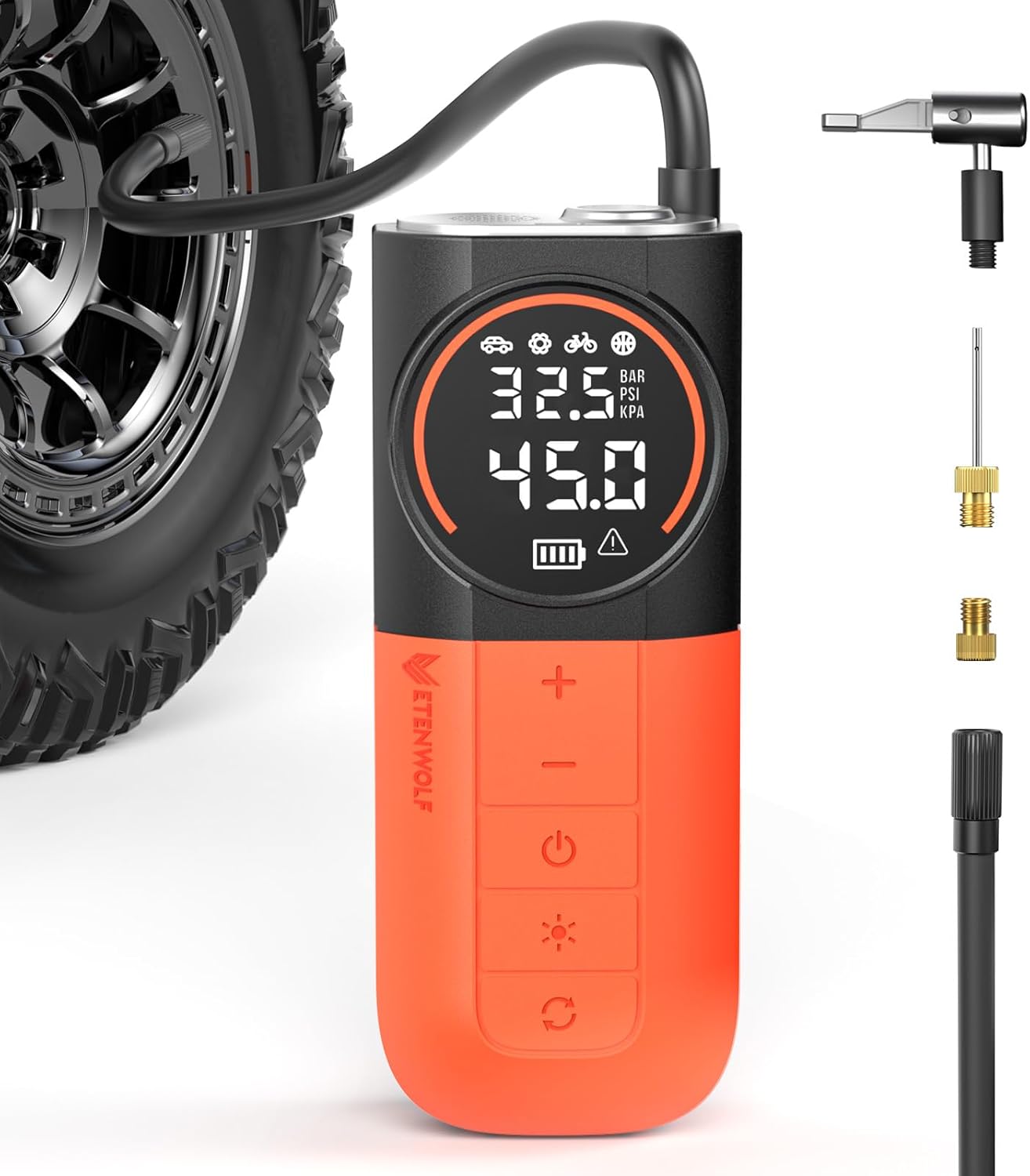
The ETENWOLF S1 cordless tire inflator delivers ultra-fast inflation with up to 160 PSI and a 20 L/min airflow for quicker tire top-offs. Its 5200mAh battery and cooling system support inflating many tires and sports balls on a single charge, while the digital pressure gauge and multi-unit display help you reach the right pressure accurately. With preset modes, pressure memory, an auto-stop feature, and an LED flashlight, it’s built for easy roadside and everyday use.
How to Measure Toyota Hilux Tire Pressure Accurately
- Park the Hilux: Leave it parked for at least three hours, preferably in shade and on level ground.
- Find the correct values: Read the tire-pressure label and note any different front, rear, normal-load, or full-load specifications.
- Check the fitted tire size: Confirm that the tires match the size and load rating covered by the label or manual.
- Remove the valve cap: Keep it somewhere clean so it is not lost.
- Attach the gauge firmly: Press it squarely onto the valve until the hissing stops and the gauge gives a stable reading.
- Compare the reading: Check it against the correct cold specification for that axle and load condition.
- Add or release air: Make small adjustments and remeasure until the pressure is correct.
- Repeat the process: Check all four road tires and the spare if the vehicle carries one.
- Replace every valve cap: Tighten it by hand.
- Inspect the tires: Look for cuts, bulges, embedded objects, cracked rubber, damaged valves, and uneven tread wear.
If you must add air after driving, do not bleed the tires to the cold specification while they are warm. Recheck them when cold and make the final adjustment then.
Troubleshooting Toyota Hilux Tire-Pressure Problems
One Tire Keeps Losing Pressure
A tire that repeatedly loses air may have a puncture, valve leak, damaged wheel, bead-seal problem, or internal damage. Have it inspected promptly. Do not rely on frequent top-ups for a tire that cannot hold its specified pressure.
All Four Tires Read Low After a Cold Night
A broad drop after a major temperature change may be caused by the colder air rather than four simultaneous punctures. Check every tire cold and adjust each one to the placard specification. Continue monitoring them to rule out leaks.
The Front and Rear Settings Are Different
This can be normal. Use the value assigned to each axle rather than setting all four tires to the same number. Recheck the positions after a tire rotation because the tire now on the other axle may need a different pressure.
The TPMS Light Returns
Check all tires with a gauge, including any tire that does not look low. If the pressures are correct but the warning remains, follow the reset or initialization procedure in the exact owner’s manual. A flashing warning may indicate a sensor or system fault.
The Hilux Pulls or Vibrates
First confirm that the pressures match the correct axle specifications. If they do, inspect for tire damage and arrange checks for wheel balance, alignment, brakes, bearings, and suspension components.
When to Stop Driving
Stop in a safe place if a tire is rapidly losing air, visibly damaged, bulging, separating, smoking, or becoming unusually hot. Fit the spare only if it is safe to do so and the spare is properly inflated, or call for roadside assistance.
Frequently Asked Questions
Should I check my Toyota Hilux tire pressure cold or hot?
Check and set it cold. A cold tire has normally been parked for at least three hours. Warm readings can help identify a problem, but they should not be used to bleed the tires down to the cold placard value.
How much does tire pressure rise when the tires get hot?
There is no universal increase. The change depends on driving distance, speed, tire construction, load, road temperature, sunlight, and ambient conditions. Do not use a fixed hot-to-cold correction; recheck the tires after they cool.
Why does tire pressure read lower when it is cold?
The air inside the tire contracts as its temperature falls, which lowers the gauge reading. Check the tires after a major weather change and restore them to Toyota’s specified cold pressure.
Is 25 PSI too low for a Toyota Hilux in winter?
It is too low if 25 PSI is below the cold pressure shown on your Hilux placard or in its exact manual. Do not judge it from a universal Hilux figure. Compare the cold reading with the specification for your vehicle, axle, tires, and load.
Where can I find my Hilux tire-pressure specification?
Look for the vehicle pressure label in the driver’s door area and check the exact owner’s manual. The location can vary by model and market. A Toyota dealer can help identify the correct manual from the VIN.
Should I use the PSI printed on the tire sidewall?
No. The sidewall figure is tire-limit information and is not the Hilux manufacturer’s normal pressure recommendation. Use the vehicle placard or exact owner’s manual.
Do I need more pressure when towing or carrying a heavy load?
Use the full-load pressure shown by Toyota when the placard or manual specifies one. Do not invent an increase. Also remain within the vehicle, axle, wheel, and tire load limits.
Can TPMS tell me the correct pressure?
TPMS warns about low pressure or a system fault, but it does not replace the placard or a manual gauge check. Use Toyota’s specified cold pressure even when no warning light is showing.
Sources
- Toyota Australia FAQs and Support — backs the use of the vehicle label or owner’s manual and regular cold-pressure checks.
- NHTSA TireWise — backs cold-pressure measurement, placard use, monthly checks, tire inspection, and TPMS limitations.
- Michelin Tire FAQs — backs the cold-tire definition and warning not to reduce pressure when tires are hot.
- Michelin Tire-Pressure Guide — backs the checking procedure and regular inspection advice.
- Continental Tire-Pressure Guide — backs temperature effects and the distinction between manufacturer pressure and sidewall maximum pressure.
- Toyota Australia Adventurer Hub — backs carrying a tire-pressure gauge and compressor for off-road preparation.
Conclusion
The correct Toyota Hilux tire pressure is the cold value listed for your exact vehicle, tires, axle, and load condition. Check it with a reliable gauge before driving, use Toyota’s full-load setting when required, and never substitute the tire sidewall maximum or a generic 32–35 PSI range.
Warm pressure will normally rise during driving, so do not bleed a hot tire merely to match the cold label. Recheck it after the Hilux has cooled, inspect any tire that repeatedly loses air, and seek professional help for damage, unusual heat, vibration, or continuing TPMS warnings.

Related Articles
Toyota Hilux Run-Flat Tires: What You Need to Know
Take control of your safety with Toyota Hilux run-flat tires; discover their benefits and hidden costs that could change your driving experience forever.
Read More
Effects of Underinflated Tires on the Toyota Hilux
Inadequate tire pressure in your Toyota Hilux can lead to serious safety issues and costly repairs; discover how to avoid these pitfalls.
Read More
The Risks of Overinflating Toyota Hilux Tires
Overinflating your Toyota Hilux tires can lead to dangerous blowouts and uneven wear, but understanding the risks is crucial for your safety.
Read More