
Toyota Hilux Max Tire Size With a 3-Inch Lift
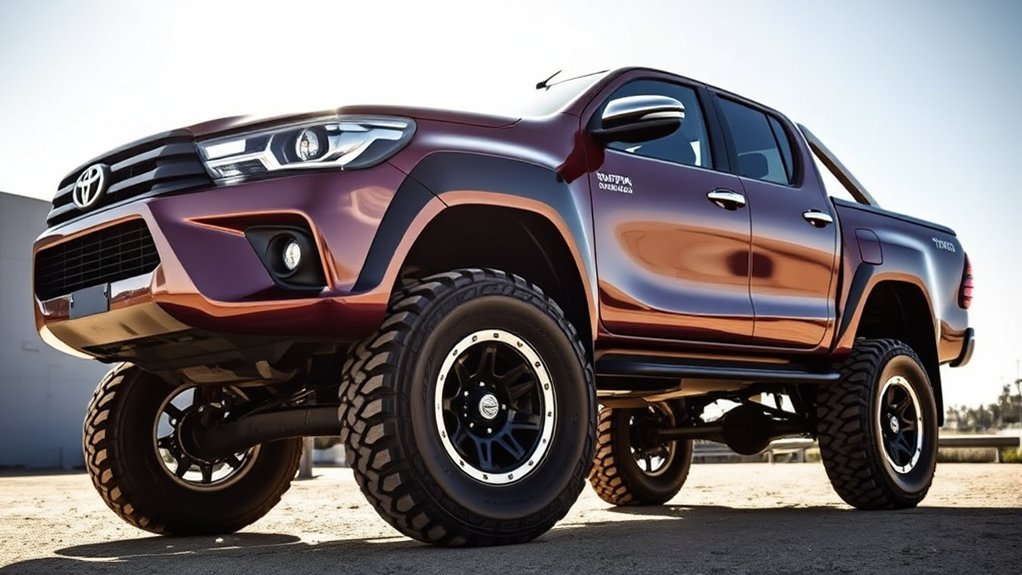
Choosing tires for a lifted Toyota Hilux is not just about picking the biggest size that looks good. A 3-inch lift gives you more room, but the final fit depends on your Hilux generation, wheel offset, tire width, caster settings, bumper shape, mud flaps, body mount clearance, and local road rules.
Quick Answer
Most Toyota Hilux builds with a true 3-inch lift can usually run a 285/70R17 or 285/75R16, both of which are roughly 33 inches tall. A wider 295/70R17 or 33×12.50 may fit, but often needs trimming, careful offset choice, and a body mount chop.
Key Takeaways
- Best all-round size: 285/70R17 is the most practical 33-inch-style option for many 3-inch-lift Hilux setups.
- 16-inch wheel option: 285/75R16 gives a similar height with more sidewall for off-road comfort.
- Wider tires rub sooner: 295/70R17 and 33×12.50 sizes need more trimming, offset planning, and alignment work.
- Do not skip ratings: choose a tire with a suitable load index and speed rating for your Hilux and its tire placard.
- Check legality first: a 3-inch lift may require engineering approval or certification depending on where the vehicle is registered.
At a Glance
| Time Required | 30–60 minutes to measure; longer if test-fitting, trimming, or aligning |
| Difficulty | Moderate; professional alignment is strongly recommended |
| Tools Needed | Tape measure, tire-size calculator, wheel offset/backspacing specs, jack stands, alignment report |
| Cost | Tires plus alignment; trimming, upper control arms, or certification can add significantly more |
Understanding Tire Size Compatibility for the Hilux
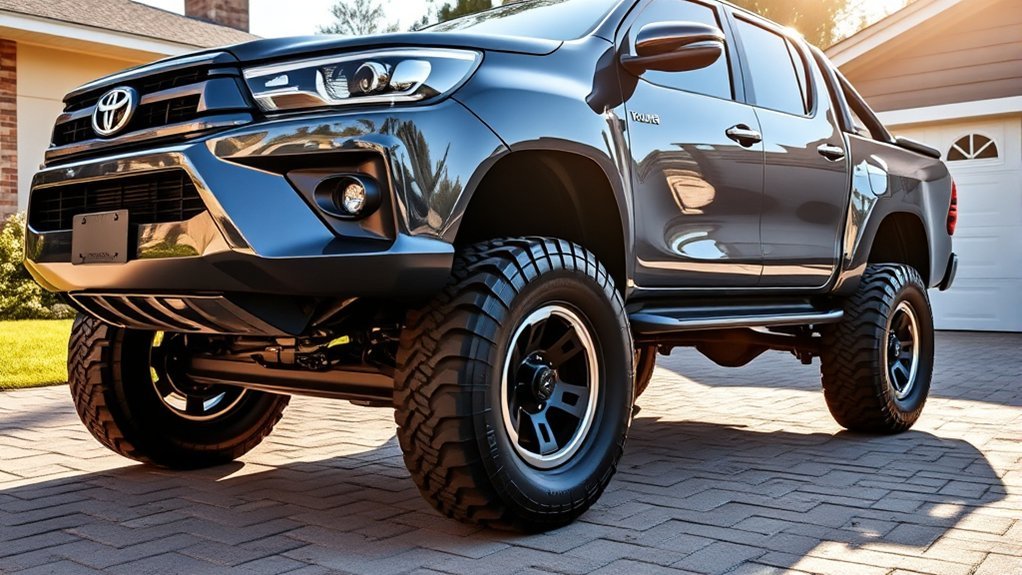
Current Toyota Hilux factory tire sizes are much smaller than most lifted-tire upgrades. For example, Toyota lists sizes such as 265/65R17 and 265/60R18 on current Australian Hilux grades, while Toyota UK lists 265/65R17 and 265/60R18 depending on grade. That means a 33-inch tire is an aftermarket fitment, not a factory-approved size.
With a 3-inch lift, the most common practical target is a tire around 32.7 to 33.0 inches tall. This usually means 285/70R17 or 285/75R16. These sizes improve ground clearance and give the Hilux a stronger off-road stance without jumping straight into the problems that come with very wide tires.
Warning: A 3-inch lift may not be road-legal without certification in some regions. In Australia, VSB 14 Section LS treats basic modifications differently from lifts beyond 50 mm. Always check your state, country, insurer, and inspection rules before fitting larger tires or cutting body mounts.
The key is not just height. Tire width matters just as much. A tall, narrow 33-inch tire may clear more easily than a shorter but wider tire. A 285 mm tire is usually easier to manage than a 295 mm or 12.50-inch-wide tire because it is less likely to hit the body mount, mud flap, inner guard, or outer fender.
[Products Worth Considering]

This VEVOR tire bead breaker uses a slide-hammer impact and wedge tip to separate tire beads from rims quickly and efficiently without damaging hub surfaces. The long handle and sturdy steel construction help reduce user strain while providing reliable, portable tire changing for cars, trucks, and more. Ideal for home mechanics and repair shops handling multiple vehicle tire sizes.
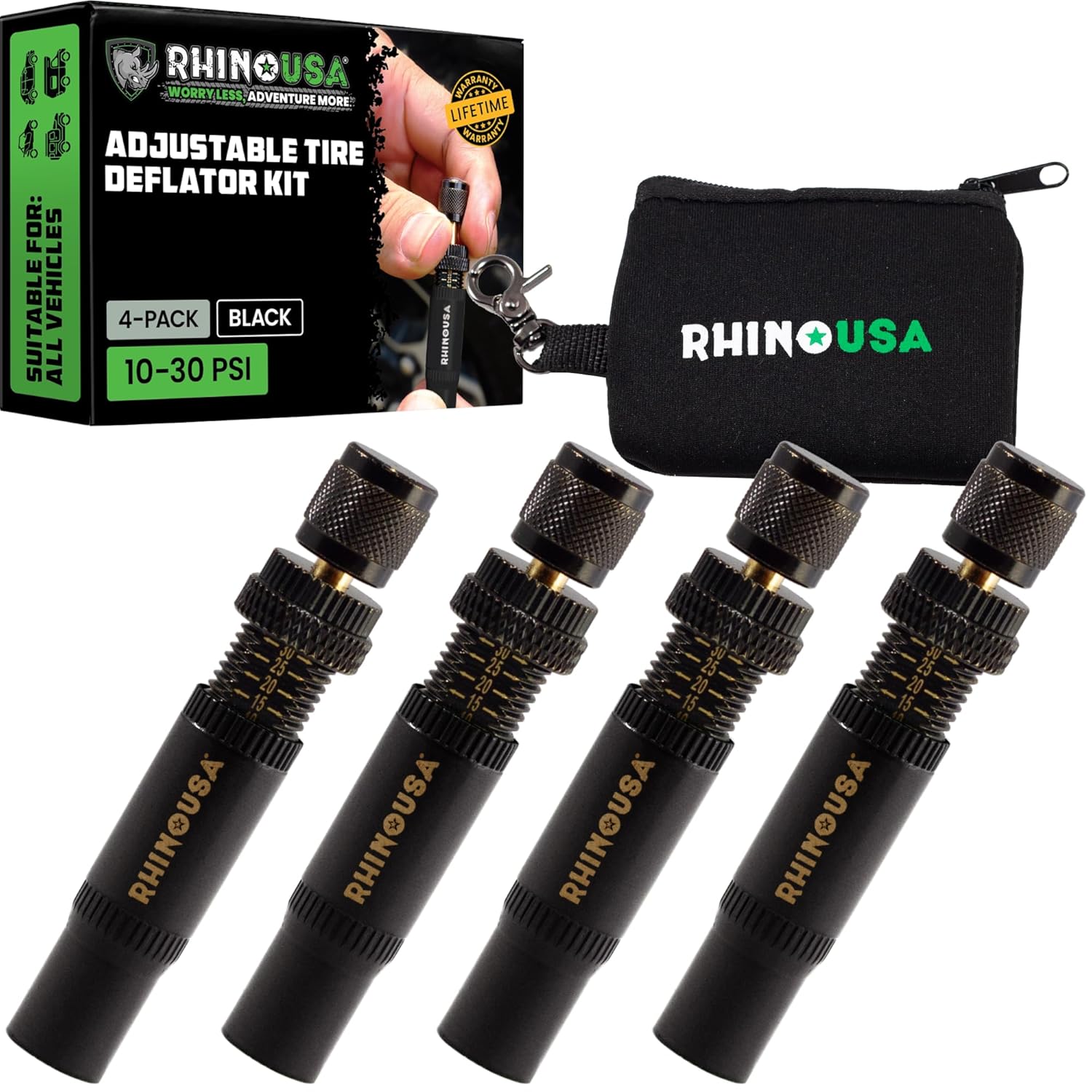
Use the Rhino USA adjustable tire deflators to air down all four tires at once by screwing one deflator onto each valve stem, letting you step away while the tires reach your preset pressure. Each deflator independently adjusts across a 10–30 PSI range with laser-etched indicators for quick setup and verification, making it ideal for beach, sand, and rocky off-road trails.

Secure your trailer or RV tires with a scissor-style wheel chock stabilizer that applies opposing force to help prevent wheel shift. It fits tight wheel gaps from 3.5 inches up to 12 inches and works for travel trailers, campers, fifth wheels, toy haulers, and heavy-duty trucks. The surface uses new electrophoretic technology to help prevent rust for reliable travel use.
Best Tire Sizes for a 3-Inch Lifted Hilux
The table below gives a practical starting point. Exact fitment still depends on your Hilux year, wheel width, offset, alignment, suspension brand, bull bar, and how much the suspension compresses off-road.
| Tire Size | Approx. Diameter | Approx. Width | Fitment Notes |
|---|---|---|---|
| 265/65R17 | 30.6 in | 10.4 in | Common factory-style size on many Hilux grades; easy clearance but not a 33-inch upgrade. |
| 285/70R17 | 32.7 in | 11.2 in | Best all-round choice for many 3-inch-lift Hilux builds; minor trimming may still be needed. |
| 285/75R16 | 32.8 in | 11.2 in | Similar to 285/70R17 but with more sidewall; good for off-road comfort if your 16-inch wheels clear the brakes. |
| 255/85R16 | 33.1 in | 10.0 in | Tall and narrow; can clear better than wider 33s, but tire choices are more limited. |
| 295/70R17 | 33.3 in | 11.6 in | More aggressive; often needs trimming, caster correction, and possibly a body mount chop. |
| 33×12.50 | 33.0 in | 12.5 in | Very wide for a Hilux; expect more rubbing, road noise, weight, and clearance work. |
Tire dimensions are calculated from the size code. In a size such as 285/70R17, Bridgestone explains that 285 is section width in millimeters, 70 is sidewall height as a percentage of width, and 17 is wheel diameter in inches.
Required Modifications for Tire Clearance
A 3-inch lift creates vertical clearance, but rubbing often happens at the front and rear of the wheel arch while turning, reversing, or compressing the suspension. That is why two Hilux trucks with the same lift and tire size can behave differently.
Common clearance modifications include:
- Fender liner trimming: helps when the tire touches plastic liners at full lock.
- Mud flap removal or trimming: common with 285 mm and wider tires.
- Front bumper trimming: may be needed with aggressive tread blocks or wider offsets.
- Body mount chop: often needed for wider or taller 33-inch tires, especially 295/70R17 or 33×12.50.
- Aftermarket upper control arms: can help restore caster after a lift, improving clearance and steering feel.
- Professional alignment: needed after lifting, changing tire size, or installing control arms.
Pro Tip: Do not buy tires based only on diameter. Ask the tire shop to test-fit one front tire first, then turn lock-to-lock, reverse slowly, and compress the suspension if possible. Most rubbing problems show up before all four tires are mounted.
How to Determine Maximum Tire Sizes for a 3-Inch Lift
To find the largest safe tire size for your Hilux, use a step-by-step check instead of relying on one generic answer.
Start With Your Stock Size
Check the tire placard on the vehicle and the owner’s manual. Many current Hilux models use factory sizes around 30.5 to 30.6 inches tall, such as 265/65R17 or 265/60R18. Moving to a 32.7-inch 285/70R17 adds about 2.1 inches of tire diameter, which gives roughly 1 inch of extra axle clearance.
Measure the Critical Clearance Points
Before ordering tires, inspect the front wheel wells. Pay close attention to the rear of the front guard, body mount area, mud flap, bumper edge, upper control arm, sway bar, and brake-line routing. These are the areas most likely to create problems with larger tires.
Check Wheel Offset and Backspacing
Wheel offset changes where the tire sits. A lower or more negative offset pushes the tire outward. That can improve inner clearance near the upper control arm, but it can also make the tire hit the outer guard or bumper sooner. A very aggressive offset may also increase steering load, bearing stress, and road spray.
Choose a Safe Load and Speed Rating
Do not choose a tire by size alone. The tire must have a suitable load index and speed rating for the vehicle. The U.S. Tire Manufacturers Association advises using tires that match the size, load index, and speed rating recommended by the vehicle manufacturer. Bridgestone’s replacement guidance also recommends using the tire placard or owner’s manual for size, load index, and speed symbol.
Align the Hilux After Installation
After fitting larger tires, book a wheel alignment. Ask for caster, camber, and toe readings. More positive caster can help move the front tire slightly forward in the arch, which may reduce rubbing at the rear of the guard and improve straight-line stability.
Pros and Cons of Upgrading to Larger Tires
Larger tires can transform how a Toyota Hilux looks and performs, but the trade-offs are real. A balanced 33-inch setup can work well for touring, trail driving, and daily use. A very wide or heavy setup can make the truck feel slower, louder, and harder to steer.
Performance Impact
A tire around 33 inches tall improves ground clearance under the diffs and can increase the approach angle slightly. The larger footprint can also help traction on sand, dirt, and loose rock. However, bigger tires are heavier and create more rolling resistance. You may notice slower acceleration, longer braking distances, more steering effort, and higher fuel use.
Re-gearing is not automatically required for a 285/70R17 or 285/75R16 setup, but it may be worth considering if your Hilux feels sluggish, tows often, carries constant weight, or runs tires heavier than a typical all-terrain 33.
Aesthetic Considerations
Visually, 33-inch tires suit a 3-inch-lift Hilux because they fill the guards better than factory tires. A 285-width tire usually gives a strong stance without looking excessive. A 33×12.50 tire looks more aggressive, but it also creates more clearance problems and may throw more road spray outside the guards.
Cost Versus Benefit
The tire purchase is only part of the cost. You may also need alignment, trimming, new upper control arms, speedometer correction, mud flap changes, body mount work, or engineering approval. For most daily-driven Hilux owners, a 285/70R17 all-terrain is the best cost-versus-benefit choice because it gives the 33-inch look without the most expensive clearance problems.
How Tire Size Affects Alignment
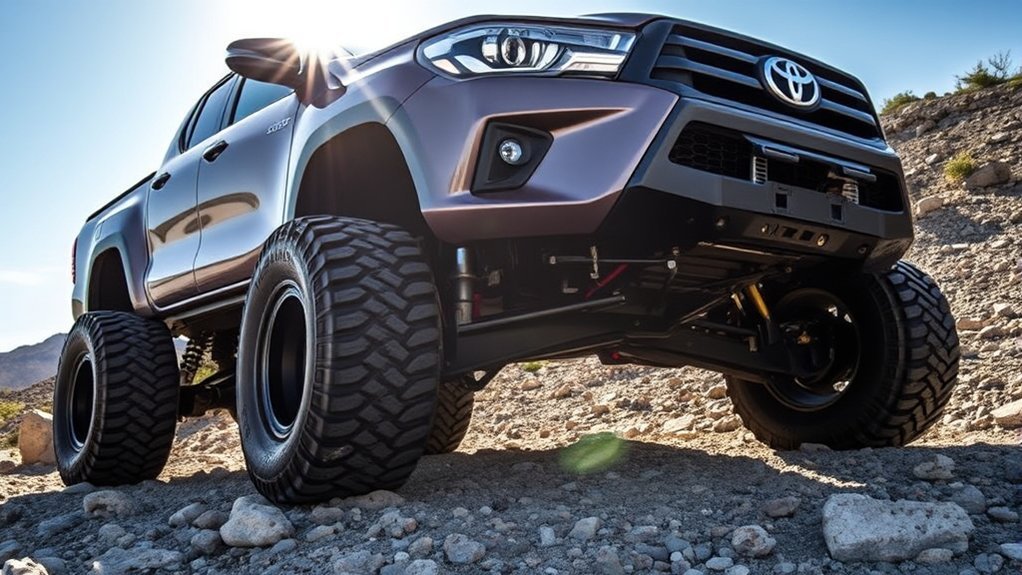
A suspension lift changes the front-end geometry of the Hilux. Larger tires make small alignment problems more obvious because they add weight, width, and leverage. If the alignment is poor, the vehicle may wander, pull to one side, scrub the outer edges of the tires, or feel vague at highway speed.
After fitting larger tires, ask the alignment shop to check:
- Caster: helps straight-line stability and can improve front-guard clearance.
- Camber: affects tire contact and edge wear.
- Toe: has a big effect on steering feel and tire wear.
- Steering wheel center: should be corrected after the alignment.
Note: If the shop cannot bring caster back into a good range after a 3-inch lift, aftermarket upper control arms may be needed. This is especially common when trying to clear 33-inch tires without heavy trimming.
How Upgraded Tires Enhance Off-Road Performance
Upgraded tires can improve off-road performance in three main ways: more clearance, better traction, and stronger sidewalls. A 285/70R17 or 285/75R16 all-terrain or mud-terrain gives the Hilux more rubber on the ground and more sidewall than many factory-style road tires.
The extra sidewall can help absorb impacts on corrugations, rocks, and ruts. Wider tread can improve grip in loose terrain, although going too wide can make the Hilux feel heavier and less precise on the road. In mud and sand, tire pressure matters as much as size, so use safe pressures for the terrain and re-inflate before highway driving.
The best Hilux tire upgrade is not always the biggest one. It is the largest size that clears safely, keeps the right load rating, aligns correctly, and still suits how you actually drive.
[Products Worth Considering]

Universal magnetic jack pad with aluminum grooved design to protect vehicle pinch welds during lifting. Durable nylon pad inserts are upgraded and secured with screws to resist damage and keep in place. Designed to fit most single vehicle pinpoint welds for safer, stable jacking when changing tires, repairs, or performing oil changes.

This portable cordless tire inflator delivers fast, efficient inflation for cars, motorcycles, bikes, and sports balls with a digital pressure gauge. Use the one-click PSI preset with auto shut-off for accurate, hands-free topping to your target pressure up to 150 PSI. It’s compact and rechargeable with a built-in emergency LED light plus valve adapters and accessories for quick, ready-to-go use.
How to Choose Tires That Look Great on Your Hilux
To get the right look without ruining drivability, balance tire height, width, tread pattern, and wheel offset.
- Pick the height first: for a 3-inch lift, around 32.7 to 33 inches is the sweet spot.
- Control the width: 285 mm is usually easier to live with than 295 mm or 12.50 inches.
- Match the tread to the use: all-terrain tires suit daily driving and touring; mud-terrain tires suit harder trails but add noise and weight.
- Avoid extreme offset: a wider stance looks good, but too much poke can create rubbing, legal, and bearing-load issues.
- Check the tire rating: make sure load index and speed rating are suitable for the Hilux.
Real User Experiences With Upgrading Tire Sizes on the Hilux
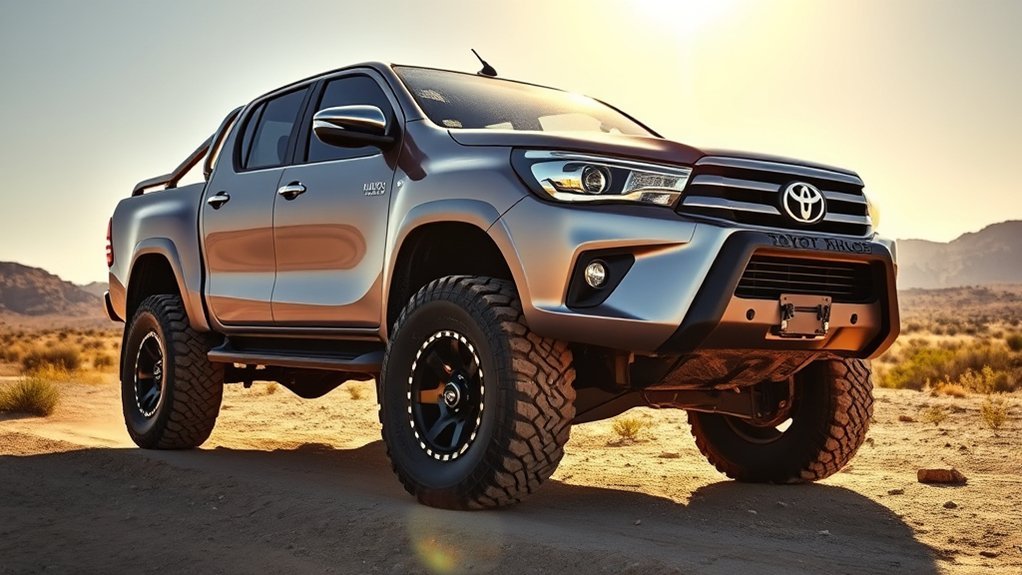
Common Hilux build patterns are fairly consistent: 285/70R17 is the popular safe bet, 285/75R16 is the practical 16-inch alternative, and 295/70R17 is where rubbing becomes more likely. Owners who run wider tires often report needing more caster, mud flap trimming, bumper trimming, or a body mount chop.
On-road feedback also changes with tire construction. A heavy mud-terrain can feel slower and louder than a lighter all-terrain in the same size. If your Hilux is used for commuting, towing, and weekend tracks, a load-rated all-terrain in 285/70R17 is usually the most balanced choice.
Community Tips for Tire Upgrades and Modifications
Before you commit to a tire upgrade, run through this checklist:
- Confirm your current tire placard size so you know how much larger the new tire really is.
- Check your wheel width and offset before assuming a tire will clear.
- Test-fit one front tire before mounting the full set.
- Turn lock-to-lock on flat ground and while reversing.
- Check compression clearance if you drive off-road or carry heavy loads.
- Book an alignment immediately after fitting tires or suspension parts.
- Re-check rubbing after the first trail drive because off-road flex can reveal contact that does not appear in the workshop.
Troubleshooting Common Rubbing Problems
If your Hilux rubs after the tire upgrade, the rubbing location usually tells you what to fix.
- Rubbing at the rear of the front guard: more caster, mud flap trimming, or body mount work may be needed.
- Rubbing at the front bumper: bumper trimming or a less aggressive offset may help.
- Rubbing near the upper control arm: wheel offset or a narrower tire may be required.
- Rubbing only off-road: check bump stops, suspension compression, and whether the tire is contacting the inner guard under load.
- Uneven tire wear: get a fresh alignment and inspect suspension bushes, ball joints, and tie rods.
Frequently Asked Questions
Will larger tires affect my fuel efficiency?
Yes. Larger tires are usually heavier and create more rolling resistance, so fuel use can increase. The change is usually moderate with 285/70R17 all-terrains, but it becomes more noticeable with heavy mud-terrain tires or very wide 33×12.50 sizes.
How do I maintain my tires’ lifespan?
Keep the tires properly inflated, rotate them regularly, check alignment after suspension work, and inspect for uneven wear after off-road trips. Larger tires are expensive, so poor alignment can waste money quickly.
Can I use all-terrain tires for daily driving?
Yes. All-terrain tires are usually the best choice for a daily-driven Hilux because they balance road comfort, wet-road grip, tire life, and off-road traction. Mud-terrain tires are better for deep mud and rough trails, but they are louder and heavier.
What are the best brands for Hilux tires?
Popular Hilux tire brands include BFGoodrich, Toyo, Falken, Nitto, Goodyear, Bridgestone, and Cooper. The best choice depends on whether you want highway comfort, all-terrain touring, mud traction, wet-road performance, or long tread life.
How does tire pressure impact performance?
Tire pressure affects grip, steering, braking, heat buildup, ride comfort, and wear. Use the placard pressure for road driving as a starting point, adjust carefully for load, and air down only for suitable off-road conditions. Always re-inflate before returning to highway speeds.
Is 285/70R17 better than 295/70R17 on a 3-inch-lift Hilux?
For most owners, yes. A 285/70R17 is close to 33 inches tall but not as wide as a 295/70R17, so it usually clears more easily and drives better on-road. Choose 295/70R17 only if you are prepared for extra trimming and fitment checks.
Do I need a body mount chop for 33-inch tires?
Not always. Many 285/70R17 or 285/75R16 setups can work with minor trimming, depending on offset and alignment. Wider options such as 295/70R17 or 33×12.50 are more likely to need a body mount chop.
Conclusion
A Toyota Hilux with a 3-inch lift can usually target a tire around 33 inches, but the smartest choice is not always the widest or most aggressive option. For most owners, 285/70R17 or 285/75R16 gives the best mix of clearance, stance, drivability, and manageable rubbing risk.
If you want to push into 295/70R17 or 33×12.50, plan for extra work: trimming, alignment correction, offset checks, and possibly a body mount chop. Before buying, confirm your load rating, speed rating, local modification laws, and insurance requirements. A well-planned tire upgrade can make your Hilux look tougher and perform better off-road without creating avoidable handling, wear, or compliance problems.
Sources
- Toyota Australia HiLux specifications — factory wheel and tire size baseline for current Australian Hilux grades.
- Toyota UK Hilux technical specifications PDF — factory wheel, tire, and ground-clearance specifications by UK grade.
- VSB 14 Section LS: Tyres, Rims, Suspension and Steering — vehicle lift, suspension, steering, tire, and certification guidance.
- Bridgestone: How to read and determine tire size — explains tire width, aspect ratio, construction, and rim-diameter markings.
- U.S. Tire Manufacturers Association: Replacing Tires — replacement tire guidance for size, load index, and speed rating.

Related Articles
Toyota Hilux Run-Flat Tires: What You Need to Know
Take control of your safety with Toyota Hilux run-flat tires; discover their benefits and hidden costs that could change your driving experience forever.
Read More
Effects of Underinflated Tires on the Toyota Hilux
Inadequate tire pressure in your Toyota Hilux can lead to serious safety issues and costly repairs; discover how to avoid these pitfalls.
Read More
The Risks of Overinflating Toyota Hilux Tires
Overinflating your Toyota Hilux tires can lead to dangerous blowouts and uneven wear, but understanding the risks is crucial for your safety.
Read More