
Toyota Hilux Max Tire Size With a 2-Inch Lift
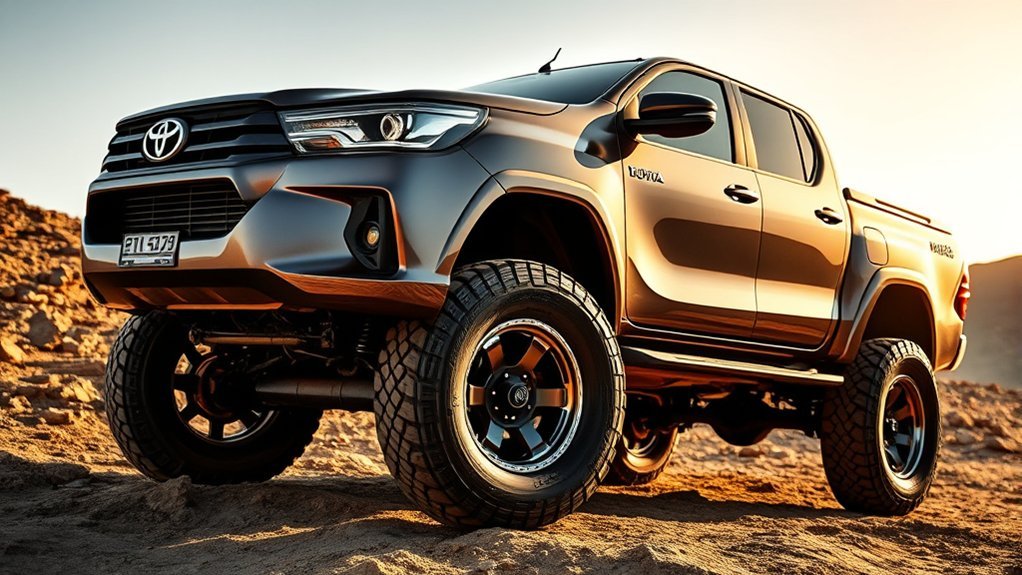
A 2-inch lift gives a Toyota Hilux more room for larger tyres, but it does not make every 33-inch setup a guaranteed bolt-on fit. The safest answer is this: many Hilux owners can run a 33-inch-class tyre with the right wheel width, offset, alignment, and clearance work, but the exact result depends on your Hilux generation, trim, suspension, tyre brand, and local road rules.
Quick Answer
With a 2-inch Hilux lift, a 265/70R17 is usually the easier upgrade, while a 285/70R17 or 33-inch-class tyre can often be made to fit with the correct rim offset, alignment, and trimming. Do not assume 33s are rub-free until you test full steering lock and suspension compression.
Key Takeaways
- A 2-inch lift helps, but tyre clearance still depends on wheel width, offset, caster, mudflaps, body mounts, bumper shape, and tyre construction.
- 265/70R17 is the safer practical upgrade for many Hilux builds; 285/70R17 is the common 33-inch-class choice but is more likely to need trimming.
- A rim offset around +10 to +20 can be a useful starting point, but it is not a universal rule. Too much poke or too much inner clearance loss can both cause problems.
- Always match or exceed the required load rating, set cold tyre pressure correctly, and check local modification rules before driving on-road.
At a Glance
| Time Required | 1–2 hours for measuring and test-fitting; longer if trimming, alignment, or suspension changes are needed |
| Difficulty | Moderate for tyre selection; advanced if cutting, body mount work, or suspension geometry correction is required |
| Tools Needed | Tape measure, torch, jack stands, tyre pressure gauge, wheel chocks, torque wrench, alignment report, and a professional fitter for final checks |
| Cost | Varies widely: budget for tyres, wheels if needed, alignment, possible upper control arms, trimming, speedometer correction, and any legal certification |
How to Choose the Right Tire Size for Your 2-Inch Lift?
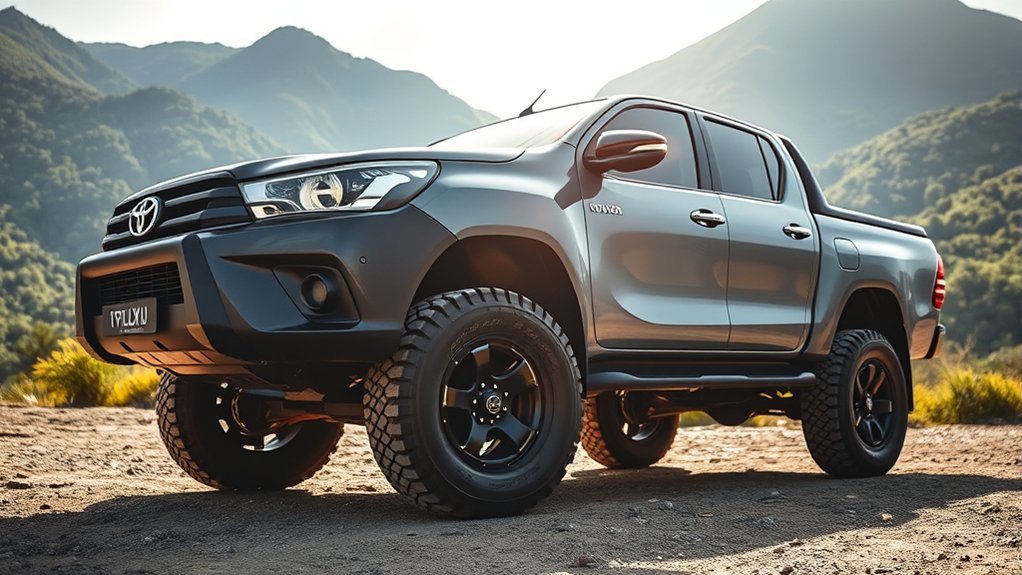
Start with your factory tyre size. Current Hilux specifications can vary by market and trim, but Toyota’s UK technical specifications list common Hilux tyre sizes such as 265/65R17 and 265/60R18. That matters because a 33-inch-class tyre is a major jump from many factory sizes, not just a minor visual upgrade.
The most common Hilux tyre upgrade choices after a 2-inch lift are:
| Tyre Size | Approx. Diameter | Best For | Fitment Notes |
| 265/70R17 | About 31.6 inches | Daily driving, touring, mild off-road use | Usually the easiest larger size on many lifted Hilux setups, but still check clearance. |
| 275/70R17 | About 32.2 inches | Extra clearance without jumping straight to 285 width | Can be a useful middle ground, depending on tyre availability and wheel specs. |
| 285/70R17 | About 32.7 inches | Common “33-inch” Hilux upgrade | Often needs careful offset, caster, mudflap/liner trimming, and body mount checks. |
| 33×12.5R17 | About 33 inches | Aggressive off-road builds | Wider casing increases rubbing risk and may need more wheel arch and body mount work. |
A 285/70R17 is the common 33-inch-class choice because it gives more ground clearance and a wider footprint. However, it is not automatically better than a narrower tyre. A narrower tyre can steer more easily, rub less, weigh less, and work better in some touring or wet-road situations.
Note: Tyre sizes vary between brands. One 285/70R17 may measure slightly taller or wider than another, especially with aggressive mud-terrain shoulder lugs. Always test the exact tyre you plan to run.
[Products Worth Considering]

This 61-piece tire repair screw kit helps you fix punctures quickly by aligning the screw plugs and twisting clockwise, finishing the repair in seconds. The self-sealing...
Check Wheel Width, Offset, and Clearance Before Buying
Wheel offset controls where the tyre sits inside the wheel arch. A more positive offset pulls the tyre inward; a lower or more negative offset pushes it outward. For many Hilux 2-inch lift builds, a rim offset around +10 to +20 can be a sensible starting point, but it is not a guaranteed fitment recipe.
Too much inward position can bring the tyre close to the upper control arm or chassis. Too much outward position can increase guard poke, scrub radius, steering effort, and contact with the front bumper, mudflap, or rear of the wheel arch.
- For mild touring: 265/70R17 on a suitable load-rated wheel is often the most practical choice.
- For 33-inch-class tyres: 285/70R17 usually needs more careful offset and alignment setup.
- For wide 33×12.5 tyres: expect a higher chance of trimming, rubbing, and legal/insurance checks.
Warning: Do not choose wheels only because they “look right.” The tyres must not foul the bodywork, mudguards, braking system, steering, suspension, or chassis through any combination of steering lock and suspension travel.
Load Rating, Pressure, and Road Safety
Before you buy larger tyres, confirm the required load rating and speed rating from your tyre placard or owner’s manual. The NHTSA tyre safety guide explains that tyre placards and certification labels show the manufacturer’s recommended tyre size, inflation pressure, vehicle capacity weight, and axle weight ratings. Your replacement tyres should be suitable for the Hilux’s axle loads, payload, towing use, and road conditions.
Tyre pressure also changes with tyre construction, load, and terrain. Use the correct cold pressure for road use, then adjust carefully for off-road driving and reinflate before returning to speed. Underinflation, overloading, and damaged tyres can lead to poor handling, overheating, and tyre failure.
Pro Tip: After fitting larger tyres, write down your road, sand, gravel, and towing pressures once you find safe settings that work. This makes future trips easier and helps you spot slow leaks or uneven wear early.
Optimize Your 2-Inch Lift for Performance
Optimizing your 2-inch lift is about more than clearing a bigger tyre. Your Hilux still needs predictable steering, enough suspension travel, safe braking, and a clean alignment.
After the lift and tyres are installed, book a proper wheel alignment. Ask the technician to check caster, camber, and toe, not just center the steering wheel. Extra positive caster can help pull the front tyre away from the rear of the wheel arch, but it must stay within a safe and achievable alignment range.
If the alignment cannot achieve a good result, you may need aftermarket upper control arms designed for the lift height. Quality shocks and springs also matter. A Hilux carrying a bull bar, winch, canopy, drawers, long-range tank, or constant touring weight may sit lower than expected, reducing tyre clearance even with a nominal 2-inch lift.
Gearing is another consideration. Larger tyres effectively make the final drive taller, which can soften low-speed response, affect automatic transmission shift behavior, and reduce engine braking off-road. Re-gearing is not always needed for a mild increase, but it becomes more relevant with heavier 33s, towing, and frequent low-range work.
Essential Tips to Prevent Tyre Rubbing After Lifts
Preventing tyre rubbing starts with a full clearance test before you assume the job is finished. A tyre that clears on flat ground can still rub during a U-turn, driveway entry, rut crossing, or hard suspension compression.
- Check straight-ahead clearance: Look at the upper control arm, chassis, brake lines, sway bar, and inner guards.
- Turn full lock left and right: Check the front bumper edge, mudflap, rear of the wheel arch, and body mount area.
- Test both directions in reverse: Some rubbing only appears when reversing at full lock.
- Compress the suspension: A workshop can check clearance with the suspension loaded or flexed more safely than guessing in the driveway.
- Recheck after 100–500 km: New suspension can settle, and tyre marks may reveal light rubbing you missed at first.
If rubbing appears, use the smallest safe fix first. Do not start cutting major metal before checking alignment, caster, mudflap position, liner clips, and bumper clearance.
| Rubbing Area | Likely Cause | Common Fix |
| Rear of front wheel arch | Not enough caster, tyre too wide, or offset pushing tyre into the arch | Alignment correction, upper control arms, liner/mudflap adjustment, or minor trimming |
| Body mount area | 33-inch-class tyre contacting during lock or compression | Professional body mount clearance work only if legally allowed and structurally safe |
| Front bumper or flare | Tyre pushed outward or aggressive shoulder lugs | Bumper trim, flare adjustment, or different wheel offset |
| Upper control arm | Wheel sits too far inward or tyre is too wide for the wheel/offset combo | Different offset, correct rim width, or suitable aftermarket control arms |
Boost Off-Road Performance With Bigger Tires
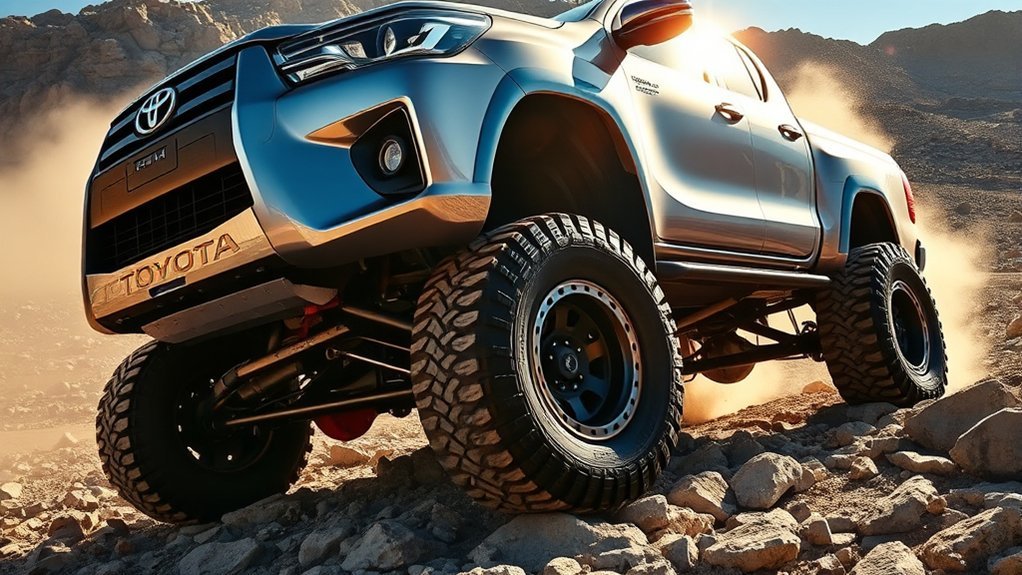
Upgrading your Toyota Hilux with bigger tyres can improve off-road performance by adding ground clearance under the diffs, increasing approach confidence, and giving you a larger contact patch when pressures are adjusted correctly. A good all-terrain or mud-terrain tread can also improve grip on gravel, sand, rocks, and mud.
The trade-off is that larger tyres are usually heavier. More weight can reduce acceleration, increase braking distance, add steering effort, and increase wear on wheel bearings, suspension parts, and driveline components. This is why a well-balanced setup is better than simply choosing the biggest tyre that can be squeezed under the guards.
The best Hilux tyre upgrade is the largest size that clears properly, stays legal, keeps the correct load rating, and still drives safely on the road you use every day.
Ensure Vehicle Stability Post-Tire Upgrade
When you install larger tyres and a lift, vehicle stability becomes a major safety point. A taller tyre and raised suspension increase ride height, and a higher vehicle can feel different in emergency lane changes, fast corners, heavy braking, and towing.
The NHTSA rollover research report notes that rollover risk is greater when a vehicle has a high center of gravity in relation to track width. That does not mean a lifted Hilux is unsafe by default, but it does mean the setup should be conservative, aligned properly, and driven with the extra height in mind.
Also check your speedometer after changing tyre diameter. A larger tyre travels farther per revolution, so your indicated speed may be lower than your real road speed. If the difference is significant, use a proper calibration method or ask a specialist about correction options.
Do not overlook payload and towing. A canopy, drawers, tools, fridge, water, recovery gear, passengers, and towball weight can all change ride height and clearance. After loading the Hilux the way you actually use it, repeat the steering and suspension clearance checks.
Legal, Insurance, and Engineering Checks
Tyre and lift rules vary by country, state, and vehicle category. In Australia, Vehicle Standards Bulletin 14 is a key national reference for light vehicle modifications, while state and territory rules still matter. Transport Victoria’s VSI 8 guidance, for example, allows certain off-road 4WD suspension-and-tyre combinations up to specific limits only when conditions are met, including clearance and suitable commercially available suspension kits.
Before fitting 33s, check whether your planned lift, tyre diameter increase, wheel offset, and track increase are legal where the vehicle is registered. Also check your insurer’s modification policy. A tyre setup that looks fine off-road can still create problems if it is not roadworthy, not disclosed, or outside local limits.
Warning: Any cutting, welding, body mount modification, or steering/suspension geometry change should be handled by a qualified professional and checked against local roadworthiness rules before the vehicle is used on public roads.
Frequently Asked Questions
Can you fit 33s on a Hilux with a 2-inch lift?
Yes, many Hilux builds can run 33-inch-class tyres with a 2-inch lift, but it is not guaranteed to be rub-free. A 285/70R17 is the most common “33s” option, and it may need the correct rim offset, caster adjustment, mudflap or liner trimming, bumper clearance, and body mount checks.
How much does a 2-inch lift cost on a Hilux?
The cost depends on the kit, brand, labour, alignment, and whether you need extras such as upper control arms, diff drop parts, trimming, or engineering approval. A basic body-lift part can be much cheaper than a full suspension package, while quality 50mm suspension kits and professional installation can cost much more once alignment and setup are included.
Will 265/70R17 fit a Hilux?
On many 4×4 Hilux models, 265/70R17 is a practical upgrade and is usually easier to fit than 285/70R17. Still, you should confirm clearance, load rating, speed rating, tyre pressure, and local legality before buying.
Is 285/70R17 the same as a 33-inch tyre?
A 285/70R17 is usually about 32.7 inches in overall diameter, so it is commonly treated as a 33-inch-class tyre. Actual measured size varies by tyre brand, tread pattern, inflation pressure, and load.
Do I need a wheel alignment after fitting bigger tyres?
Yes. A wheel alignment is strongly recommended after a lift or tyre-size change. Caster, camber, and toe can affect tyre clearance, steering feel, tyre wear, and straight-line stability.
Will bigger tyres affect my speedometer?
Yes. A taller tyre covers more distance per wheel rotation, so your speedometer and odometer can read differently from your actual road speed and distance. Check the difference after fitting larger tyres and recalibrate if needed.
Conclusion
Choosing the right tire size for your Toyota Hilux after a 2-inch lift is about more than chasing the biggest number. A 265/70R17 is often the easier daily-friendly upgrade, while 285/70R17 or other 33-inch-class tyres can work well when the wheel offset, rim width, caster, trimming, load rating, and legal requirements are all handled properly. Test clearance carefully, align the vehicle correctly, and keep safety and roadworthiness ahead of looks.
Sources
- Toyota UK Hilux Technical Specifications — backs up factory Hilux tyre-size examples and vehicle specification context.
- Toyota Australia HiLux Specifications — backs up the need to confirm exact model specifications and fitment requirements.
- NHTSA Tire Safety Guide — backs up tyre pressure, load limit, placard, and tyre safety guidance.
- Vehicle Standards Bulletin 14: National Code of Practice — backs up Australian light vehicle modification compliance context.
- VSB 14 Section LS: Tyres, Rims, Suspension and Steering — backs up tyre, rim, suspension, steering, track, clearance, and certification considerations.
- Transport Victoria VSI 8: Guide to Modification for Motor Vehicles — backs up state-level guidance for 4WD lift and larger tyre combinations.

Related Articles
Toyota Hilux Run-Flat Tires: What You Need to Know
Take control of your safety with Toyota Hilux run-flat tires; discover their benefits and hidden costs that could change your driving experience forever.
Read More
Effects of Underinflated Tires on the Toyota Hilux
Inadequate tire pressure in your Toyota Hilux can lead to serious safety issues and costly repairs; discover how to avoid these pitfalls.
Read More
The Risks of Overinflating Toyota Hilux Tires
Overinflating your Toyota Hilux tires can lead to dangerous blowouts and uneven wear, but understanding the risks is crucial for your safety.
Read More