
Toyota Hilux OEM Tire and Wheel Specs Explained
Getting the right Toyota HiLux tire and wheel specs matters for safety, handling, towing, fuel economy, and legal road use. Many current Australian-market HiLux models use 265/65R17 or 265/60R18 tires on 17- or 18-inch wheels, but the correct size for your ute always depends on its year, grade, body style, market, and tire placard.
Quick Answer
For many current Toyota HiLux variants, common OEM tire sizes are 265/65R17 and 265/60R18, paired with 17- or 18-inch wheels. Always confirm your exact tire size, load index, speed rating, and cold inflation pressure on the driver-door tire placard or in the owner’s manual before buying tires or wheels.
Key Takeaways
- Use the tire placard first; online charts are only a guide because HiLux specs vary by year, trim, and market.
- Common current OEM sizes include 265/65R17 and 265/60R18, but older and non-Australian models may use different sizes.
- Load index matters: for example, 108 = 1,000 kg, 110 = 1,060 kg, and 112 = 1,120 kg per tire at the correct pressure.
- Do not confuse psi with bar. A normal HiLux tire pressure may be around 2.0–2.5 bar, not 28–32 bar.
- Upsized tires and aftermarket wheels can affect clearance, braking, speedometer accuracy, insurance, and road legality.
At a Glance
| Time Required | 10–15 minutes to check the placard, tire sidewall, wheel markings, and owner’s manual. |
| Difficulty | Easy for checking specs; moderate if measuring wheel fitment; professional help recommended for upgrades. |
| Tools Needed | Tire pressure gauge, owner’s manual, flashlight, tape measure, and a reputable fitment guide or tire shop for upgrades. |
| Cost | Free to check; tire or wheel replacement cost depends on brand, size, construction, load rating, and fitting. |
What You Need to Know About HiLux Tire Specs
The safest way to choose tires for a Toyota HiLux is to match the specifications printed on the vehicle’s tire placard. The placard usually lists the approved tire size, load index, speed rating, and cold tire pressure for normal and loaded driving. Toyota’s current Australian HiLux specifications list 17-inch wheels with 265/65R17 tires on many WorkMate and SR variants, and 18-inch wheels with 265/60R18 tires on many SR5, SR5+, Rogue, and Rugged X variants.
Those specs are not universal for every HiLux ever sold. A single-cab work ute, double-cab pickup, cab-chassis, 4×2, 4×4, older model, or import-market HiLux may have different approved tires. Before ordering, match all four details: size, load index, speed rating, and construction.
Warning: Never inflate a HiLux tire to “28–32 bar.” That is not a normal tire-pressure range. Always use the cold pressure listed on your tire placard or owner’s manual, usually shown in psi, kPa, and/or bar.
[Products Worth Considering]

EVOULTES heavy duty tire inflator with an integrated gauge delivers accurate pressure readings from 10–120 PSI, helping you inflate, deflate, and check tires in one tool. The 16.5-inch extended dual-head air chuck with swivel base reaches hard-to-access dual wheel valves on trucks and RVs. A brass trigger core and side-mounted air release valve make operation smooth, with standard 1/4" NPT threading and quick-connect compatibility for easy setup.

The AstroAI 2 pack air chucks provide a heavy-duty, closed-flow locking design that helps keep air flowing during inflation while securely attaching to the valve stem. Built with 250 PSI rated brass components and compatible with Schrader valves, they feature 1/4" female NPT threads for a wide fit with common inflators. The straight tip and locking clip make filling tires and monitoring pressure more convenient.

The JACO FlowPro Tire Inflator measures, inflates, and airs down tires up to 100 PSI with battery-free operation and ±2% accuracy after calibration. It features a glowing pressure dial for night visibility, a heavy-duty steel build with a hybrid hose, and a precision push-to-inflate thumb trigger. The patented Lightning Air Chuck locks on for a secure seal, and the kit includes quick-connect hardware for easy inline use with your air compressor.
How to Confirm the Right Specs for Your HiLux
Use this quick process before buying replacement tires or aftermarket wheels:
- Check the tire placard. Look on the driver-door jamb, door edge, glovebox area, or fuel flap depending on market.
- Read the current tire sidewall. Confirm the size, load index, speed rating, and whether it is a passenger, commercial, or light-truck tire.
- Check the owner’s manual. Use the manual for pressures, spare-wheel guidance, towing notes, and warning information.
- Inspect the wheel markings. Many wheels have width, diameter, and offset stamped or cast on the inner face.
- Confirm with a tire professional. This is especially important for towing, heavy loads, off-road use, or tire upsizing.
Note: The tire placard beats generic online advice. If a website, tire shop, and placard disagree, ask the tire shop to explain the difference before fitting anything.
Recommended Tire Sizes for Your HiLux
The best tire size is the one approved for your exact HiLux. For current Australian-market examples, Toyota lists the following common OEM combinations:
| Common OEM tire size | Common OEM wheel size | Typical use in current range |
|---|---|---|
| 265/65R17 | 17-inch steel or alloy | Many WorkMate and SR grades, depending on body and drivetrain |
| 265/60R18 | 18-inch alloy or unique-design alloy | Many higher-grade 4×4 variants, depending on trim |
Some older HiLux models and export-market versions may use other sizes, such as narrower commercial tires or different rim diameters. Do not assume a tire size from another HiLux will fit yours correctly.
How to Read a HiLux Tire Size
A tire marked 265/65R17 112S breaks down like this:
- 265 = tread section width in millimeters.
- 65 = sidewall height as a percentage of tire width.
- R = radial construction.
- 17 = wheel diameter in inches.
- 112 = load index, meaning 1,120 kg per tire at the correct pressure.
- S = speed rating, meaning the tire is rated to a specific maximum speed under controlled conditions.
Off-Road Tire Recommendations
Off-road tire upgrades can improve traction and sidewall protection, but they also change the vehicle’s rolling diameter, weight, gearing, speedometer reading, and clearance. Common HiLux upgrade paths include all-terrain or light-truck construction tires in the factory size, or a mild diameter increase after checking clearance.
Pro Tip: If you want better off-road durability without creating fitment problems, start by choosing a quality all-terrain tire in your factory size and correct load rating before jumping to a larger diameter.
For larger tires such as 265/70R17, 275/65R18, 275/70R17, or 33-inch options, check all of the following before fitting:
- Front mud flap, inner guard, body mount, upper control arm, brake line, and suspension clearance.
- Wheel offset and width, because the same tire can rub or clear depending on the wheel.
- Speedometer and odometer error.
- Load index, speed rating, and light-truck construction suitability.
- Local roadworthiness, insurance, and engineering rules.
- Spare-wheel fitment under the vehicle or in the tub.
Performance Tire Options
For mostly road use, choose a tire that matches the OEM size and meets or exceeds the placard load and speed rating. Highway-terrain tires usually ride quieter and may improve fuel economy. All-terrain tires add durability and gravel-road grip but can be louder and heavier. Mud-terrain tires suit tougher off-road work but often compromise wet-road grip, braking, noise, and tire wear.
Choosing Wheel Sizes and Types for Your HiLux
Wheel choice affects more than looks. Diameter, width, offset, load rating, center bore, brake clearance, and bolt pattern all matter. A wheel that bolts on can still be unsafe if the load rating is too low or the offset causes rubbing.
Wheel Size Considerations
Many current HiLux models run 17- or 18-inch wheels from the factory. Smaller-diameter wheels can allow a taller tire sidewall, which often helps off-road comfort and rim protection. Larger wheels can sharpen steering feel and change the appearance, but they usually reduce sidewall height if the outside tire diameter stays close to factory size.
- 17-inch wheels: Often the practical choice for off-road use, work vehicles, and cheaper replacement tires.
- 18-inch wheels: Common on higher trims and a good balance for mixed road and gravel use.
- 19- or 20-inch aftermarket wheels: Mostly style-focused; check load rating, tire availability, ride comfort, and legal fitment carefully.
Type and Style Options
| Wheel type | Best for | Main trade-off |
|---|---|---|
| Steel | Work use, remote travel, budget replacements | Heavier and less stylish than alloy |
| Cast alloy | Daily driving, mixed use, factory-style upgrades | Quality and load rating vary by brand |
| Forged alloy | Premium strength-to-weight builds | Higher cost |
For aftermarket wheels, verify the bolt pattern, center bore, offset, wheel width, brake clearance, and wheel load rating before purchase. Many recent 4×4 HiLux fitment listings use a 6-stud 139.7 mm PCD and 106.1 mm center bore, but you should still confirm your exact vehicle and wheel specification before ordering.
How to Choose the Right Wheel Offset
Wheel offset is the distance between the wheel’s mounting face and the centerline of the wheel. It is usually shown as an ET number in millimeters.
- Higher positive offset: Moves the wheel and tire farther inward, all else equal.
- Lower positive offset: Pushes the wheel and tire farther outward, all else equal.
- Negative offset: Pushes the wheel outward even more and can place extra load on bearings, steering, and suspension parts.
Offset changes can improve stance and create clearance for wider tires, but too much poke can cause rubbing on guards, steering kickback, bearing stress, and legal problems. Always check the full suspension and steering range, not just how the wheel looks when the ute is parked.
The right HiLux wheel is not just the one that clears the guard. It must also carry the load, clear the brakes, match the hub, keep steering geometry sensible, and stay legal for road use.
How Load Ratings Affect Performance and Safety in HiLux Wheels
There are two different ratings to understand: tire load index and wheel load rating.
The tire load index is the number after the tire size, such as 108, 110, or 112. It tells you the maximum load that one tire can carry at the correct pressure. The wheel load rating is the maximum load the wheel itself is designed to carry. Both must be suitable for the vehicle, cargo, accessories, and towing use.
| Load index | Maximum load per tire | What it means |
|---|---|---|
| 108 | 1,000 kg | Common load index on some SUV/ute tires |
| 110 | 1,060 kg | Often seen on 265/60R18 tire options |
| 112 | 1,120 kg | Often seen on 265/65R17 tire options |
Do not fit tires with a lower load index than the placard requires. If your HiLux regularly carries tools, canopy weight, a drawer system, bull bar, winch, long-range tank, trailer download, or camping gear, load rating becomes even more important.
Key Features of HiLux Original vs. Aftermarket Wheels
Original Toyota wheels are designed around the vehicle’s factory brakes, hub, suspension geometry, tire placard, and load requirements. Aftermarket wheels can work well, but only when the specifications are right.
| Feature | Original wheels | Aftermarket wheels |
|---|---|---|
| Fitment | Designed for the vehicle’s hub, brakes, and body clearance | Must be verified by size, offset, bore, PCD, and brake clearance |
| Load rating | Matched to the vehicle’s intended rating | Varies by brand and model; check stamped or published rating |
| Appearance | Factory look | More styles, finishes, widths, and offsets |
| Risk | Low if kept with correct tires | Can affect legality, speedometer, bearing load, rubbing, and insurance |
[Products Worth Considering]
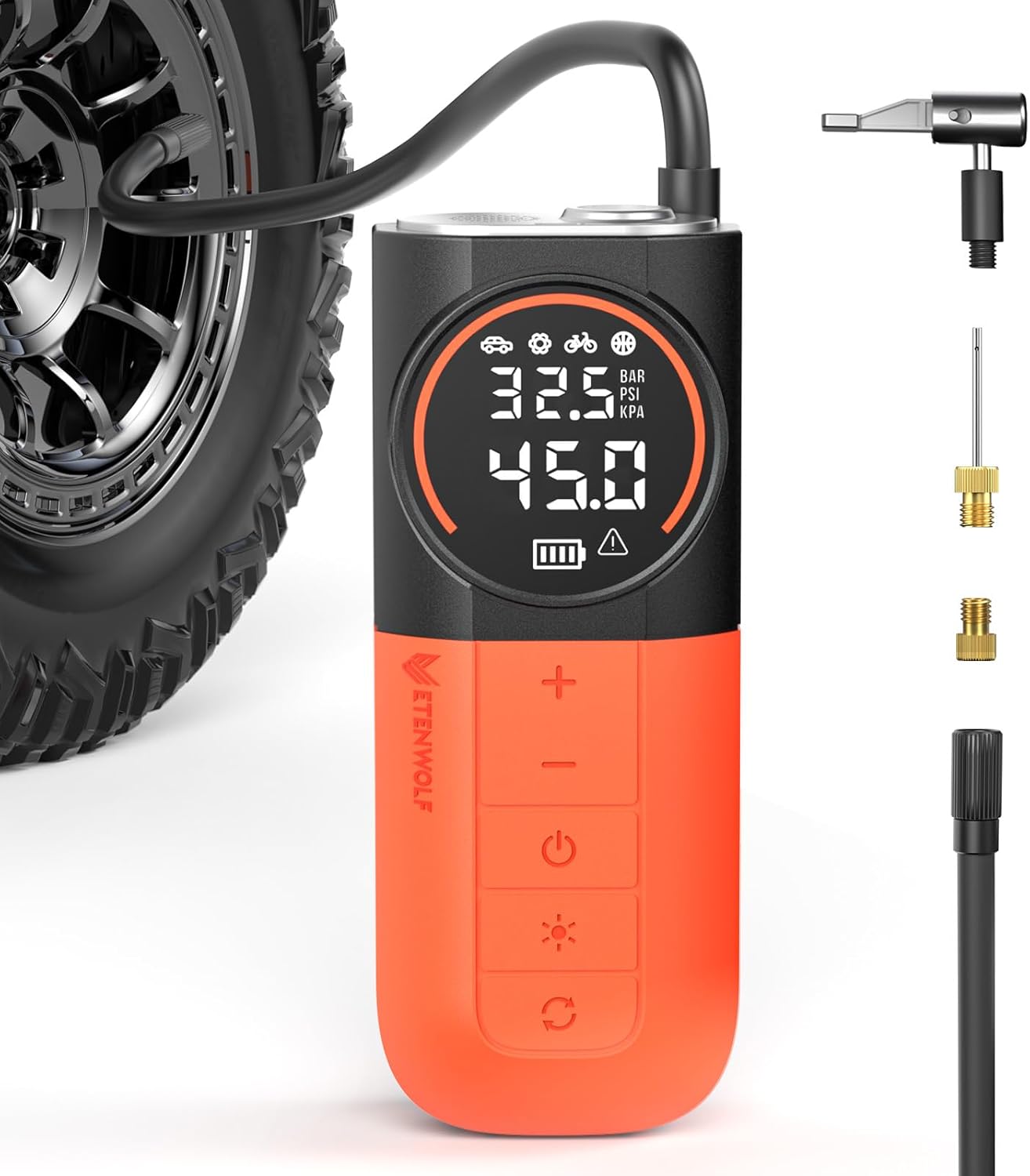
The ETENWOLF S1 cordless tire inflator delivers ultra-fast inflation with up to 160 PSI and a 20 L/min airflow for quicker tire top-offs. Its 5200mAh battery and cooling system support inflating many tires and sports balls on a single charge, while the digital pressure gauge and multi-unit display help you reach the right pressure accurately. With preset modes, pressure memory, an auto-stop feature, and an LED flashlight, it’s built for easy roadside and everyday use.

This portable cordless tire inflator delivers up to 160 PSI with fast 17 L/min airflow to help you quickly top up tires and get back on the road. It features dual power mode, running on a 21V rechargeable battery or a 12V DC adapter for convenient roadside use. An automatic shut-off with digital pressure gauge helps prevent overinflation, and a built-in LED light improves visibility in low-light conditions.
Importance of Proper Tire Pressure for HiLux Performance
Correct tire pressure helps your HiLux steer, brake, carry load, and wear tires evenly. It can also help fuel economy. The right pressure is the cold inflation pressure shown by the vehicle manufacturer, not the maximum pressure printed on the tire sidewall.
Cold pressure means the vehicle has been parked long enough for the tires to cool, usually before driving or after sitting for several hours. If you check pressure after highway driving, the reading will be higher because the tire is warm.
Pressure may be shown in three common units:
- psi: pounds per square inch.
- kPa: kilopascals.
- bar: metric pressure unit; 2.0 bar is about 29 psi, and 2.5 bar is about 36 psi.
For many HiLux applications, recommended pressures can vary between front and rear tires and may change when the vehicle is fully loaded or towing. Always use the placard for your exact model.
Warning: Under-inflation can increase heat build-up and tire failure risk. Over-inflation can reduce ride comfort and grip and may increase impact damage. Check pressures at least monthly and before long trips.
Troubleshooting Common HiLux Tire and Wheel Issues
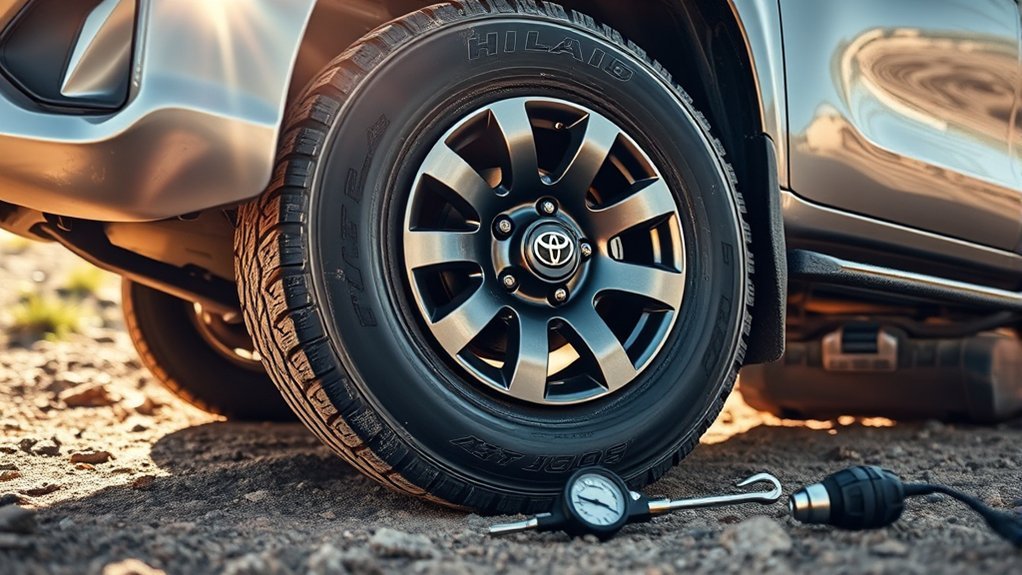
If your HiLux feels different after a tire or wheel change, do not ignore it. Small fitment or pressure problems can become expensive or unsafe.
| Symptom | Possible cause | What to check |
|---|---|---|
| Uneven shoulder wear | Low pressure, poor alignment, worn suspension, or aggressive driving | Cold pressure, wheel alignment, ball joints, control arms, and shocks |
| Vibration at speed | Wheel imbalance, bent wheel, damaged tire, mud inside rim, or hub-fit issue | Balance, wheel runout, tire condition, hub rings, and wheel nuts |
| Pulling to one side | Uneven pressure, alignment issue, brake drag, or tire conicity | Pressure, alignment report, brake temperature, and tire rotation test |
| Rubbing on turns or bumps | Oversized tire, wrong offset, wide wheel, or insufficient guard clearance | Full steering lock, compression clearance, mud flaps, guards, and body mount |
| TPMS or pressure warning | Low pressure, temperature drop, puncture, sensor issue, or spare-wheel mismatch | All tire pressures when cold, including spare if monitored |
Tips for Extending the Life of Your HiLux Wheels
Good wheel and tire care is simple, but it needs to be consistent:
- Check tire pressure monthly. Include the spare before long trips or remote travel.
- Rotate tires regularly. Follow the owner’s manual or tire-shop schedule, especially if you tow or carry loads.
- Rebalance when vibration appears. Do not wait for uneven wear to develop.
- Wash wheels after mud, salt, or beach driving. Brake dust, salt, and mud can damage finishes and hide cracks.
- Inspect for cracks, dents, and corrosion. Pay close attention after pothole hits or rocky tracks.
- Use the correct wheel nuts. Seat type, thread, and torque must match the wheel and hub.
- Avoid overloading. Keep the vehicle, axle, tire, and wheel ratings within limits.
Frequently Asked Questions
What size are the rims on a Toyota HiLux?
Many current HiLux variants use 17- or 18-inch wheels, depending on trim and body style. Some older or non-Australian models may use different sizes, so confirm the wheel and tire size on your vehicle’s placard and current wheel markings.
How do I read HiLux wheel and tire specs?
For tires, read the size, load index, and speed rating, such as 265/65R17 112S. For wheels, check diameter, width, offset, bolt pattern, center bore, and wheel load rating. All of these must suit your exact HiLux.
Can you fit 33-inch tires on a HiLux?
Sometimes, but it depends on the HiLux generation, suspension height, wheel offset, tire width, trimming, and local road rules. A 33-inch tire is a modification, not a simple OEM replacement. Check clearance, speedometer error, load rating, insurance, and legality before fitting.
What tire pressure should I use in a Toyota HiLux?
Use the cold tire pressure printed on your vehicle’s tire placard or owner’s manual. The correct pressure can vary by tire size, front/rear axle, load, and towing condition. Do not use the maximum pressure printed on the tire sidewall as your normal setting.
Can I replace 17-inch HiLux wheels with 18-inch wheels?
Yes, if the 18-inch wheels have the correct bolt pattern, center bore, offset, width, brake clearance, and load rating, and if the tires maintain an appropriate overall diameter and meet the placard load and speed requirements. Have the fitment checked before purchase.
Conclusion
The right Toyota HiLux tire and wheel setup starts with the placard, not guesswork. For many current models, 265/65R17 and 265/60R18 are common OEM tire sizes, but your exact HiLux may differ. Match the approved size, load index, speed rating, pressure, wheel load rating, and fitment details before replacing or upgrading. If you plan to tow, carry heavy accessories, drive off-road, or fit larger tires, get the setup checked by a qualified tire and wheel professional.
Sources
- Toyota Australia HiLux specifications — current wheel and tire sizes by grade.
- Toyota Australia HiLux overview — current range, towing notes, and model context.
- Toyota Service Information and Repair Manuals — official owner-manual and repair-information portal.
- Bridgestone Speed & Load Ratings — tire load index, speed rating, and safety guidance.
- NHTSA TireWise tire safety — cold inflation pressure and tire safety guidance.
- FuelEconomy.gov maintenance tips — fuel-economy effect of proper tire inflation.

Related Articles
Toyota Hilux Run-Flat Tires: What You Need to Know
Take control of your safety with Toyota Hilux run-flat tires; discover their benefits and hidden costs that could change your driving experience forever.
Read More
Effects of Underinflated Tires on the Toyota Hilux
Inadequate tire pressure in your Toyota Hilux can lead to serious safety issues and costly repairs; discover how to avoid these pitfalls.
Read More
The Risks of Overinflating Toyota Hilux Tires
Overinflating your Toyota Hilux tires can lead to dangerous blowouts and uneven wear, but understanding the risks is crucial for your safety.
Read More