
6-Ply vs 10-Ply Tires for a Tundra: When Heavier Duty Actually Helps
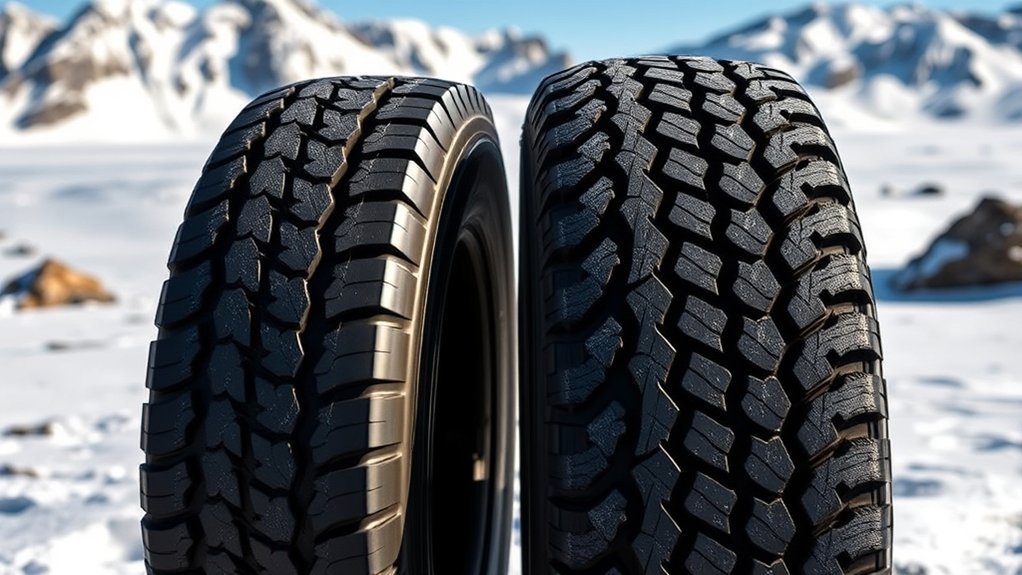
When choosing tires for your Tundra, consider how 6-ply and 10-ply ratings affect performance. While 6-ply tires provide a smoother ride for light-duty use, they may lack durability for heavy loads. Conversely, 10-ply tires, with enhanced stiffness and load capability, excel in towing and off-road situations. They balance comfort with exceptional durability, making them a superior choice for demanding tasks. Explore further to uncover more insights on optimizing your tire selection.
What Ply Ratings Mean for Your Tundra
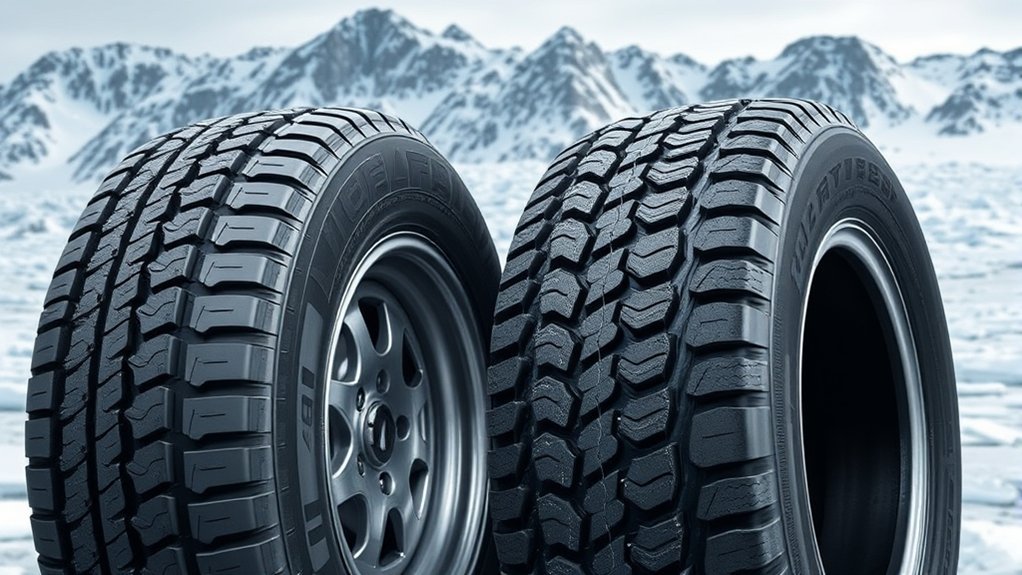
When choosing tires for your Tundra, understanding ply ratings is essential. Ply ratings indicate a tire’s strength and load capacity, with 10-ply tires classified as Load Range E. These tires can carry up to 3,085 lbs each at 80 psi, providing robust load distribution. While original ply ratings reflected the number of physical layers, modern tire technology utilizes advanced materials requiring fewer layers for similar strength. With your Tundra’s towing capacity around 7,200 lbs, opting for 10-ply tires offers a safety margin, as four can support approximately 170% of the truck’s rated weight. However, it’s crucial to recognize that higher ply ratings may lead to a harsher ride. Adjusting tire pressure can help mitigate this discomfort. Many Tundra owners prefer 10-ply tires for their durability and longevity, especially when towing or carrying heavy loads, ensuring you’re ready for any challenge.
Are 6-Ply Tires Enough for Your Tundra?
Can 6-ply tires meet the demands of your Tundra? While they may be suitable for light-duty applications, you might find them lacking, especially under heavy loads. Here are some considerations:
- Towing Capacity: The Tundra’s 7,200 lbs capacity often exceeds 6-ply limits.
- Ride Quality: They offer a smoother ride on paved roads but compromise stability under load.
- Durability: 6-ply tires struggle with durability and traction on rough terrains.
- Tire Pressure: Maintaining proper tire pressure is essential for performance, especially with a heavy load.
- Tread Patterns: The tread patterns on 6-ply tires may not provide the best grip in off-road conditions.
Ultimately, if you frequently tow or haul, 6-ply tires may not be enough. For enhanced performance and safety, consider the demands of your Tundra before making a decision.
Why 10-Ply Tires Are the Best Choice
Opting for 10-ply tires considerably enhances your Tundra’s performance, especially if you regularly tow or haul heavy loads. Categorized as Load Range E, these tires can handle up to 3,085 lbs each at 80 psi, perfectly complementing the Tundra’s towing capacity of approximately 7,200 lbs. The stiffer sidewalls of 10-ply tires provide exceptional stability and control, essential for towing and maneuvering off-road conditions.
With improved puncture resistance and longevity, these tires can last up to 100,000 miles, ensuring reliable performance in demanding environments. Users appreciate the balanced combination of comfort and durability, making them ideal for daily driving and light towing without excessive wear. While you might experience a slightly harsher ride on smooth surfaces, proper tire inflation can alleviate discomfort, allowing for enhanced ride quality. The advanced tread patterns also contribute to superior traction, empowering you to tackle various terrains with confidence.
How Do 6-Ply and 10-Ply Tires Compare in Ride Quality?
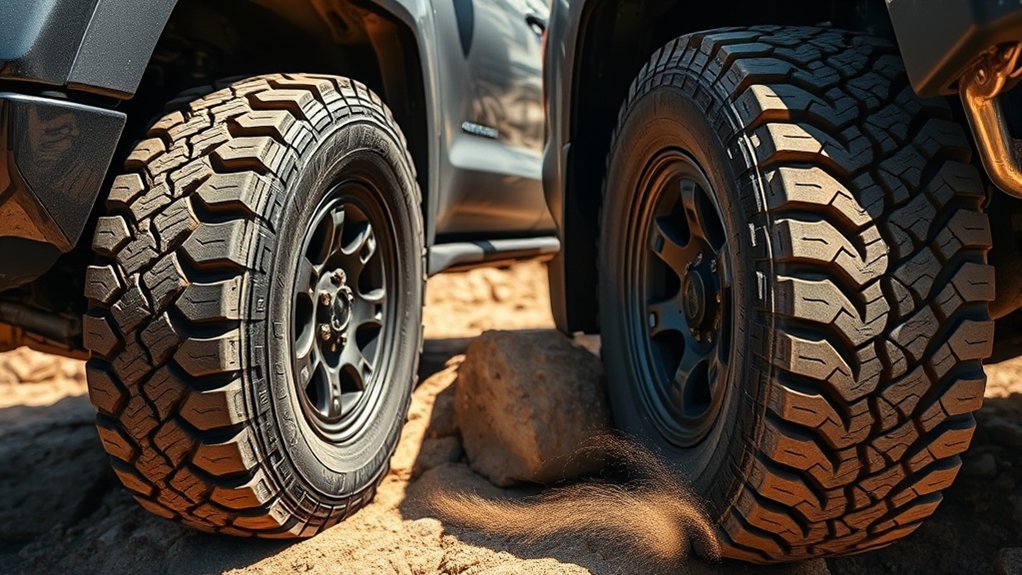
When comparing ride quality between 6-ply and 10-ply tires, you’ll notice distinct differences in comfort and performance. While 6-ply tires generally provide a smoother ride, 10-ply options may lead to a harsher experience, especially on rough terrains. Additionally, long-distance driving may feel more taxing with 10-ply tires due to increased road noise and stiffness.
Ride Comfort Differences
While both 6-ply and 10-ply tires serve distinct purposes, their ride comfort greatly differs. Generally, 6-ply tires offer a smoother, more forgiving ride, while 10-ply tires can feel stiffer due to their reinforced construction. This stiffness often results in a harsher driving experience, especially on rough or uneven surfaces. Though lowering tire inflation in 10-ply tires can enhance comfort, it may compromise handling and wear when fully loaded. Here are some key points to contemplate:
- 6-ply tires excel in ride quality.
- 10-ply tires provide superior durability.
- Adjusting pressure can reduce harshness.
- Surface conditions impact ride comfort.
- Reflect on your load needs versus comfort preferences.
Ultimately, your choice should align with your driving style and requirements.
Off-Road Performance Impact
Ride comfort is just one aspect to evaluate; off-road performance also significantly varies between 6-ply and 10-ply tires. 6-ply tires excel in absorbing shocks and adapting to uneven terrain, making them ideal for moderate off-road conditions. Their flexibility enhances traction dynamics on softer surfaces, allowing you to navigate with greater ease. Conversely, 10-ply tires offer superior durability, resisting punctures on rocky trails, yet this comes at the cost of a stiffer ride quality. While they can provide enhanced traction in rugged environments, they may compromise terrain adaptability during low-pressure scenarios. Ultimately, if you prioritize comfort and maneuverability in varied terrains, 6-ply tires may be the better choice for your Tundra.
Long-Distance Driving Effects
Choosing between 6-ply and 10-ply tires for long-distance driving hinges on ride quality, comfort, and your specific usage needs.
- 6-ply tires offer a smoother ride due to softer sidewalls.
- 10-ply tires provide durability but can result in harsher ride quality.
- Lower tire pressure on 10-ply tires may improve comfort, but can affect fuel efficiency.
- Users generally prefer 6-ply tires for everyday comfort, especially on highways.
- Consider your primary concerns: towing capacity versus ride comfort.
Ultimately, if you’re prioritizing highway stability and comfort for long trips, 6-ply tires are often the better choice unless heavy loads are a frequent requirement.
Understanding Towing Capacity and Ply Ratings
When selecting tires for your Tundra, understanding towing capacity and ply ratings is vital for ensuring safety and performance. The 2016 Tundra has a towing capacity of approximately 7,200 lbs, so you need tires that can effectively support this weight. Ten-ply tires, categorized as Load Range E, can carry up to 3,085 lbs each at 80 psi, providing a robust solution for heavy towing. Using four 10-ply tires offers a combined capacity exceeding 12,000 lbs, adding a significant safety margin. While 6-ply tires may suffice for lighter loads, they lack the durability and stability required under heavy towing conditions. Choosing the right ply rating not only enhances load distribution but also maintains ideal tire pressure, ensuring a smoother ride. This careful selection is essential for both safety and performance during your towing activities.
Off-Road Performance: Choosing the Right Ply Rating
Selecting the right ply rating can greatly influence your Tundra’s off-road performance. 10-ply tires stand out for their flexibility and durability, making them ideal for traversing uneven and rugged terrains. With superior traction control and enhanced terrain adaptability, these tires optimize load distribution and off-road stability.
Consider the following benefits of 10-ply tires:
- Increased puncture resistance for rocky trails
- Higher load capacity (up to 3,085 lbs at 80 psi)
- Pressure adjustment capabilities for varying conditions
- Improved tire longevity through durable construction
- Enhanced handling characteristics on rough surfaces
While 10-ply tires may feel harsher on smooth roads, they excel when absorbing impacts off-road. Just remember, the trade-offs in driving efficiency might be worth it for those performance metrics when you’re tackling challenging landscapes. Choose wisely to maximize your Tundra’s off-road potential!
Expected Lifespan and Durability of 10-Ply Tires
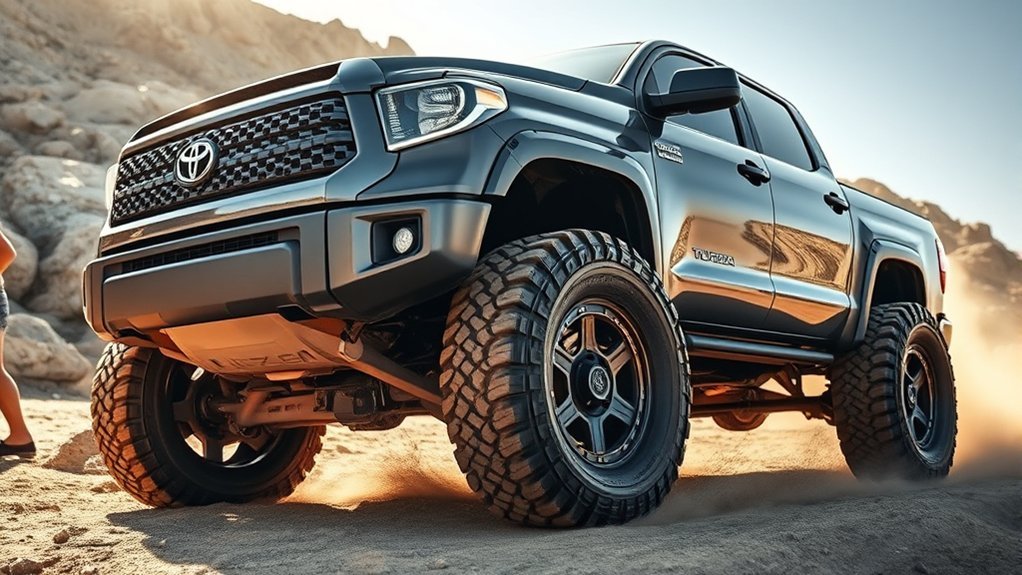
10-ply tires offer exceptional durability and longevity, often lasting up to 100,000 miles under ideal conditions. Classified under Load Range E, they can support up to 3,085 lbs at 80 PSI, making them ideal for heavier loads and towing. Their stiffer sidewalls enhance resistance to punctures and wear, particularly in demanding driving conditions. While you may experience a harsher ride quality, the trade-off for increased durability is often worthwhile for truck owners who prioritize performance. Regular tire maintenance, including rotation every 5,000 miles, can further extend the lifespan of your 10-ply tires by promoting even wear. By adhering to these practices, you’ll maximize the benefits of your investment and guarantee that your tires withstand the rigors of both on-road and off-road environments. Ultimately, choosing 10-ply tires can lead to a more reliable driving experience, especially when heavy-duty performance is essential.
Choose the Best Tires for Your Driving Needs
When choosing tires for your Tundra, understanding tire load ratings is essential to match your driving needs. Consider how ride comfort varies between 6-ply and 10-ply options, especially if you frequently tow heavy loads or drive off-road. Evaluating these factors will help you select the best tires for peak performance and comfort.
Tire Load Ratings Explained
Understanding tire load ratings is essential for ensuring your vehicle handles safely and effectively. These ratings indicate the maximum weight each tire can carry, directly impacting your driving experience.
- 6-ply tires suit lighter loads, ideal for everyday use.
- 10-ply tires, rated for heavier duties, can carry up to 3,085 lbs at 80 PSI.
- Proper load distribution enhances vehicle stability and safety.
- Higher ply ratings offer increased durability and puncture resistance.
- Choosing the right tire affects towing capacity—like the Tundra’s 7,200 lbs.
Ride Comfort Considerations
Choosing the right tires for your Tundra involves balancing durability with ride comfort. If you opt for 10-ply tires, known for their robust load capacity, you might experience increased sidewall stiffness, resulting in a harsher ride, especially on rough terrain. However, adjusting tire pressure can greatly enhance comfort, mitigating the impact of that stiffness. In contrast, 6-ply tires provide a smoother ride due to their softer sidewalls, but they may fall short in durability under heavier loads. For everyday driving and light towing, 10-ply tires can strike a balance, offering both comfort and the capability to handle moderate loads effectively. Ultimately, consider your specific driving needs to make the best choice for ride quality and performance.
Frequently Asked Questions
What Ply Tires for Tundra?
For your Tundra, consider 10-ply tires. They offer superior tire durability and load capacity, making them ideal for towing. While they may provide a harsher ride, their strength guarantees reliability under heavy loads.
Conclusion
To conclude, choosing between 6-ply and 10-ply tires for your Tundra hinges on your specific needs. If you regularly tow heavy loads, 10-ply tires are perfect, offering a 20% increase in load capacity compared to 6-ply options. This added strength enhances durability and off-road performance notably. Ultimately, evaluating your driving habits and conditions will guide you to the best choice, ensuring safety and peak performance on and off the road.

Related Articles
OEM vs Aftermarket Tires on a Toyota Tundra: Quality and Value Differences
Are you torn between OEM and aftermarket tires for your Toyota Tundra? Discover the crucial differences that could impact your driving experience.
Read More
Nitrogen vs Regular Air in Truck Tires: Is the Extra Cost Worth It?
Inquiring whether nitrogen in truck tires justifies the added expense? Discover the surprising benefits and drawbacks that could change your driving experience.
Read More
Hybrid-Terrain vs Mud-Terrain Tires: The New Middle Ground Explained
Uncover the key differences between hybrid-terrain and mud-terrain tires, and find out which option truly meets your adventurous driving needs.
Read More