
33 Vs 35-Inch Tires on a Tundra: Clearance, MPG, and Looks Compared
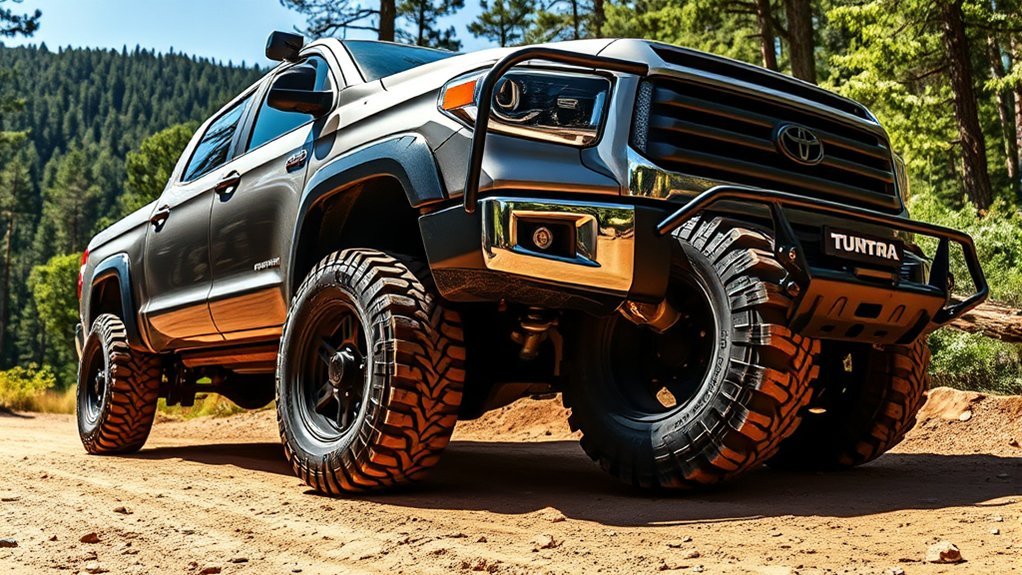
When deciding between 33 and 35-inch tires for your Tundra, you’ll notice key differences in clearance, MPG, and looks. Switching to 35s gives you an extra inch or two of ground clearance, enhancing off-road capability. However, you might see a drop in MPG from around 15 to 11, due to increased weight and rolling resistance. Plus, 35-inch tires can cause rubbing issues, requiring modifications. Keep exploring to uncover essential details on re-gearing and cost implications for your Tundra.
Which Tire Size Is Best for Your Tundra?
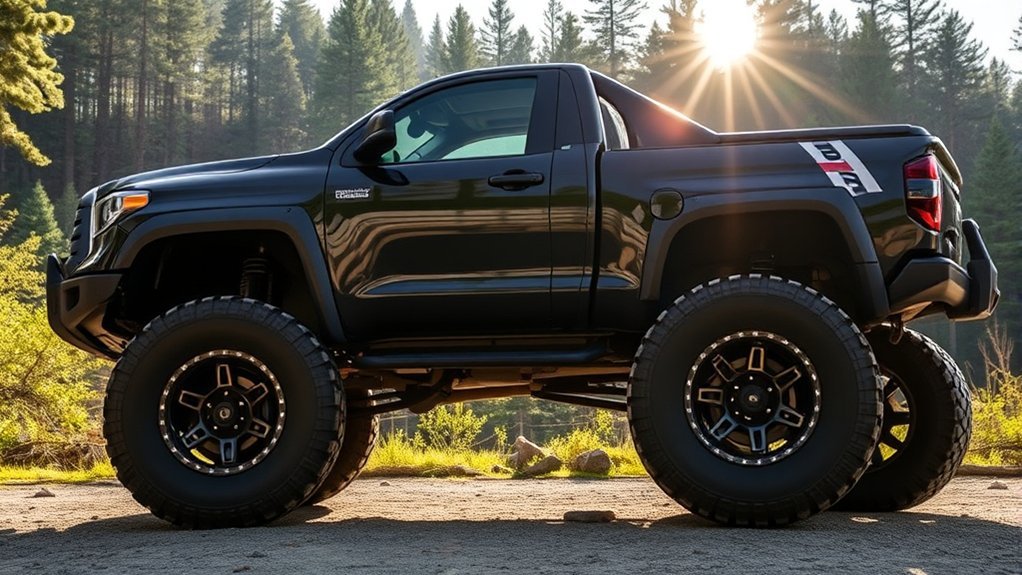
When it comes to choosing the right tire size for your Tundra, what factors should you consider? First, think about tire performance. If you’re venturing off-road, 35-inch tires can enhance your vehicle’s capability and ground clearance, allowing for a more liberating experience on rugged terrain. However, be aware that switching from 33-inch to 35-inch tires may lead to a drop in MPG due to increased weight and rolling resistance—typically around 1-2 MPG.
Next, consider wheel alignment and gear ratios. The stock 4.30 gears work well with 33-inch tires, but upgrading to 35s often means re-gearing to 4.88 for peak performance. Also, a body mount chop might be necessary for fitting larger tires, though some brands fit without modifications. Ultimately, balance your desire for off-road prowess with the practicality of fuel efficiency and the need for proper alignment to keep your ride smooth and enjoyable.
Tire Size Differences: 33 vs. 35 Inches
When you switch from 33-inch to 35-inch tires on your Tundra, you’ll encounter several key differences that go beyond just size. You’ll need to reflect on clearance and fitment issues, along with the significant impact on your MPG—many users report a drop from around 15 to nearly 12. Plus, the aesthetic upgrade might be tempting, but it comes with the price of additional modifications and potential performance adjustments.
Clearance and Fitment Issues
Choosing between 33-inch and 35-inch tires for your Tundra can considerably affect clearance and fitment. While 33-inch tires generally fit without modifications, 35-inch tires often present fitment challenges, requiring a body mount chop (BMC) to avoid rubbing issues, especially at steering lock or during suspension flex. Notably, BFG KO2 tires (35×12.50) measure about 34.5 inches, potentially easing fitment under specific conditions. If you’re looking for a more aggressive stance, switching to a +25mm offset from the stock +55mm can enhance your Tundra’s look but may further complicate clearance solutions. Upgrading to aftermarket bumpers can improve compatibility with larger tires, making your decision on tire size essential for both performance and aesthetics.
2. Impact on MPG
Upgrading to larger tires like 35-inch options can considerably impact your Tundra’s fuel economy. Users often report a drop of 1-2 MPG, especially in city driving, where figures can plummet to around 10.2 MPG. The increased weight and rolling resistance of 35-inch tires play a significant role here. To counteract this, you might need to explore re-gearing to 4.88 gears, which can help maintain performance and mitigate MPG loss. Your driving habits, tire pressure, and even weight distribution affect fuel efficiency, so be mindful of those factors. Regular maintenance routines and performance tuning can also make a difference. Exploring fuel additives may provide some relief, but ultimately, expect lower MPG with larger tires.
3. Aesthetic Considerations
Switching from 33-inch to 35-inch tires on your Tundra considerably alters its visual appeal, giving it a more aggressive and commanding presence on the road. This change enhances tire aesthetics, showcasing a bold visual stance that captures attention. However, you might need to take into account body modifications like a mount chop for proper clearance with 35s, while 33s usually fit without fuss. Additionally, your choice of wheel offset impacts the overall look; a +25mm offset offers a wider stance compared to stock offsets, amplifying the aggressive vibe. Keep in mind that if you opt for wider 35-inch tires, they may rub during tight turns, potentially affecting your truck’s aesthetic during maneuvers. Choose wisely to match your style!
How Tire Size Affects Ground Clearance and Off-Road Capability
When considering tire size for your Tundra, the impact on ground clearance and off-road capability is substantial. Switching to 35-inch tires can elevate your ride, enhancing your ability to navigate obstacles with ease. Here’s how tire size plays an essential role:
- Increased Clearance: 35-inch tires can provide an additional 1-2 inches of ground clearance, improving off-road stability.
- Improved Angles: Larger tires enhance approach and departure angles, allowing you to tackle steep inclines and declines more effectively.
- Better Traction: With increased ground clearance, your traction control system works more efficiently, giving you better maneuverability in rugged terrains.
Don’t forget to monitor tire pressure for ideal performance. Upgrading to larger tires not only transforms your Tundra’s looks but greatly boosts its off-road capability, letting you explore the great outdoors with confidence.
MPG Impacts of 33 vs. 35-Inch Tires on Tundras
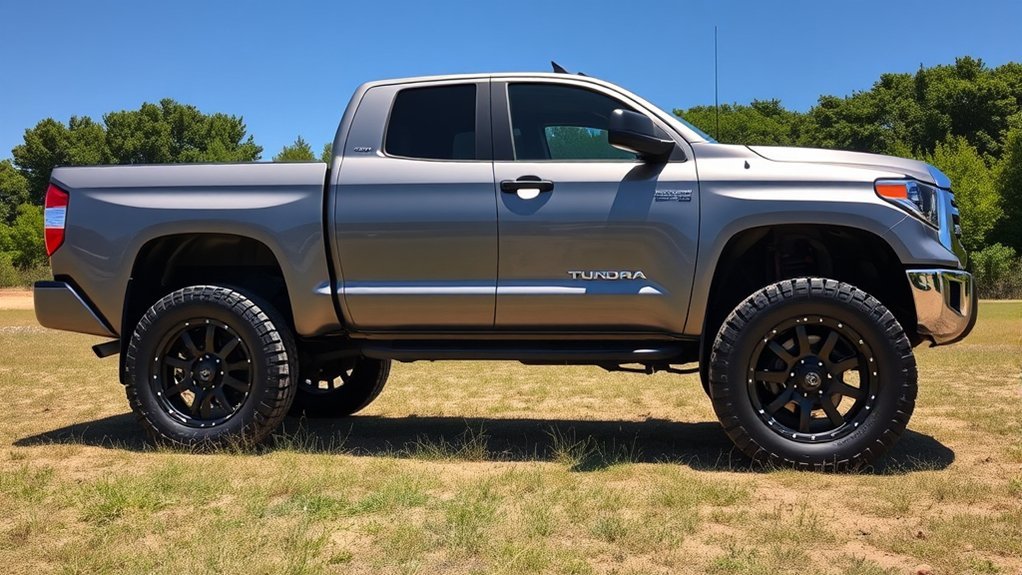
Choosing between 33-inch and 35-inch tires for your Tundra not only influences off-road performance but also considerably affects your fuel economy. Shifting to 35-inch tires typically results in a noticeable drop in MPG, with many users reporting a decrease of 1-2 MPG. While 33-inch tires often yield around 15 MPG on mixed driving, 35-inch options usually bring that down to 11-12 MPG.
Driving habits play a vital role in this equation; aggressive driving can worsen fuel efficiency with larger tires. Tire pressure also matters—keeping your tires properly inflated can help mitigate some of the MPG loss. Regular vehicle maintenance is key, as it guarantees your Tundra runs efficiently, regardless of tire size. Ultimately, if you’re seeking a balance between performance and fuel economy, understanding these factors is fundamental for making the best choice for your driving lifestyle.
What to Know About Re-Gearing for Larger Tires?
Upgrading to larger tires, like moving from 33 to 35 inches, often means you’ll need to reflect on re-gearing your Tundra to maintain peak performance. Without proper re-gearing, you may experience reduced power and efficiency, which can be frustrating. Here are a few key points to keep in mind:
- Gear Ratio Considerations: Stock ratios typically range from 4.10 to 4.56. For 35″ tires, you might need to upgrade to 4.88 or 5.29 to enhance torque and acceleration.
- Re-Gearing Benefits: Proper re-gearing helps offset MPG losses associated with larger tires, improving overall performance during towing and daily driving.
- Tire Weight Impact: Larger tires add weight and rolling resistance, which can still affect MPG even after re-gearing.
Finding the right gear ratio is essential for achieving the performance you desire while enjoying the liberation that larger tires can bring.
Aesthetic Changes: Enhancing Your Tundra’s Appearance
While switching from 33 to 35-inch tires on your Tundra can markedly enhance its aggressive stance, the visual transformation goes beyond just size. The larger tires elevate your truck’s rugged appeal, creating a pronounced wheel gap that screams off-road capability. This aesthetic upgrade is complemented by wider profiles, providing a bolder look that captures attention.
Consider enhancing your Tundra further with custom bumpers and accessories that align with the new tire aesthetics. Here’s a quick overview of visual changes you can expect:
| Feature | 33-Inch Tires | 35-Inch Tires | Aesthetic Impact |
|---|---|---|---|
| Wheel Gap | Moderate | Pronounced | More aggressive appearance |
| Tire Width | Standard | Wider | Bolder, more robust look |
| Body Mount Chop (BMC) | Not needed | May be needed | Customized fit |
| Aftermarket Options | Limited | Extensive | Enhanced overall design |
| Off-Road Capability | Good | Excellent | Ready for adventure |
This transformation not only boosts looks but also your Tundra’s adventurous spirit!
Rubbing Issues: What to Expect With Larger Tires
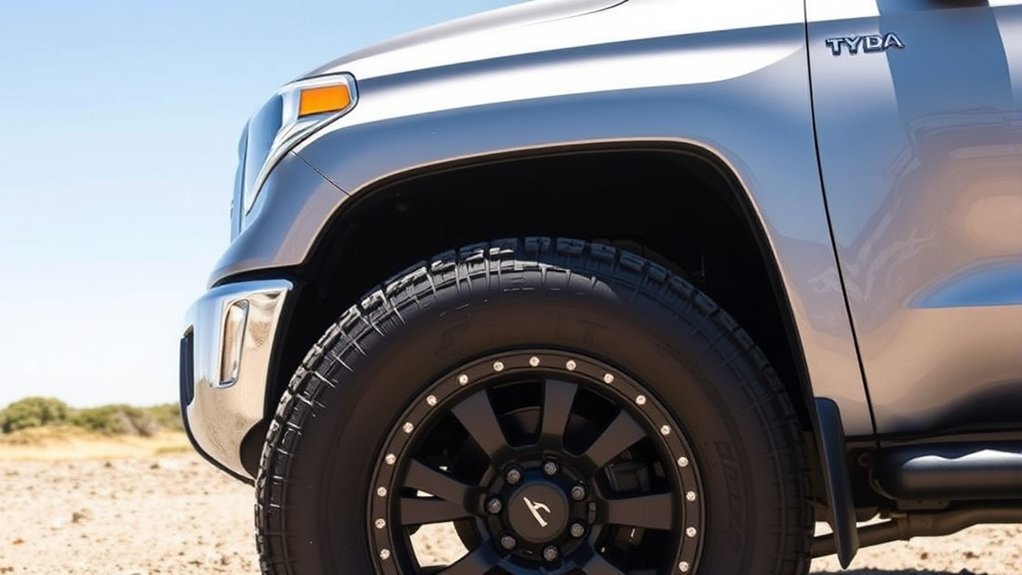
When you upgrade to 35-inch tires on your Tundra, you might encounter rubbing issues, especially during sharp turns and suspension flex. This can occur against components like the sway bar or skid plate, depending on your wheel offset and overall setup. Understanding these potential challenges will help you prepare for necessary modifications to guarantee a smooth ride.
Steering Lock Clearance
- Rubbing Risks: Expect potential rubbing at full steering lock, especially with wider tires or aggressive offsets.
- Body Mount Chop (BMC): A BMC may be necessary for fitting 35-inch tires, but some brands like BFG KO2 might fit without modification.
- Lift Kit: A 2-inch lift can greatly reduce rubbing chances during steering and suspension flex.
Understanding these aspects will help you navigate the shift smoothly, ensuring your Tundra maintains its rugged charm while maximizing performance.
Suspension Flex Rubbing
Switching to 35-inch tires on your Tundra can introduce notable suspension flex rubbing issues, especially during off-road adventures. You might experience rubbing at full steering lock and during suspension flex, particularly with wider tires. A body mount chop (BMC) is often necessary to mitigate these issues, although 34.5-inch BFG KO2 tires might fit without modifications. Keep in mind that the sway bar or skid plate could also be prone to rubbing, depending on your tire width and setup. Maintaining proper wheel offset is vital—while a stock Tundra has a +55mm offset, a more aggressive +25mm can increase rubbing risks. To enhance clearance and reduce rubbing, consider suspension upgrades like Camburg upper control arms (UCAs) as effective rubbing solutions.
Driving Experience With 33 vs. 35-Inch Tires on Tundras
While the allure of 35-inch tires on your Tundra may be strong, the driving experience can change markedly compared to the more moderate 33-inch options. Here’s what you can expect:
- Tire Noise: Larger tires can generate more noise, especially on highways, which might detract from your driving comfort.
- Handling Differences: The increased weight and rolling resistance of 35-inch tires can impact your steering response, making it feel less agile than with 33-inch tires.
- Fuel Efficiency: Switching to 35-inch tires often results in an MPG drop of 1-2, leading to an average of around 11-12 MPG, compared to 15 MPG with 33-inch tires.
Ultimately, while 35-inch tires enhance off-road capability and aesthetics, they come with trade-offs in handling and fuel efficiency that you should carefully consider.
Costs of 33 vs. 35-Inch Tires
When considering the costs of 33 vs. 35-inch tires, you’ll notice a significant price gap, with 33-inch options typically ranging from $150 to $300 and 35-inch tires jumping to $200 to $400 each. Beyond the initial purchase, think about installation fees and potential modifications, which can elevate your overall expenses. Additionally, keep in mind how larger tires might impact your fuel economy, affecting your long-term investment.
Price Difference Analysis
Upgrading to larger tires can greatly impact your wallet, especially when comparing 33-inch and 35-inch options. Here’s a breakdown of costs you should consider:
- Tire Prices: 33-inch tires range from $150 to $300 each, while 35-inch tires can cost $200 to $500, reflecting a 25-50% increase.
- Installation Costs: Expect to pay $15 to $25 per tire for 33-inch tires, but installation for 35-inch tires averages $20 to $35 due to installation challenges.
- Modification Expenses: Upgrading to 35-inch tires may require modifications costing an additional $300 to $1,000.
When considering tire brand comparison, premium options for 35-inch tires could reach up to $600, making the overall upgrade potentially exceed $1,500.
Long-Term Investment Considerations
Considering the long-term costs of 33 vs. 35-inch tires can greatly influence your decision. While 33-inch tires are typically cheaper, with price differences of $50 to $100 per tire, the financial implications extend beyond initial costs. Shifting to 35-inch tires can reduce your fuel efficiency by 1-2 MPG due to added weight and rolling resistance, impacting your overall fuel expenses. Plus, you might face re-gearing costs ranging from $1,000 to $2,500 to maintain performance. Additionally, 35-inch tires often have shorter tread life under aggressive driving, leading to more frequent replacements. Weigh these performance trade-offs carefully against their enhanced off-road capability to guarantee your investment aligns with your driving goals.
Tips for Maximizing MPG With Larger Tires on Your Tundra
Shifting to larger tires on your Tundra can certainly enhance off-road capability and aesthetic appeal, but it often comes at the cost of fuel economy. To maximize your MPG with those beefy tires, consider these tips:
Upgrading to larger tires on your Tundra boosts off-road ability and style, but may impact fuel economy.
- Maintain Tire Pressure: Regularly check and adjust your tire pressure. Properly inflated tires reduce rolling resistance and can help improve fuel efficiency.
- Re-Gear Your Truck: If you’ve switched to 35-inch tires, consider re-gearing to optimize performance. Ratios like 4.88 or 5.29 can make a noticeable difference in fuel consumption.
- Adjust Driving Habits: Ease off the throttle during acceleration and maintain steady speeds. These habits can greatly enhance your MPG, even with larger tires.
Implementing these strategies can help you enjoy the thrill of larger tires without sacrificing too much fuel efficiency. Embrace the journey while keeping your Tundra efficient!
Frequently Asked Questions
How Much Do 35 Inch Tires Affect MPG?
Switching to 35-inch tires generally reduces your MPG by 1-2 miles, largely due to increased tire weight and engine strain. This change can impact performance, especially during towing or aggressive driving conditions.
What Is the Real Life MPG of a 5.7 Tundra?
You’ll find the real-life MPG of a 5.7 Tundra averages between 11-15 in city driving. Tire wear and fuel efficiency fluctuate, but with steady driving, you can optimize your experience and enjoy better performance.
How Much Lift to Fit 35S on Tundra?
To fit 35s on your Tundra, you’ll need a lift kit of at least 2 to 3 inches. This prevents tire rub and guarantees your ride maintains both performance and style. Enjoy the upgrade!
Conclusion
Choosing between 33 and 35-inch tires for your Tundra ultimately depends on your priorities. While 35-inch tires provide a boost in ground clearance, they can reduce fuel efficiency by about 10% compared to 33-inch tires. If you’re serious about off-roading, that extra clearance might be worth it. However, for daily driving, 33-inch tires offer a balanced approach between performance and fuel economy. Consider your driving habits and lifestyle to make the best choice for your Tundra.

Related Articles
Studded vs Non-Studded Winter Tires for Trucks: Traction and Legal Rules
In exploring studded versus non-studded winter tires for trucks, you'll uncover crucial factors that could impact your safety this winter season. What will you choose?
Read More
Tire Chains vs Cables for a Tundra in Snow: Which Grips Better?
Wondering which provides better traction for your Tundra in snowy conditions? Discover the crucial differences between tire chains and cables.
Read More
Steel vs Alloy Wheels for Tundra Winter Tires: Weight, Cost, and Durability
Navigating the choice between steel and alloy wheels for Tundra winter tires? Discover the key factors that could impact your decision.
Read More