
Should You Include the Spare in 4Runner Tire Rotation
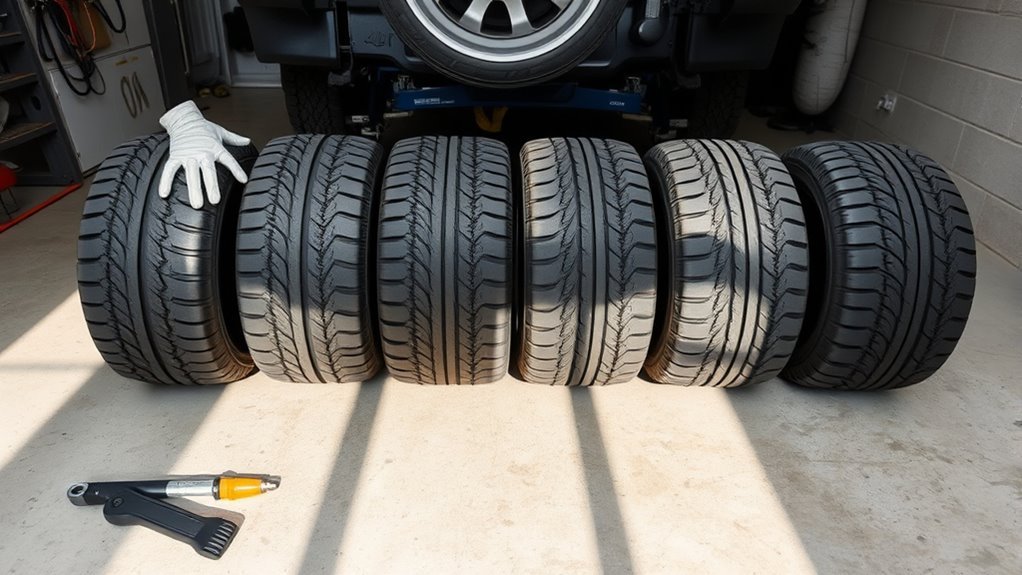
Yes, you absolutely should include your 4Runner’s full-size spare in every tire rotation. Rotate all five tires every 5,000 miles using a cross-pattern: spare to passenger rear, passenger rear to driver front, driver front to driver rear, driver rear to passenger front, and passenger front to spare. This prevents uneven tread depths that compromise handling, extends tire life by 20%, and guarantees your spare stays road-ready rather than degrading from static storage. A proper five-tire rotation demands attention to directional arrows, TPMS resets, and torque specs—details that transform a simple swap into a precision maintenance procedure.
How to Rotate All Five 4Runner Tires (And Why It Pays Off)
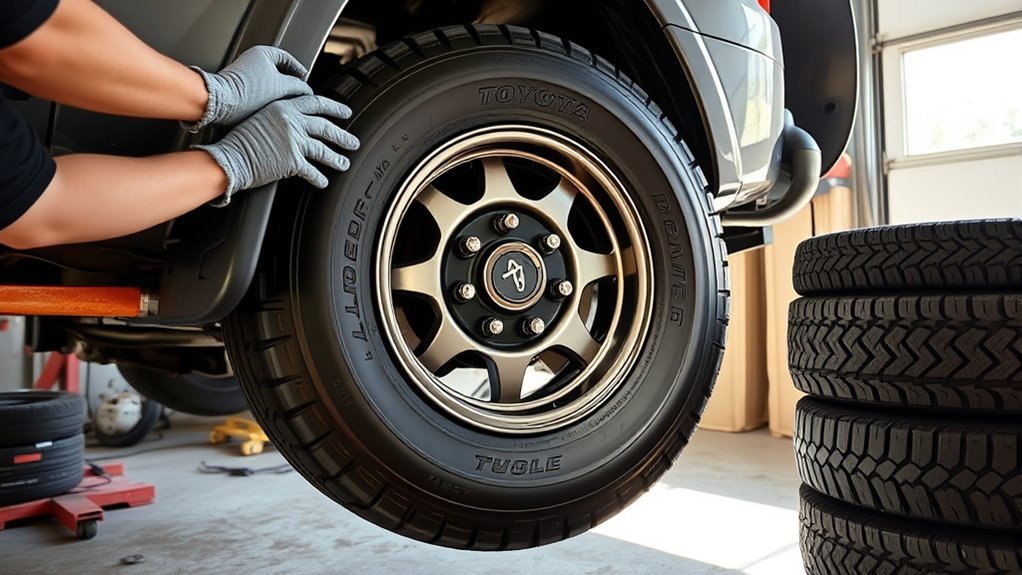
Rotating all five tires on your 4Runner demands a specific pattern: move the spare to the passenger rear, shift the passenger rear to the driver front, move the driver front to the driver rear, relocate the driver rear to the passenger front, and place the passenger front into the spare position. This five-tire rotation prevents mismatched tread depths that compromise handling and stability.
Execute this tire maintenance ritual every 5,000 miles, synchronizing it with oil changes. You’ll eliminate uneven wear patterns that create dangerous driving conditions, particularly during off-road excursions where traction failures prove catastrophic.
The payoff extends beyond longevity. You’re liberating yourself from premature tire replacement costs and roadside vulnerability. Your spare remains deployment-ready, inflated, and structurally sound—not a dry-rotted liability. These safety enhancements transform your 4Runner into a consistently reliable platform, whether traversing daily commutes or remote terrain. Precision in rotation yields freedom from mechanical failure and financial waste.
The 5-Tire Rotation Pattern That Actually Works
You’ll maximize tire longevity by rotating all five tires every 5,000 miles using a cross-pattern sequence: spare to passenger rear, rear tires forward, and front tires diagonally to opposite rear positions. This procedure guarantees uniform tread wear across all tires, including your previously idle spare. Maintain identical tire specifications and tread depths to prevent drivetrain stress and maintain balanced vehicle dynamics.
Five-Tire Benefits
Because uneven tread wear compromises both safety and longevity, incorporating your spare into a five-tire rotation pattern distributes load and wear across all five tires rather than confining it to four. You maximize tire longevity by ensuring each tire shares duty cycles equally, postponing replacement costs. Traction improvement becomes evident as matched tread depths maintain consistent grip across all contact patches, eliminating handling irregularities like wobble or vibration.
You preserve your spare’s emergency readiness by rotating it every 5,000 miles, preventing dry rot and degradation from static storage. The pattern also counteracts uneven wear from weight distribution variances and driving conditions specific to your 4Runner. Off-road performance gains particular advantage—five tires with identical wear characteristics deliver predictable handling when terrain demands it most. You control maintenance outcomes through disciplined rotation procedures.
Rotation Pattern Steps
Once you’ve committed to five-tire rotation, executing the correct pattern guarantees you’re actually distributing wear rather than just shuffling tires randomly.
Move your spare to the passenger rear position. Shift the passenger rear tire to the driver front. Relocate the driver front to the driver rear. Transfer the driver rear to the passenger front. This cross-pattern redistributes tire wear systematically across all five positions, preserving balanced handling and traction.
Stick to this maintenance schedule: rotate every 5,000 miles without exception. Consistency prevents uneven degradation that triggers vibrations or compromises stability. You’re not extending tire life arbitrarily—you’re engineering predictable, uniform wear through disciplined execution. Master this procedure, and you’ve liberated yourself from premature replacements and performance degradation.
Tread Depth Matching
When you commit to a five-tire rotation, you’re engineering uniform tread depth across all positions rather than allowing your spare to become an outlier with degraded rubber. You eliminate the risk of vehicle wobbling and vibrations that plague mismatched sets. Your tread depth comparison stays tight, maximizing traction across terrains.
| Rotation Cycle | Spare Position | Tread Depth Result |
|---|---|---|
| 1 | Rear passenger | Initial integration |
| 2 | Front driver | Balanced distribution |
| 3 | Rear driver | Full equalization |
You prevent dangerous disparities through systematic tire wear prevention. Your 4Runner maintains stability because no single tire lags behind. You dictate performance rather than surrendering to uneven degradation. Execute this pattern consistently, and you command predictable handling when conditions demand it most.
Is Your 4Runner’s Spare Tire Directional or Not?
How do you determine if your 4Runner’s spare tire is directional? Begin your directional identification by inspecting the sidewall for rotation arrows. These indicate the tire must spin in a specific direction. No arrows mean you’ve got a symmetrical or asymmetrical pattern—far more forgiving for rotation.
Check your 4Runner’s current setup. Many models ship with non-directional tires, but don’t assume. Your spare compatibility hinges on matching what you’ve got mounted. Directional spares pair with directional sets; non-directional spares work with symmetrical or asymmetrical arrangements.
Mixing types creates handling chaos if you deploy that spare roadside. You’ll lose predictable grip and compromise safety systems. Verify tread patterns match across all five positions before including the spare in rotation. Mismatched rubber isn’t just inconvenient—it’s a liability waiting to exploit your next emergency. Know your equipment. Match your spare. Rotate with confidence.
Handling TPMS Lights and Tread Depth Mismatches
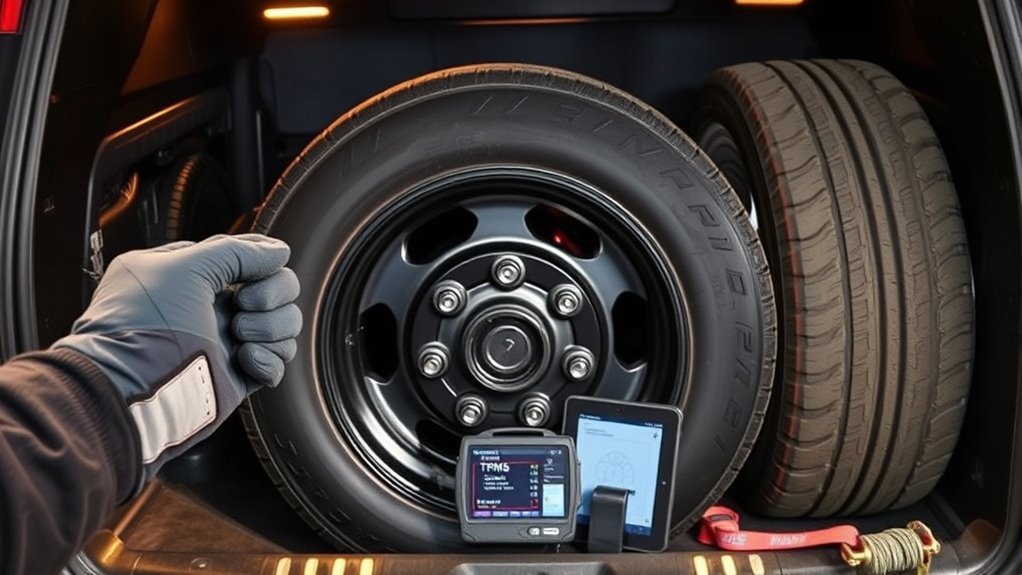
Matching your spare’s tread pattern to your mounted set keeps you rolling safely, but rotation introduces another set of variables you’ll need to manage. When you integrate the spare, you’re juggling TPMS troubleshooting and tread depth considerations simultaneously.
Your 4Runner’s Tire Pressure Monitoring System demands a sensor on every wheel. Skip the spare’s sensor, and you’ll trigger warning lights that demand immediate attention. Reset the system per your owner’s manual when lights appear post-rotation.
Tread depth mismatches create traction imbalances that compromise stability. You’ll feel it in cornering and braking. Measure all five tires before rotation; differences exceeding 2/32 inch between any two tires undermine performance. Rotate the spare regularly to equalize wear across your set. This prevents premature replacement and maintains predictable handling. Monitor depths quarterly, adjust rotation intervals based on your driving demands, and you’ll maximize tire longevity while preserving your 4Runner’s capability.
3 Rotation Strategies From 4Runner Owners Who’ve Done It
You can implement a five-tire full rotation to distribute wear across all tires, adopt a spare-only reserve strategy that keeps your spare static while cycling four road tires, or follow the four-tire standard pattern that matches manufacturer recommendations. Each approach requires you to track tread depth and position history to maintain balanced handling. Your choice depends on whether you prioritize maximizing tire lifespan or minimizing maintenance complexity.
Five-Tire Full Rotation
While conventional four-tire rotations suffice for most vehicles, 4Runner owners who push their rigs through demanding terrain have developed a more thorough approach: integrating the spare into a full five-tire rotation cycle.
Execute this proven pattern: move your passenger rear tire to the front passenger position, shift the front passenger to the front driver, transfer the front driver to the rear driver, and rotate the rear driver into your spare mount. This sequence distributes wear across all five tires, maximizing tire longevity and ensuring your spare remains trail-ready.
The benefits compound immediately:
- Uniform tread depth eliminates handling inconsistencies when you’re maneuvering technical terrain
- Your spare won’t degrade from static aging, preserving its integrity for emergency deployment
- Sustained off-road performance demands consistent grip across every tire in your arsenal
Spare-Only Reserve Strategy
Where does the spare tire truly belong in your rotation strategy? You might choose the Spare-Only Reserve Strategy—keeping your spare static while rotating only your four main tires.
You preserve spare tire longevity by limiting its exposure to road wear, maintaining full tread depth for emergency deployment. This approach prioritizes flat tire preparedness: when you suffer a puncture, you install a tire with maximum grip and no degradation. You avoid mixing a worn spare with partially worn tires, eliminating handling imbalances and vibrations.
Execute standard four-tire rotations every 5,000 miles. Inspect your spare quarterly for pressure, cracking, and aging. Replace it every six years regardless of appearance. You sacrifice even five-tire wear distribution, but you gain certainty—your reserve remains factory-fresh, ready for extraction from beneath your 4Runner when terrain or debris demands immediate action.
Four-Tire Standard Pattern
Four distinct rotation patterns dominate 4Runner owner forums when you’re running five matching tires. The four-tire standard pattern offers simplicity: you’ll move front tires straight back, cross rear tires to the front, and leave your spare untouched. This approach demands stricter rotation frequency—typically every 5,000 miles—to manage uneven tire wear across your active set.
- Your spare remains a true emergency backup, ready with full tread depth when blowouts strike remote trails
- You sacrifice the fifth tire’s utility, accepting faster wear rates on your four primary tires
- You maintain predictable handling without introducing the spare’s potentially different age or construction
You’ll track tire wear more aggressively with this pattern. Measure tread depth quarterly; replace in matched pairs when variance exceeds 2/32″. Your liberation comes through disciplined maintenance, not complexity.
Complete Walkthrough: Rotating Your 4Runner’s Five Tires
Since you’ve already gathered your tools and confirmed your spare matches the road tires’ specifications, you’re ready to execute a five-tire rotation on your 4Runner—a procedure that’ll maximize tread life and guarantee your spare remains road-ready.
Position your vehicle on level ground. Loosen all lug nuts before jacking. Remove the spare from its mount beneath the rear. Move the passenger rear tire to the front passenger position. Transfer the driver rear to the driver front. Install the front driver tire into the spare position. Mount the spare onto the passenger rear. Torque all lug nuts to 76 ft-lbs in a star pattern.
Reset your TPMS through the vehicle menu or button sequence outlined in your manual—failure to do so triggers false warnings. These tire maintenance tips assure even wear across all five positions. Consistent spare tire care prevents degradation from prolonged static storage. Rotate every 5,000 miles.
Frequently Asked Questions
What Does Toyota Recommend for Tire Rotation?
Toyota recommends you rotate all five tires, including your spare tire, every 5,000 miles using a cross-pattern sequence. You’ll maximize rotation benefits through even tread wear, consistent handling, and guaranteed emergency readiness.
How Often Should I Rotate the Tires on My Toyota 4runner?
Rotate your 4Runner’s tires every 5,000 miles—neglect this, and you’ll face uneven tire wear; embrace it, and you’ll maximize spare usage freedom. Your owner’s manual confirms this precise, liberating maintenance rhythm.
Conclusion
You ignore your spare, and you’re burning money. You rotate all five, and you’re maximizing tread life—simple math, real results. Directional tires demand discipline; non-directional tires reward flexibility. TPMS lights flash, but you clear them. Tread depths vary, but you track them. Three owners proved it works. You’ve got the pattern, the walkthrough, the why. Now grab that fifth tire and rotate it like the asset it is.

Related Articles
How to Change a Flat Tire on a Toyota 4Runner Safely
Learn the essential steps to safely change a flat tire on your Toyota 4Runner, and discover tips to prevent future issues. Don't miss out!
Read More
How to Store Seasonal Tires for Your Toyota 4Runner
Uncover the hidden storage mistakes that could ruin your 4Runner's tires before next season.
Read More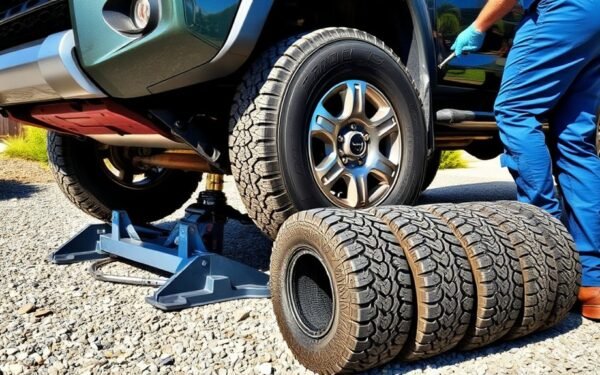
How to Rotate Tires on a 4Runner the Right Way
Unlock the secrets to properly rotating tires on your 4Runner for optimal performance; discover the essential steps to ensure a smooth ride.
Read More