
How to Put Air in a Tire at a Gas Station: 5 Steps
Last updated: July 7, 2026
Low tire pressure can make your car harder to control, shorten tire life, and trigger the tire pressure light. To put air in a tire at a gas station, park close to the air pump, check the cold PSI listed on your driver’s door sticker or owner’s manual, attach the hose straight to the valve stem, and add air until the gauge reaches the recommended pressure. Do not use the tire sidewall maximum as your normal target.
What’s in This Article
- Quick Answer: How to Put Air in a Tire at a Gas Station
- Key Takeaways
- Before You Begin: What You Need at the Air Pump
- How to Find the Right PSI for Your Car
- What to Bring and Quick Safety Checks
- Quick Step-by-Step: Inflate a Tire at the Pump
- How to Check Tire Pressure With a Manual Gauge
- Use an Automated Air Pump to Inflate Tires
- How to Attach the Hose, Monitor PSI, and Finish
- Quick Troubleshooting: Common Problems and Fixes
- When to Stop Inflating and Get Professional Help
- Monthly Checks and Simple Habits to Keep Tire Pressure Correct
- Frequently Asked Questions
- Conclusion
Quick Answer: How to Put Air in a Tire at a Gas Station
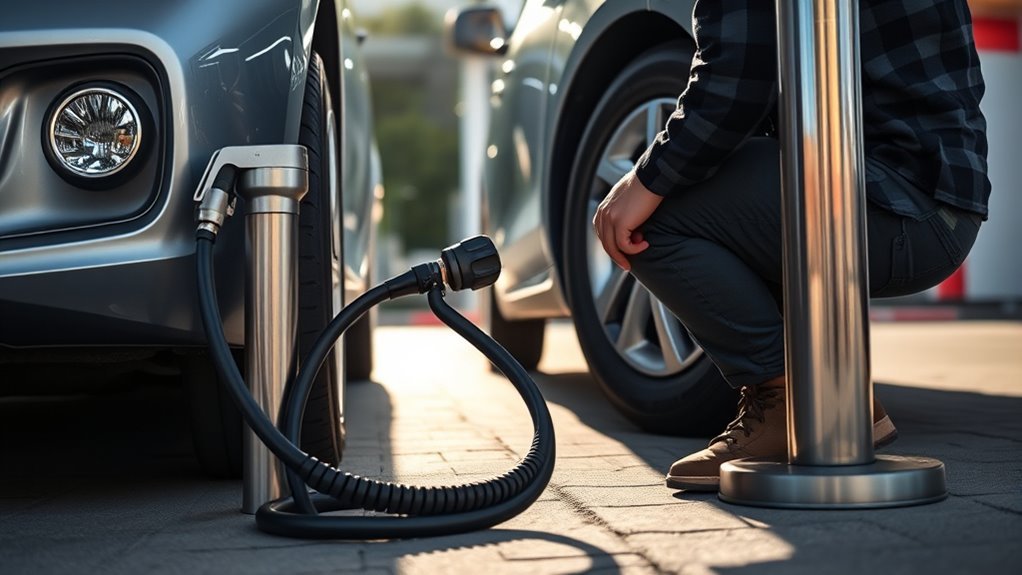
Park close enough for the air hose to reach each tire. Set the parking brake, turn off the engine, remove the valve cap, and check the cold tire pressure with your own gauge if possible. Use the recommended PSI from the driver’s door jamb or owner’s manual, not the tire sidewall number. Attach the hose firmly, add air in short bursts, and stop at the target pressure. Replace the cap, recheck the pressure, and listen for leaks before you drive.
Key Takeaways
- Use the PSI listed on your door jamb sticker or owner’s manual, not the tire sidewall maximum.
- Check tire pressure when the tires are cold for the most reliable reading.
- Attach the air hose straight and firmly so the valve does not leak while you fill.
- Add air slowly and recheck often to avoid overinflating the tire.
- Get help from a tire shop if pressure drops again soon after you fill the tire.
Before You Begin: What You Need at the Air Pump
Estimated time: 5 to 10 minutes for all four tires.
Before you start, gather a few simple items and confirm your target PSI. A clear target helps you fill each tire without guessing.
- Tire pressure gauge, digital or analog
- Driver’s door jamb sticker or owner’s manual PSI reference
- Coins, card, or payment app if the pump charges a fee
- Gloves or a small towel for dirty valve stems
- Flashlight if you fill tires at night
| Pump or Tire Issue | What It Usually Means | Best Next Step |
|---|---|---|
| Hose hisses loudly | The nozzle is not sealed straight on the valve stem. | Remove it and press it on squarely. |
| Gauge jumps past the target | The pump may fill quickly or the gauge may lag. | Stop, release small bursts, and recheck. |
| Tire will not gain pressure | The valve, bead, or tread may be leaking. | Stop filling and get a tire shop inspection. |
| TPMS light stays on | One tire may still be low, or the system may need driving time or service. | Check all tires cold, including the spare if your vehicle monitors it. |
[Products Worth Considering]

The Milton 555e digital tire inflator delivers fast, accurate pressure readings with a backlit display and multiple unit options, making tire inflation quick and easy. Its durable 20" EPDM rubber hose and grip‑head chuck provide reliable connection, while the ±1 PSI accuracy ensures precise inflation for cars, bikes, and trucks.

This digital tire pressure gauge combines a sturdy pistol grip inflator with a backlit 0.1 PSI display for quick, accurate readings in any lighting condition. Its 360° swivel gauge and 20" rubber hose make it easy to use and store, while the integrated inflate/deflate trigger and ¼" NPT air inlet provide fast, reliable tire maintenance.

The Milton 507KIT delivers fast, accurate tire inflation, deflation and pressure measurement with a backlit LCD gauge and 14" rubber hose. Its 3‑in‑1 design meets ANSI/ASME standards and provides readings from 0‑250 PSI with 0.1 PSI resolution. The ergonomic pistol‑grip body and brass lock‑on chuck make one‑handed operation effortless, while the auto‑off feature conserves battery life.
How to Find the Right PSI for Your Car
Check the correct pounds per square inch (PSI) on the sticker in your driver’s side door jamb or in your owner’s manual. That recommended pressure, often around 27 to 35 PSI for many passenger cars, gives you the target you should use. Do not use the tire sidewall’s maximum as your normal fill pressure.
The National Highway Traffic Safety Administration tells drivers to use the vehicle maker’s listed pressure, check tires when cold, and remember that TPMS does not replace regular pressure checks. A cold reading usually means the vehicle has not been driven for at least three hours.
If you drove several miles before reaching the pump, fill to the door-sticker target for now, then recheck the tires later when they are cold.
Check Door Jamb Sticker
The door jamb sticker on the driver’s side gives the exact recommended tire pressure for your vehicle. Read the front and rear values before you use the gas-station pump.
- Locate the sticker on the driver’s door frame.
- Note the cold PSI for front and rear tires.
- Set each axle to its own value if the numbers differ.
- Use the sticker value instead of guessing.
- Check the owner’s manual if the sticker looks missing or unreadable.
Refer To Owner’s Manual
Your owner’s manual also lists the correct cold PSI for the front and rear tires. It may also give pressure guidance for heavy loads or long highway trips.
Use those values for better handling, tire life, and fuel economy. Avoid filling to the sidewall maximum unless the vehicle maker tells you to do so.
| Example Source | Front PSI | Rear PSI |
|---|---|---|
| Owner’s Manual Example | 32 | 35 |
| Door Jamb Sticker Example | 32 | 35 |
| Tire Sidewall Maximum Example | 44 | 44 |
This example shows why the sidewall number can mislead you. Your car may need much less pressure than the tire’s listed maximum.
Warning: Never use the tire sidewall maximum as your normal target unless your vehicle maker says to use it.
What to Bring and Quick Safety Checks
Before you start inflating, bring a tire pressure gauge and know your vehicle’s recommended PSI. Many tires lose small amounts of pressure over time, so a monthly check helps you catch low pressure early.
Park away from traffic, set the parking brake, and turn off the engine. Use hazard lights if the pump area sits close to moving cars.
Before inflating, gather a gauge, check cool tires, set the brake, and confirm the recommended PSI.
- Tire pressure gauge, digital or analog
- Valve stem cap tool or clean fingers
- Owner’s manual or door-sticker PSI reference
- Gloves and a flashlight for visibility
- Small towel to wipe the valve and check for leaks
These steps reduce risk and help you fill each tire with more care.
Quick Step-by-Step: Inflate a Tire at the Pump
Follow these steps in order so you get a clean seal and an accurate fill. Move slowly near the target PSI because some pumps add air quickly.
- Park close enough for the hose to reach all tires.
- Set the parking brake and turn off the engine.
- Find the recommended PSI on the door sticker or owner’s manual.
- Remove the valve cap from the tire you plan to fill.
- Press the air hose straight onto the valve stem.
- Add air until the gauge reaches the target PSI.
- Detach the hose quickly and straight to limit pressure loss.
- Replace the valve cap and repeat the process for each tire.
If the pump uses an automatic setting, enter your target PSI first. The pump should stop or beep when the tire reaches the set pressure.
Pro tip: Keep your own gauge in the glovebox because gas-station pump gauges can vary.
How to Check Tire Pressure With a Manual Gauge
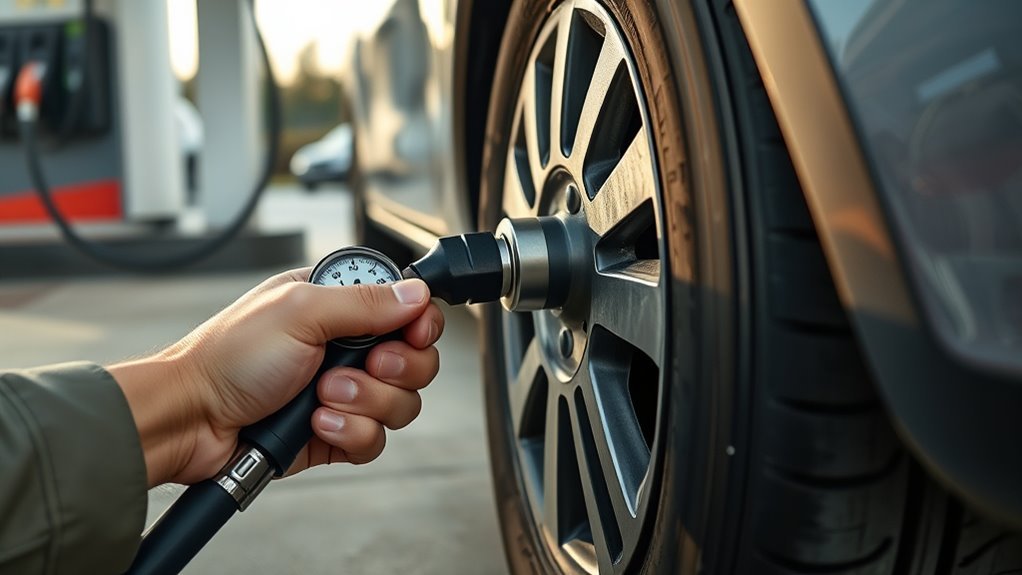
Start with a cool tire and remove the valve cap. Keep the cap in your hand or pocket so it does not roll away.
Press the manual gauge firmly onto the valve stem until the hiss stops. Read the PSI reading, compare it with your recommended pressure, and add air if the tire reads low.
[Products Worth Considering]
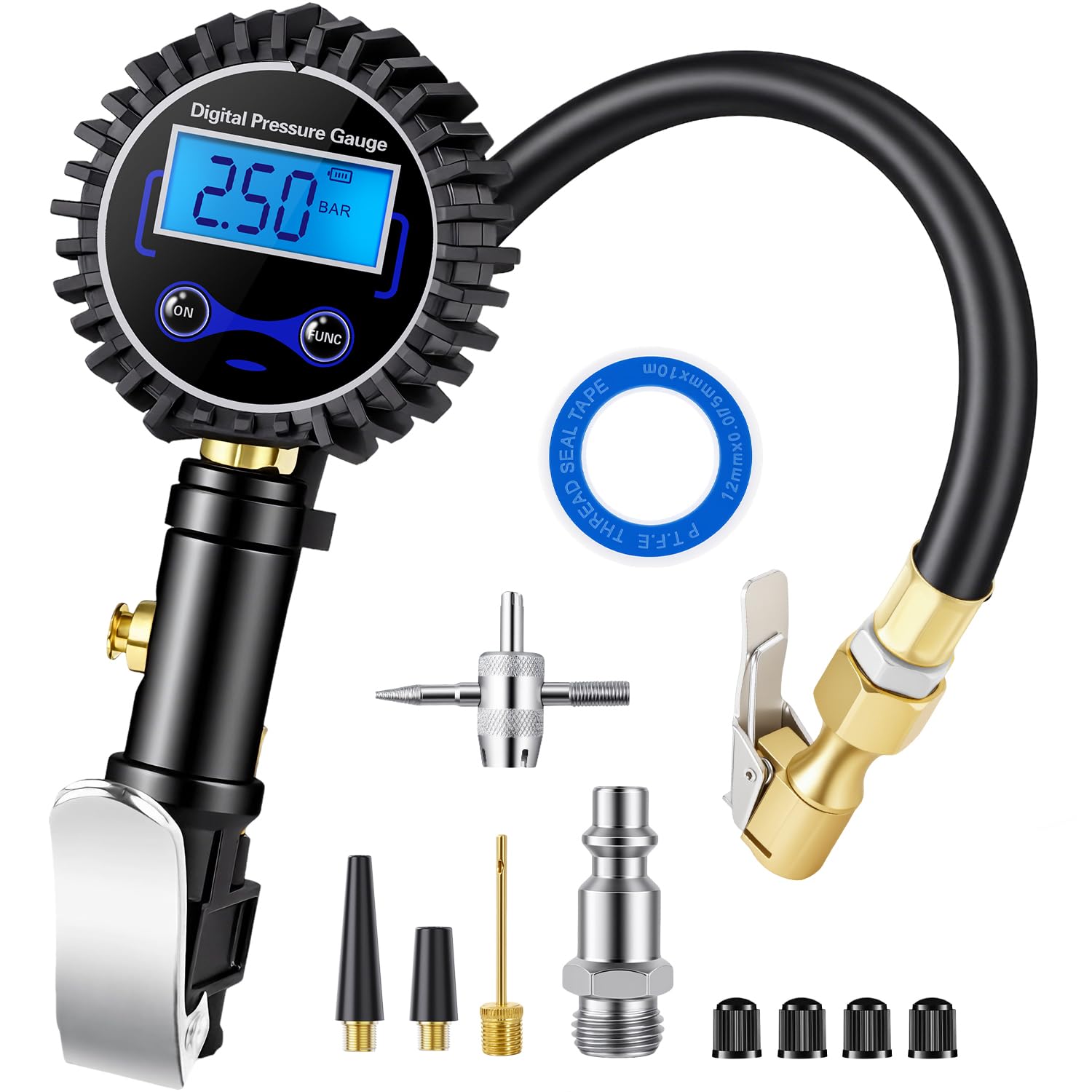
The Digital Tire Pressure Gauge with Inflator offers precise pressure readings with a high‑resolution LED display and four unit options, making tire maintenance quick and accurate. Built from stainless steel and brass, it includes a durable rubber hose, quick‑connect coupler, and a 3‑year warranty for reliable, everyday use across cars, RVs, bikes, and inflatables.

The GERCHWAY Digital Bike Tire Pressure Gauge offers precise ±1% accuracy across a 3–200 PSI range, fitting both Presta and Schrader valves without extra adapters. Its 16‑inch hose provides extra reach for easy inflation on bikes, motorcycles, SUVs, and cars, while the 1/4" NPT quick connector enables direct compressor attachment. Designed for quick checks, deflation, and inflation, it delivers reliable, leak‑free performance for all your tire needs.

RUGGED DESIGN: The stainless steel components prevent rust and corrosion while the precision-crafted nozzle seamlessly seals onto the valve stems for highly accurate readings (±2% span). We also provide 4 valve stem caps for convenient replacement.
Prepare The Tire Valve
Pull the valve cap off the stem and set it somewhere clean. Dirt inside the valve can cause slow leaks or false readings.
Press the manual gauge nozzle straight onto the stem. A steady seal gives you the most useful reading.
- Keep the cap in your hand or a clean pocket.
- Check the valve stem for cracks, corrosion, or debris.
- Seat the gauge squarely on the valve stem.
- Press again if you hear a strong hiss.
- Add air and recheck if the tire reads below the recommended PSI.
Read And Interpret Gauge
A cool tire gives you the most accurate reading, so check pressure before a long drive. You can also wait a few hours after driving if your schedule allows.
Read the gauge in PSI or kilopascals (kPa), depending on the tool. Compare the reading with the sticker or manual, then inflate and recheck until the tire reaches the recommended value.
| Step | Action |
|---|---|
| 1 | Remove valve cap |
| 2 | Press gauge firmly |
| 3 | Listen for hissing |
| 4 | Read pressure units |
| 5 | Inflate and recheck |
Use an Automated Air Pump to Inflate Tires
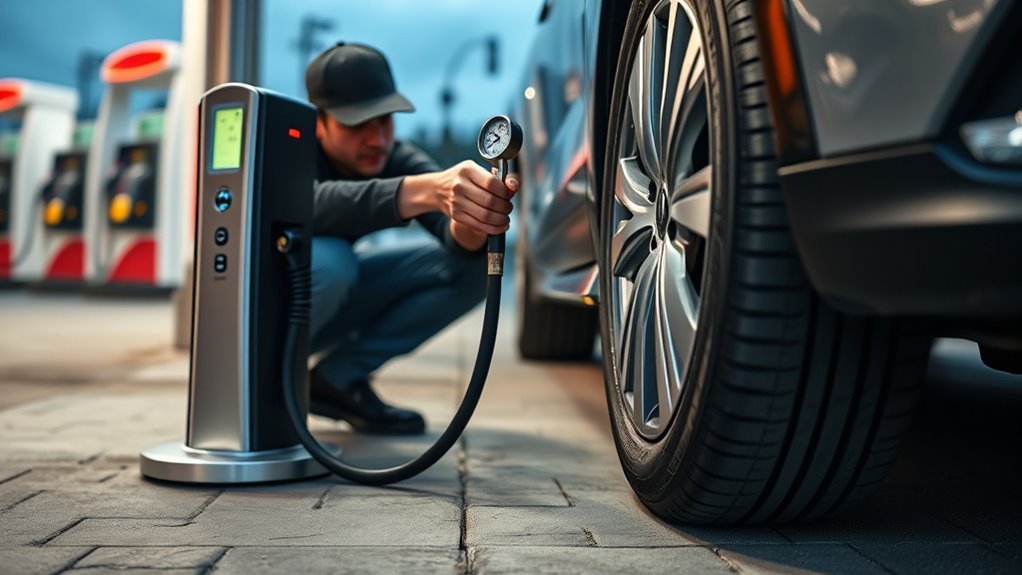
Set the pump to your vehicle’s recommended PSI using the digital display. Secure the hose to the valve stem so air does not leak while the pump fills the tire.
The station’s air compressor should monitor pressure and stop or beep when it reaches the target. After it signals completion, remove the hose and replace the valve cap.
- Check the driver’s door sticker or owner’s manual for recommended PSI.
- Enter the target PSI on the pump’s digital display.
- Push the hose firmly onto the valve stem.
- Listen for the beep or stop signal.
- Recheck with a handheld gauge for better accuracy.
[Products Worth Considering]
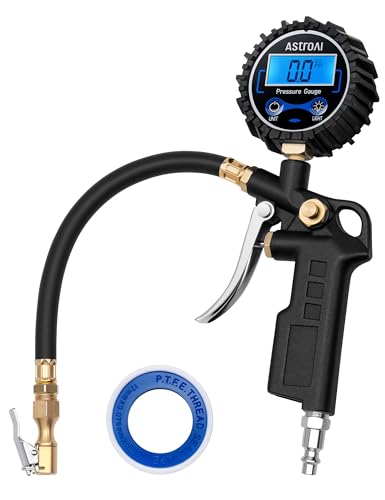
COMPATIBLE WITH both ¼” and ½” NPT air compressors outputs. COMPATIBLE WITH Standard Schrader Valves.

【Accurate Digital Tire Gauge】The digital pressure gauge always returns a stable reading within 1% of the exact pressure of your tire by incredible 0.1 display resolution. No more guessing!

WHY CHOOSE ASTROAI: Based in Garden Grove, California. AstroAI services 15+ countries worldwide and 3,000,000+ users, it has become the preferred choice of countless users thanks to its high accuracy, durability, and user-friendly operation.
How to Attach the Hose, Monitor PSI, and Finish
Press the dispenser nozzle firmly onto the valve stem until you get a secure seal. If the pump has a locking chuck, lock it before air starts flowing.
Watch the pump or manual gauge and stop at the vehicle’s recommended PSI. If you use an automated pump, program the target and let it shut off or beep on its own.
Secure The Air Hose
Seat the pump nozzle firmly onto the valve stem before you start filling. A snug connection prevents leaks and helps the gauge read correctly.
- Press the nozzle straight onto the valve stem.
- Check for hissing that signals a poor seal.
- Enter the desired PSI first if the pump uses a digital setting.
- Slow down near the target pressure to avoid overshooting.
- Remove the hose straight off to avoid bending the valve stem.
Finish by checking the pressure with your own gauge if you have one.
Monitor Tire Pressure
Hold the chuck firmly as the tire fills. A crooked seal lets air escape and can make the gauge read wrong.
Watch the PSI readout as you add air, or enter the target PSI on an automated unit. Most passenger cars use about 27 to 35 PSI, but your vehicle’s label gives the correct value.
Pause and recheck as needed. After you reach the recommended pressure, remove the hose quickly and replace the valve cap to block dirt and debris.
Replace Valve Cap
After you finish inflating, pull the hose straight off the valve stem. Screw the valve cap back on right away to help block dirt, moisture, and debris.
Tighten the cap by hand only. Too much force can damage the cap or make it harder to remove later.
- Tighten the cap hand-tight only.
- Avoid cross-threading the stem.
- Listen for air leaks.
- Keep spare caps in the glovebox.
- Recheck PSI later if the tire looked very low.
Quick Troubleshooting: Common Problems and Fixes
A short checklist can help you solve most pump problems before you lose time. Start with the simple issues, then check for tire damage if the pressure still will not hold.
- The pump will not start: Check for a power switch, payment screen, or coin slot.
- The gauge seems wrong: Compare it with your handheld tire pressure gauge.
- The hose keeps hissing: Press the chuck straighter and clear debris from the valve.
- The tire gets too much air: Press the valve core in short bursts to release air.
- The tire loses pressure again: Check for punctures, valve leaks, or sidewall damage.
- The TPMS light stays on: Check all tires again when cold, then review your owner’s manual for reset steps.
If you cannot find the issue, ask a tire shop to inspect the tire. A slow leak can become a flat when you least expect it.
When to Stop Inflating and Get Professional Help
If you can’t reach the vehicle’s recommended PSI after several fill attempts, stop pumping. The tire may have a leak, a faulty valve, or hidden damage that needs a professional inspection.
Do not keep driving on a tire that loses pressure quickly. Use a spare or roadside help if the tire looks unsafe.
- Stop if the tire will not reach the target PSI.
- Get help if the gauge drops soon after filling.
- Inspect any visible bulge, cut, or odd tread wear.
- Use the spare after a flat or sudden pressure loss.
- Visit a tire shop if correct pump use does not solve the issue.
Monthly Checks and Simple Habits to Keep Tire Pressure Correct
Check your tire pressure at least once a month with a reliable gauge while the tires are cold. Confirm the PSI on the driver’s door sticker or owner’s manual, then top up as needed.
Build a simple tire routine. Look for cuts, bulges, uneven wear, and low-looking tires before long trips.
Pressure can change when outdoor temperatures shift. Recheck after major temperature swings so each tire stays close to the recommended PSI.
Frequently Asked Questions
How Do You Put Air in a Tire for Beginners?
Remove the valve cap, press the air hose onto the valve stem, and fill until the gauge reaches your vehicle’s recommended PSI. Recheck with a gauge, detach the hose, and replace the valve cap.
How Much Air Should I Put in My Tires at a Gas Station?
Use the cold PSI listed on your driver’s door sticker or owner’s manual. Do not use the maximum PSI molded into the tire sidewall as your normal fill pressure.
Can I Drive on Low Tire Pressure?
You should avoid driving on low tire pressure when you can. Low pressure can hurt handling, increase tire wear, and make the tire run hotter.
Can You Put Air in Your Tires at Any Gas Station?
You can use an air compressor at many gas stations, but not every station has one. Check the pump instructions, payment signs, and gauge before you start.
Does a Car Need to Be Running to Use a Tire Inflator?
No, the car does not need to run when you use most gas-station air pumps. Set the parking brake, turn the engine off, and follow the pump instructions.
Can You Fill Tires When They Are Warm?
You can add air if a tire is clearly low, but recheck the pressure later when the tires are cold. Warm tires can show a higher reading after driving.
Why Is My Tire Pressure Light Still On After Adding Air?
One tire may still be low, the spare may be monitored, or the system may need a short drive or reset. Check all tires cold and follow your owner’s manual.
What Should You Do If You Overinflate a Tire?
Press the valve core briefly to release small bursts of air. Recheck the PSI after each burst until the tire matches the recommended pressure.
Conclusion
Correct tire pressure starts with the PSI listed on your vehicle, not with guesswork at the pump. Check the pressure while the tires are cold, attach the hose firmly, and fill slowly until each tire reaches the right number.
Keep a gauge in your car and check your tires every month. If a tire loses pressure again, stop treating it as a simple top-up and have the valve, tread, and wheel inspected.

Related Articles
What Does THE P Stand For on a Tire? Full Meaning Explained
I’ll explain what the “P” on a tire really means and why it could change how you choose your next set.
Read More
How to Use a Tubeless Tire Repair Kit: Complete Field Guide
Learn how to fix tubeless tire punctures fast with the right kit, because one small mistake can leave you stranded on the trail.
Read More
How to Tell a Tire’s Diameter: Easy Guide to Reading Tire Size
Want to decode tire sidewall numbers and find the right diameter, but wonder what those hidden digits really mean?
Read More