
Does a Hyundai Sonata Need Alignment After New Tires? Yes

New tires are a smart investment for your Hyundai Sonata, but they do not automatically prove the wheels are aligned correctly. The safest answer is this: have the alignment checked when you install new tires, then approve a full alignment only if the readings are outside Hyundai specifications or the car shows symptoms such as pulling, uneven wear, or an off-center steering wheel.
Quick Answer
After installing new tires on a Hyundai Sonata, you should at least have the alignment checked. A full alignment is needed if the readings are out of spec or you notice pulling, uneven wear, an off-center steering wheel, or vibration. Proper alignment helps protect the new tire set and keeps steering predictable.
Key Takeaways
- A Hyundai Sonata does not always need an immediate alignment adjustment after new tires, but an alignment check is a smart move.
- Approve the alignment if the shop shows out-of-spec camber, caster, toe, or thrust-angle readings on the printout.
- Uneven tire wear, pulling, an off-center steering wheel, or recent pothole/curb impact are strong reasons to schedule service.
- Vibration on a smooth road may point to wheel balance, bent wheels, tire issues, or suspension wear, not alignment alone.
- Ask the technician to inspect tire pressure, tire condition, and suspension parts before making alignment adjustments.
At a Glance
| Time Required | About 30–90 minutes for a standard alignment, longer if suspension repairs or extra calibration are needed |
| Difficulty | Professional service; not a driveway DIY job without alignment equipment |
| Tools Needed | Alignment rack, wheel sensors, Hyundai specifications, tire pressure gauge, and suspension inspection tools |
| Cost | Often about $65–$200 in many U.S. markets; dealer pricing, local labor, worn parts, and added services can change the final bill |
Why Is Wheel Alignment Important After New Tires?

Wheel alignment sets the suspension angles so the tires point and sit on the road as the vehicle manufacturer intended. On a Hyundai Sonata, those angles affect how the car tracks straight, how the steering wheel returns to center, and how evenly the new tires wear.
Hyundai’s owner information explains that the wheels are aligned and balanced at the factory, and that alignment may need adjustment if you notice unusual tire wear or the vehicle pulling to one side. That is why a new-tire installation is a good time to check alignment, especially if the old tires wore unevenly.
New tires can also hide old problems. If your previous set had feathering, cupping, shoulder wear, or one tire wearing faster than the others, the fresh tread may feel better at first while the alignment problem continues underneath. A quick alignment check gives you a baseline before the new set starts wearing.
Pro Tip: Ask for a before-and-after alignment printout. If the “before” numbers are already within specification, you may only need the check. If camber, caster, toe, or thrust angle is out of spec, the printout shows why the adjustment was worth doing.
[Products Worth Considering]

Measure tire tread depth quickly and accurately with this LUMITECO dial gauge that reads in 1/32" increments up to 14/32". The color-coded green/yellow/red zones make it easy to judge tire wear and know when replacement is needed. A rugged, compact design with a protective pouch helps keep the gauge ready for use on cars, trucks, motorcycles, and more.

The Ziopetru adjustable magnetic wheel alignment tool helps you check and restore camber and caster positioning after removing and reinstalling undercarriage components. With a clear leveling/bubble measurement system and an easy zeroing adjustment knob, it supports precise horizontal angle checking. The strong magnetic base mounts to metal surfaces for convenient use at home on cars, motorcycles, trucks, vans, and SUVs.

Monitor tire tread wear with a smart, color-coded depth gauge that shows clear condition ranges at a glance. The bar is range marked for fast, easy readings, helping you maintain safer traction and performance. Each gauge is portable with a pocket clip, and the set includes 20 units for daily use and sharing.
Do You Need an Alignment or Just an Alignment Check?
These are not the same thing. An alignment check measures your Sonata’s current wheel angles. A full wheel alignment adjusts those angles back to factory specifications.
You should strongly consider a full alignment after new tires if:
- Your old tires had uneven inner-edge, outer-edge, feathered, or diagonal wear.
- The steering wheel is crooked when driving straight.
- The Sonata pulls or drifts on a straight, level road.
- You recently hit a pothole, curb, road debris, or had suspension work done.
- The shop’s alignment printout shows readings outside factory specification.
You may not need an adjustment immediately if the vehicle drives straight, the steering wheel is centered, the old tires wore evenly, there was no recent impact, and the alignment readings are already within spec.
Warning: Do not keep driving normally if the car suddenly pulls hard, shakes badly, or shows a bulge, cut, exposed cord, or rapid pressure loss. Have the tires, wheels, and suspension inspected before relying on an alignment alone.
What Are the Signs Your Sonata Needs a Wheel Alignment?
Watch for these common signs after installing new tires on your Hyundai Sonata:
- Uneven tire wear: One shoulder wears faster than the other, or one tire wears faster than the rest.
- Pulling or drifting: The car moves left or right on a straight, level road when your grip is light.
- Off-center steering wheel: The steering wheel sits crooked while the car is driving straight.
- Squealing during turns: Tires may be scrubbing instead of rolling smoothly.
- Loose or unstable steering feel: The car does not feel settled at highway speeds.
Vibration deserves a separate note. Hyundai states that vibration while driving on a smooth road may indicate the wheels need to be rebalanced. So if your new tires vibrate, ask the shop to check tire balance, wheel condition, tire pressure, and suspension parts along with alignment.
Alignment vs. Balancing vs. Rotation
Many drivers use these terms interchangeably, but they solve different problems:
| Alignment | Adjusts suspension angles so tires track correctly and wear evenly. |
| Balancing | Adds small weights so the tire-and-wheel assembly spins smoothly without vibration. |
| Rotation | Moves tires to different positions to help spread wear, when the tire sizes and owner’s manual allow it. |
New tires should be balanced when installed. Alignment is separate. Rotation comes later as part of routine tire maintenance.
How Does Misalignment Affect Tire Performance?
Misalignment changes the way the tire contacts the road. Instead of rolling cleanly, the tire may scrub sideways or carry too much load on one edge. That can create irregular tread wear, noisier driving, reduced grip, and a steering feel that makes the car harder to keep centered.
The U.S. Tire Manufacturers Association notes that misaligned wheels can lead to uneven, rapid tread wear and should be corrected by a tire dealer. This matters most right after you buy new tires because you are trying to protect the full life of the set.
Misalignment can also increase rolling resistance, which means the car may need more energy to move down the road. Do not expect a guaranteed fuel-economy number from an alignment alone, but keeping tires properly inflated and rolling correctly supports efficiency. FuelEconomy.gov reports that proper tire inflation can improve gas mileage by 0.6% on average and up to 3% in some cases.
A good alignment does not just make the steering wheel straight. It helps the tires roll without unnecessary scrub, which protects tread life, handling, and ride comfort.
What Are the Benefits of Proper Wheel Alignment?
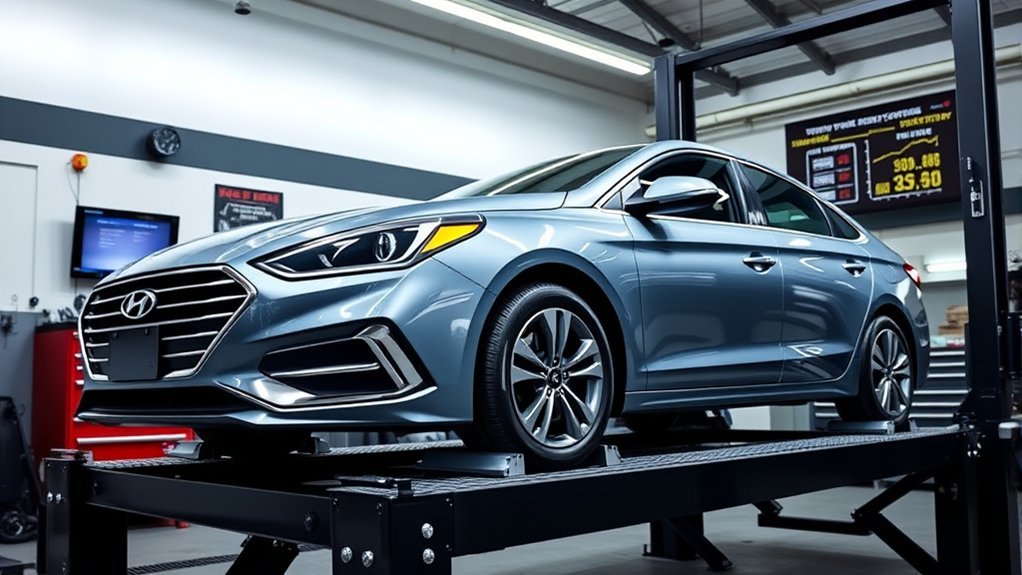
Enhanced Tire Longevity
New tires are expensive, and alignment helps them wear more evenly. When toe, camber, caster, and thrust angle are within specification, the tread is less likely to scrub, feather, or wear heavily on one shoulder. That helps you get more value from the tire set.
Improved Steering and Handling
A properly aligned Sonata should feel stable and predictable. The steering wheel should sit centered, the vehicle should track straight on a level road, and the tires should respond consistently during turns and braking.
Better Efficiency Support
Alignment is one part of the efficiency picture. Tire pressure, tire design, tread condition, wheel balance, road surface, and driving style also matter. The National Highway Traffic Safety Administration explains that tire maintenance, rolling resistance, and proper inflation affect fuel use and tire safety.
When Should You Schedule Your Wheel Alignment?

Schedule an alignment check for your Hyundai Sonata:
- When you install new tires, especially if the old tires wore unevenly.
- At least once a year if you drive on rough roads or want a preventive check.
- After hitting a pothole, curb, road debris, or after a minor accident.
- After replacing steering or suspension parts.
- Any time the car pulls, the steering wheel sits off-center, or tread wear looks uneven.
AAA recommends routine alignment checks at least annually or any time tires are replaced or the vehicle hits a pothole or curb. USTMA also advises checking alignment when there is trouble such as pulling, and periodically as specified by the owner’s manual.
[Products Worth Considering]

Accurately measure tire tread depth with a calibrated gauge marked from 0 to 1 inch in 1/32 inch increments. The color-coded bar helps you quickly identify tread condition ranges, supporting safe driving for trucks, motorcycles, automobiles, and passenger vehicles.

The SAFELIFE dial tire tread depth gauge measures tread depth in 1/32 inch increments with clear, easy-to-read 2-inch dial face. Color zones using a traffic light system help you quickly judge whether tread is low, marginal, or ample for safer driving. Built with a durable zinc cast body and a metal detect probe for precise, comfortable use across cars, motorcycles, trucks, and buses.

This universal wheel alignment tool helps you accurately restore tire tilt angles after tire or suspension repairs using an adjustable camber gauge. It features a powerful magnetic base that firmly attaches to brake rotors for stationary, slip-free readings, improving consistency during measurement. Built from durable PC plastic, it resists wear and corrosion and is compact enough for car, truck, RV, and motorcycle alignment tasks.
Signs of Misalignment
The clearest warning signs are uneven tire wear, pulling to one side, and a steering wheel that is not centered while driving straight. If these signs appear after new tires, do not wait for the tread to wear down. A quick check can prevent avoidable damage.
Recommended Alignment Frequency
For most Sonata owners, a practical schedule is to check alignment after new tires, after impacts, after suspension repairs, or about once a year if roads are rough. Do not approve an alignment at every oil change unless the shop shows a real reason, such as out-of-spec readings or visible tire-wear symptoms.
Benefits of Regular Alignment
Regular alignment checks can protect tire life, support steering control, and catch suspension issues early. The biggest benefit is not the service itself; it is catching problems before they ruin a fresh set of tires.
What Happens During Your Alignment at Gurnee Hyundai?
At Gurnee Hyundai, or any qualified Hyundai service department, an alignment should begin with inspection, not just adjustment. A technician should check tire pressure, tread wear, wheel condition, and key suspension and steering components before changing alignment angles.
During the service, the vehicle is placed on an alignment rack and sensors are attached to the wheels. The alignment machine compares your Sonata’s readings with Hyundai specifications. The technician then adjusts the appropriate angles, usually toe and sometimes camber or caster depending on the design and what the vehicle allows.
| Step | What It Means |
| Initial Inspection | Checks tire pressure, tread condition, wheels, steering, and suspension parts. |
| Measurement | Compares camber, caster, toe, and thrust angle with factory specifications. |
| Adjustment | Brings out-of-spec angles back into the correct range where adjustment is available. |
| Final Printout | Shows before-and-after readings so you can confirm the alignment was corrected. |
Note: If a part is bent, loose, or worn, the shop may recommend repair before alignment. That is reasonable when the damaged part prevents the vehicle from holding alignment.
Cost of Wheel Alignment: Is It a Worthwhile Investment?
A Hyundai Sonata wheel alignment often falls in the same general range as other mainstream sedans, but the final price depends on your location, shop type, equipment, and whether extra work is needed. J.D. Power lists general alignment pricing at about $65–$100 for a primary alignment and up to $200 for more complex alignment work, with four-wheel alignment commonly costing more than front-end service.
The alignment is usually worth it when the printout shows out-of-spec readings or when symptoms are present. It is much cheaper to correct alignment early than to replace tires prematurely because the tread wore unevenly.
To avoid paying for unnecessary work, ask three questions before approving the service:
- Are the current readings outside Hyundai specifications?
- Can I see the before-and-after printout?
- Did you inspect tire pressure, wheel balance, and suspension parts first?
Common Misconceptions About Wheel Alignment
Misconception 1: New tires automatically require a full alignment.
Not always. New tires make it a smart time to check alignment, but the car only needs adjustment if the readings are out of spec or symptoms are present.
Misconception 2: Alignment fixes every vibration.
No. Vibration often points to tire balance, a bent wheel, tire defect, road-force variation, or worn suspension parts. Alignment can help with tracking and tire wear, but balancing is a separate service.
Misconception 3: If the car drives straight, alignment is perfect.
Not always. Slight toe or camber issues may not feel obvious at first, but they can still show up as uneven tread wear later.
Misconception 4: A two-wheel alignment is always enough.
Many modern vehicles benefit from four-wheel alignment because rear-wheel angle and thrust angle can affect straight-line tracking. Ask the shop which alignment type fits your Sonata’s year, trim, and suspension design.
Misconception 5: Alignment replaces tire maintenance.
Alignment helps, but you still need correct tire pressure, rotation when allowed, balancing, and tread checks.
Tips for Maintaining Your Hyundai Sonata’s Alignment
Use these habits to help your Sonata stay aligned longer:
- Avoid hard impacts: Slow down for potholes, railroad crossings, and rough pavement when safe.
- Check tire pressure monthly: Use the pressure on the driver-door tire placard or owner’s manual, not the maximum pressure printed on the tire sidewall.
- Inspect tread monthly: Look for inner-edge wear, outer-edge wear, feathering, cupping, or one tire wearing faster than the others.
- Rotate tires when appropriate: Follow the owner’s manual and tire-size setup for your specific Sonata.
- Fix worn suspension parts: A vehicle with loose or damaged parts may not hold alignment.
- Keep your printouts: Compare alignment readings over time to spot recurring problems.
NHTSA recommends checking tire pressure and tread regularly and notes that balance and alignment help maximize tire life. USTMA also recommends checking tire alignment when there is trouble such as pulling and periodically according to the vehicle owner’s manual.
Frequently Asked Questions
Do I have to get an alignment immediately after getting new tires?
You do not always have to get a full alignment immediately, but you should have the alignment checked. If the readings are out of spec, your old tires wore unevenly, or the Sonata pulls or has an off-center steering wheel, getting the alignment done right away is the best way to protect the new tires.
How much is an alignment for a Hyundai Sonata?
In many U.S. markets, a standard alignment often costs about $65–$200. The final price depends on the shop, local labor rates, whether it is a two-wheel or four-wheel alignment, and whether worn suspension parts or additional calibration work are needed.
How long does a Hyundai Sonata alignment take?
A normal alignment usually takes about 30–90 minutes. It can take longer if the technician finds seized adjusters, damaged wheels, worn suspension parts, or other issues that must be repaired before the alignment will hold.
Can bad alignment cause my new tires to wear out fast?
Yes. Misalignment can cause the tire to scrub or carry too much load on one edge, which can create uneven and rapid tread wear. That is why an alignment check is especially useful when you are installing a fresh set of tires.
Is vibration after new tires an alignment problem?
Not always. Vibration on a smooth road often points to wheel balance, tire condition, a bent wheel, or suspension wear. Ask the shop to check balance and tire condition along with alignment readings.
Conclusion
Your Hyundai Sonata does not automatically need a full alignment just because you installed new tires, but it should get an alignment check. If the readings are out of spec, the steering wheel is off-center, the car pulls, or the old tires wore unevenly, a proper alignment is worth doing right away. It helps protect your new tires, keeps the Sonata tracking straight, and gives you a clear before-and-after record of the work performed.
Sources
- Hyundai Owner’s Manual — Wheel Alignment and Tire Balance — Hyundai guidance on pulling, unusual tire wear, and vibration.
- Hyundai USA Suspension Service — Hyundai service guidance on alignment, handling, road conditions, and suspension checks.
- U.S. Tire Manufacturers Association — Tire Care Essentials — Tire rotation, alignment checks, pothole impacts, and uneven tread wear.
- NHTSA TireWise — Tire pressure, tread depth, balance, alignment, fuel efficiency, and tire-safety guidance.
- FuelEconomy.gov — Keeping Your Vehicle in Shape — Tire inflation and fuel-economy maintenance data.
- J.D. Power — Wheel Alignment Cost — General alignment price ranges and cost factors.
[Products Worth Considering]

Steelman white tire marking crayons provide high-contrast, semi-permanent marks for repairing and inspecting tires and equipment. They write on wet or dry, smooth or coarse surfaces including rubber, metal, glass, and wood, making them ideal for puncture location and damage outlining. The lead- and zinc-free crayons resist weather and fading yet wipe away when you no longer need the marks.

This heavy-duty tire pressure gauge combines measurement, inflation, and deflation in one compact tool for quick roadside and garage use. Its dual-head chuck helps reach inner and outer dual-wheel positions, while the clear indicator bar makes readings easy to see. Built for durability, it supports a wide pressure range and works across cars, trucks, RVs, SUVs, and motorcycles.

Keep your tires properly inflated with this analog VONDIOR tire pressure gauge, designed for fast, easy readings without batteries. The swiveling, two-axis hose and large glow dial help you measure at any tire angle with instant visibility. Built with a protective rubber shield, it supports durable, low-maintenance use for cars and trucks.

Related Articles

Danger of Using Summer Tires in Winter on a Hyundai Sonata
Potentially perilous, using summer tires in winter on your Hyundai Sonata can compromise safety—discover the hidden dangers that await you on icy roads.
Read More
Can You Mix Nitrogen and Air in Hyundai Sonata Tires? Answered
Discover the implications of mixing nitrogen and air in your Hyundai Sonata tires—are the benefits worth the risks? Explore the answer inside!
Read More
How to Tell If Hyundai Sonata Tires Are Too Old to Use Safely
Understand how to assess the age of your Hyundai Sonata tires and discover crucial signs of deterioration that could compromise your safety on the road.
Read More