
How Far Can You Drive on a Flat Tire in a Hyundai Sonata?

A flat tire in a Hyundai Sonata is not something to “drive through.” The safest move is to slow down carefully, get out of traffic, stop on firm level ground, and then use your spare, Tire Mobility Kit, roadside assistance, or a tow. The exact equipment in your Sonata can vary by model year and trim, so always check your owner’s manual, tire placard, and the label on the spare or repair kit.
Quick Answer
You should not drive on a true flat tire in a Hyundai Sonata except to move out of immediate danger. If the tire is fully flat, slow down, pull over safely, turn on hazards, and use a spare, Tire Mobility Kit, roadside assistance, or a tow. Driving even a short distance can destroy the tire and damage the wheel.
Key Takeaways
- A fully flat tire has no guaranteed safe driving distance; only move far enough to escape immediate traffic danger.
- Do not slam the brakes when a tire goes flat. Ease off the accelerator, keep the car straight, then brake carefully when it is safe.
- If your Sonata has a compact spare, use it only as an emergency tire, keep speed at or below 50 mph, and go directly for repair.
- If the puncture is in the sidewall, shoulder, or larger than 1/4 inch, the tire usually needs replacement, not a plug.
- Check the driver’s door-jamb tire placard and owner’s manual for your exact cold tire pressure; do not rely on a generic PSI number.
At a Glance
| Time Required | A few minutes to pull over safely; about 20–40 minutes for a spare change if conditions are safe and you have the right tools. |
| Difficulty | Moderate for a spare tire change; easy if you call roadside assistance or a tow truck. |
| Tools Needed | Hazard lights, spare tire or Tire Mobility Kit if equipped, jack, jack handle, wheel lug nut wrench, tire pressure gauge, wheel chock or sturdy block, and phone. |
| Cost | Free if you safely install your usable spare; repair or replacement costs vary. Roadside assistance may help if your vehicle or plan is eligible. |
How Far Can You Drive on a Flat Tire in a Hyundai Sonata?
The safest answer is: do not drive on a flat Hyundai Sonata tire. A fully flat tire cannot support the car correctly, and the wheel may ride on the tire sidewall or rim. That can quickly ruin the tire, bend the wheel, damage the valve stem or TPMS sensor, and make the car harder to steer or stop.
If the tire goes flat while you are already moving, your goal is not to reach home or a shop. Your goal is to get out of the travel lane without losing control. Hyundai’s flat-tire guidance says to take your foot off the accelerator, keep the vehicle moving straight, avoid braking immediately, then brake carefully and pull off the road once speed is low enough to do so safely. You can review Hyundai’s official flat-tire guidance here: Hyundai owner’s manual: if you have a flat tire while driving.
Warning: Do not try to drive 1 mile, 2 miles, or “just to the next exit” on a fully flat tire. If you must move, creep only far enough to get away from immediate traffic danger, then stop and use your emergency option.
A flat tire is an emergency-stop problem, not a normal driving problem. Treat the wheel and tire as damaged until a technician checks them.
[Products Worth Considering]
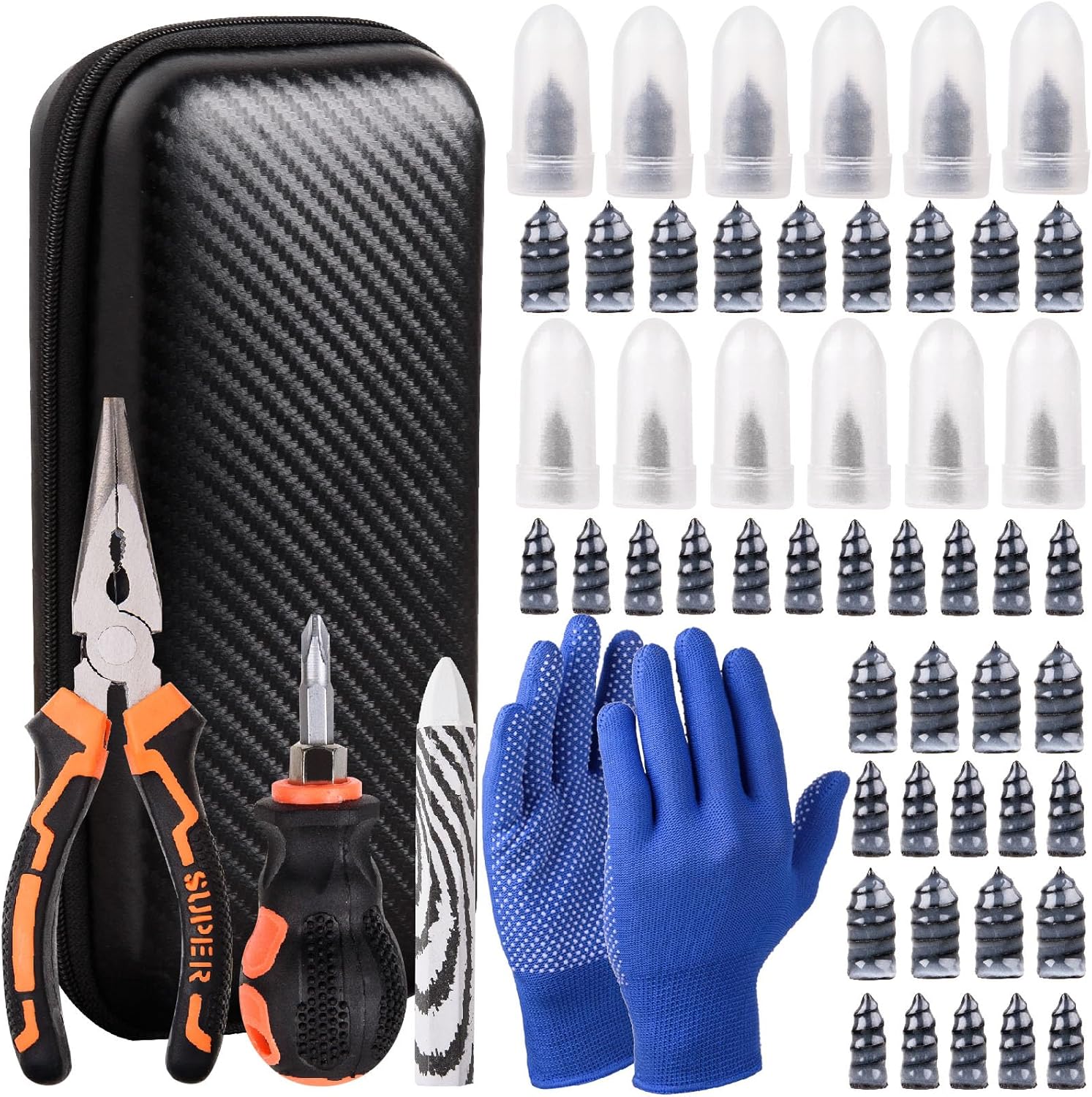
This tire sidewall puncture repair kit fixes flats fast without removing the tire, helping you get back on the road in minutes. It includes self-tapping repair nails, essential tools, gloves, and a portable storage bag for convenient roadside use. Designed for tubeless tires, it helps create a tight, leak-resistant seal for cars, motorcycles, trucks, SUVs, and ATVs.

This AUTOWN flat tire repair kit is designed for quick, reliable puncture repairs using a plug kit and spiral probe tool to simplify installation. Built for durability and safe handling, it offers strong adhesion and flexibility to help maintain tire air tightness. With a portable storage case and a multi-vehicle approach, it’s suitable for cars, motorcycles, ATVs, tractors, lawn mowers, RVs, jeeps, and trucks.

This roadside assistance kit helps drivers and passengers in urgent situations after an accident or breakdown, providing practical support while waiting for help. It includes a lightweight, compact tire inflator for fast inflation of standard vehicle tires, plus reinforced jumper cable protection for safer handling. Ideal for winter weather, road trips, camping, and travel, with everything stowed neatly in a trunk bag.
What to Do If You Experience a Flat Tire?

Experiencing a flat tire can be stressful, but a calm response protects you, your passengers, and your Sonata. Use this order:
- Hold the steering wheel firmly. Keep the car as straight as possible.
- Ease off the accelerator. Let the vehicle slow naturally before making major steering or braking inputs.
- Do not slam the brakes. Sudden braking with a flat tire can make the vehicle harder to control.
- Signal and move away from traffic. When speed is low enough, brake gently and pull as far off the roadway as possible.
- Park on firm, level ground. Avoid soft shoulders, hills, curves, medians, and narrow shoulders when you can.
- Turn on hazard lights. Shift to Park, set the parking brake, and turn the engine off.
- Move passengers away from traffic. Have them exit on the side away from traffic if it is safe.
- Choose the safest repair option. Use the spare tire, Tire Mobility Kit, roadside assistance, or a tow.
Note: If you are on a busy highway, in heavy rain, at night, or on a narrow shoulder, calling roadside assistance or highway patrol is usually safer than changing the tire yourself.
Flat Tire, Low Tire Pressure, or Slow Leak?
Not every tire warning means the tire is fully flat. Use the signs below to decide what to do next:
| Situation | What It Means | Safe Action |
|---|---|---|
| Tire is visibly flat or the car pulls hard | The tire may not support the vehicle. | Stop safely. Do not continue driving. |
| TPMS light comes on but tire still looks inflated | One tire may be significantly underinflated. | Reduce speed, avoid hard turns, and check pressure as soon as possible. |
| Slow leak from nail or screw | The tire may still hold air briefly but can fail later. | Inflate only if safe, then go directly for inspection. Do not ignore it. |
Understanding Flat Tire Risks in a Hyundai Sonata
Driving on low tire pressure or a fully flat tire can reduce steering control, increase stopping distance, overheat the tire, and damage the tire’s internal structure. NHTSA’s tire-safety guidance explains that proper tire pressure, load limits, road-hazard avoidance, and regular inspections help prevent tire failure such as blowouts and flats. See the official NHTSA Tire Safety booklet.
On a Sonata, continued driving on a flat can also damage parts that are more expensive than the tire itself, including the wheel rim, valve stem, tire pressure monitoring sensor, suspension components, and brake-area hardware. Even if the outside of the tire looks repairable, internal sidewall damage may make it unsafe.
How to Safely Use a Spare Tire When You’re in a Jam
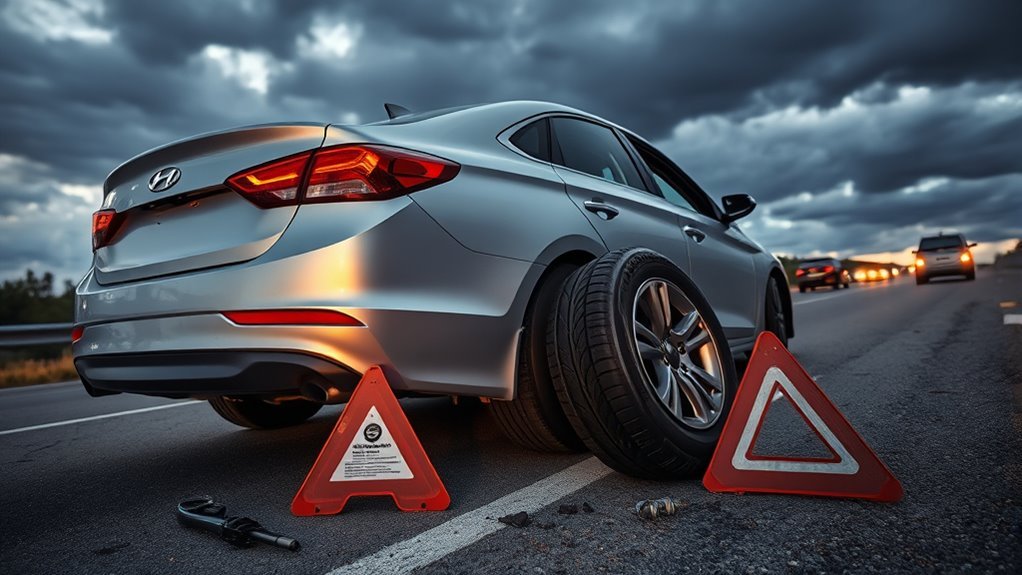
If your Hyundai Sonata has a spare tire, remember that the jack and spare are for emergency use. Do not change a tire unless the vehicle is on stable, level ground and you can work away from traffic.
If Your Sonata Has a Compact Spare
Hyundai’s compact spare guidance says the compact spare is for emergency use only, and you should never drive over 50 mph (80 km/h) with it. Hyundai also lists the compact spare inflation pressure as 60 psi (420 kPa), but you should still check the spare sidewall and your model-year manual. Read Hyundai’s compact spare guidance here: Hyundai owner’s manual: compact spare tires.
- Use the compact spare only to reach a repair facility or safe service location.
- Drive slowly enough for conditions and avoid potholes, debris, sharp turns, and hard braking.
- Do not use more than one compact spare at a time.
- Do not put tire chains on a compact spare.
- Repair or replace the original tire as soon as possible.
Pro Tip: Check the spare tire pressure when you check the other tires. A compact spare that has been sitting for years may be too low to use safely when you need it.
If Your Sonata Has a Tire Mobility Kit
Some Hyundai models and trims may use a Tire Mobility Kit instead of a spare. A Tire Mobility Kit is a temporary sealant-and-compressor system for certain small tread punctures. It is not for shredded tires, sidewall damage, large punctures, or a tire that has come off the wheel. Hyundai’s Tire Mobility Kit instructions include driving a short distance after adding sealant to distribute it, and not exceeding 50 mph. Check Hyundai’s official guidance here: Hyundai owner’s manual: using the Tire Mobility Kit.
Why Professional Tire Repairs Are Essential
Not every flat tire can be repaired. A professional tire technician must remove the tire from the wheel and inspect the inside for damage. According to the U.S. Tire Manufacturers Association, a puncture repair should be considered only when the damage is in the tread area and the puncture is no larger than 1/4 inch (6 mm). Sidewall and shoulder damage should not be repaired. You can review the repair criteria here: USTMA tire repair basics.
A plug by itself may stop air loss temporarily, but it does not prove the tire is structurally safe. If you drove on the tire while flat, the tire may have hidden internal damage even if the puncture looks small from the outside.
[Products Worth Considering]

This compact capsule-style tire repair kit helps you quickly fix punctures and plug flats with minimal effort. The rugged stainless steel shell protects the contents for reliable roadside use, while the simple plug assembly makes repairs fast and tool-free. Suitable for motorcycles, cars, ATVs, UTVs, and even mountain bikes.

This tire repair kit provides fast emergency puncture repair without removing the tire from the rim, helping you get back on the road quickly. Its screw plug system is designed for punctures in both tread and sidewall and includes a complete patch plug tool set with essential accessories. A portable storage bag makes it easy to carry for cars, trucks, SUVs, motorcycles, and heavy-duty applications.
Critical Signs Indicating You Should Not Drive on a Flat Tire
Stop and call for help if you notice any of these signs:
| Sign | Implication | Action |
|---|---|---|
| Visible gash, bulge, shredded rubber, or sidewall damage | High risk of tire failure or non-repairable damage | Do not drive; use spare, roadside assistance, or tow |
| Car pulls hard, shakes, or feels unstable | Reduced steering and braking control | Slow down gradually and pull over safely |
| Rim is close to the road or tire is fully collapsed | Wheel and tire damage may already be happening | Stop immediately once safely out of traffic |
How to Prevent Flat Tires in Your Hyundai Sonata

You cannot prevent every nail, pothole, or road hazard, but regular tire care lowers your risk. NHTSA recommends maintaining proper tire pressure, staying within load limits, avoiding road hazards, and inspecting tires for cuts, slashes, and irregularities.
Regular Tire Inspections
- Check all four tires and the spare at least once a month. Use a quality tire pressure gauge; a tire can look normal and still be underinflated.
- Use the driver’s door-jamb placard. That placard lists the correct cold tire pressure for your Sonata’s tire size and load.
- Inspect tread and sidewalls. Look for nails, cuts, bulges, cracking, uneven wear, or exposed cords.
- Watch vehicle load. Overloading adds heat and stress to the tires.
- Avoid road hazards when possible. Potholes, construction debris, curbs, and metal scraps are common flat-tire causes.
Proper Tire Inflation
Do not rely on a generic 32 psi number unless your Sonata’s placard says so. Tire pressure varies by model year, trim, tire size, load, and market. Check pressure when the tires are cold, meaning the vehicle has been parked for several hours or driven only a very short distance. Hyundai’s pressure-checking guidance also reminds drivers to check the spare tire if equipped: Hyundai owner’s manual: check tire inflation pressure.
Warranty Benefits for Tire Damage and Replacement
Flat-tire help and tire replacement coverage are not the same thing. Eligible Hyundai Roadside Assistance may help with a flat tire change or tow, depending on your model year, equipment, ownership status, and program terms. Hyundai’s current warranty page lists 5-year/unlimited-mile 24-hour roadside assistance, but you should confirm the terms for your exact Sonata here: Hyundai warranty and roadside assistance information.
A tire damaged by a nail, curb impact, pothole, or road debris is usually handled through the tire manufacturer’s warranty, a separate road-hazard plan, a tire shop plan, insurance, or out-of-pocket replacement. If you bought coverage from a tire retailer such as National Tire and Battery, Discount Tire, Costco, or another shop, check that retailer’s paperwork before paying for a replacement.
Frequently Asked Questions
Can I drive 0.3 miles on a flat tire?
You should not plan to drive 0.3 miles on a fully flat tire. If you are stuck in an active lane or another unsafe spot, move only far enough to reach a safer shoulder or parking area, then stop.
Can I drive 0.2 miles on a flat tire?
Even 0.2 miles can damage a tire or wheel if the tire is fully flat. Use that distance only if it is necessary to escape immediate traffic danger, and drive very slowly with hazard lights on.
Does Hyundai cover flat tires?
Hyundai Roadside Assistance may help eligible owners with a flat-tire change or tow, but that is not the same as paying for a new tire. Tire replacement coverage depends on the tire manufacturer, a road-hazard plan, retailer coverage, insurance, or your specific warranty documents.
What happens if you drive 2 miles on a flat tire?
Driving 2 miles on a flat tire can destroy the tire, bend or scrape the rim, damage the valve stem or TPMS sensor, and make the car harder to control. It may turn a simple tire repair into a tire-and-wheel replacement.
How fast can I drive on a Hyundai Sonata compact spare?
Hyundai’s compact spare guidance says not to operate the vehicle over 50 mph (80 km/h) when using the compact spare. Drive slower if road, weather, or traffic conditions require it.
Why is my TPMS light still on after installing the spare?
The spare tire may not have a TPMS sensor, so the TPMS light can stay on until the repaired or replacement full-size tire with a working sensor is reinstalled and the system resets after driving.
Conclusion
If your Hyundai Sonata has a flat tire, do not drive on it like a normal tire. Slow down carefully, pull off the road, turn on hazards, and choose the safest emergency option: compact spare, Tire Mobility Kit, roadside assistance, or a tow. Once you are safe, have the tire inspected professionally before assuming it can be repaired. The small delay is worth avoiding wheel damage, loss of control, and a much more expensive repair.
Sources
- Hyundai Owner’s Manual: If you have a flat tire while driving — safe pull-over procedure.
- Hyundai Owner’s Manual: Compact spare tire guidance — compact spare use, 50 mph limit, and 60 psi pressure.
- Hyundai Owner’s Manual: Using the Tire Mobility Kit — temporary sealant-kit usage and speed caution.
- NHTSA Tire Safety — tire pressure, load limits, inspections, and tire-failure prevention.
- U.S. Tire Manufacturers Association: Tire Repair Basics — professional repair criteria and puncture limits.
- Hyundai Warranty and Roadside Assistance Information — current Hyundai roadside assistance overview and warranty resources.

Related Articles

Danger of Using Summer Tires in Winter on a Hyundai Sonata
Potentially perilous, using summer tires in winter on your Hyundai Sonata can compromise safety—discover the hidden dangers that await you on icy roads.
Read More
Can You Mix Nitrogen and Air in Hyundai Sonata Tires? Answered
Discover the implications of mixing nitrogen and air in your Hyundai Sonata tires—are the benefits worth the risks? Explore the answer inside!
Read More
How to Tell If Hyundai Sonata Tires Are Too Old to Use Safely
Understand how to assess the age of your Hyundai Sonata tires and discover crucial signs of deterioration that could compromise your safety on the road.
Read More