
How Summer Heat Affects Your Hyundai Sonata Tires (& What to Do)

Summer heat can make your Hyundai Sonata’s tires work harder, especially on long drives, hot pavement, and sudden rainstorms. The safest approach is simple: check the correct cold tire pressure, inspect the tread and sidewalls, rotate the tires on schedule, and fix damage before a small problem turns into a roadside emergency.
Quick Answer
Summer heat can raise Hyundai Sonata tire pressure by about 1–2 PSI for every 10°F temperature change, but the number that matters is the cold PSI on your driver-side door label. Check pressure monthly, inspect tread and sidewalls, rotate regularly, and never drive on a bulging or repeatedly losing-pressure tire.
Key Takeaways
- Use the Hyundai Sonata’s driver-side door-jamb Tire and Loading Information Label for the correct PSI, not the number printed on the tire sidewall.
- Check tire pressure when the tires are cold, meaning the car has been parked for at least three hours.
- Do not rely only on TPMS; the warning light may come on after the tire is already significantly underinflated.
- Replace or professionally inspect tires with bulges, cracks, exposed cords, repeated pressure loss, or vibration at speed.
- Before summer road trips, check tread depth, tire age, spare condition, load limits, and tire recalls.
At a Glance
| Time Required | 10–15 minutes for a basic pressure, tread, and sidewall check |
| Difficulty | Easy for inspection and pressure checks; professional help recommended for bulges, vibration, punctures, alignment, or tire replacement |
| Tools Needed | Tire pressure gauge, tread depth gauge or penny/quarter, portable air compressor, flashlight, valve caps, and your Sonata owner’s manual or door-jamb label |
| Cost | Usually $0 if you already have a gauge; about $10–$40 for a quality gauge or basic inflator accessories |
How Summer Heat Affects Your Hyundai Sonata Tires

Air expands as it warms, so tire pressure can rise in hot weather and after highway driving. As a general rule, inflation pressure may change by about 1–2 PSI for every 10°F temperature shift, according to the U.S. Tire Manufacturers Association. That does not mean you should automatically bleed air from a hot tire. The pressure target for your Sonata is the cold tire pressure listed by Hyundai.
For the most accurate reading, check the tires before driving or after the car has been parked for at least three hours. The National Highway Traffic Safety Administration says the correct pressure is the vehicle manufacturer’s cold inflation pressure, usually found on the Tire and Loading Information Label on the driver-side door edge or door post. Do not use the maximum PSI printed on the tire sidewall as your target.
Warning: If a tire has a bulge, exposed cords, a deep sidewall cut, or keeps losing pressure after inflation, do not treat it as normal summer pressure change. Have it inspected before driving at highway speed.
Heat also makes underinflation more dangerous. When a tire is low, the sidewall flexes more, which creates extra heat and stress inside the tire. That can lead to irregular wear, internal damage, tread separation, or a blowout. Overinflation is also a problem because it can reduce the tire’s contact patch and make the tire more vulnerable to impact damage from potholes or road debris.
NHTSA’s TireWise page reports that 511 people died in tire-related crashes in 2024, making basic tire maintenance more than a comfort issue—it is a safety habit.
[Products Worth Considering]

The JACO FlowPro Tire Inflator measures, inflates, and airs down tires up to 100 PSI with battery-free operation and ±2% accuracy after calibration. It features a glowing pressure dial for night visibility, a heavy-duty steel build with a hybrid hose, and a precision push-to-inflate thumb trigger. The patented Lightning Air Chuck locks on for a secure seal, and the kit includes quick-connect hardware for easy inline use with your air compressor.

This portable cordless tire inflator delivers up to 160 PSI with fast 17 L/min airflow to help you quickly top up tires and get back on the road. It features dual power mode, running on a 21V rechargeable battery or a 12V DC adapter for convenient roadside use. An automatic shut-off with digital pressure gauge helps prevent overinflation, and a built-in LED light improves visibility in low-light conditions.

This cordless portable tire inflator delivers fast, safe inflation with an automatic shutoff when the target pressure is reached, helping prevent overinflation. The built-in LED lighting and real-time digital display make it easier to check pressure and handle roadside tire changes at night. It includes multiple nozzles for use on cars, motorcycles, bicycles, and inflatables like balls and swimming rings.
How to Check Hyundai Sonata Tire Pressure in Summer
Follow these steps once a month, before long trips, and whenever the weather changes sharply.
- Find the correct PSI. Open the driver door and read the Tire and Loading Information Label on the door edge or door post. If you cannot find it, check the Sonata owner’s manual or Hyundai owner resources.
- Check when cold. Measure pressure before driving or after the car has been parked for at least three hours.
- Check all four tires and the spare. A spare can age and lose air even when it is not used.
- Add air if low. Add only the missing PSI needed to reach Hyundai’s cold-pressure recommendation.
- Release air only when truly high. If the tire is cold and above the recommended PSI, release air slowly with the gauge until it matches the label.
- Recheck after filling. Replace valve caps tightly to keep dirt and moisture out of the valve stem.
Pro Tip: Keep a digital tire gauge in the glove box. Gas-station gauges are convenient, but a personal gauge gives you more consistent readings from month to month.
Proper inflation also helps efficiency. FuelEconomy.gov says keeping tires inflated to the proper pressure can improve gas mileage by 0.6% on average and up to 3% in some cases. That is a bonus; the main reason to check pressure is safer handling, braking, and tire durability.
What Your Sonata TPMS Light Means
Your Hyundai Sonata’s Tire Pressure Monitoring System can warn you when one or more tires are significantly underinflated, but it should not replace manual pressure checks. NHTSA states that TPMS is not a substitute for regular tire maintenance, and the system may not warn you early enough to prevent irregular wear or heat damage.
| TPMS behavior | What to do |
|---|---|
| Light turns on and stays on | Pull over when safe, visually inspect the tires, then check pressure with a gauge and inflate to the cold PSI recommendation. |
| Light comes on in the morning, then turns off later | Check the tires cold. The pressure may be near the warning threshold and rising as the tires warm up. |
| Light flashes, then stays on | Have the TPMS inspected. A flashing warning can indicate a system fault, not just low pressure. |
Note: A tire can be unsafe even if it does not look flat. Always use a gauge; visual checks alone can miss underinflation.
How to Spot Summer Tire Damage
High heat, road debris, potholes, and long highway drives can reveal weak spots in a tire. Walk around your Sonata and inspect each tire in good light. Look at the tread, outer sidewall, inner sidewall when visible, valve stem, and the area where the tire meets the wheel.
| Damage Type | Action Needed |
|---|---|
| Bulges or bubbles | Stop using the tire and have it replaced or professionally inspected immediately. |
| Cracks, deep cuts, or exposed cords | Do not ignore them; these can signal sidewall or structural damage. |
| Uneven wear patterns | Check inflation, alignment, balance, and rotation history. |
| Low tread depth | Replace the tire when it reaches the minimum tread threshold or when wet-road grip is no longer safe. |
| Vibration, thumping, or new road noise | Have the tire and wheel inspected for internal damage, imbalance, or separation. |
| Nails, screws, glass, or embedded objects | Do not pull large objects out on the roadside unless you are prepared for rapid air loss. Have the tire inspected and repaired only if the puncture is repairable. |
If the Sonata pulls to one side, shakes at highway speed, or shows feathered tread wear, schedule an alignment and balance inspection. Those symptoms often mean the tire is not contacting the road evenly.
How to Check Tread Depth and Rotate Tires for Safety
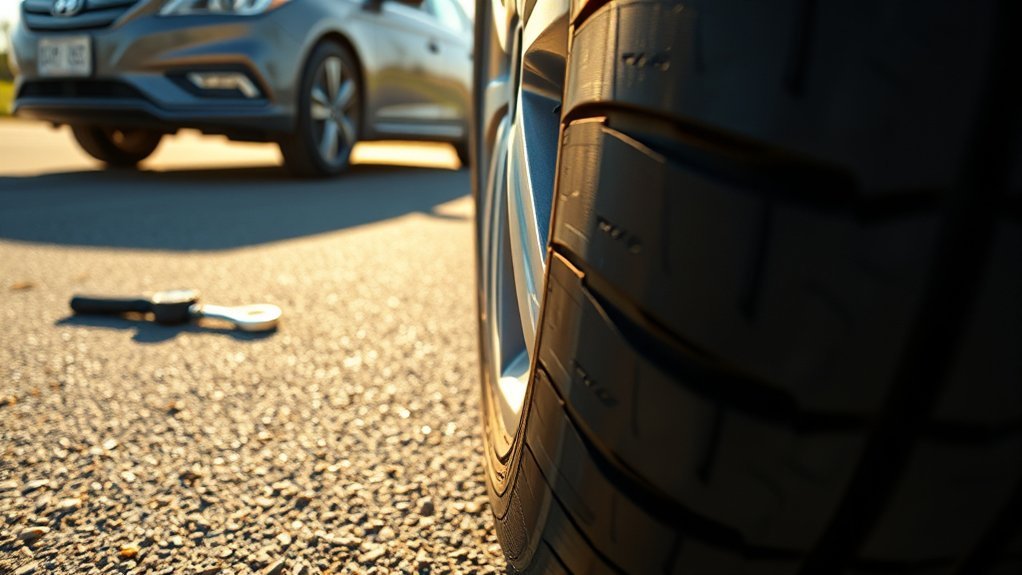
Tread depth matters in summer because worn tires have less room to move water away from the road surface. That increases the risk of hydroplaning during sudden storms. You can use a tread depth gauge for the best reading, but the penny and quarter tests are useful quick checks.
- Penny test: Place a penny into the tread with Lincoln’s head upside down. If you can see all of Lincoln’s head, the tread is at or near the minimum replacement point.
- Quarter test: Place a quarter into the tread with Washington’s head upside down. Hyundai’s tire-care guidance says if you can see the top of Washington’s head, the tire should be replaced.
- Wear bars: Look for raised treadwear indicators in the grooves. When the tread is level with those bars, it is time to replace the tire.
- Check several spots: Measure the center, inner edge, and outer edge of each tire. One good groove does not mean the whole tire is safe.
For rotation, follow the schedule in your Hyundai Sonata owner’s manual. If no specific interval is listed for your driving situation, NHTSA and USTMA recommend rotating tires about every 5,000 to 8,000 miles when rotation is recommended by the manufacturer or when no period is specified. Rotation helps even out wear, but it cannot fix a damaged tire or a bad alignment.
[Products Worth Considering]

EVOULTES heavy duty tire inflator with an integrated gauge delivers accurate pressure readings from 10–120 PSI, helping you inflate, deflate, and check tires in one tool. The 16.5-inch extended dual-head air chuck with swivel base reaches hard-to-access dual wheel valves on trucks and RVs. A brass trigger core and side-mounted air release valve make operation smooth, with standard 1/4" NPT threading and quick-connect compatibility for easy setup.
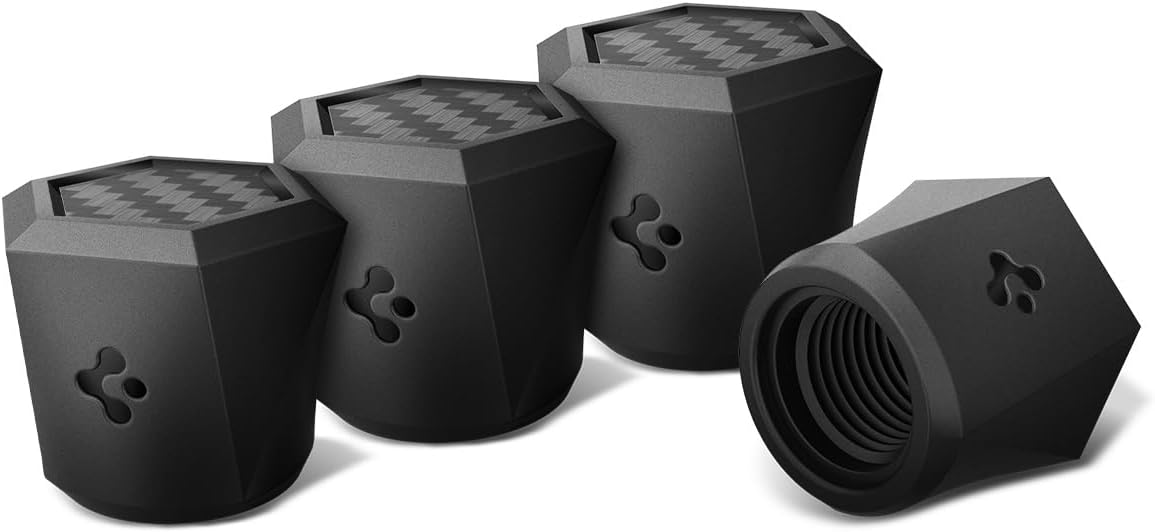
Spigen magnetic tire valve caps attach securely to metal surfaces so you never have to search for lost caps. Designed for Schrader valve stems, they install quickly, help protect against air leakage and corrosion, and feature a light magnet that won’t interfere with TPMS signals.
Prepare Your Tires for Road Trips
Before a summer road trip, inspect more than just the four tires touching the road. A long drive adds heat, speed, load, and distance, so small tire problems can become serious faster.
| Task | Frequency | Reason |
|---|---|---|
| Check cold tire pressure | Before every long trip | Reduces heat buildup, uneven wear, and blowout risk |
| Inspect tread depth | Monthly and before trips | Supports wet-road traction and hydroplaning resistance |
| Examine sidewalls and tread for damage | Before every road trip | Catches cracks, bulges, punctures, and exposed cords early |
| Check spare tire and tools | Before long trips | A flat spare, missing lug wrench, or missing jack can leave you stranded |
| Confirm load limits | When carrying passengers or luggage | Overloading increases heat and stress on tires |
| Check tire age/date code | Before seasonal travel | Older tires can fail even if tread remains |
| Search for tire recalls | Before long-distance travel | NHTSA allows drivers to check tire recalls by tire information |
| Pack a gauge and portable compressor | Always | Lets you make safe pressure adjustments during travel |
To check tire age, look for the DOT Tire Identification Number on the sidewall. NHTSA explains that the last four digits show the week and year the tire was made. For example, “2522” means the tire was made in the 25th week of 2022. Some vehicle and tire manufacturers recommend replacing tires that are six to 10 years old regardless of tread, so age matters even when the tire looks usable.
Note: Check your Sonata’s load label before packing heavy luggage. Tire pressure and load capacity work together; a properly inflated tire can still be overstressed if the vehicle is overloaded.
What to Do If a Tire Overheats or Blows Out
If you smell hot rubber, feel vibration, notice the car pulling, or see the TPMS warning, slow down carefully and pull over somewhere safe. Do not continue at highway speed to “make it to the next exit” if the car feels unstable.
If a tire blows out, keep both hands on the wheel, avoid slamming the brakes, gradually ease off the accelerator, steer in the direction you want the car to go, and pull off the road when the vehicle is stable. After stopping, turn on hazard lights and call roadside assistance if changing the tire is not safe.
Warning: Never stand close to traffic while inspecting or changing a tire. If the shoulder is narrow, visibility is poor, or traffic is fast, stay away from the roadway and call for help.
Frequently Asked Questions
Do I need to add air to my tire when the temperature drops?
Yes, check the pressure with a gauge when the tires are cold. Tire pressure often drops as temperatures fall, so add air if the reading is below the Hyundai-recommended cold PSI on the door-jamb label.
Should I let air out of my Sonata tires on a hot day?
Not just because the tire reads higher after driving. Tire pressure rises when tires warm up, so adjust pressure based on a cold reading whenever possible. If a cold tire is above the recommended PSI, release air slowly until it matches the label.
How do I stop tires from overheating?
Keep tires inflated to the correct cold PSI, avoid overloading the vehicle, replace damaged or aged tires, rotate on schedule, and slow down if you feel vibration, pulling, or instability. Underinflation and overloading are two major causes of excess tire heat.
What temperature is too hot for Hyundai Sonata tires?
There is no single outside temperature that makes every tire unsafe. Risk rises when heat combines with low pressure, overloading, high speed, worn tread, old rubber, or existing damage. In hot weather, check pressure cold and inspect the tires before long drives.
How often should I rotate Hyundai Sonata tires?
Follow your Sonata owner’s manual first. If your manual does not list a specific interval for your driving conditions, a common safety range is every 5,000 to 8,000 miles, or sooner if uneven wear appears.
Conclusion
Summer tire care for your Hyundai Sonata comes down to a few repeatable habits: check cold PSI, inspect tread and sidewalls, watch for TPMS warnings, rotate on schedule, and prepare the spare before road trips. Heat does not have to ruin your tires, but it does punish low pressure, old rubber, overloading, and ignored damage. A 10-minute check can help keep your Sonata safer, smoother, and ready for summer driving.
Sources
- Hyundai Tire Care and Maintenance — Hyundai guidance on tire pressure, tire wear, tread checks, and tire maintenance.
- NHTSA TireWise — cold-pressure checks, TPMS limits, treadwear, tire aging, blowout response, and tire safety data.
- NHTSA Tire Safety Month — monthly inspections, cold tire pressure, tread checks, rotation intervals, and door-label guidance.
- U.S. Tire Manufacturers Association Tire Care Essentials — temperature-related PSI changes, pressure checks, tread depth, TPMS limits, rotation, and alignment.
- FuelEconomy.gov Vehicle Maintenance Tips — fuel economy impact of proper tire inflation and guidance to use the door-jamb label or owner’s manual.

Related Articles

Danger of Using Summer Tires in Winter on a Hyundai Sonata
Potentially perilous, using summer tires in winter on your Hyundai Sonata can compromise safety—discover the hidden dangers that await you on icy roads.
Read More
Can You Mix Nitrogen and Air in Hyundai Sonata Tires? Answered
Discover the implications of mixing nitrogen and air in your Hyundai Sonata tires—are the benefits worth the risks? Explore the answer inside!
Read More
How to Tell If Hyundai Sonata Tires Are Too Old to Use Safely
Understand how to assess the age of your Hyundai Sonata tires and discover crucial signs of deterioration that could compromise your safety on the road.
Read More