Summer heat can change how your Toyota Tacoma feels, handles, and stops because the tires are the only parts of the truck touching the road. Hot air, hot pavement, highway speed, towing weight, and low pressure can all add stress to the rubber. The safest approach is simple: check pressure cold, inspect the tread and sidewalls often, and choose tires that match your Tacoma’s size, load rating, and driving conditions.
Quick Answer
Heat raises tire pressure and speeds up tire wear, but underinflation is usually the bigger danger because it creates extra flex and heat inside the tire. For a Toyota Tacoma, check PSI when the tires are cold, use the driver-side door placard, inspect for cracks or bulges, and recheck before towing or long summer trips.
Key Takeaways
- Use the Toyota tire placard on the driver-side door jamb for the correct cold PSI, not the maximum PSI printed on the tire sidewall.
- Check pressure when the tires are cold, ideally before driving in the morning or after the truck has been parked for several hours.
- Do not bleed air from hot tires just because the reading is higher after driving; pressure normally rises as tires warm up.
- Replace or professionally inspect tires with bulges, exposed cords, deep cracks, tread separation, repeated air loss, or tread at 2/32 inch.
- For towing, hauling, or off-road use, choose Tacoma tires by size, load index, speed rating, terrain type, and Toyota-approved fitment.
At a Glance
| Time Required | 5–10 minutes for a basic pressure and visual check; 15 minutes if you check tread depth and the spare tire. |
| Difficulty | Easy for inspection and pressure checks; moderate for changing a flat tire. |
| Tools Needed | Accurate tire pressure gauge, tread depth gauge or penny, flashlight, gloves, air compressor, and your Tacoma owner’s manual. |
| Cost | Usually free if you already own a gauge; about $5–$20 for a basic gauge or tread depth tool. |
How Does Heat Impact Toyota Tacoma Tire Pressure?

Heat affects tire pressure because air expands as it warms. A common rule of thumb is that tire pressure changes by about 1 PSI for every 10°F change in temperature, but real-world readings can vary because tire temperature also depends on driving speed, driving distance, load, road surface temperature, and the pressure you started with.
That is why a Tacoma tire may read higher after a highway drive than it did in the morning. This warm reading does not automatically mean the tire was overinflated when cold. The correct baseline is the cold tire pressure listed on your Toyota Tire and Loading Information Label, usually on the driver-side door edge or door jamb. Toyota also explains that the recommended cold tire inflation pressure and tire size are shown on the tire and loading information label.
For general tire-safety guidance, the National Highway Traffic Safety Administration says the correct pressure is the vehicle manufacturer’s recommended cold pressure, not the maximum pressure printed on the tire sidewall. You can review NHTSA’s tire-pressure guidance here: NHTSA TireWise tire safety.
Warning: Do not lower pressure from hot tires just because the gauge shows a higher number after driving. Heat normally raises pressure. Bleeding hot tires can leave them underinflated once they cool, which can increase heat buildup, poor handling, and tire damage.
Signs of Heat Damage on Your Tacoma Tires
Heat does not usually ruin a healthy tire in one afternoon, but it can speed up problems that already exist. Older rubber, low pressure, overloaded driving, pothole damage, and long highway trips in extreme heat can all make tire failure more likely.
Inspect your Tacoma tires for these warning signs:
- Sidewall cracks or dry rot: Small surface checking can appear as rubber ages, but deep cracks need professional inspection.
- Bulges or bubbles: A bulge can mean internal tire damage. Do not ignore it.
- Tread separation: Look for raised, wavy, split, or uneven tread areas.
- Exposed cords: If you can see fabric or steel cords, the tire is unsafe.
- Uneven wear: Center wear can point to overinflation, shoulder wear can point to underinflation, and one-sided wear can point to alignment or suspension issues.
- Repeated pressure loss: A tire that keeps losing air may have a puncture, valve-stem leak, wheel issue, or bead leak.
Underinflated tires are especially risky in hot weather because extra sidewall flex creates heat. The U.S. Tire Manufacturers Association lists pressure, tread, rotation, and alignment as the four core tire-care essentials and notes that underinflation can create excessive heat buildup and internal damage. See the USTMA guide here: USTMA Tire Care Essentials.
How Can You Properly Inspect Tires in Hot Weather?
A hot-weather tire inspection should answer four questions: Is the pressure correct when cold? Is the tread deep enough? Is the sidewall healthy? Are the tires matched to the load and trip?
Proper Tire Pressure Checks
| Measurement Tool | Purpose |
|---|---|
| Digital or dial tire pressure gauge | Checks each tire against your Tacoma’s cold PSI placard. |
| Tread depth gauge | Measures remaining tread in 32nds of an inch. |
| Penny test | Quickly checks whether tread is near the 2/32-inch replacement point. |
| Flashlight | Helps spot cracks, nails, cuts, bubbles, and inner-sidewall damage. |
| Owner’s manual | Confirms jack points, spare-tire instructions, tire size, and tire-pressure procedures. |
For the most accurate pressure reading, check the tires before driving. NHTSA defines a cold tire as one that has not been driven on for at least three hours. Toyota service guidance also treats cold pressure as a tire that has not been driven for several hours and has been parked outdoors. If you must check after driving, understand that the reading may be temporarily higher.
Note: TPMS is a warning system, not a replacement for a tire gauge. Check your Tacoma’s pressure manually, including the spare, before long summer trips.
Visual Damage Inspection Tips
Park on level ground and turn the steering wheel left and right so you can see more of the front tire tread. Walk around the Tacoma and inspect each tire from the outer sidewall to the tread blocks. Use a flashlight to look for nails, screws, cuts, bubbles, and uneven wear. If possible, also look at the inner sidewall because damage can hide where it is harder to see.
Heat makes small problems more serious. A tire with a slow leak, a plugged puncture near the sidewall, or old cracked rubber may survive short errands but fail under highway speed, payload, towing weight, or desert heat.
Tread Depth Measurement Methods
The easiest tread check is the penny test. Insert a penny into a main tread groove with Lincoln’s head facing down. If you can see all of Lincoln’s head, the tread is at or near 2/32 inch and the tire should be replaced. A tread depth gauge is better because it gives an actual measurement and helps you compare different spots across the tire.
The U.S. Department of Transportation recommends replacing tires when tread reaches 2/32 inch, and many states use that depth as the legal minimum. Bridgestone explains the penny test and tread-depth threshold here: Bridgestone guide to checking tire tread depth.
If you drive often in rain, plan ahead before your tires reach the legal minimum. Low tread can reduce wet-road grip and make hydroplaning more likely, especially in a pickup with uneven loading.
Why Tire Maintenance Is Crucial in Summer
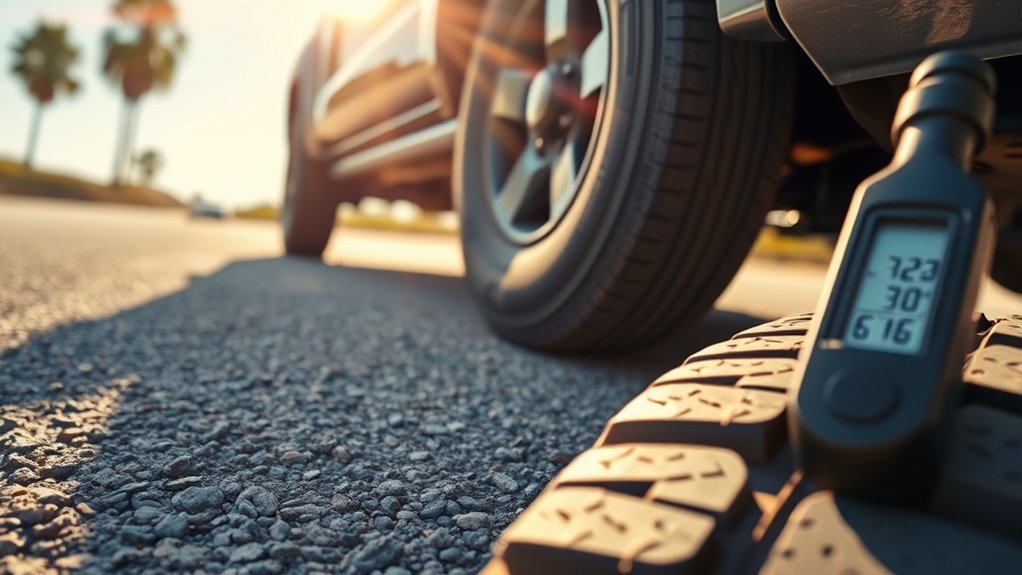
Summer tire maintenance matters because high temperatures add stress to tires that may already be underinflated, overloaded, worn, or aged. Hot pavement also increases tire operating temperature, especially during long highway drives.
Summer Heat Effects
As the tire warms, pressure rises. That normal rise is expected. The danger comes when a tire starts the day too low, carries too much weight, or has hidden damage. Low pressure allows more flex in the sidewall, and that flex creates heat. Over time, heat can contribute to internal damage, uneven wear, and tire failure.
Before summer road trips, check:
- Cold PSI on all four tires
- Spare tire pressure and condition
- Tread depth across each tire
- Sidewall cracks, bulges, cuts, and punctures
- Valve stems and caps
- Payload and towing weight
- Rotation and alignment history
Preventing Blowouts And Wear
To reduce blowout risk, keep your Tacoma tires properly inflated, avoid overloading the truck, replace damaged tires promptly, and slow down when carrying weight in extreme heat. Also avoid aggressive steering, hard braking, and high-speed driving on visibly damaged tires.
If a tire blows out while driving, do not slam on the brakes. Hold the steering wheel firmly with both hands, gradually release the accelerator, keep the truck pointed straight, and slow down before pulling off the road. NHTSA’s blowout guidance recommends stabilizing the vehicle first, then moving off the road when it is safe.
Pro Tip: Check pressure the morning after a long hot drive. That cold reading tells you whether your tires are actually underinflated, not just temporarily warm from the road.
Best Tips for Choosing Tacoma Tires
The best tires for a Toyota Tacoma in hot weather are not always the highest-speed performance tires. The right choice depends on your Tacoma’s year, trim, wheel size, payload, towing needs, road surface, and off-road use.
Use this tire-selection checklist:
- Match the Toyota-approved size: Start with the tire size on the door placard or owner’s manual. If you change wheel or tire size, confirm fitment, load rating, speed rating, clearance, and TPMS compatibility with a qualified tire professional.
- Check the load index: A Tacoma used for towing, camping gear, tools, or off-road equipment needs tires that can safely carry the load. Do not exceed the truck’s payload or towing limits.
- Choose the right tire category: Highway-terrain tires are smoother and efficient for pavement. All-terrain tires add dirt, gravel, and trail grip. Mud-terrain tires are tougher off-road but usually noisier and less efficient on highways.
- Consider LT tires only when useful: LT-rated tires can be stronger for hauling and off-road use, but they may ride firmer and require different inflation decisions. Do not switch blindly.
- Use UTQG and temperature ratings wisely: UTQG ratings help compare treadwear, traction, and temperature resistance for many passenger and light-duty tires, but they are not the only buying factor and do not apply to every tire type. Goodyear explains UTQG ratings here: Goodyear UTQG rating guide.
[Products Worth Considering]

Measure tire tread depth quickly and accurately with this LUMITECO dial gauge that reads in 1/32" increments up to 14/32". The color-coded green/yellow/red zones make it easy to judge tire wear and know when replacement is needed. A rugged, compact design with a protective pouch helps keep the gauge ready for use on cars, trucks, motorcycles, and more.

Monitor tire tread wear with a smart, color-coded depth gauge that shows clear condition ranges at a glance. The bar is range marked for fast, easy readings, helping you maintain safer traction and performance. Each gauge is portable with a pocket clip, and the set includes 20 units for daily use and sharing.

The SAFELIFE dial tire tread depth gauge measures tread depth in 1/32 inch increments with clear, easy-to-read 2-inch dial face. Color zones using a traffic light system help you quickly judge whether tread is low, marginal, or ample for safer driving. Built with a durable zinc cast body and a metal detect probe for precise, comfortable use across cars, motorcycles, trucks, and buses.
Got a Flat Tire? Here’s What You Should Do
If your Tacoma gets a flat, focus on safety before speed. Pull as far away from traffic as possible, turn on the hazard lights, shift into Park, set the parking brake, and use wheel chocks if available. Never crawl under a truck supported only by a jack.
Basic flat-tire steps:
- Park on a firm, level surface away from traffic.
- Turn on hazard lights and set the parking brake.
- Find the jack, tool bag, lug wrench, and spare tire.
- Chock the wheel diagonally opposite the flat tire if you have chocks.
- Slightly loosen the wheel nuts while the tire is still on the ground.
- Place the jack only at the Toyota-approved jacking point listed in your owner’s manual.
- Raise the truck, remove the wheel nuts, and take off the flat tire.
- Install the spare, hand-tighten the nuts, lower the truck, and tighten the nuts in a star pattern.
- Check spare tire pressure as soon as possible.
- Have the damaged tire inspected or replaced by a tire professional.
Toyota’s Tacoma flat-tire instructions include chocking the tires and slightly loosening the wheel nuts before raising the vehicle. You can review Toyota’s current Tacoma flat-tire guidance here: Toyota Tacoma flat tire instructions.
How to Handle Hot Tires Safely and Effectively
Hot tires need careful handling because the gauge reading can be higher than the true cold pressure. If you check a tire right after driving and it reads above the placard PSI, do not release air just to bring it down to the cold number. Let the tire cool and check again.
If a hot tire looks visibly low or the TPMS warning appears, pull over safely and inspect the tire. If there is no obvious damage and you need to add air, NHTSA advises filling the tire to the vehicle manufacturer’s recommended cold inflation pressure as a temporary measure, then rechecking and adjusting it when you can get a cold reading. Toyota’s pressure-adjustment guidance also shows that warm and hot tire pressure compensation depends on tire temperature and conditions, not a universal add-on number.
Warning: Do not keep driving on a tire with a bulge, exposed cord, tread separation, severe cracking, or rapid pressure loss. Install the spare or call roadside assistance.
Which Tires Perform Best in High Temperatures?
In high temperatures, the best tire is one that matches your Tacoma and your use case. For a street-driven Tacoma, a quality highway-terrain or all-season truck/SUV tire in the correct size and load rating is often the most practical choice. For gravel, trails, and camping roads, an all-terrain tire may be better. For frequent towing or hauling, load rating and inflation guidance matter more than sporty handling.
Summer performance tires can provide strong warm-weather grip on pavement, but they are usually aimed at performance cars and street use. They may not be the best match for a Tacoma used for off-road driving, towing, construction work, or winter travel. If temperatures drop near freezing where you live, remember that many summer tires are not designed for cold weather, snow, or ice.
When comparing tires for heat, look for:
- Correct Toyota-approved tire size
- Equal or higher load index than required
- Appropriate speed rating for the vehicle and tire type
- Good heat/temperature performance where UTQG applies
- Strong wet traction if you drive in summer storms
- Sidewall strength appropriate for towing or trails
- Warranty and rotation requirements you can actually follow
[Products Worth Considering]

These aluminum alloy tire valve stem caps with an O-ring seal help protect valve stems from corrosion while adding a clean, stylish look to your vehicle. The universal fit works across cars, trucks, motorcycles, bicycles, and more, making them an easy upgrade for everyday driving and off-road use. Installation is quick, and the included four-pack keeps all your tires dressed and protected.

Accurately measure tire tread depth with a calibrated gauge marked from 0 to 1 inch in 1/32 inch increments. The color-coded bar helps you quickly identify tread condition ranges, supporting safe driving for trucks, motorcycles, automobiles, and passenger vehicles.

ETENWOLF’s tire pressure gauge helps you quickly and accurately check tire PSI across cars, trucks, motorcycles, bikes, and more. It’s manually calibrated to ANSI B40.1 Grade A for reliable readings, includes a large glow dial for easy nighttime viewing, and features a 360-degree swivel chuck for use at any valve angle. The gauge also works consistently in extreme hot or cold weather.
Key Factors for Choosing the Best Tires for Your Toyota Tacoma
Before buying new Tacoma tires, answer these questions:
- Where do you drive most? Pavement, gravel, job sites, sand, mud, snow, and rocks all call for different tread designs.
- How much weight do you carry? Bed racks, rooftop tents, tools, trailers, and camping gear can change tire needs.
- Do you tow in hot weather? Towing adds load and heat. Stay within Toyota’s limits and choose tires with the correct load rating.
- Are your tires aging out? Check the DOT date code and inspect for cracks. Heat and sunlight can age rubber even when tread remains.
- Will the tire fit without rubbing? Oversized tires may rub suspension, fenders, or mud flaps and may affect speedometer accuracy.
- Can you maintain them? Some tires require more frequent rotations, pressure checks, or alignment attention to wear evenly.
For the safest fit, use your Tacoma’s tire placard and owner’s manual as the starting point. Toyota’s current Tacoma tire-pressure page explains that the recommended cold tire pressure and tire size are displayed on the tire and loading information label: Toyota Tacoma tire inflation pressure.
[Products Worth Considering]

ETENWOLF’s calibrated tire pressure gauge delivers accurate readings for cars, trucks, motorcycles, bikes, SUVs, RVs, and ATVs across a 0–75 PSI range. The large glow dial improves visibility in low light, while the 360° swivel chuck makes it easy to check valve pressure from any angle. It’s designed to stay accurate even in extreme hot or cold weather.

Milton S-921 pencil tire pressure gauge helps you maintain optimal tire pressure for passenger cars with accurate readings in PSI and kPa. It features a built-in deflator valve for convenient pressure adjustments, plus a single chuck head and nylon indicator bar for easy use on the go. Built from durable plated brass and designed for reliable performance, it’s a practical road trip and cold-weather maintenance tool.

The Dr.Roc spare tire tool kit helps you release, lower, or raise your spare tire with reliable extension tools and a lug nut wrench. It is made from rustproof automotive-grade steel and includes an organized carry case for convenient storage. Designed for compatibility with select GM models from the late 1990s through 2019, it uses upgraded extension components to install and remove spare tires with less hassle.
Frequently Asked Questions
How does temperature affect tire performance?
Temperature affects tire pressure, grip, tread wear, and internal heat buildup. As tires warm up, pressure rises. If a tire starts too low, it flexes more and builds extra heat, which can damage the tire and reduce safe handling.
Should I lower my Tacoma tire pressure when it is hot outside?
No. Do not bleed air from hot tires to match the cold PSI number. Pressure normally rises after driving. Check pressure when the tires are cold and adjust to the Toyota placard PSI.
Where do I find the correct tire pressure for my Toyota Tacoma?
Use the Tire and Loading Information Label on the driver-side door edge or door jamb. Do not use the maximum PSI printed on the tire sidewall as your normal inflation target.
How often should I check Tacoma tire pressure in summer?
Check pressure at least monthly, before long trips, before towing, and when the weather changes sharply. In extreme heat or heavy-load driving, check more often.
When should I replace Tacoma tires for tread wear?
Replace tires when tread reaches 2/32 inch, or sooner if they are damaged, cracking, separating, repeatedly losing air, or performing poorly in rain. Use a tread depth gauge for the most accurate check.
Are all-terrain tires good for hot weather?
Many all-terrain tires work well in hot weather if they are the correct size, load rating, and pressure for your Tacoma. Choose based on how you drive: pavement, gravel, towing, trails, or heavy payloads.
Conclusion
Heat can raise tire pressure, speed up wear, and expose weak spots in your Toyota Tacoma’s tires. The best defense is routine maintenance: check cold PSI at the door-jamb placard value, inspect tread and sidewalls, keep the spare ready, avoid overloading, and choose tires that match your Tacoma’s load and terrain. A few minutes with a gauge before a hot-weather drive can prevent poor handling, tire damage, and a dangerous roadside emergency.
Sources
- NHTSA TireWise — cold tire pressure, tire placard guidance, spare checks, and blowout response.
- Toyota Tacoma tire inflation pressure — Tacoma tire pressure and tire-size label guidance.
- Toyota Tire Inflation Pressure Compensation and Adjustment bulletin — tire temperature, pressure compensation, and warm/hot tire considerations.
- USTMA Tire Care Essentials — pressure, tread, rotation, alignment, and heat buildup from underinflation.
- Bridgestone Penny Test guide — tread depth checks and the 2/32-inch replacement threshold.
- Goodyear UTQG rating guide — treadwear, traction, and temperature rating basics.