
225 vs. 235 Tire Width Difference on a RAV4: Effects on Performance
Choosing between 225 and 235 tires for your RAV4 is not just a 10 mm width decision. The full tire size matters. A tire marked 225/65R17 is very different from a 235/55R19 because the aspect ratio and wheel diameter change the tire’s height, sidewall, speedometer reading, ride comfort, and clearance.
Quick Answer
For most RAV4 drivers, the safer choice is the tire size listed on the driver-side door placard or owner’s manual. A 235 tire can add dry-road grip and a wider look, while a 225 tire often keeps steering lighter and efficiency slightly better. Always compare the full size, load index, speed rating, rim fitment, and clearance before switching.
Key Takeaways
- 225 and 235 refer to tire section width in millimeters, not the complete tire size.
- A wider 235 tire may improve dry grip, but it can also add weight, road noise, and wet-road hydroplaning risk if the tread design is not suitable.
- A 225 tire often feels lighter, quieter, and more efficient for daily driving, especially when it matches the factory size.
- Load capacity comes from the load index, not width alone. Match or exceed the OEM load index and speed rating.
- Speedometer change depends on overall diameter, so you must compare the full tire size, not just 225 vs. 235.
225 vs. 235 Tires: Key Differences Explained
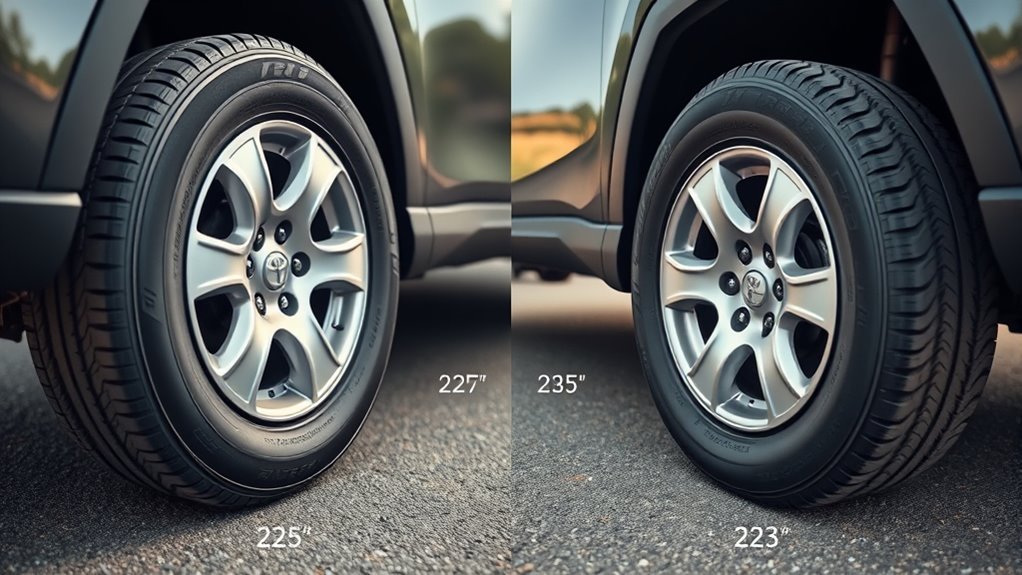
The first number in a tire size is the section width. In a size such as 225/65R17, the “225” means the tire is about 225 millimeters wide from sidewall to sidewall. In 235/55R19, the “235” means the tire is about 235 millimeters wide. That extra 10 mm is only part of the story.
The second number is the aspect ratio, which controls sidewall height as a percentage of the width. The final number is the wheel diameter in inches. That means a 235 tire is not automatically taller than a 225 tire. It depends on the full size.
Before changing sizes, start with your Toyota tire and loading information label. Toyota’s owner guidance points drivers to that label for the recommended cold tire pressure and tire size, and NHTSA tire safety guidance recommends choosing the same size as the original tire or another manufacturer-recommended size.
| Factor | 225 Tire | 235 Tire |
|---|---|---|
| Width | Narrower contact patch | About 10 mm wider |
| Typical feel | Lighter steering and easier daily driving | More planted feel when properly fitted |
| Fuel economy | Often slightly better if tire design and pressure are equal | May use slightly more fuel if heavier or higher rolling resistance |
| Wet-road behavior | Can cut through standing water more easily | Needs a good tread design and adequate tread depth |
| Best use case | Commuting, MPG, comfort, factory fitment | Dry-road grip, stance, stability, approved upgrade sizes |
[Products Worth Considering]

These universal tire valve stem caps help protect valve cores from dust, debris, and moisture while helping maintain stable tire pressure. The corrosion-resistant metal construction and sealed design provide reliable protection in road grime, mud, and winter conditions. Twist-on installation makes them quick to fit on cars, SUVs, trucks, and motorcycles.

Keep your tires properly inflated with this analog VONDIOR tire pressure gauge, designed for fast, easy readings without batteries. The swiveling, two-axis hose and large glow dial help you measure at any tire angle with instant visibility. Built with a protective rubber shield, it supports durable, low-maintenance use for cars and trucks.

Measure tyre tread depth precisely with a digital gauge that reads in both MM and inches, helping you monitor safe driving conditions. The large LCD screen is easy to operate, and the compact tool fits for cars, trucks, and motorcycles. It provides high accuracy with a 0-25.4mm range and includes a 1-year warranty for added peace of mind.
Impact on Handling and Stability: Which Tire Size Performs Better?
A 235 tire can feel more stable than a 225 tire because it is wider and may place more rubber on the road. That can help during dry-road cornering, highway lane changes, and faster sweeping turns. But this benefit only applies when the tire fits the wheel correctly, has the right load index, and uses a tread compound suited to your driving conditions.
Grip on Dry Surfaces
On dry pavement, a properly fitted 235 tire may give your RAV4 a more planted feel. The wider footprint can help with cornering confidence, especially on trims that already came with wider wheel-and-tire packages.
That said, tire model matters more than width alone. A high-quality 225 touring tire can outperform a budget 235 tire in braking, rain traction, noise, and tread life. Compare tire tests, treadwear ratings, wet traction, and rolling resistance before assuming the wider option is better.
Cornering Stability Differences
If your main priority is dry-road stability, the 235 tire has the advantage when all other factors are equal. It can reduce the “narrow tire” feel in corners and give the RAV4 a more solid stance.
However, wider tires may feel less nimble at parking-lot speeds, and they can follow road grooves more noticeably. If you mostly drive in traffic, tight city streets, or rough pavement, the 225 size may feel more relaxed and predictable.
Steering Response and Daily Driving
A 225 tire is usually easier to live with for commuting. It may feel lighter through the steering wheel and can absorb small road imperfections better, especially when paired with a taller sidewall. For many RAV4 owners, that balance is more useful than the extra width of a 235 tire.
How Do 225 vs. 235 Tires Affect Fuel Efficiency?
In general, a narrower 225 tire can have a small fuel-economy advantage because it may be lighter and may create less rolling resistance. But this is not guaranteed. Tire pressure, tread pattern, compound, weight, and rolling-resistance design can outweigh the 10 mm width difference.
FuelEconomy.gov notes that keeping tires properly inflated can improve gas mileage and that under-inflated tires reduce fuel economy. That means a properly inflated 235 tire may be more efficient than an under-inflated or high-rolling-resistance 225 tire.
| Tire Choice | Fuel Efficiency Impact | What to Check |
|---|---|---|
| 225 | Often slightly better for MPG when tire model and pressure are similar | Cold PSI, rolling-resistance rating, treadwear, load index |
| 235 | May be slightly less efficient if heavier or wider than the factory size | Overall diameter, tire weight, cold PSI, rim fitment |
Pro Tip: If MPG matters, compare the exact tire model, not just the size. A low-rolling-resistance 235 tire can be more efficient than a heavy, aggressive-tread 225 tire.
Ride Comfort: The Differences in Driving Experience
Ride comfort depends on both tire width and sidewall height. A 225 tire with a taller sidewall can feel softer over broken pavement, while a 235 tire with a shorter sidewall may feel firmer. Tread pattern also affects cabin noise, especially on coarse highway surfaces.
Ride Quality Comparison
A 225 tire often gives a smoother daily ride when it has more sidewall. The taller sidewall can flex over small bumps, pothole edges, and expansion joints. This is one reason base or comfort-focused RAV4 trims often feel calmer on smaller wheels and taller tires.
A 235 tire may feel more planted, but it can also feel firmer if the sidewall is shorter. That is not always bad. Drivers who prefer a sportier feel may like the added firmness and stability.
Noise Levels Assessment
Wider tires can create more road noise because they have a larger footprint, but tread design is usually the bigger factor. All-terrain tires, worn tires, and aggressive tread blocks tend to be louder than highway all-season tires, regardless of whether the width is 225 or 235.
Handling Responsiveness Factors
The 225 tire can feel quick and easy around town because there is less width to push across the pavement. The 235 tire may feel more stable once the RAV4 is moving faster, especially on smooth highways and dry curves.
The best choice depends on what you notice more: light steering and comfort, or a wider stance and firmer grip.
Tire Aesthetics: Finding the Right Look for Your RAV4
Many RAV4 owners consider 235 tires because they fill the wheel arches more completely. A 235 tire can give the SUV a wider, more confident stance, especially with the right wheel offset and trim package.
A 225 tire has a cleaner factory look. It may not appear as muscular, but it often keeps the RAV4 looking balanced and avoids the risk of a tire that appears too wide for the wheel.
Appearance should never be the only reason to switch. The tire still needs to fit the rim width, clear the fenders and suspension, match the required load index, and keep the overall diameter close to the factory size.
Can You Safely Switch From 225 to 235 Tires?
Yes, some RAV4 owners can safely switch from a 225-width tire to a 235-width tire, but only when the complete tire size is compatible with the vehicle. Do not choose a tire based on width alone.
Warning: Do not install a tire size that Toyota does not recommend unless a qualified tire professional confirms rim width, load index, speed rating, clearance, overall diameter, and AWD compatibility. A poor tire-size change can affect braking, handling, drivetrain behavior, and speedometer accuracy.
Before switching, check these items:
- Door-jamb tire placard: Confirm your original tire size, cold PSI, and load information.
- Owner’s manual: Check Toyota’s tire-size and tire-replacement guidance for your model year and trim.
- Full tire size: Compare the complete size, such as 225/65R17 vs. 235/60R17, not just 225 vs. 235.
- Overall diameter: Keep the new tire close to the factory diameter to avoid speedometer and clearance issues.
- Load index: Match or exceed the OEM load index. Width alone does not prove load capacity.
- Speed rating: Match or exceed the factory speed rating unless Toyota or a qualified professional approves otherwise.
- Rim width: Make sure your wheel is approved for the 235 tire’s measured width.
- Clearance: Check for rubbing at full steering lock, over bumps, and with passengers or cargo loaded.
- AWD and matched sets: Keep all four tires closely matched in size, model, and tread depth, especially on AWD models.
- TPMS and calibration: Confirm tire-pressure monitoring works correctly after installation.
Speedometer Difference: Use the Full Tire Size
Your speedometer is affected by tire circumference. A taller tire travels farther with each rotation, so the speedometer may read lower than your actual speed. A shorter tire does the opposite.
Use this basic formula:
Overall diameter = wheel diameter + 2 × sidewall height. Sidewall height = tire width × aspect ratio.
| Example Change | Approx. Diameter Change | When Speedometer Shows 60 mph |
|---|---|---|
| 225/65R17 to 235/65R17 | About 1.8% taller | Actual speed is about 61.1 mph |
| 225/65R17 to 235/60R17 | About 1.5% shorter | Actual speed is about 59.1 mph |
| 225/65R17 to 235/55R19 | About 2.3% taller | Actual speed is about 61.4 mph |
Note: These are examples, not approval to install those sizes. Always compare your exact original tire size with your exact replacement size.
[Products Worth Considering]

These aluminum alloy tire valve stem caps with an O-ring seal help protect valve stems from corrosion while adding a clean, stylish look to your vehicle. The universal fit works across cars, trucks, motorcycles, bicycles, and more, making them an easy upgrade for everyday driving and off-road use. Installation is quick, and the included four-pack keeps all your tires dressed and protected.

The SAFELIFE dial tire tread depth gauge measures tread depth in 1/32 inch increments with clear, easy-to-read 2-inch dial face. Color zones using a traffic light system help you quickly judge whether tread is low, marginal, or ample for safer driving. Built with a durable zinc cast body and a metal detect probe for precise, comfortable use across cars, motorcycles, trucks, and buses.

This manual duck head tire changer kit makes tire installation and removal simpler by letting you embed the duck head into the tire with applied pressure. The integrated design and durable steel construction help reduce friction and improve efficiency and safety during use. Suitable for 16–21 inch wheels, it’s convenient for cars, trucks, SUVs, and ATV tires, with 24-hour after-sales support.
Are Wider Tires Safer?
Wider tires are not automatically safer. A 235 tire can improve dry grip and cornering feel, but wet-road safety depends on tread depth, tread design, speed, water depth, tire pressure, and vehicle load. Tire Rack’s hydroplaning guidance explains that tire width is only one factor in when a tire begins to hydroplane.
If you regularly drive in heavy rain, snow, or standing water, a narrower 225 tire with an excellent wet-traction tread may be safer than a wider 235 tire with a poor tread design. If you mostly drive on dry pavement and want a firmer, more confident feel, a correctly fitted 235 tire can make sense.
The safest choice is the tire that matches your RAV4’s specifications, your climate, and your driving style.
Best Choice by Driving Style
| Your Priority | Better Starting Point | Why |
|---|---|---|
| Best fuel economy | 225 | Usually lighter and narrower, but choose a low-rolling-resistance model. |
| Dry-road grip | 235 | Wider footprint may improve cornering feel when fitted correctly. |
| Quiet comfort | 225 | Often pairs with more sidewall and lighter steering. |
| Sportier appearance | 235 | Fills the wheel well more and gives a wider stance. |
| Rain or standing water | Depends on tread | Wet traction and hydroplaning resistance depend heavily on tread depth and design. |
| Factory-safe replacement | Placard size | The original Toyota-listed size is the safest default. |
What RAV4 Owners Should Check Before Buying
Before ordering tires, confirm your exact RAV4 year, trim, drivetrain, wheel diameter, and current tire size. A gas RAV4, RAV4 Hybrid, RAV4 Prime, Adventure, Limited, and TRD Off-Road may not all use the same tire setup.
Use the door placard as your starting point. Then compare real tire models in the correct size. Look at wet traction, treadwear, ride comfort, road noise, warranty, and rolling resistance. The best tire for your RAV4 is not always the widest tire. It is the tire that fits correctly and performs well where you actually drive.
Frequently Asked Questions
What is my speedometer going to be off going from 225 to 235?
You cannot know from 225 vs. 235 alone. You need the full sizes, such as 225/65R17 and 235/60R17. If the new tire is taller, your actual speed will be higher than the speedometer shows. If the new tire is shorter, your actual speed will be lower than the speedometer shows.
What size tires are best for a Toyota RAV4?
The best tire size is usually the size listed on your driver-side door placard. Toyota selected that size to balance ride comfort, handling, braking, fuel economy, load capacity, and speedometer accuracy for your exact trim.
Does tire width affect performance?
Yes, tire width can affect grip, steering feel, ride comfort, road noise, wet traction, and fuel economy. But width is only one factor. Tread design, compound, tire pressure, load index, sidewall height, and overall diameter also matter.
Can I put 235 tires on wheels that came with 225 tires?
Sometimes, but not always. The wheel must be wide enough for the 235 tire, and the complete tire size must clear the body, suspension, and steering components. Ask a tire professional to verify rim-width range and clearance before installation.
Do 235 tires reduce MPG on a RAV4?
They can, but the difference is usually small if the tire is properly sized and inflated. A heavy 235 tire with aggressive tread may reduce MPG more noticeably. A low-rolling-resistance 235 tire may be close to a 225 tire in everyday driving.
Are 235 tires better in rain or snow?
Not automatically. Wider tires can help dry grip, but rain and snow performance depends heavily on tread design, tread depth, rubber compound, and tire pressure. For winter driving, a dedicated winter tire in the correct factory-approved size is usually more important than choosing 225 or 235 width.
Conclusion
If your RAV4 came with 225 tires, staying with the factory-approved size is the safest and simplest choice. It protects ride comfort, fuel economy, speedometer accuracy, and Toyota’s intended handling balance.
A 235 tire can be a smart upgrade when it is part of an approved or properly verified setup. It may give the RAV4 a wider stance and stronger dry-road feel, but it must match the right overall diameter, rim width, load index, speed rating, and clearance requirements.
For most drivers, the decision comes down to priorities. Choose 225 if you want factory fitment, comfort, and efficiency. Consider 235 if you want a wider look and more dry-road stability, and only after confirming the full tire size is safe for your exact RAV4.
Sources
- Toyota Owners Manual: Tire Inflation Pressure — supports checking the tire and loading information label for tire size and cold pressure.
- NHTSA Tire Safety Brochure — supports tire-size selection, sidewall code meanings, load index, pressure checks, tread depth, and manufacturer-recommended sizing.
- NHTSA TireWise — supports tire maintenance, tire design, rolling resistance, and fuel-efficiency trade-offs.
- FuelEconomy.gov: Keeping Your Vehicle in Shape — supports the fuel-economy benefit of proper tire inflation.
- Tire Rack: What Causes Tire Hydroplaning? — supports the discussion of wet-road hydroplaning factors, including tire width, tread depth, tread design, water depth, speed, and vehicle weight.
[Products Worth Considering]

Accurately measure tire tread depth with a calibrated gauge marked from 0 to 1 inch in 1/32 inch increments. The color-coded bar helps you quickly identify tread condition ranges, supporting safe driving for trucks, motorcycles, automobiles, and passenger vehicles.

Measure tire tread depth quickly and accurately with this LUMITECO dial gauge that reads in 1/32" increments up to 14/32". The color-coded green/yellow/red zones make it easy to judge tire wear and know when replacement is needed. A rugged, compact design with a protective pouch helps keep the gauge ready for use on cars, trucks, motorcycles, and more.
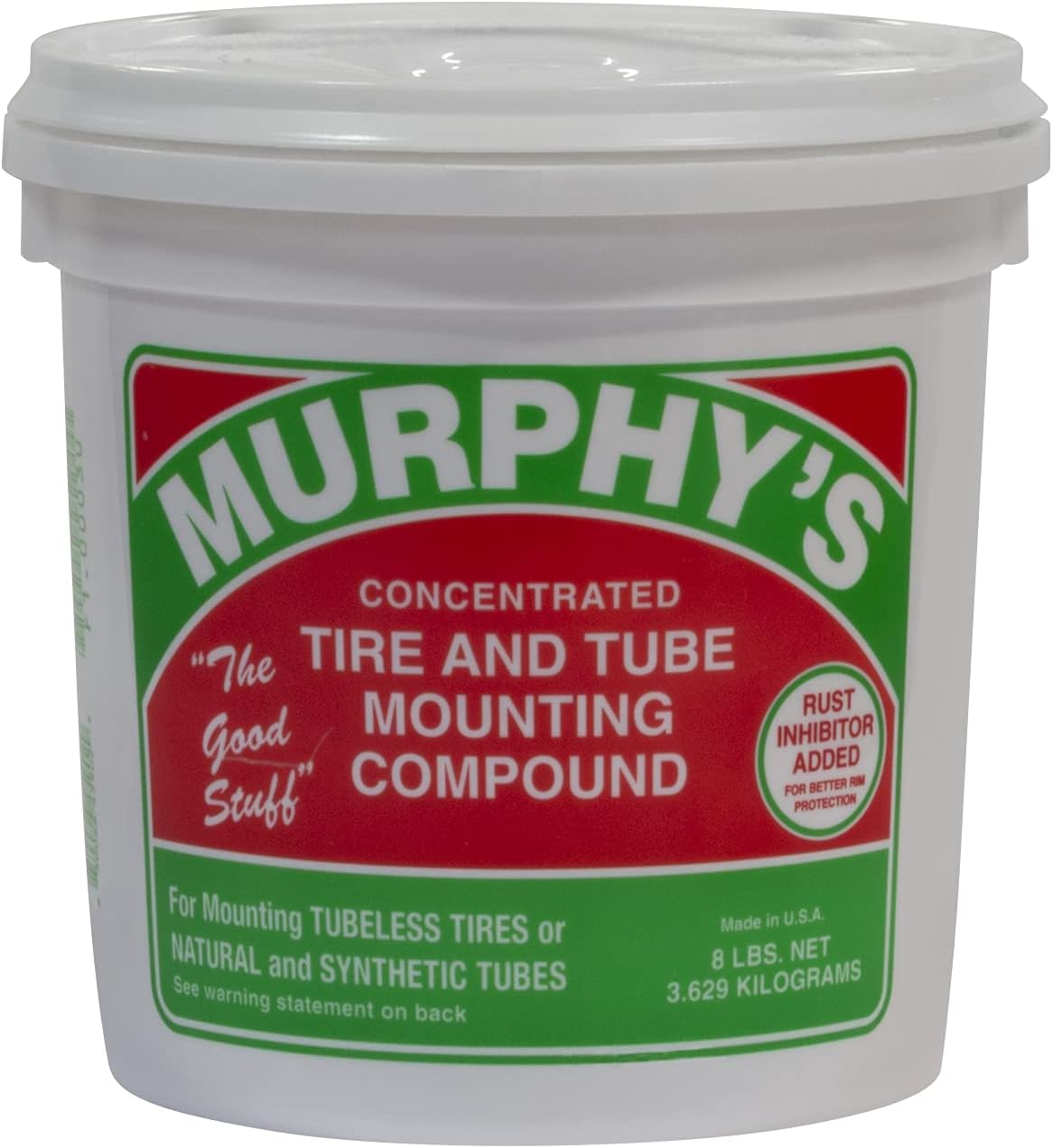
A concentrated tire and tube mounting compound designed to help simplify mounting rubber tires and tubes on passenger, semi truck, construction, and OTR applications. Its ultra-thick formula packs beads effectively and includes rust inhibitors to help protect against corrosion during use.

Related Articles

Toyota RAV4 TPMS Reset: Easy Steps That Work
Unlock the secrets to resetting your Toyota RAV4's TPMS effortlessly—discover the essential steps to ensure your tires are always safe.
Read More
Toyota RAV4 Tire Rotation: DIY Steps & Pattern
Take control of your Toyota RAV4's tire maintenance with our simple DIY rotation guide—discover the best steps for optimal performance and longevity!
Read More
Mix Tire Brands on a Toyota RAV4? Expert Guide
Keeping your RAV4 safe? Learn when mixing tire brands risks traction, ABS/TCS and AWD damage — and what exact matches you must insist on.
Read More