
How Big Is a 285 70R17 Tire? Full Size Breakdown & Dimensions
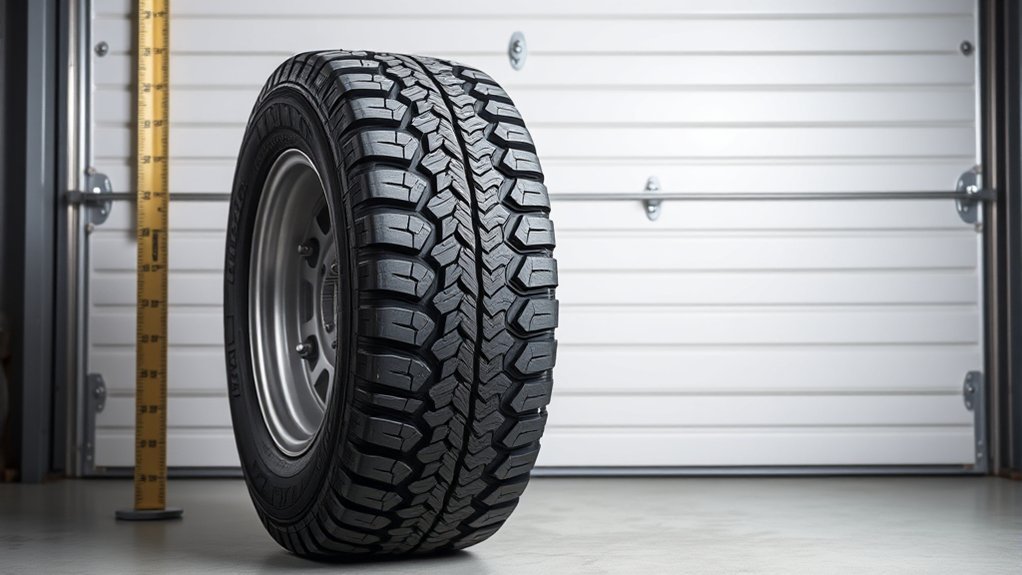
A 285/70R17 tire is about 32.7 inches tall, 11.2 inches wide, and fits a 17-inch wheel. Its sidewall is about 7.85 inches, so it’s a near-33-inch tire with a solid balance of ride comfort, load support, and traction. You’ll often see it on trucks and SUVs like F-150s, Wranglers, and Silverados. It can affect MPG and speedometer accuracy, and there’s more to compare in the details ahead.
Key Takeaways
- A 285/70R17 tire is about 11.22 inches wide and 32.71 inches tall overall.
- Its sidewall height is about 7.85 inches, because the 70% aspect ratio is measured from the 285 mm width.
- It fits a 17-inch wheel, with an ideal rim width between 7.5 and 9 inches.
- This size is very close to a 33-inch tire and is commonly used on trucks and SUVs.
- Larger diameter can slightly affect speedometer accuracy and fuel economy, so recalibration may be needed.
How Big Is a 285/70R17 Tire?
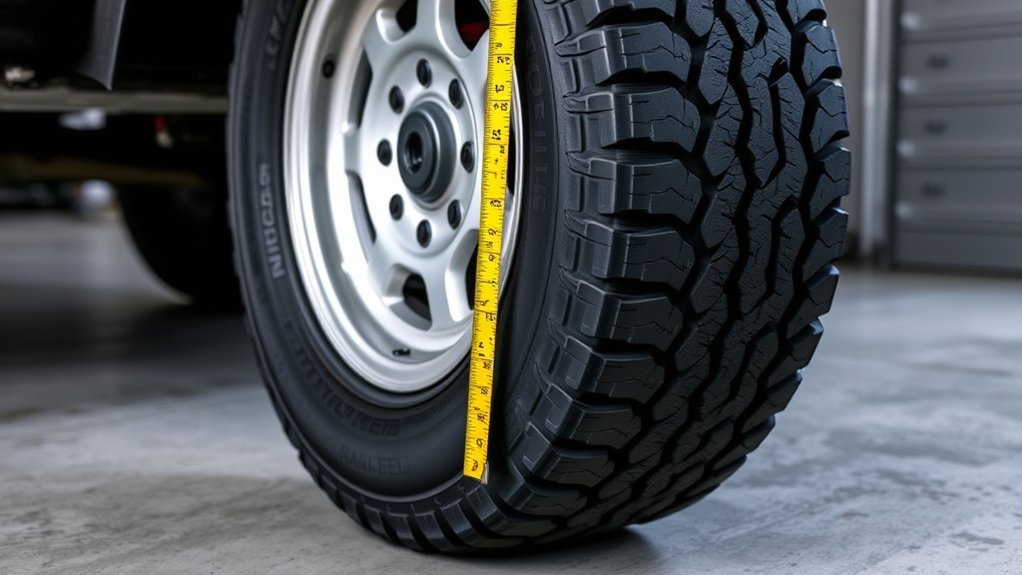
A 285/70R17 tire is 285 mm wide, or about 11.22 inches, and its 70% aspect ratio gives it a sidewall height of roughly 7.85 inches. You can use these tire dimensions to gauge fitment and load behavior with precision. The 285/70R17 mounts on a 17-inch wheel, and its overall diameter comes out to about 32.71 inches. That size reflects twice the sidewall height plus the wheel diameter, so you get a tall, controlled profile without excess bulk. You should pair it with a 7.5- to 9-inch rim for ideal support and stability. Because it uses radial construction, it delivers stronger grip, better fuel economy, and longer service life. If you compare it with a 33×12.50R17, you’ll see it’s slightly smaller, which can preserve clearance while still giving you assertive ground contact and road presence. Additionally, this tire size is often favored for its compatibility with all-terrain tires, providing versatility for both on-road and off-road driving.
285/70R17 Dimensions in Inches
The 285/70R17 tire measures 11.22 inches wide, giving you a stable footprint for larger vehicles and better traction. In 285/70R17 dimensions, that width works with a 70 aspect ratio to produce a sidewall height of 7.85 inches, so you get more vertical compliance without losing control. When you calculate the overall diameter, you’ll find it reaches about 32.71 inches, using 2 times the sidewall height plus the 17-inch wheel diameter. These dimensions matter because they shape how the tire carries load, absorbs impact, and maintains ground contact. You’re looking at a tire built for precise fitment on 17-inch wheels, with rim width compatibility from 7.5 to 9 inches. That range gives you room to match your setup deliberately. If you want technical clarity, the 285/70R17 delivers a balanced profile: wide, tall enough to soften irregularities, and sized to support confident, independent movement on the road. Additionally, selecting tires based on treadwear ratings can enhance performance and longevity.
What Vehicles Use 285/70R17 Tires?
285/70R17 tires typically show up on larger trucks and SUVs built for stability, load support, and off-road traction. You’ll see the 285/70R17 size on vehicles like the Ford F-150, Toyota Land Cruiser, Jeep Wrangler, and Chevrolet Silverado 1500. These vehicles often use this fitment to gain stronger grip, steadier handling, and better performance on rough terrain. The tire’s 285 mm width and 32.71-inch diameter support a confident contact patch without sacrificing too much ride control. Its 70-series sidewall helps absorb impacts while keeping response predictable.
You also get broad compatibility because many rims between 7.5 and 9 inches wide can accept this size. That flexibility makes it easier to match the tire to different vehicle setups, whether you’re optimizing a factory-spec truck or upgrading an off-road build. If you want a tire that balances traction, clearance, and utility, 285/70R17 is a highly practical choice. Additionally, these tires are favored for their off-road capability, making them ideal for adventurous driving experiences.
285/70R17 Vs 33-Inch Tires?
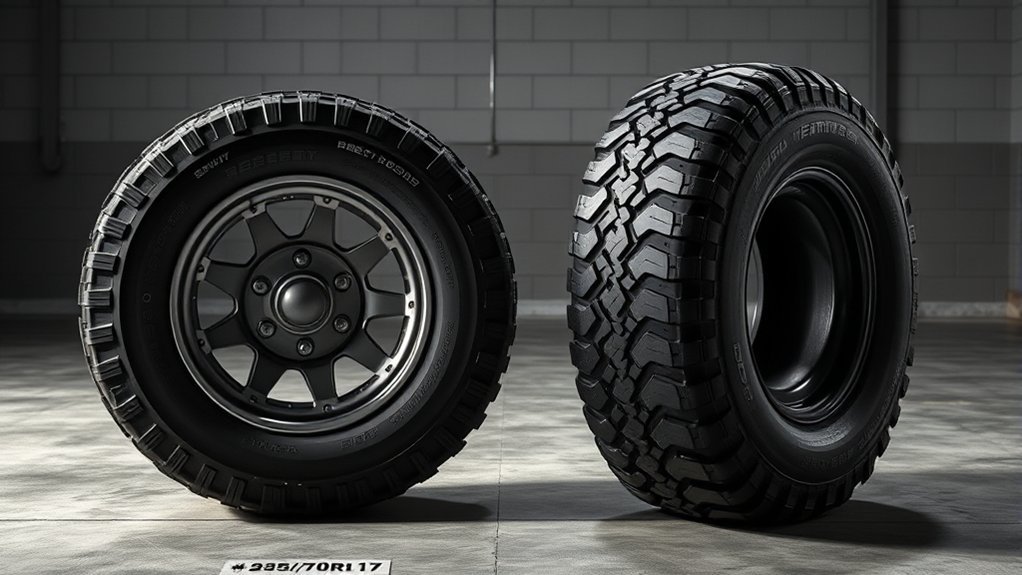
A 285/70R17 measures about 32.71 inches in diameter, so it’s slightly smaller than a true 33-inch tire at roughly 33.03 inches. You’ll also see a width gap: the 285/70R17 is 11.22 inches wide versus 12.52 inches for a 33×12.50R17, with a small sidewall increase of about 2% on the larger tire. That difference affects fitment, revolutions per mile, speedometer reading, and how the tire handles on-road and off-road. Choosing the right tires based on driving conditions and needs can significantly enhance your vehicle’s performance and safety.
Size And Diameter Difference
When you compare a 285/70R17 to a true 33-inch tire, the difference is small but measurable: the 285/70R17 measures about 32.71 inches in overall diameter, while a typical 33×12.50R17 comes in at 33.03 inches. That gap is only 0.32 inches, so your tire size is effectively very close to 33-inch dimensions without fully matching them. In practical terms, you keep your vehicle within the 3% diameter window that supports accurate speedometer and drivetrain behavior. You’ll also notice the 285/70R17 turns about 616.6 revolutions per mile, slightly more than the 33-inch tire. If you want a precise fit without surrendering performance, this tire gives you near-33-inch diameter freedom with disciplined geometry.
Width And Sidewall Comparison
On width alone, the 285/70R17 is noticeably narrower than a true 33-inch tire: it measures 285 mm, or about 11.22 inches wide, while a 33×12.50R17 comes in at roughly 12.52 inches. That width gap shapes the comparison and the sidewall profile.
| Tire | Dimensions |
|---|---|
| 285/70R17 | 11.22 in width, 7.85 in sidewall |
| 33×12.50R17 | 12.52 in width, 8.01 in sidewall |
You’ll also see a slight sidewall difference: the 33-inch tire adds about 0.16 inch, which raises its overall stance and can increase ground clearance. The 285/70R17 stays more compact, with a 32.71-inch diameter versus 33.03 inches. In practical terms, this is a precise dimensions comparison, not a dramatic one, but it matters.
Fitment And Driving Impact
The 285/70R17 sits very close to a 33-inch tire, but its 32.71-inch diameter means you’re still giving up about 0.32 inch compared with a 33×12.50R17. That difference matters for fitment, because the narrower 285 section can clear tighter wheel wells more easily, yet it also changes your driving impact. You’ll gain less ground clearance than a true 33, and the 7.85-inch sidewall won’t absorb hits quite like the 8.01-inch sidewall on a 33×12.50R17. Expect slightly sharper steering, but less footprint for traction and load support. Your speedometer may read about 7% slow, so verify calibration. If you want balanced dynamics, stay within 3% diameter tolerance; a 33×10.50R17 can preserve performance and keep your setup more free.
What Are the Best Equivalent Sizes for 285/70R17?
For a 285/70R17, the best equivalent sizes are those that keep overall diameter close to its 32.71-inch measurement, so your speedometer, gearing, and handling stay as consistent as possible. When you compare 285/70R17 tire dimensions, the strongest equivalent sizes are 33×10.50R17 and 33×12.50R17, at 32.98 and 33.03 inches. Both preserve nearly the same overall diameter while giving you a true 33-inch profile. Within a 3% tolerance, 295/70R17 at 33.26 inches and 305/65R17 at 32.61 inches also fit well. If you want more height, 285/75R17 reaches 33.83 inches, but it’s no longer a close match. You should choose the size that matches your goals, but stay near the factory spec if you want balanced performance and freedom from unwanted compromises. Additionally, consider the tread life performance of various tire options to ensure they meet your driving needs.
How Do 285/70R17 Tires Affect MPG And Speedometer?
When you switch to 285/70R17 tires, you can expect your speedometer to read about 7% slower than your actual road speed because the tire’s 32.71-inch diameter increases distance traveled per revolution. That creates measurable speedometer inaccuracies, so your indicated 60 mph is closer to 64 mph. In practical terms, 285/70R17 sizes usually reduce fuel economy by 5-10% because the larger rolling diameter and extra mass demand more energy. Stay mindful of diameter tolerance; keeping changes within 3% helps preserve calibration, gearing, and drivability.
- Taller sidewalls trace a longer arc on the pavement.
- The truck covers more ground with each wheel turn.
- Engine load rises as the tires rotate heavier.
- Your dash can mislead you on highways and trails.
- Upgrading to larger tires can also enhance traction and handling, particularly in winter conditions.
You’re trading a small efficiency hit for a stronger stance and freer capability, but the numbers should stay precise if you want clean performance.
What Tire Pressure Works Best for 285/70R17?
A 285/70R17 tire typically performs best at 30 to 35 PSI, but you should always verify the vehicle placard and adjust for load, towing, or off-road use. Your tire pressure directly shapes how your 285/70R17 behaves on pavement and trail. Maintaining the correct pressure can also enhance fuel efficiency by reducing rolling resistance.
| PSI | Effect | Use Case |
|---|---|---|
| 30 | Softer ride, more grip | Light load |
| 32 | Balanced handling | Daily driving |
| 35 | Better support | Heavier load |
| Below 30 | Poor fuel efficiency | Risky |
| Above 35 | Reduced contact | Harsh ride |
You’ll get ideal fuel efficiency when inflation stays within spec, because correct tire pressure cuts rolling resistance and stabilizes handling. Under-inflation steals traction and increases wear; over-inflation hardens the ride and narrows contact patch. Check pressure monthly and before long trips, since temperature and payload shift readings. Keep it precise, and your 285/70R17 will deliver safer, freer performance.
Frequently Asked Questions
Is a 285 70R17 a 33 Inch Tire?
No, you don’t have a true 33-inch tire here. A 285/70R17’s tire height is about 32.7 inches, so it’s slightly short of 33. Its tire width is 285 mm, or 11.2 inches, and the sidewall aspect is 70%. That profile supports solid load capacity while keeping geometry close to 33-inch fitment. You’ll get near-33 performance, but not exact size.
What Is a 285 70R17 Equivalent To?
A 285/70R17 is roughly equivalent to a 33×11.5R17 tire, and you can also cross-shop 33×10.50R17 or 33×12.50R17 depending on fitment. Ironically, the “freedom” of tire sizing still chains you to clearance, gearing, and rim width. Use metric conversion to compare diameter, then check tread patterns and load capacity. You’ll find 295/70R17 and 305/65R17 are close alternatives for tighter, more precise substitution.
Is a 285 Tire Equivalent to a 33?
No, you don’t have a true 33-inch tire with a 285. In tire sizing, a 285/70R17 measures about 32.71 inches, so it’s slightly undersized versus a 33×12.50R17. You’ll see narrower tread patterns, different load capacity, and marginally different off road performance. If you want near-33 dimensions, a 295/70R17 fits closer while staying within acceptable diameter tolerance for your vehicle’s liberated, precise setup.
Is 285 70 17 the Same as 35?
No, you’re not looking at a true 35; it’s a giant step short. Your 285/70R17 Tire Measurement comes to about 32.7 inches, not 35. That affects Off Road Performance, Load Capacity, and gearing. You’ll also need to verify Wheel Compatibility before fitting. Compared with a real 35-inch tire, you lose height, footprint, and clearance. You’re free to choose it, but it isn’t the same size.
Conclusion
In the end, a 285/70R17 gives you a substantial, balanced footprint: roughly 32.7 inches tall and 11.2 inches wide. You get a tire that looks and performs like a near-33, with enough sidewall to absorb rough terrain without feeling vague on pavement. If you’re choosing this size, you’re likely after that Goldilocks middle ground—strong traction, solid clearance, and predictable handling. Dial in pressure correctly, and you’ll keep your rig running true.

Related Articles
How Big Is a 275 55R20 Tire? Full Size Breakdown & Dimensions
A 275/55R20 tire’s size may surprise you—discover the full dimensions and fitment details before you choose the wrong one.
Read More
What Is a Bsw Tire? Complete Guide & Best Options
Clean and practical, a BSW tire offers hidden benefits, but which models and specs are best for your vehicle?
Read More
What Is a 275 Tire in Inches? Easy Size Conversion Explained
Okay—discover what a 275 tire measures in inches and why the exact size can change your fitment, ride, and speed.
Read More