
Nitrogen vs Regular Air in Tires: Is There a Real Benefit?
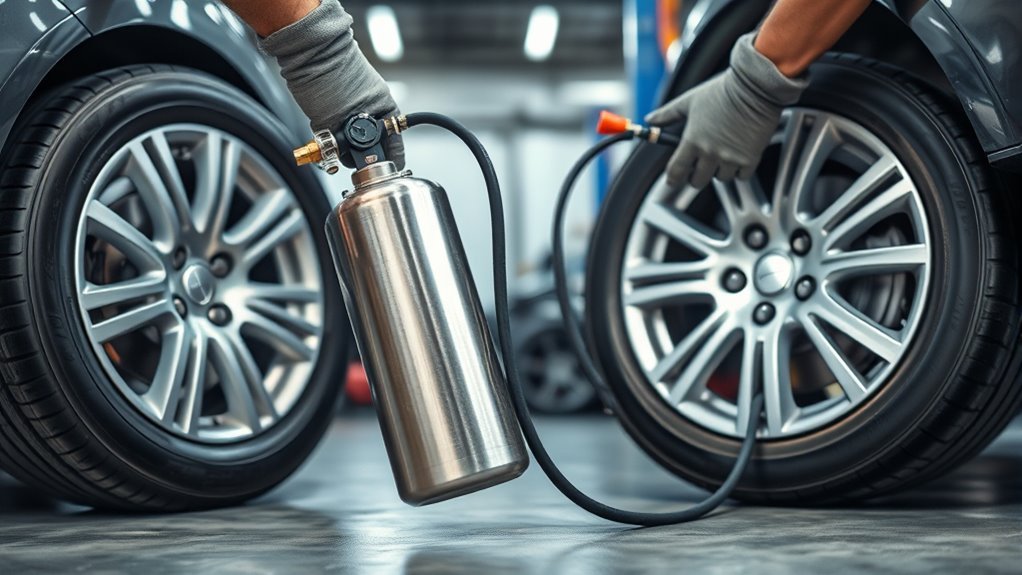
For most everyday drivers, the best tire fill is the one that helps you keep the tires at the vehicle manufacturer’s recommended pressure. Nitrogen can slow pressure loss a little because it is dry and contains less oxygen, but regular compressed air is already about 78% nitrogen and works well when you check and correct pressure regularly.
Quick Answer
Nitrogen in tires is worth considering for fleets, track use, long storage, or drivers who already get it free. For normal commuting, the benefit is small. Proper tire pressure matters far more than whether the tire is filled with nitrogen or regular air.
Key Takeaways
- Regular air is already mostly nitrogen: dry air is about 78% nitrogen and 21% oxygen.
- A high-purity nitrogen fill can reduce pressure loss, but the real-world difference for passenger cars is usually modest.
- Fuel economy improves when tires are kept at the correct PSI, not because nitrogen directly creates extra mileage.
- Topping off a nitrogen-filled tire with regular air is better than driving underinflated.
- Check cold tire pressure monthly and before long trips, no matter which gas is inside the tire.
Nitrogen vs Air Tires: What’s the Real Difference?
The main difference is gas purity. Regular compressed air contains nitrogen, oxygen, water vapor, and trace gases. A nitrogen tire fill is usually marketed as about 93% to 95% nitrogen or higher, with much less oxygen and moisture.
| Factor | Regular Air | ~95% Nitrogen |
|---|---|---|
| Typical composition | About 78% nitrogen, 21% oxygen, plus trace gases and variable moisture | Mostly nitrogen, with less oxygen and moisture |
| Pressure retention | Loses pressure over time and needs monthly checks | Can lose pressure more slowly, but still needs checks |
| Cost | Often free or low-cost at gas stations and tire shops | May cost extra unless included with tire service |
| Availability | Widely available | Less common; usually found at tire shops, dealerships, or fleet facilities |
| Best use | Everyday driving with routine maintenance | Fleets, track use, aircraft-style maintenance environments, stored vehicles, or drivers who get it free |
What’s in Your Tires: Air vs ~95% Nitrogen
Standard air is not “the opposite” of nitrogen. According to NOAA’s atmosphere data, dry air is about 78.084% nitrogen, 20.946% oxygen, 0.934% argon, and small amounts of other gases. Water vapor varies with humidity.
That matters because oxygen and moisture are the parts nitrogen service tries to reduce. Less oxygen can reduce internal oxidation over long periods, and less moisture can make pressure behavior more predictable in demanding conditions. For a typical daily driver, though, the advantage is usually small compared with simply keeping the tire at the right PSI.
Composition of Standard Air
Regular compressed air is convenient and usually cheap. Its downside is that it can contain moisture, especially if the compressor system is poorly maintained. Moisture can contribute to corrosion at metal surfaces and can add some pressure variability as temperatures change.
Benefits of ~95% Nitrogen
A high-purity nitrogen fill is drier and contains less oxygen. In controlled testing, nitrogen has shown better pressure retention than air, but it is not leak-proof and it does not remove the need for maintenance. Think of nitrogen as a small stability upgrade, not a replacement for checking pressure.
Pressure Retention and Leak Rates
All tires slowly lose pressure through normal permeation, valve stems, temperature changes, and small leaks. Nitrogen can slow that loss, but the difference is often smaller than advertising makes it sound.
A Consumer Reports tire test found that nitrogen-filled tires lost an average of 2.2 psi over one year, while air-filled tires lost 3.5 psi over the same period. That is a real difference, but only 1.3 psi across a full year.
NHTSA-related laboratory testing also found that nitrogen reduced inflation pressure loss compared with air under controlled conditions, but the same research emphasized that nitrogen is not a substitute for regular pressure maintenance.
The practical takeaway: nitrogen may slow pressure loss, but monthly pressure checks still matter more than the fill gas.
Nitrogen Leak Rates
Nitrogen’s pressure-retention advantage comes from lower oxygen content, dry gas, and slower gas migration through the tire structure. That can be helpful for vehicles that sit for long periods, commercial vehicles that rack up high mileage, or performance cars where small pressure changes matter.
Pressure Loss Over Time
Do not expect nitrogen-filled tires to stay perfect for months without attention. Tires can still lose pressure from punctures, valve leaks, bead leaks, seasonal temperature changes, or normal seepage. If a tire repeatedly loses pressure, have it inspected instead of assuming nitrogen will solve the problem.
Temperature Stability and Real-World Performance
Both regular air and nitrogen respond to temperature changes. A tire checked on a cold morning can read lower than the same tire after driving or sitting in the sun. Nitrogen is dry, so it can reduce moisture-related variation, but it does not make tire pressure immune to heat and cold.
For daily commuting, you probably will not feel a handling difference between air and nitrogen if both tires are set to the same correct PSI. For racing, heavy-duty fleet work, or repeated high-heat use, the drier and more consistent nature of nitrogen can be more useful.
Note: Always check tire pressure when the tires are cold, before driving more than a short distance. Use the PSI on the driver’s door placard or owner’s manual, not the maximum pressure printed on the tire sidewall.
Moisture, Corrosion, and Tire/Rim Longevity
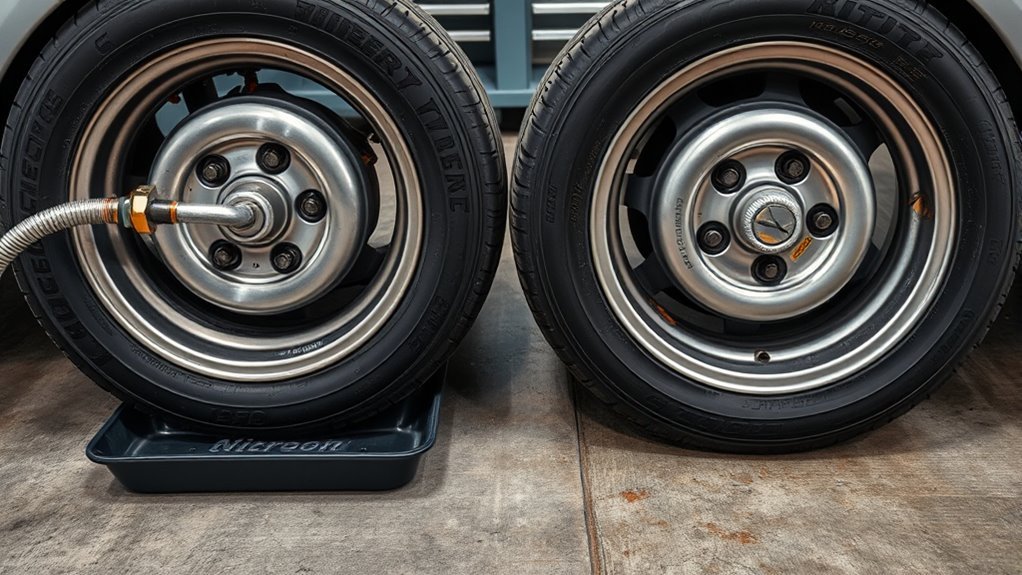
Because nitrogen fills are drier and lower in oxygen, they can reduce the conditions that contribute to internal oxidation and rim corrosion. This benefit is most relevant where tires face long service intervals, high heat, high load, or long storage.
For the average passenger car, tread wear, road damage, alignment, rotation habits, and inflation pressure usually have a much bigger effect on tire life. Nitrogen may help at the margins, but it will not prevent age cracking, sidewall damage, uneven wear, or failure from underinflation.
Costs and Availability of Nitrogen Fills
Regular air is easier to find and is often free or inexpensive. Nitrogen may be included with a new tire package, membership, dealership service, or fleet program, but many shops charge extra for a nitrogen fill or purge-and-refill service.
The value depends on access. If your tire shop provides nitrogen for free and you can top off conveniently, there is little downside. If you have to pay extra and drive out of your way, regular air plus disciplined pressure checks is usually the better everyday choice.
[Products Worth Considering]

EVOULTES heavy duty tire inflator with an integrated gauge delivers accurate pressure readings from 10–120 PSI, helping you inflate, deflate, and check tires in one tool. The 16.5-inch extended dual-head air chuck with swivel base reaches hard-to-access dual wheel valves on trucks and RVs. A brass trigger core and side-mounted air release valve make operation smooth, with standard 1/4" NPT threading and quick-connect compatibility for easy setup.

This portable cordless tire inflator delivers up to 160 PSI with fast 17 L/min airflow to help you quickly top up tires and get back on the road. It features dual power mode, running on a 21V rechargeable battery or a 12V DC adapter for convenient roadside use. An automatic shut-off with digital pressure gauge helps prevent overinflation, and a built-in LED light improves visibility in low-light conditions.

The Fanttik X10 Pro is a cordless portable tire inflator that reaches up to 150 PSI and can inflate an R15 tire in about 35 seconds for quick roadside or home top-ups. With AccuInFlate auto-stop and smart start/stop controls, it helps maintain accurate pressure and frees your hands once the target is reached. A high-visibility digital display and preset modes make it easy to set and monitor inflation for cars, motorcycles, bikes, and balls.
Who Benefits Most: Everyday Drivers, Fleets, and Performance Cars
Nitrogen is not equally useful for every driver. Use this table as a practical decision guide.
| Driver / Vehicle Type | Is Nitrogen Worth It? | Why |
|---|---|---|
| Daily commuter | Usually no | Regular air works well if pressure is checked monthly. |
| Family SUV or light truck | Maybe, if free | The benefit is small, but free nitrogen is fine if maintenance stays easy. |
| High-mileage fleet | Often worth evaluating | Small pressure-retention gains can scale across many vehicles and many miles. |
| Track or performance car | More likely | Dry nitrogen can help keep pressure changes more predictable under repeated heat cycles. |
| Stored vehicle or spare set | Possibly | Slower pressure loss and lower moisture may help during long storage, but checks are still required. |
[Products Worth Considering]

The JACO FlowPro Tire Inflator measures, inflates, and airs down tires up to 100 PSI with battery-free operation and ±2% accuracy after calibration. It features a glowing pressure dial for night visibility, a heavy-duty steel build with a hybrid hose, and a precision push-to-inflate thumb trigger. The patented Lightning Air Chuck locks on for a secure seal, and the kit includes quick-connect hardware for easy inline use with your air compressor.

This portable cordless tire inflator delivers fast, efficient inflation for cars, motorcycles, bikes, and sports balls with a digital pressure gauge. Use the one-click PSI preset with auto shut-off for accurate, hands-free topping to your target pressure up to 150 PSI. It’s compact and rechargeable with a built-in emergency LED light plus valve adapters and accessories for quick, ready-to-go use.
Daily Commuter Needs
For normal city and highway driving, regular air is usually the smartest choice. It is available almost everywhere, costs little or nothing, and performs well when the tires are kept at the correct pressure.
Fleet Cost Efficiency
Fleet operators may benefit more because small pressure-retention improvements can reduce maintenance interruptions across many vehicles. The right way to decide is to compare nitrogen service costs against tire life, downtime, fuel use, and labor time.
Myths, Safety, and Mixing Nitrogen With Air
It is safe to add regular air to a nitrogen-filled tire when the tire is low. The air will dilute the nitrogen concentration, so some of the pressure-retention benefit may be reduced, but correct inflation is always the priority.
Warning: Never drive on an underinflated tire just to keep a nitrogen fill “pure.” Underinflation can hurt handling, increase heat buildup, reduce fuel economy, and damage the tire.
Also remember that green valve caps only suggest that nitrogen may have been used at some point. They do not prove the current purity level, and they do not change the tire’s required pressure.
Actionable Steps: Choose and Maintain Tire Pressure
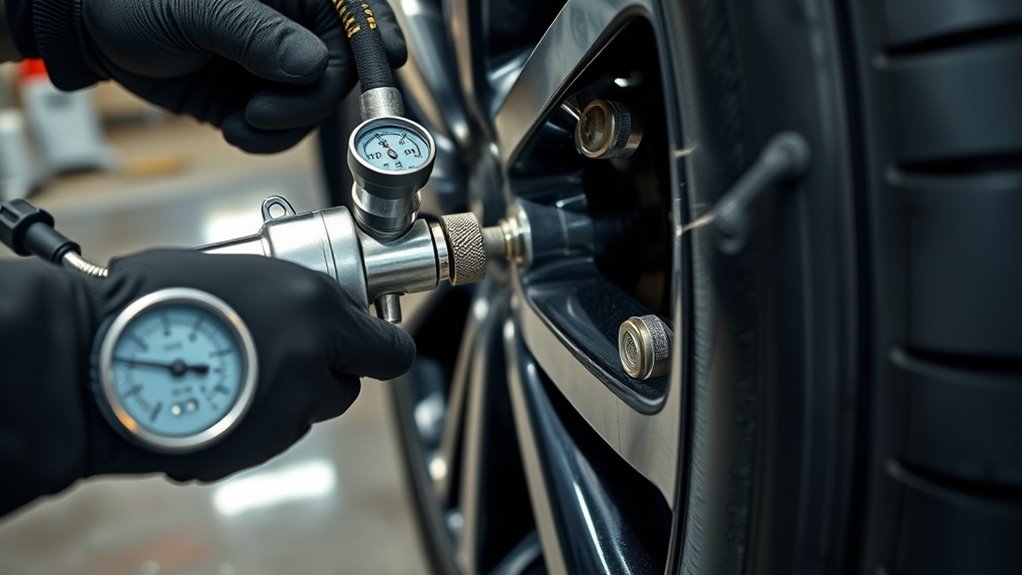
At a Glance
| Time Required | 5–10 minutes per month |
| Difficulty | Easy |
| Tools Needed | Digital or dial tire-pressure gauge, air compressor if adjustment is needed |
| Cost | Usually free to low-cost for air; nitrogen cost varies by shop |
- Find the correct PSI. Look at the driver’s door jamb placard or owner’s manual. Do not use the maximum PSI molded into the tire sidewall.
- Check pressure cold. Measure before driving or after the vehicle has been parked for several hours.
- Check all four tires and the spare. A spare tire can lose pressure while it sits unused.
- Adjust immediately. Add air or nitrogen as needed to reach the recommended PSI.
- Inspect tread and sidewalls. Look for uneven wear, cracks, bulges, nails, cuts, or other damage.
- Log pressure monthly. A tire that keeps losing pressure may have a puncture, valve-stem leak, or bead leak that needs service.
Pro Tip: Your TPMS light is a backup warning, not a maintenance plan. NHTSA notes that TPMS may not alert until tire pressure is significantly low, so manual monthly checks are still important.
Fuel economy is another reason to stay consistent. FuelEconomy.gov says properly inflated tires can improve gas mileage by 0.6% on average and up to 3% in some cases. It also notes that underinflated tires can lower gas mileage by about 0.2% for every 1 psi drop in the average pressure of all tires.
Frequently Asked Questions
Is it better to fill tires with nitrogen or air?
For most drivers, regular air is better because it is cheap, convenient, and effective when tire pressure is checked monthly. Nitrogen is better only when you value slightly slower pressure loss, lower moisture, and more consistent service access.
Does nitrogen improve fuel economy?
Nitrogen does not directly improve fuel economy when tire pressure is the same. Any fuel benefit comes from keeping the tires properly inflated for longer. If you check and correct regular air pressure monthly, the fuel-economy result should be very similar.
Can I add regular air to nitrogen-filled tires?
Yes. Adding regular air is acceptable when a tire is low. It lowers the nitrogen purity, but driving at the correct PSI is much safer than driving underinflated.
How often should I check nitrogen-filled tires?
Check them at least once a month and before long trips, just like air-filled tires. Nitrogen slows pressure loss in some conditions, but it does not stop leaks, punctures, valve problems, or seasonal pressure changes.
Are green valve caps proof that my tires have nitrogen?
No. Green caps usually mean nitrogen was used at some point, but they do not confirm the current nitrogen purity. The tire may have been topped off with regular air since then.
Conclusion
Nitrogen is not a scam, but it is often oversold. It can reduce pressure loss, moisture, and oxygen exposure inside the tire, which helps most in fleets, performance driving, high-heat use, or long storage. For everyday driving, regular air is usually the better value because it is easy to find and works well when maintained.
The simplest rule is this: choose nitrogen if it is convenient and reasonably priced, but do not pay extra expecting dramatic fuel savings or maintenance-free tires. Whether you use nitrogen or air, check cold tire pressure monthly, follow the door-jamb PSI, inspect tread wear, and fix slow leaks quickly.
Sources
- NOAA — The Atmosphere — supports air composition and water-vapor context.
- FuelEconomy.gov — Keeping Your Vehicle in Shape — supports fuel-economy effects of proper tire pressure.
- NHTSA TireWise — supports tire safety, maintenance, and tire-care guidance.
- NHTSA — Tires in the Garage Infographic — supports monthly checks, TPMS caveat, and pressure-loss reminders.
- Consumer Reports — Should You Use Nitrogen in Your Car Tires? — supports the 12-month nitrogen vs air pressure-retention comparison.
- Rubber Chemistry and Technology — Nitrogen Inflation of Tires — supports laboratory findings on pressure loss and oxygen-related tire aging.

Related Articles

What Is a Fat Tire? Complete Guide & Best Options
I’ll show you what makes fat tires different, which setups work best, and why the right choice could change your ride.
Read More
What Does W Mean on a Tire? Load, Speed & Rating Guide
Huh, what does W on a tire really mean, and why could choosing the wrong rating affect your safety and performance?
Read More
What Does Tire Flipping Work? Muscles, Benefits & Workout Guide
Strong tire flips hammer your entire body, but which muscles and benefits matter most?
Read More