
Keep your Toyota Camry safer and easier to drive by checking tire pressure, tread depth, rotation schedule, alignment symptoms, TPMS warnings, load limits, and tire damage before small problems become roadside trouble. Use the tire placard on the driver-side door jamb, check tires when they are cold, and have any bulge, sidewall cut, vibration, or questionable puncture inspected by a tire professional.
Quick Answer
For Toyota Camry tire maintenance, check cold tire pressure monthly and before trips, use the driver-side door-jamb placard, inspect tread with the penny test, rotate tires about every 5,000 to 8,000 miles if your manual allows it, and act quickly on TPMS lights, pulling, vibration, bulges, cuts, or uneven wear.
Key Takeaways
- Use the Camry’s door-jamb tire placard or owner’s manual for the correct cold PSI, not the maximum pressure molded on the tire sidewall.
- Replace tires at 2/32 inch tread depth, or sooner when wet, snowy, or icy traction matters.
- Rotate tires on the schedule in your owner’s manual; NHTSA lists 5,000 to 8,000 miles as a common interval when the manufacturer recommends rotation.
- Treat TPMS warnings, pulling, vibration, humming, bulges, cracks, and sidewall cuts as safety signals, not minor annoyances.
- Use a qualified tire shop for puncture repair because safe repairs require tire removal, internal inspection, and an approved patch-plug method.
At a Glance
| Time Required | 5 to 10 minutes for pressure and tread checks; longer if you inspect damage after a pothole hit. |
| Difficulty | Easy for checks; professional service needed for alignment, balancing, tire repair, and mounting. |
| Tools Needed | Tire pressure gauge, tread depth gauge or penny, flashlight, air pump, and your Camry owner’s manual. |
| Cost | Basic checks are low cost; repairs, alignment, balancing, rotation, or replacement depend on your tire shop and tire size. |
Check Your Camry Tire Pressure

Check your Camry’s tire pressure at least once a month and before long trips. The National Highway Traffic Safety Administration recommends checking all tires, including the spare, when the tires are cold. A cold tire means the car has not been driven for at least three hours.
Find the correct PSI on the driver-side door-jamb tire placard or in your owner’s manual. Do not use the maximum pressure printed on the tire sidewall as your normal inflation target. That sidewall number shows the tire’s maximum rating, not the pressure Toyota selected for your Camry’s ride, handling, and load.
Use an accurate pressure gauge instead of judging by sight. If pressure is low, add air in small amounts, recheck with the gauge, and reinstall the valve cap. If pressure is high, release air slowly until the reading matches the placard.
Pro Tip: Keep a pencil-style or digital tire gauge in the glove box. TPMS warnings usually trigger only after pressure is already low enough to matter, so a monthly manual check still protects tire life and handling.
Check the spare tire too. Many compact spares use a higher pressure than the four road tires, but you should confirm the exact number on the spare tire label or in your Camry owner’s manual.
Read Camry Tire Tread Before It Wears Out
As your Camry’s tires wear, check tread depth at least monthly. Use the penny test: place a penny into the tread groove with Lincoln’s head upside down and facing you. If you can see the top of Lincoln’s head, the tread is at or near 2/32 inch and the tire needs replacement.
Also check the built-in treadwear indicators. These raised bars sit between the tread grooves. When the surrounding tread becomes level with those bars, the tire has reached its replacement limit.
The legal minimum in many places is 2/32 inch, but that does not mean the tire still performs well in rain, snow, or ice. Wet traction drops as tread gets shallow because the grooves cannot move water as effectively. If you often drive in heavy rain, replace earlier than the legal minimum. For snow-covered roads, Transport Canada advises against using tires worn close to 4 mm, which is about 5/32 inch.
Check tread and pressure on the same day each month. One simple routine catches low air, uneven wear, tire aging, and damage before they turn into safety problems.
Rotate Your Camry Tires on Schedule
Once you confirm the tread is safe, keep wear even by rotating the tires on schedule. Toyota recommends checking your owner’s manual for the correct tire rotation schedule and pattern. NHTSA lists 5,000 to 8,000 miles as a common interval when the vehicle manufacturer recommends rotation.
Front tires on many Camry models wear faster because they handle steering loads, braking forces, and much of the vehicle weight. Regular rotation helps spread that work across the set, improves ride quality, and reduces irregular wear.
Use the rotation pattern approved for your Camry’s drivetrain and tires. Directional tires, staggered tire sizes, and some AWD conditions may require a specific pattern. If your Camry has all-wheel drive, ask your tire shop whether tread depth differences are still within the safe range before replacing only one or two tires.
Spot Camry Alignment Problems Early
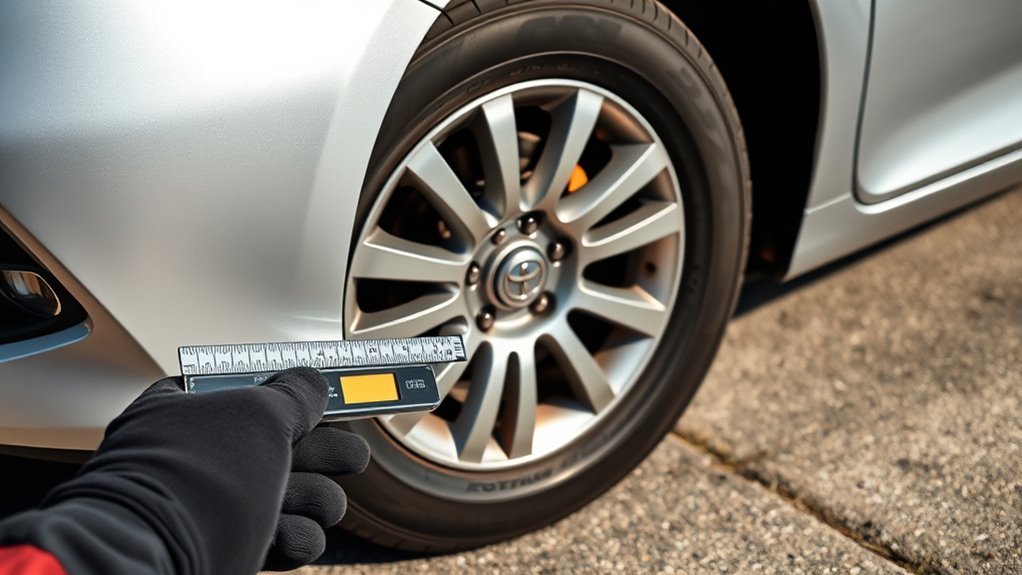
If your Camry pulls or drifts to one side, the steering wheel sits off-center, or the tires show uneven shoulder wear, schedule an alignment check. Alignment problems can shorten tire life and make the car harder to control on wet or rough pavement.
Pulling and Steering Drift
A Camry that pulls to one side on a level road may have misalignment, uneven tire pressure, brake drag, tire damage, or worn suspension parts. Start with a pressure check because low pressure on one tire can mimic alignment trouble. If pressure is correct and the car still drifts, have a technician inspect it.
- Confirm the vehicle tracks straight on a flat, level road.
- Check tire pressure on all four tires before assuming alignment is the cause.
- Schedule alignment service after a hard pothole hit or curb impact.
- Ask the shop to inspect suspension and steering parts if pulling returns.
Quick correction protects tread, improves steering response, and helps your Camry feel stable again.
Vibrations and Uneven Wear
Steering-wheel vibration, uneven tread wear, tire humming, or shaking at highway speed can point to alignment problems, tire imbalance, bent wheels, tire separation, or suspension wear. Look across each tread face and compare the inside, center, and outside edges.
If one shoulder wears faster than the other, the wheels may not be tracking squarely. If the center wears faster, the tire may be overinflated. If both outer edges wear faster, the tire may be underinflated or overloaded. Have a tire shop diagnose the pattern before replacing tires, or the new set may wear the same way.
Check Your Tire Load Limits

Check your Camry’s load limit before you carry several passengers, luggage, tools, or heavy gear. The Tire and Loading Information label on the driver-side door jamb lists the vehicle’s seating and cargo limits. The tire sidewall also lists a maximum load rating, but your primary guide for the vehicle should be the placard and owner’s manual.
Overloading adds heat and stress to the tire casing. That can worsen wear, reduce handling, and raise the risk of tire failure. Stay within the vehicle’s rated capacity and keep the tires inflated to the placard pressure for normal driving.
- Check the door-jamb placard before carrying heavy cargo.
- Count passengers and luggage together, not separately.
- Do not exceed the tire or vehicle load rating.
- Recheck tire pressure before long trips with a full cabin or trunk.
Inspect Tires After Pothole Hits
After you hit a pothole, inspect the sidewalls, tread, wheels, and steering feel as soon as it is safe. A hard impact can bend a wheel, knock the alignment out, damage internal tire cords, or create a bulge that may fail later.
Hidden Internal Tire Damage
A tire can suffer internal damage even when the tread looks normal. Watch for new vibration, pulling, air loss, thumping, or a steering wheel that feels off-center after the impact.
- Check all four tires for new bulges, cuts, cracks, or exposed cords.
- Compare tire shape and inflation on the impacted side against the opposite side.
- Look for bent wheel lips or a tire bead that no longer sits evenly.
- Have the tire inspected if vibration, pulling, or air loss appears after the hit.
Warning: Do not keep driving on a tire with a sidewall bulge, exposed cords, deep cut, or sudden pressure loss. Install the spare if it is safe to do so, or call roadside assistance.
Check Sidewalls and Tread
Inspect the sidewalls and tread in bright light. Look for cracks, tears, bubbles, gouges, missing chunks, nails, screws, and uneven wear patterns. Check the treadwear bars and run the penny test if the tire already looks worn.
Also check tire age. Find the DOT Tire Identification Number on the sidewall. The last four digits show the week and year the tire was made. For example, 3021 means the tire was made in the 30th week of 2021. NHTSA notes that some vehicle and tire manufacturers recommend replacing tires at six to 10 years old, regardless of treadwear.
Inflate Tires Safely
To inflate your Toyota Camry tires safely, start with cold tires whenever possible. Open the driver door, read the placard, and set each tire to the listed cold PSI. Use a reliable gauge because a tire can look normal while still being underinflated.
- Check pressure before driving or after the car has been parked for at least three hours.
- Match the PSI to the door-jamb label or owner’s manual.
- Add air in small amounts and recheck with the gauge.
- Replace missing valve caps to keep dirt and moisture out of the valve stem.
- Check the spare tire before trips and before relying on it in an emergency.
If you must add air while tires are warm, set them to the placard pressure, then recheck when cold. Do not bleed air from a hot tire just because the reading is slightly above the cold spec.
Replace Camry Tires at 2/32 Inch
You should replace your Camry’s tires when tread depth reaches 2/32 inch, when treadwear bars are flush with the tread, or when a tire shows unsafe damage. At 2/32 inch, the tire cannot channel water well, so traction and braking performance drop, especially on wet roads.
[Products Worth Considering]

Keep your tires properly inflated with this analog VONDIOR tire pressure gauge, designed for fast, easy readings without batteries. The swiveling, two-axis hose and large glow dial help you measure at any tire angle with instant visibility. Built with a protective rubber shield, it supports durable, low-maintenance use for cars and trucks.

The SAFELIFE dial tire tread depth gauge measures tread depth in 1/32 inch increments with clear, easy-to-read 2-inch dial face. Color zones using a traffic light system help you quickly judge whether tread is low, marginal, or ample for safer driving. Built with a durable zinc cast body and a metal detect probe for precise, comfortable use across cars, motorcycles, trucks, and buses.

Measure tire tread depth quickly and accurately with this LUMITECO dial gauge that reads in 1/32" increments up to 14/32". The color-coded green/yellow/red zones make it easy to judge tire wear and know when replacement is needed. A rugged, compact design with a protective pouch helps keep the gauge ready for use on cars, trucks, motorcycles, and more.
Tread Depth Warning Signs
Watch for these signs that your tires are near the replacement limit:
- The top of Lincoln’s head is visible during the penny test.
- The treadwear bars are level with the surrounding tread.
- The car hydroplanes more easily in rain.
- The tires show cracking, bulges, cuts, exposed cords, or irregular wear.
- The tires are old enough that age has become a concern, even if tread remains.
2/32 Inch Replacement
At 2/32 inch, replace the tire instead of trying to stretch a few more miles from it. If all four tires are worn evenly, replacing the full set keeps handling balanced. If only two tires are being replaced, many tire makers and safety organizations recommend placing the better pair on the rear axle to help maintain stability. For Camry AWD models, ask your tire shop whether the remaining tread depth is close enough to avoid drivetrain and handling issues.
Check Tread With Penny
The penny test is quick, but a tread depth gauge gives a clearer number. Check several grooves across each tire, not just one spot. If one section is much lower than the rest, have the alignment, inflation, suspension, and balance checked.
- Run the penny test on each tire monthly.
- Check inner and outer tread edges, not just the center.
- Replace tires at 2/32 inch or sooner for severe rain, snow, or ice driving.
- Record uneven wear so your tire shop can diagnose the cause.
Watch for TPMS Warning Lights
If your Camry’s TPMS warning light comes on, slow down, pull over safely, and check all tire pressures with a reliable gauge. A visual check alone can be misleading. Toyota’s Camry quick reference guidance says a solid tire pressure warning means you should adjust pressures to factory-specified levels. It also notes that a warning light may appear because of temperature changes or natural pressure loss.
If the TPMS indicator flashes for about a minute and then stays on, the system may have a fault or sensor issue. Check your owner’s manual and schedule service if the warning does not clear after proper inflation. Do not keep resetting the light without finding the cause.
Low tire pressure can reduce fuel economy, increase heat, speed up tread wear, and make the car feel less stable. A working TPMS helps, but it does not replace monthly pressure checks.
Repair Camry Tires Safely
When your Camry needs tire repair, use a trained tire professional. Safe puncture repair is more than plugging a hole from the outside. The U.S. Tire Manufacturers Association says a tire must be removed from the wheel so the inside can be inspected, and a plug alone is not an acceptable permanent repair.
The Tire Industry Association says puncture repairs are limited to the center tread area. Sidewall and shoulder punctures are not repairable, and punctures larger than 1/4 inch, or 6 mm, should not be repaired.
- Do not repair a tire with a sidewall puncture, bulge, exposed cord, or deep cut.
- Do not rely on a plug-only repair as a permanent fix.
- Ask for a tire-off inspection and an approved patch-plug repair when the puncture is repairable.
- Replace the tire if the damage is outside the repairable area or the tread is already at 2/32 inch.
- Register new tires so you can receive safety recall notices.
[Products Worth Considering]

Accurately measure tire tread depth with a calibrated gauge marked from 0 to 1 inch in 1/32 inch increments. The color-coded bar helps you quickly identify tread condition ranges, supporting safe driving for trucks, motorcycles, automobiles, and passenger vehicles.

Monitor tire tread wear with a smart, color-coded depth gauge that shows clear condition ranges at a glance. The bar is range marked for fast, easy readings, helping you maintain safer traction and performance. Each gauge is portable with a pocket clip, and the set includes 20 units for daily use and sharing.

Milton S-921 pencil tire pressure gauge helps you maintain optimal tire pressure for passenger cars with accurate readings in PSI and kPa. It features a built-in deflator valve for convenient pressure adjustments, plus a single chuck head and nylon indicator bar for easy use on the go. Built from durable plated brass and designed for reliable performance, it’s a practical road trip and cold-weather maintenance tool.
Prepare Your Tires for Winter
As temperatures fall, prepare your Camry’s tires for winter by checking tread depth, pressure, sidewall condition, and tire type before snow or ice arrives. If temperatures in your area regularly stay near or below 45°F, or 7°C, winter tires can provide better cold-weather grip than many all-season tires. Michelin Canada uses the 7°C rule for seasonal changeover timing.
For snow-covered roads, use deeper tread than the legal minimum. Transport Canada advises against using tires worn close to 4 mm, or about 5/32 inch, in snow. That gives the tread more room to bite into snow and move slush away from the contact patch.
| Winter Check | What to Do |
|---|---|
| Tread depth | Use at least 5/32 inch for regular snow driving when possible. |
| Pressure | Check monthly because cold weather can reduce PSI. |
| Damage | Look for cracks, cuts, bulges, and impact damage before freezing weather. |
| Tire storage | Store spare seasonal tires clean, dry, cool, and away from direct sunlight. |
[Products Worth Considering]

Measure tyre tread depth precisely with a digital gauge that reads in both MM and inches, helping you monitor safe driving conditions. The large LCD screen is easy to operate, and the compact tool fits for cars, trucks, and motorcycles. It provides high accuracy with a 0-25.4mm range and includes a 1-year warranty for added peace of mind.

ETENWOLF T300 is a calibrated digital tire pressure gauge for accurate readings from 3 to 200 PSI across light and heavy-duty vehicles. It includes thermal compensation for reliable performance in extreme cold or heat, with an auto shut-off to extend battery life and an LED for easier reading. The sturdy design supports rugged everyday use, making it ideal for pickups, RVs, and industrial applications.

These universal tire valve stem caps help protect valve cores from dust, debris, and moisture while helping maintain stable tire pressure. The corrosion-resistant metal construction and sealed design provide reliable protection in road grime, mud, and winter conditions. Twist-on installation makes them quick to fit on cars, SUVs, trucks, and motorcycles.
Keep Camry Tires Maintained Year-Round
Build tire checks into your normal Camry maintenance routine. Check tire pressure monthly and before road trips, inspect tread depth, look for sidewall damage, rotate on schedule, and respond quickly to pulling, vibration, noise, or TPMS warnings.
Check tire pressure monthly and before long trips; rotate on your owner’s manual schedule, often around 5,000 to 8,000 miles when rotation is recommended.
- Use the penny test and treadwear bars to spot tires near 2/32 inch.
- Use a tread depth gauge if you drive often in rain, snow, or mountain conditions.
- Check alignment if the Camry pulls, drifts, vibrates, or wears one tire edge faster.
- Inspect tires after pothole hits, curb strikes, or sudden pressure loss.
- Keep service records so you can track tire age, rotations, repairs, and replacements.
These habits protect traction, reduce uneven wear, and help your Camry stay ready for daily driving and seasonal weather.
Frequently Asked Questions
What pops tires the most?
Underinflation is one of the biggest tire-failure risks because it builds heat and weakens the tire structure. Road hazards such as nails, glass, potholes, curb impacts, overloading, old tires, and damaged sidewalls can also cause sudden air loss or blowouts.
How many miles should tires last on a Camry?
Many Camry tires last about 40,000 to 70,000 miles, but the real number depends on tire model, driving style, road surface, alignment, rotation, pressure, climate, and load. Performance tires may wear faster, while touring tires may last longer when maintained correctly.
What tire pressure should I use for a Toyota Camry?
Use the cold PSI printed on the driver-side door-jamb placard or listed in your owner’s manual. The correct pressure can vary by model year, trim, tire size, and load. Do not use the sidewall maximum as your normal inflation target.
How often should I rotate Toyota Camry tires?
Check your owner’s manual first. A common interval is about every 5,000 to 8,000 miles when the vehicle manufacturer recommends rotation. Rotate sooner if you see uneven wear or if your tire shop recommends it based on your driving conditions.
Can I keep driving when the Camry TPMS light is on?
Do not ignore it. Pull over safely, check each tire with a gauge, and inflate to the factory-specified pressure. If the light flashes for about a minute and then stays on, the TPMS may need service. Check your owner’s manual or contact a Toyota service center.
Can a punctured Camry tire be repaired?
Only some punctures can be repaired. A repairable puncture must be in the center tread area, no larger than 1/4 inch, and the tire must be removed from the wheel for internal inspection. Sidewall, shoulder, large, overlapping, or damaged-tire punctures should not be repaired.
Conclusion
Good tire care makes your Toyota Camry safer, smoother, and easier to control. Check pressure when tires are cold, inspect tread monthly, rotate on schedule, watch for alignment symptoms, respond to TPMS warnings, and never ignore bulges, cracks, cuts, or post-impact vibration.
Replace tires at 2/32 inch, or sooner when weather and traction demand it. Use professional help for repairs, alignment, balancing, and questionable damage. A simple monthly tire routine can prevent uneven wear, improve fuel economy, and reduce the risk of tire failure.
Sources
- NHTSA TireWise — supports tire pressure, cold-tire checks, tread depth, penny test, TPMS, rotation, and tire aging guidance.
- Toyota Tire Rotation Guide — supports using the owner’s manual for rotation schedule and pattern.
- Toyota Camry Quick Reference Guide — supports TPMS warning behavior and factory-pressure guidance for Camry models covered by the guide.
- U.S. Tire Manufacturers Association Tire Repair Basics — supports tire-off inspection and approved puncture repair methods.
- Tire Industry Association Tire Repair — supports tread-only repair limits and 1/4-inch puncture repair guidance.
- Transport Canada Winter Tire Guidance — supports winter tread-depth guidance for snow-covered roads.