Tire Pressure for Off-Road Driving: When to Air Down
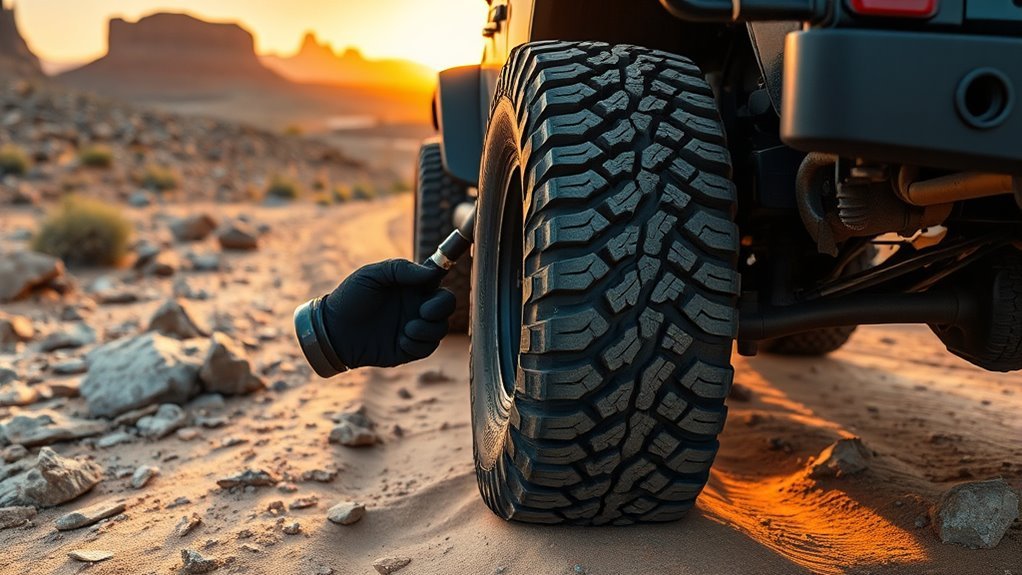
You should air down whenever soft, uneven, or sharp terrain reduces traction or makes the ride harsh—typically drop about 10–15 PSI from street pressure. Go lower for deep sand (≈15 PSI), mud (10–15 PSI), and rocks (15–25 PSI); use beadlocks for extreme crawling (6–12 PSI). Monitor handling, watch for de‑beading, and limit speed when aired down. Carry a deflator, accurate gauge, and compressor to reinflate to street PSI after the trail, and more tips follow below.
Quick Answer: How Low to Air Down Tires for Off‑Roading
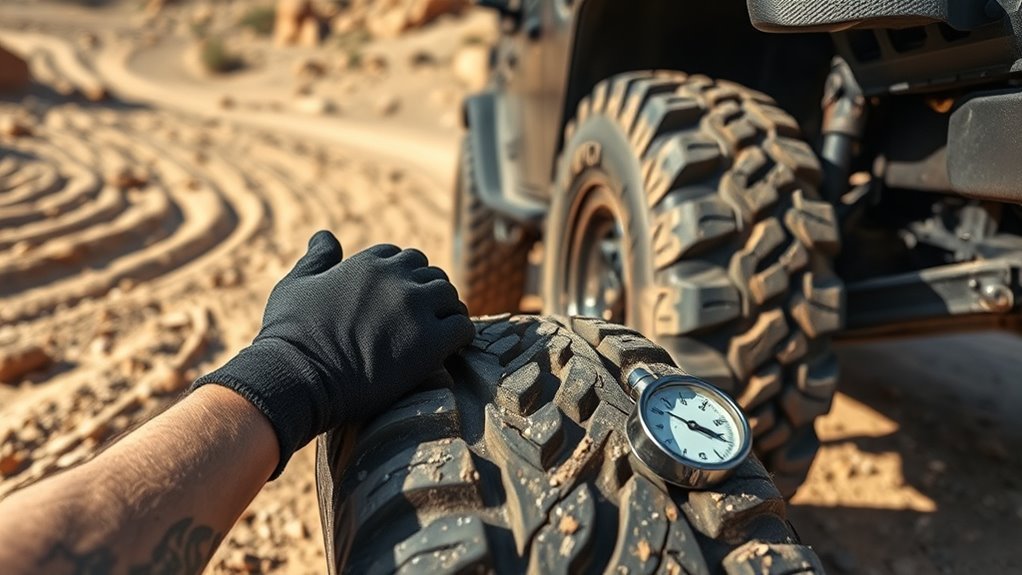
Wondering how low to air down for off‑roading? You’ll tailor tire pressure settings to terrain and payload: deep sand often calls for about 15 PSI to boost flotation and off road performance, while rocky trails suit 15–25 PSI to lower puncture risk and improve grip. For extreme rock crawling or very soft sand, you can drop to 6–12 PSI if you’ve got beadlocks and understand the risks. As a practical rule, reduce pressure roughly 10–15 PSI from the manufacturer’s street recommendation, then fine‑tune for vehicle weight and specific conditions. You’ll monitor for sidewall rub, rim spin, and handling changes as you go. Carry a reliable gauge and compressor so you can re‑inflate before pavement. This approach gives you actionable control: you’ll liberate capability without gambling safety, balancing flotation, protection, and predictable steering for confident off‑road performance.
How Tire Pressure Affects Traction, Flotation, and Ride Comfort
Now that you know rough pressures for different terrain, let’s look at why those numbers matter: lowering tire pressure increases the contact patch, which boosts traction on loose surfaces like sand, mud, and snow and lets the tire flex around obstacles for better grip and control. When you air down, traction dynamics shift—contact patch length can grow 20–80% and width about 20%, translating to measurable grip gains. Tire flexibility increases the tread’s ability to conform to ruts and rocks, so you maintain control without fighting the terrain.
On soft surfaces, dropping toward 15 PSI dramatically improves flotation, preventing you from digging in and getting stuck. Softer tires also absorb impacts, smoothing ride comfort and reducing fatigue on long runs. Use precise pressure changes: smaller adjustments fine-tune traction dynamics and ride feel. That control liberates you to push farther and explore more confidently while minimizing damage to the vehicle and environment.
How Vehicle Weight, Tire Type, and Beadlocks Change Your Target PSI
Your vehicle’s weight is a primary factor when setting target PSI—heavier rigs should be conservative and generally only air down 10–15 PSI below manufacturer specs to avoid tire stress. Tire construction matters: radials can run lower pressures than bias-ply for better traction and comfort, while bias-ply need higher pressures to protect the carcass. If you have beadlocks you can safely run much lower pressures (typically 5–12 PSI) because the bead is mechanically secured, but always adjust based on load and terrain.
Vehicle Weight Effects
Because vehicle weight directly changes the load each tire carries, you’ll need to adjust your target PSI to balance traction, sidewall stress, and bead security; heavier rigs usually call for a smaller pressure drop (about 10–15 PSI) than the typical 20–25 PSI used on lighter vehicles. Account for weight distribution front-to-rear and side-to-side—uneven loading forces you to tailor pressures per corner to avoid tire damage and uneven wear. Higher load-range tires (D, E, F) tolerate lower pressures and give better sidewall flex for grip, while beadlock wheels let you run extreme lows (5–12 PSI) without de-beading on technical terrain. Start conservative, monitor tire behavior, and adjust incrementally to maintain control, durability, and the freedom to push harder off-road.
Tire Construction Differences
Tire construction directly shapes how far you can safely lower pressure: heavier vehicles and tougher terrain demand a more conservative drop, while purpose-built off-road tires and beadlocked wheels let you air down much further. You’ll base target PSI on tire materials and internal construction: radial designs tolerate lower pressures than bias-ply, improving traction and ride comfort. Standard street tires should drop conservatively—roughly 10–15 PSI lower than highway pressure—keeping you near ~20 PSI off-road on heavier rigs. Mud-terrain and all-terrain tires with reinforced sidewalls and aggressive tread patterns handle deeper airing down, often 6–12 PSI reductions. If your setup secures the bead, you can go even lower for maximum flotation, but don’t ignore vehicle weight or risk of tire damage when selecting your target PSI.
Beadlock Versus Standard
When you’re choosing target PSI for off-road use, factor in vehicle weight, tire construction, and whether you’re running beadlocks—each directly changes how low you can safely air down. Beadlock benefits let you run 5–12 PSI confidently for maximum traction; standard limitations mean 10–15 PSI is safer to avoid de-beading. Heavier rigs need higher pressures to protect sidewalls, so up your baseline when hauling or armor-clad. Load-range D/E/F tires flex better and tolerate lower pressures than street tires. Use beadlocks for aggressive lines and technical terrain; accept higher PSI with standard wheels to maintain safety.
| Wheel Type | Typical Safe PSI | Notes |
|---|---|---|
| Beadlock | 5–12 | Extreme traction |
| Standard | 10–15 | Risk of de-bead |
| Heavy Vehicle | +2–5 | Protect sidewalls |
Target PSI by Terrain: Dirt/Trails, Rocks, Sand, Mud, Snow
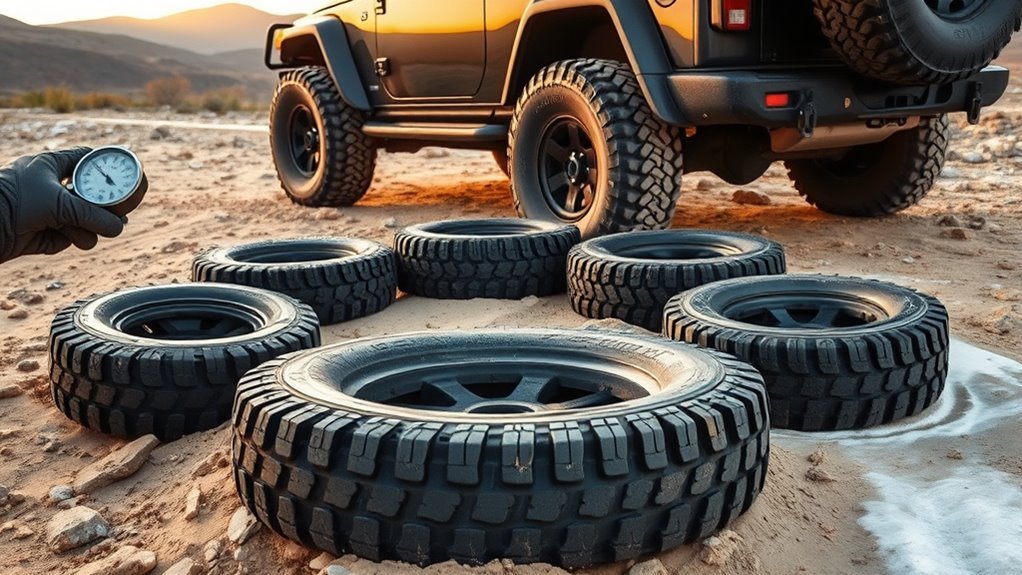
If you’re tackling varied terrain, adjust your psi to match conditions: aim for about 25 psi on dirt and trails for comfort and control, drop to 15–25 psi on rocks to let the tire conform and resist punctures, go as low as ~15 psi in deep sand for flotation, reduce to roughly 10–15 psi in mud to widen the contact patch and avoid sinkage, and use around 20 psi on snow and ice to improve grip by increasing contact area. You’ll balance traction, ride quality, and tire maintenance by matching psi to terrain challenges. On dirt you preserve sidewall life while gaining traction; on rocks you trade some steering precision for conformity that resists cuts. In sand and mud the goal is flotation and rerouting torque through a broader footprint. Snow benefits from increased contact area without excessive flex. Always monitor temps and inspect for damage after runs. Lower pressures free you from constraint, but remember to re-inflate for highway speeds and longevity.
Tools for Airing Down: Deflators, Gauges, Compressors (Rhino USA Checklist)
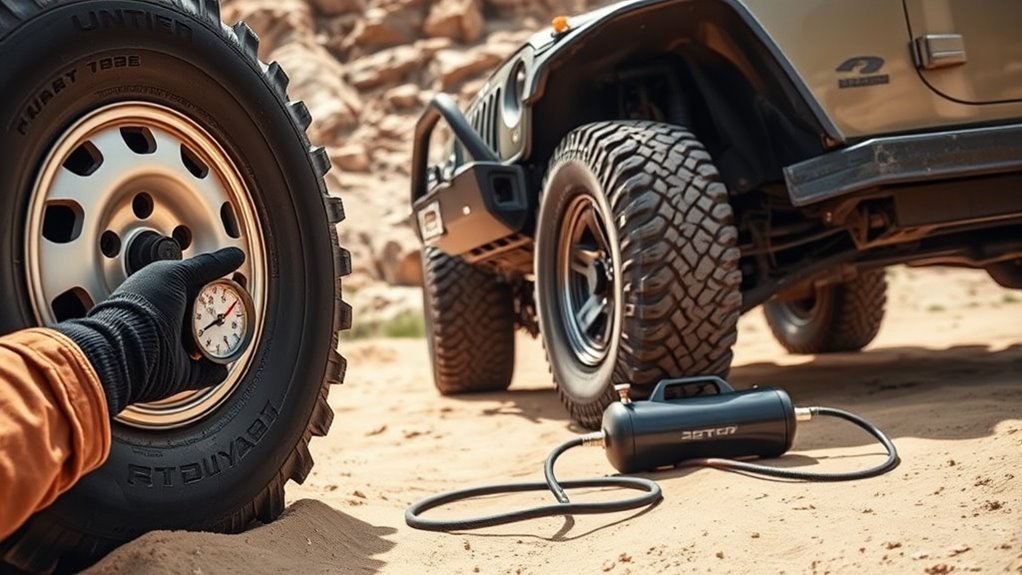
A compact toolkit makes airing down quick and reliable, and you’ll want a calibrated deflator, an accurate gauge, a capable compressor, and a few small accessories. You’ll choose a Rhino USA Pro Tire Deflator Kit or similar for controlled reductions; look for deflator features like preset stops, robust fittings, and corrosion‑resistant materials so you can trust repeatable results under harsh conditions. Prioritize gauge accuracy—digital or high‑quality dial gauges—so you can monitor pressures precisely after each adjustment and avoid overdeflation. Consider compressor types: small portable 12V units for solo trips, high‑flow models for faster recovery, or two‑hose systems like the Indeflate for simultaneous service of two tires. Always pack valve core spares and a remover tool to prevent leaks during changes. This compact, purpose‑built set keeps tire maintenance efficient, minimizes downtime, and lets you push farther knowing tire pressures are managed reliably and quickly.
Step‑by‑Step: Safely Air Down Your Tires
Start by assembling your kit—gauge, calibrated deflator, and reinflation gear—and check each tire’s current PSI, recording those baseline numbers so you can restore them later. Work one tire at a time: attach the gauge, confirm pressure, then apply the deflator to reduce PSI in controlled increments. Use calibrated deflation techniques to pull roughly 10–15 PSI below road pressure, pausing to re‑measure after each release. Repeat the cycle evenly across all four tires to preserve balance and predictable handling.
Monitor pressures frequently while on the trail; adjust as terrain changes, but avoid large, sudden drops that compromise sidewall support. Maintain a log of target and actual pressures to simplify reinflation later. When you’re done off‑road, use your compressor and the recorded baselines to restore highway pressures. This disciplined approach to tire maintenance and measured deflation techniques protects your tires, maximizes traction, and keeps your freedom to roam efficient and safe.
Safety Limits & Common Mistakes (De‑beading, Speed, Reinflation Timing)
Because lowering tire pressure changes how your tire seats and handles, you must respect clear safety limits to avoid de‑beading, loss of control, and premature tire failure. You can liberate your trail experience, but you have to manage de beading risks: without beadlock wheels don’t go below ~10 PSI. Keep speed under 35 mph when aired down to preserve handling stability and prevent abrupt loads that lift the bead.
Maintain active pressure monitoring while off‑road to catch leaks or over‑deflation. Avoid aggressive turns or maneuvers at low pressures; lateral forces are the main cause of bead separation and early tire wear. Reinflation after the trail is essential to restore tire structure and prevent rapid wear or blowouts on pavement.
- Respect minimum pressure thresholds (≈10 PSI without beadlocks)
- Limit speed to <35 mph when aired down
- Monitor pressure regularly during use
- Avoid sharp steering inputs to protect bead integrity
Reinflation and Recovery: When to Air Up, Compressor Tips, and Stuck‑Vehicle Best Practices
When you finish the trail and are back on firm surfaces, reinflate to the manufacturer’s recommended PSI (typically 30–39 PSI) before any sustained paved driving to prevent tire damage and poor handling. Choose a durable compressor—an ARB‑style unit will reliably move a tire from ~20 to 39 PSI in roughly eight minutes and is worth carrying for quick, repeatable fills. After airing up, monitor pressures and plan reinflation stops during the trip so you don’t drive long distances on softened tires.
When To Reinflate
Wondering how soon you should air up after a muddy or sandy section? You’ll reinflate as soon as terrain ends and before you hit higher-speed surfaces. Reinflation timing matters: don’t wait—air up to manufacturer PSI on the driver’s door panel to protect tires and handling. Use compressor efficiency to cut downtime; a quality unit can go 20→39 PSI in about eight minutes.
- Confirm you’re on firm ground, then start the compressor to reach recommended pressure (typically 30–35 PSI for highway).
- Monitor pressures frequently during inflation to avoid over/underfill.
- If stuck, reinflate selectively to regain traction and use recovery gear like snatch blocks safely.
- Finish by checking pressures after a short drive, adjusting to spec.
Compressor Selection Tips
If you want fast, reliable reinflation and a smoother recovery, choose a compressor that matches your vehicle use: high-quality portable units (like ARB or NAPA-rated models) give versatility for multiple rigs, while an on-board system cuts setup time for frequent off-roaders and lets you adjust pressure on the trail. Prioritize compressor brands known for durability and consistent inflation speed; a unit that moves tires from 20 to 39 PSI in ~8 minutes minimizes downtime. Consider dual-hose or Indeflate Two Hose Units to service two tires simultaneously during recovery. Match duty cycle and CFM to tire volume and ambient conditions. For liberation-minded drivers, an integrated on-board system with pressure gauges and quick-connect fittings frees you to self-recover and maintain safe highway pressures without waiting.
Frequently Asked Questions
Is 40 PSI Too High for 4WD?
Yes, 40 PSI’s generally too high for 4WD off-roading; you’ll reduce tire performance and compromise off road safety. You should drop to about 20–25 PSI (or lower with beadlocks) for better traction and control.
Conclusion
You’ll air down for traction but you’ll air up for safety — lower PSI gives float and grip on sand and mud while higher PSI protects beads and steering on pavement. Balance tire pressure with vehicle weight, tire construction, and terrain: soft for sand, firmer for rocks. Use accurate gauges, keep compressors ready, and reinflate as soon as you hit hard surface. Smart airing is the difference between confident recovery and avoidable damage.
Related Articles
Valve Stem Length Guide: Choose the Right Size
I need to explain how to choose and extend valve stems for deep-section rims—discover which lengths, types, and tricks prevent leaks and broken cores.
Read More
Trailer Tire Pressure Guide: Load-Based PSI Recommendations
Guide your trailer’s tire inflation by matching load-per-tire to manufacturer charts—discover the step-by-step math, charts, and troubleshooting ahead.
Read More
Tire Pressure for Sand Driving: PSI Tips for Beach & Dunes
Discover how to safely lower tire pressure for sand driving—12–18 PSI guidance, tools, and step-by-step tips await to keep you rolling.
Read More