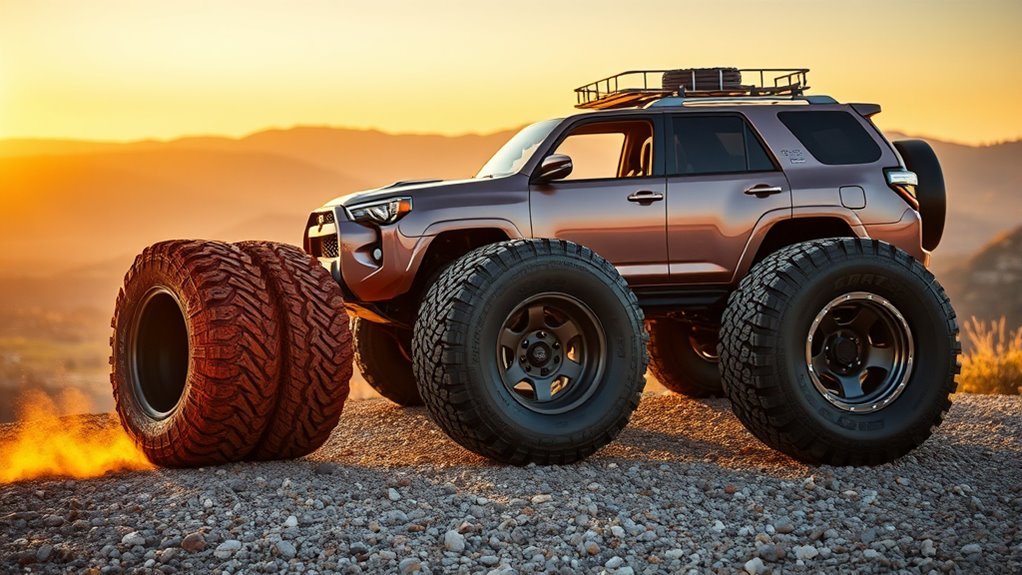
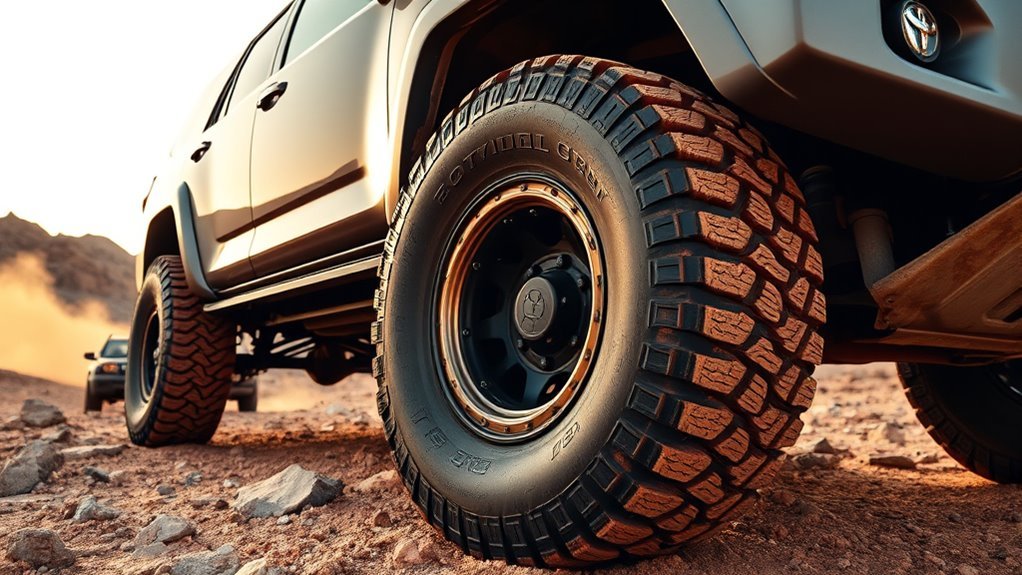
Choosing the right tires for your Toyota 4Runner involves more than selecting the largest size that fits under the fenders. Tire diameter, wheel width, offset, load rating, tread design, suspension geometry, and actual tire construction all affect clearance, steering, braking, comfort, and drivetrain performance. This guide primarily covers 2010–2024 fifth-generation 4Runners using 17-inch wheels.
Quick Answer
For most fifth-generation 4Runners, 265/70R17 is the easiest factory-size choice, 275/70R17 is a mild upgrade, and 285/70R17 requires careful clearance testing rather than a guaranteed lift height. Larger 33- to 35-inch tires usually need progressively more trimming, alignment work, wheel-fitment planning, and possible gearing changes.
Key Takeaways
- Confirm your generation first: the all-new 2025+ sixth-generation 4Runner uses different factory wheel packages and clearances.
- A suspension lift does not guarantee tire clearance: wheel offset, caster, tire width, mud flaps, fender liners, and body-mount clearance also matter.
- Load range is not a universal capacity: verify the tire’s exact load index and manufacturer load-and-inflation data.
- Expect calibration changes: larger tires can affect indicated speed, odometer readings, acceleration, braking, transmission behavior, and fuel use.
- Test the complete setup: check steering lock, reverse, suspension compression, spare-tire storage, wheel torque, alignment, and TPMS operation.
Note: Toyota identifies 2010–2024 as the fifth 4Runner generation and 2025 as the start of the sixth generation. Owners of 2025 and newer models should use generation-specific fitment information and the exact tire specifications in their model-year owner’s manual.
Which Tire Size Fits Your 4Runner Build?
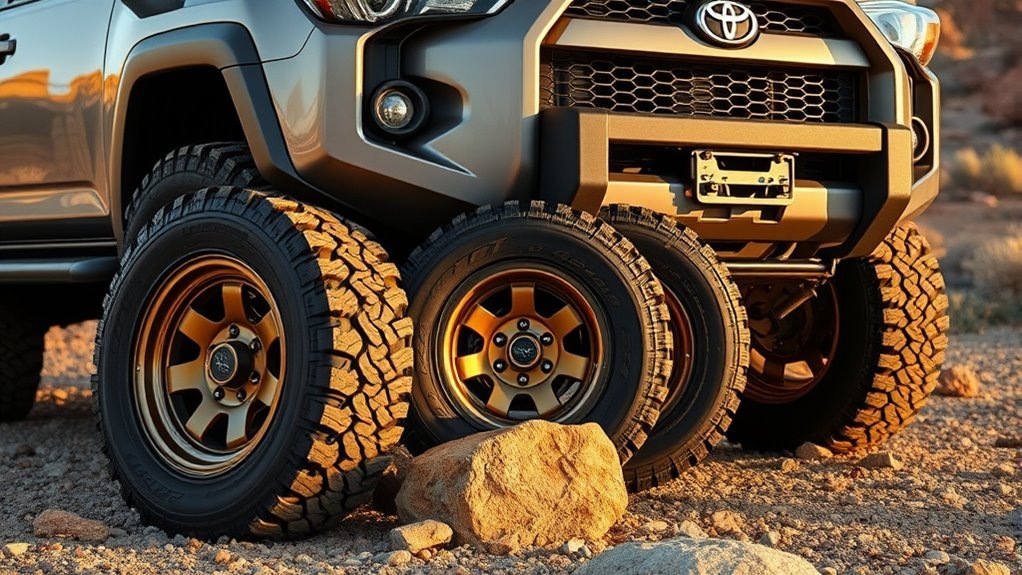
Your tire size changes ground clearance, sidewall height, effective gearing, speedometer accuracy, rotating weight, and available space around the suspension and body. However, the size printed on the sidewall is only a nominal measurement. Two tires carrying the same size may have different measured diameters and section widths.
The following table compares common fifth-generation 4Runner sizes against a 265/70R17 baseline. Calculations use the size-label formula, so you should confirm the manufacturer’s published dimensions before buying.
| Tire Size | Nominal Diameter | Change vs. 265 | Typical Fitment Expectation |
|---|---|---|---|
| 265/70R17 | About 31.6 inches | Baseline | Generally the easiest fit on fifth-generation models originally equipped with this size and compatible wheels. |
| 275/70R17 | About 32.2 inches | About 1.8% taller | A mild upgrade that may fit without a lift, but wheel specifications and liner clearance still require checking. |
| 285/70R17 | About 32.7 inches | About 3.5% taller | A common upgrade. Clearance depends heavily on wheel offset, caster, tire model, mud flaps, liners, and body-mount position. |
| 295/70R17 | About 33.3 inches | About 5.2% taller | Usually requires targeted clearance work, careful wheel selection, and a suspension and alignment setup built around the tire. |
| 285/75R17 | About 33.8 inches | About 7.0% taller | A substantial fitment project that commonly needs trimming, alignment changes, and drivetrain evaluation. |
| 315/70R17 | About 34.4 inches | About 8.7% taller | A nominal 35-inch-class setup requiring extensive planning and usually major clearance modifications. |
A 265/70R17 remains the practical choice for a daily-driven 4Runner because it preserves factory-like clearance, gearing, spare-tire compatibility, and road manners. A 275/70R17 adds a small amount of height and sidewall without creating the same fitment challenge as a wider 285.
A 285/70R17 can provide a useful balance of ground clearance and trail performance, but it is not a guaranteed bolt-on size. Some configurations clear with minor adjustments, while others contact the fender liner, mud flap, pinch seam, upper control arm, or body mount.
Pro Tip: Check the tire manufacturer’s measured diameter, section width, approved wheel-width range, and tire weight. These specifications are more useful than relying only on the size printed on the sidewall.
[Products Worth Considering]

Secure a full-size spare on your trailer with this powder-coated steel spare tire mount bracket. It fits most 4-, 5-, and 6-lug wheel bolt patterns and mounts to trailer tongues up to 4 in wide and 5 in tall. Built for reliable carry with a max 150 lb load rating and includes zinc-plated hardware for straightforward installation.

This universal wheel alignment tool helps you accurately restore tire tilt angles after tire or suspension repairs using an adjustable camber gauge. It features a powerful magnetic base that firmly attaches to brake rotors for stationary, slip-free readings, improving consistency during measurement. Built from durable PC plastic, it resists wear and corrosion and is compact enough for car, truck, RV, and motorcycle alignment tasks.

Upgrade your 2024-2026 Tesla Model 3 Highland with REEVAA all-weather mud flaps designed for seamless fit along the original body lines. The set of four delivers strong splash protection against mud, gravel, and road debris while using OEM-grade durable materials. Installation is non-destructive with original hole positions and snap-in clips, and the aerodynamic design helps minimize impact on efficiency.
Tire Load Range C vs. E: What Changes Your Daily Drive?
Load Range C and Load Range E describe pressure and load-capability classes for LT tires, but the letter alone does not tell you the tire’s exact capacity. You must also check the complete service description, including the load index, and consult the tire manufacturer’s load-and-inflation table.
A C-range tire is often lighter and more compliant than an E-range version of the same model and size. That can improve steering response, acceleration, and ride comfort on an unloaded daily driver. However, construction varies between brands, and not every C-range tire feels soft.
An E-range tire commonly has a stronger, heavier construction and a higher maximum pressure capability. It may be useful for a heavily loaded overland build, frequent towing, sharp rock, or demanding commercial use. The trade-offs can include added rotating mass, firmer impacts, and slower acceleration.
Do not inflate an E-range tire to the maximum pressure printed on its sidewall simply because it can accept that pressure. For an original tire size, begin with the vehicle manufacturer’s cold-pressure information. When changing tire type, size, or load class, use the replacement tire’s load table and obtain guidance from the tire manufacturer or a qualified tire professional. The selected pressure must support the actual axle load without exceeding the tire or wheel limits.
Warning: An incorrect tire size, load index, wheel rating, or inflation pressure can reduce load capacity and affect steering, braking, heat buildup, and tire durability. Never use the sidewall maximum pressure as a universal daily-driving recommendation.
All-Terrain, Mud-Terrain, or Hybrid: Which Tread Fits Your 4Runner?
Your regular driving conditions should determine the tread type. Aggressive tread can look capable while adding noise, weight, vibration, and wet-road compromises that you may experience every day.
[Products Worth Considering]

The Ziopetru adjustable magnetic wheel alignment tool helps you check and restore camber and caster positioning after removing and reinstalling undercarriage components. With a clear leveling/bubble measurement system and an easy zeroing adjustment knob, it supports precise horizontal angle checking. The strong magnetic base mounts to metal surfaces for convenient use at home on cars, motorcycles, trucks, vans, and SUVs.
This flat-free TICONN wheelbarrow tire features durable polyurethane foam construction that never needs inflation, helping prevent punctures and reducing maintenance on rough outdoor terrain. With a 300 lb max load capacity and stable steel rim design, it supports safer transport for yard work and hauling tasks. An adapter kit with ball bearings and nylon spacers is included for easier fit and customization across common wheelbarrow and cart axle setups.

These pre-assembled 15x6.00-6 front tire and wheel assemblies are designed for quick replacement on riding lawn mowers and lawn tractors. Built with natural rubber pneumatic tires and turf-friendly tread for solid traction and improved shock absorption. A thickened welded rim and 3/4" sintered iron bushing help provide stable, heavy-duty support for everyday mowing use.
All-Terrain Tires
All-terrain tires provide the most balanced option for mixed highway, gravel, forest-road, snow, and moderate trail use. Current examples include the BFGoodrich All-Terrain T/A KO3, Falken Wildpeak A/T4W, and Yokohama Geolandar A/T G015.
Look beyond tread appearance. Compare wet braking, severe-snow certification, tire weight, sidewall construction, approved wheel widths, measured dimensions, warranty terms, and availability in your preferred load range.
Hybrid-Terrain Tires
A hybrid-terrain tire uses a more open and aggressive pattern than a conventional all-terrain tire while attempting to retain reasonable highway behavior. The Nitto Ridge Grappler is one current example.
This category can suit a 4Runner that spends most of its time on pavement but regularly encounters loose rock, dirt, and muddy trail sections. Expect more tread noise and weight than you would normally get from a highway-focused all-terrain tire.
Mud-Terrain Tires
Mud-terrain tires use larger tread voids and aggressive shoulder blocks to clear soft soil and mud. They can provide strong traction in the terrain they are designed for, but usually create more road noise, vibration, rolling resistance, and wet-pavement trade-offs.
Choose a mud-terrain tire when the terrain genuinely requires it, not solely for appearance. A daily-driven 4Runner that sees occasional maintained trails will usually be easier to live with on an all-terrain or hybrid-terrain tire.
How to Choose Offset and Backspacing That Won’t Rub
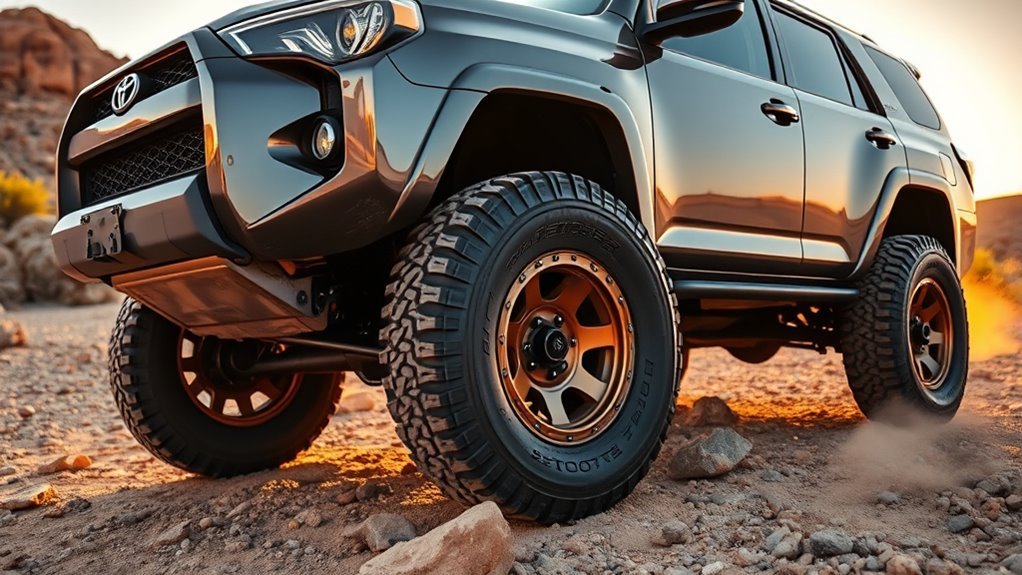
Wheel offset is the distance between the wheel’s mounting surface and its centerline. A lower or more negative offset moves the tire outward. A higher positive offset keeps it farther inward.
Backspacing measures from the wheel mounting surface to the rear wheel edge. You cannot judge backspacing by itself because the same backspacing on two different wheel widths does not place the tire in the same position.
Moving the wheel outward may improve clearance near the upper control arm, but it can increase contact at the fender liner, body mount, mud flap, and outer fender. It also increases leverage on wheel bearings and suspension components. Moving the tire too far inward can create contact with the upper control arm or inner suspension components.
Instead of selecting a universal offset range, compare the proposed wheel against your current wheel:
- Confirm the wheel diameter and width are approved for the tire.
- Calculate how far the inner and outer wheel edges will move.
- Check brake-caliper and upper-control-arm clearance.
- Measure the space at the front and rear of the wheel opening.
- Include the effect of spacers, if installed.
- Verify the wheel’s load rating and correct lug-seat design.
After installation, turn the steering from lock to lock while moving forward and in reverse. Repeat the inspection with the suspension loaded and articulated because a tire that clears on level pavement may rub during braking, compression, or off-road travel.
Will You Need a Lift? Clearance for 265s, 285s, and 35s
A suspension lift can increase ride height and change available vertical travel, but it does not automatically move every point that causes tire rubbing. The rear of the front wheel opening, body mount, pinch seam, mud flap, caster position, and wheel offset remain critical.
- 265/70R17: Normally the simplest choice on a compatible fifth-generation factory setup. A lift is not generally required.
- 275/70R17: Often manageable without a lift, although the exact tire and wheel combination still requires testing.
- 285/70R17: May need liner reshaping, mud-flap removal or modification, additional positive caster, careful wheel positioning, or body-mount clearance work. A lift may help the overall setup but does not guarantee rub-free fitment.
- 295/70R17 or 285/75R17: Usually requires a more deliberate suspension, alignment, trimming, and wheel-fitment plan.
- 315/70R17 or similar 35-inch-class sizes: Commonly requires extensive clearance modifications, suspension planning, drivetrain evaluation, spare-tire planning, and close attention to braking and steering performance.
Do not size the lift only by tire diameter. Excessive lift can raise the center of gravity, reduce available down travel, alter alignment geometry, and place CV joints or other components at more severe operating angles.
How to Test Tire Clearance Before Regular Driving
Complete a controlled inspection before highway driving or trail use:
- Verify the installed size: Check all four tires, wheel specifications, load index, direction markings, and lug-seat compatibility.
- Inspect static clearance: Check the upper control arm, brake hoses, sway bar, fender liners, mud flaps, body mount, and pinch seams.
- Test full steering lock: Turn fully left and right while moving slowly forward and backward.
- Load the suspension: Repeat the inspection with passengers or cargo and during controlled suspension compression.
- Listen and inspect: Look for polished plastic, cut rubber, scuffing, loose liners, or contact marks.
- Align the vehicle: Obtain an alignment after changing suspension height or any component that affects caster, camber, or toe.
- Recheck wheel torque: Follow the correct wheel manufacturer or Toyota torque procedure after the initial installation interval.
- Confirm TPMS operation: Transfer, replace, or register sensors as required for your model year.
If the tire contacts a brake hose, steering component, suspension part, or structural body area, stop using the setup until the interference is corrected.
Best 4Runner Tire Strategy by Build Type
[Products Worth Considering]

Replace or upgrade your zero-turn lawn mower tires with a universal fit flat-free tire and wheel assembly in a convenient 2-pack. Smooth tread front-caster style helps turning with reduced turf damage, while flat-free design eliminates the maintenance and downtime of air-filled flats. The included adapter kit supports 5/8-inch axles and hub lengths from 3.4 to 5 inches for compatibility across most ZTR mowers.

The Kurgo Seasonal Tire Tote helps protect your car interior, clothes, and garage from tire grime, brake dust, and residue during seasonal tire changes. Its universal design fits most passenger tires between 22" and 31" in diameter, making storage and transport simpler with less mess. Built for rugged, repeated use, it’s machine washable for easy care and comes with a lifetime warranty.

This metal-free wheel and tire cleaning brush uses dense, fluffy synthetic wool to safely clean rims, spokes, fenders, and engine areas without worrying about damaging surfaces. Its flexible, comfortable design helps you reach detailed areas while maintaining durability, and the extra absorbent fibers work well with wheel spray cleaners for faster cleanup. Reusable and washable performance helps prevent grime and build-up for cleaner vehicles and easier maintenance at home.
Daily Driving
A 265/70R17 or 275/70R17 all-terrain tire usually provides the easiest balance of road comfort, steering response, winter availability, replacement cost, and light-trail capability. Tire weight and wet-road performance often matter more than the most aggressive tread design.
Overland and Loaded Travel
A 275/70R17 or carefully planned 285/70R17 can provide additional sidewall and clearance. Account for the combined weight of armor, drawers, passengers, water, recovery equipment, roof loads, and trailers. Select the tire by its exact load index and use an appropriate pressure based on the load table and actual axle weights.
Also confirm that the spare tire matches the installed diameter closely enough for the drivetrain and fits its storage location. A heavily worn spare or a smaller factory spare can create an unacceptable circumference difference during extended four-wheel-drive use.
Hardcore Off-Road Build
A 33.8- to 35-inch-class setup can improve obstacle clearance and increase the available tire footprint when aired down correctly for off-road use. It also adds rotating weight and usually increases modification requirements.
Plan the tires as one part of a complete system that includes suspension geometry, wheel fitment, body clearance, steering, brakes, axle gearing, recovery equipment, spare-tire mounting, and legal requirements in your area.
How Bigger Tires Affect Your Speedometer, Gearing, and MPG
A larger tire covers more distance with each revolution. If the vehicle remains calibrated for the original tire diameter, the speedometer and odometer will normally read lower than the vehicle’s actual speed and distance.
A nominal 285/70R17 is approximately 3.5% taller than a 265/70R17. When the speedometer shows 60 mph, the calculated actual speed is about 62.1 mph before accounting for real measured tire dimensions.
| Tire Size | Calculated Diameter Change | Approximate Actual Speed at Indicated 60 mph |
|---|---|---|
| 275/70R17 | +1.8% | About 61.1 mph |
| 285/70R17 | +3.5% | About 62.1 mph |
| 295/70R17 | +5.2% | About 63.1 mph |
| 285/75R17 | +7.0% | About 64.2 mph |
| 315/70R17 | +8.7% | About 65.2 mph |
Use the tire manufacturer’s measured revolutions per mile or loaded radius when available. Tread wear, pressure, wheel width, vehicle load, and tire construction can make the real difference slightly smaller or larger than the size-label calculation.
Gearing and Acceleration
Larger tires create a taller effective final-drive ratio. The engine must produce more torque at the axle to achieve the same acceleration, especially when the replacement tire is also much heavier.
A 285/70R17 does not automatically require differential re-gearing. Many drivers accept the change for normal use. Re-gearing becomes more valuable when the vehicle also carries heavy armor, operates at elevation, tows regularly, uses much heavier tires, struggles to hold transmission gears, or moves to a substantially larger 33.8- or 35-inch-class setup.
Fuel Use and Braking
Fuel use may increase because of added tire weight, greater aerodynamic exposure, tread design, rolling resistance, altered gearing, and changes in driving style. The result cannot be predicted accurately with one universal MPG figure.
Heavier and larger-diameter tires also require more energy to accelerate and decelerate. Keep the braking system in good condition and leave additional stopping distance until you understand how the modified vehicle responds.
Electronic Systems and Calibration
An incorrect tire calibration can affect speed display, odometer accumulation, maintenance-distance tracking, and transmission behavior. Significant diameter changes may also influence how wheel-speed-dependent systems interpret vehicle movement.
Use a compatible calibration device or qualified service provider when correction is available for your model. Confirm the result with a reliable GPS speed reading under safe conditions.
4Runner Tire and Wheel Pre-Purchase Checklist
- Confirm the vehicle generation, model year, trim, drivetrain, and current factory tire specification.
- Record the current wheel diameter, width, offset, backspacing, and load rating.
- Check the replacement tire’s measured diameter, section width, weight, load index, speed rating, and approved wheel-width range.
- Compare inner clearance near the upper control arm and outer clearance near the liner, body mount, and fender.
- Determine whether the full-size spare will fit and whether it closely matches the installed tire circumference.
- Calculate the expected speedometer difference.
- Plan for alignment, TPMS service, balancing, and possible calibration.
- Consider braking, acceleration, towing, fuel use, and transmission behavior.
- Verify local inspection, tire-coverage, bumper-height, and modification rules.
- Use a qualified installer who will perform a complete clearance test rather than checking only the parked vehicle.
Frequently Asked Questions
Is 265 or 275 better for a 4Runner?
Choose 265/70R17 when you want factory-like clearance, predictable handling, and easy spare compatibility. Choose 275/70R17 when you want a modest increase in diameter and sidewall without taking on the wider fitment challenge of a 285. Verify the exact tire and wheel combination before installation.
Can 285/70R17 tires fit a stock fifth-generation 4Runner?
Some carefully selected 285/70R17 combinations can fit with limited changes, while others rub. The result depends on the tire’s measured dimensions, wheel width and offset, caster, mud flaps, fender liners, body-mount clearance, vehicle load, and suspension condition. A lift alone does not guarantee clearance.
Do 285 tires require differential re-gearing?
Not always. A nominal 285/70R17 changes effective gearing by about 3.5% compared with 265/70R17. Re-gearing may become worthwhile when the tires are heavy, the vehicle carries armor or cargo, towing is frequent, elevation is high, or transmission behavior becomes unacceptable.
Should a daily-driven 4Runner use Load Range C or E tires?
A lighter C-range option often suits an unloaded daily driver, while an E-range tire may suit heavy loads, towing, or severe terrain. The correct choice depends on the exact tire’s load index, construction, pressure requirements, vehicle axle loads, and intended use. Load range alone is not enough.
Can I keep the factory spare after installing larger tires?
A smaller spare may be acceptable only for limited emergency use under the vehicle manufacturer’s restrictions. For regular off-road or four-wheel-drive use, carry a spare that closely matches the installed tires in diameter and wear. Also verify that it fits the factory storage location or plan an alternative carrier.
How much will 285/70R17 tires affect the speedometer?
The nominal diameter is approximately 3.5% larger than 265/70R17. An indicated 60 mph would therefore equal about 62.1 mph by calculation. Use the tire’s measured revolutions per mile and verify the final result because actual dimensions vary.
Conclusion
The best 4Runner tire size is the one that supports your real driving needs without creating unresolved clearance, load, braking, or drivetrain problems. A 265 or 275 offers the simplest daily-driving setup, while a 285 can work well when the wheel, alignment, and body clearances are planned together. Larger 33.8- to 35-inch-class tires should be treated as complete vehicle modifications rather than simple tire swaps.
Before buying, confirm your model year, measure the proposed wheel position, review the tire’s actual dimensions and load data, plan the spare, and test the vehicle through full steering and suspension travel. Careful fitment saves more money than correcting a poorly matched setup later.
Sources
- Toyota 4Runner Fifth- and Sixth-Generation History — confirms the 2010–2024 fifth generation and 2025 sixth generation.
- Toyota 2026 4Runner Owner’s Manual: Tires and Wheels — provides current sixth-generation factory tire, wheel, pressure, and torque information.
- NHTSA TireWise — supports tire-pressure, load, maintenance, and replacement-tire safety guidance.
- BFGoodrich All-Terrain T/A KO3 — current manufacturer information for the KO3 all-terrain tire.
- Falken Wildpeak A/T4W — current manufacturer information for Falken’s A/T4W all-terrain tire.
- Yokohama Geolandar A/T G015 — manufacturer information for an all-terrain tire with severe-snow-rated options.