
Full Size Spare vs Donut Spare on a Toyota Tacoma
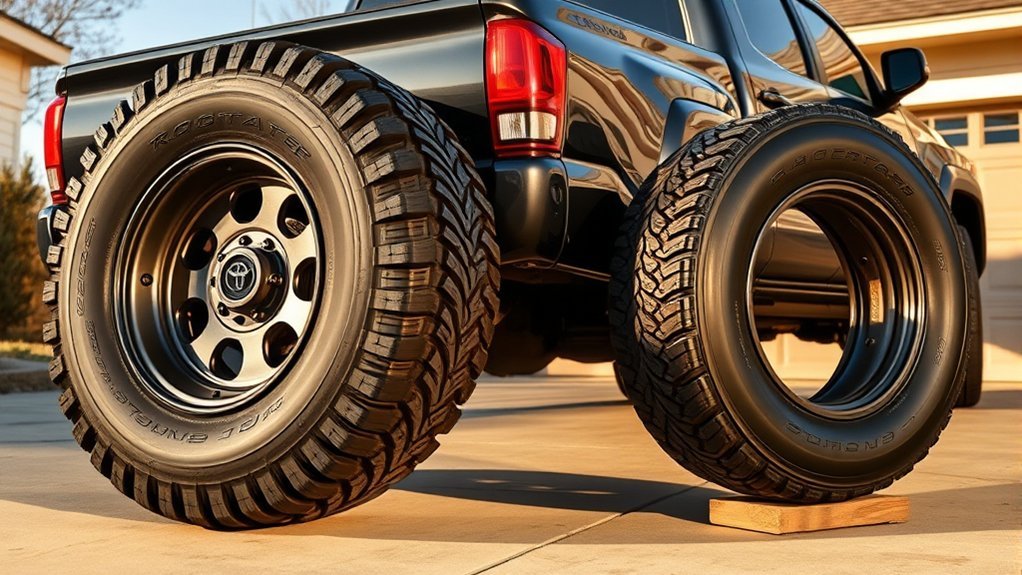
For a 2024 Toyota Tacoma, the spare-tire choice is more complicated than simply “full-size versus donut.” Toyota lists compact temporary spares on some configurations, narrower full-diameter spares on others, and matching full-size spares on certain trucks. Before buying or using a replacement, identify your truck’s exact setup from its tire placard, spare-tire sidewall, owner’s manual, and VIN.
Quick Answer
A matching full-size spare provides the most normal handling and flexibility, but only when its tire and wheel truly match the Tacoma’s road setup. A compact or nonmatching temporary spare is lighter and easier to store but must be used only for emergencies, kept at its specified pressure, and driven no faster than 50 mph.
Key Takeaways
- The 2024 Tacoma can have a compact temporary spare, a full-diameter but nonmatching spare, or a matching full-size spare.
- A 245/75R17 spare is not automatically a compact donut or a permanent road-tire replacement.
- Toyota limits temporary-spare speed to 50 mph and directs owners to replace it with a standard tire as soon as possible.
- Tire diameter alone does not prove compatibility; the wheel, load rating, brake clearance, pressure, and storage fit must also be correct.
- Verify every purchase with the Tacoma’s VIN, driver-door tire placard, owner’s manual, and the markings on the existing spare.
At a Glance
| Time Required | About 10–20 minutes to identify and inspect the current spare; installation time depends on the tire shop and whether a wheel, tire, sensor, or balancing service is needed. |
| Difficulty | Easy to identify; moderate to select and install correctly. |
| Tools Needed | Owner’s manual, tire-pressure gauge, flashlight, tape measure, and a correctly rated torque wrench if you are performing the installation. |
| Cost | Varies by tire, wheel, TPMS equipment, mounting, balancing, and whether OEM or compatible aftermarket parts are used. Obtain a VIN-matched quote before ordering. |
Know Which Spare Your 2024 Tacoma Has
Toyota’s 2024 Tacoma maintenance data lists several tire-and-spare combinations. Toyota labels these as tire “types” in the manual rather than assigning one spare configuration to every truck with the same trim name. Equipment can vary, so confirm your own Tacoma before relying on the table.
| 2024 manual configuration | Road tire | Spare tire | Cold pressure | Practical meaning |
|---|---|---|---|---|
| 17-inch Type A | 245/70R17 110T | T175/90D18 111M | 35 psi road tires; 60 psi spare | Compact temporary spare—the closest configuration to what drivers commonly call a donut. |
| 17-inch Type B | 245/70R17 110T | 245/70R17 110T | 35 psi | Matching tire size and service description; verify wheel type and all sidewall markings before treating it as interchangeable. |
| 17-inch Type C | 265/70R17 115T | 245/75R17 112S | 30 psi road tires; 32 psi spare | Full-diameter but narrower and lower-rated spare; it is not a matching road tire. |
| 17-inch Type D | 265/70R17 115T | 265/70R17 115T | 30 psi | Matching tire size and service description; confirm the wheel and tire are road-ready. |
| 18-inch Type A/B | 265/65R18 114T | 245/75R17 112S | 32 psi | Full-diameter nonmatching spare on a smaller-diameter wheel; use according to Toyota’s restrictions. |
Note: The letter T at the start of T175/90D18 identifies a temporary spare. A conventional-looking size such as 245/75R17 can still be a nonmatching emergency spare. Read every sidewall marking, including any “Temporary Use Only” wording.
If your truck is a different model year, use Toyota’s current Tacoma manual lookup. Do not assume that 2024 specifications apply to a 2025 or 2026 Tacoma.
[Products Worth Considering]

Universal magnetic jack pad with aluminum grooved design to protect vehicle pinch welds during lifting. Durable nylon pad inserts are upgraded and secured with screws to resist damage and keep in place. Designed to fit most single vehicle pinpoint welds for safer, stable jacking when changing tires, repairs, or performing oil changes.

This spare tire tool kit is designed for the 2004 to 2018 Ford F-150 to help you loosen and tighten wheel lug nuts and manage the spare tire and provided jack functions from underneath the vehicle. It includes the lug nut wrench and extension pieces plus a convenient storage carrying case for organized transport. The jack itself is not included.

This roadside assistance kit helps drivers and passengers in urgent situations after an accident or breakdown, providing practical support while waiting for help. It includes a lightweight, compact tire inflator for fast inflation of standard vehicle tires, plus reinforced jumper cable protection for safer handling. Ideal for winter weather, road trips, camping, and travel, with everything stowed neatly in a trunk bag.
Advantages of a Matching Full-Size Spare
A true matching full-size spare uses the same approved tire size, load index, speed rating, construction, and compatible wheel as the Tacoma’s road tires. When it is properly inflated, undamaged, and not marked for temporary use, it provides several practical advantages:
- More consistent handling: The tire’s dimensions and capability are closer to the other three tires.
- Fewer emergency-use restrictions: A road-rated matching tire is not automatically subject to compact-spare limits.
- Better trip resilience: You can reach a distant repair facility without depending on a narrow emergency tire.
- Greater usefulness off pavement: A matching spare is better suited to trail preparation than a restricted temporary tire, provided the replacement itself is approved for the truck.
- Possible five-tire rotation: This may help spread wear when all five tires and wheels match and the rotation method is approved for the vehicle and tire type.
A tire that is merely close in overall diameter is not necessarily a matching full-size spare. Different load ratings, widths, speed ratings, tread depths, wheel offsets, or temporary-use markings can still make it unsuitable for unrestricted driving.
Pro Tip: Photograph the driver-door tire placard, the current road-tire sidewall, the spare sidewall, and the VIN before contacting a dealer or tire shop. Those four images prevent most size and configuration misunderstandings.
Pros and Cons of a Compact or Nonmatching Temporary Spare
A temporary spare is designed to restore mobility after a flat—not to replace a road tire for everyday use. Tacoma temporary spares can be either compact or close to the road tires’ overall diameter while remaining narrower or lower-rated.
| Advantages | Disadvantages |
|---|---|
| Usually lighter to lower and install | Restricted to emergency use |
| Uses less storage space than some matching assemblies | Maximum temporary-spare speed of 50 mph |
| Can cost less than a matching alloy wheel and road tire | Reduced grip, braking capability, and handling reserve |
| Provides a way to leave the roadside after many ordinary punctures | May affect ABS, stability control, traction control, four-wheel-drive operation, or driver-assistance features |
| Factory configuration is already designed for the truck’s storage system | May lack a tire-pressure warning sensor and may leave the TPMS warning illuminated |
| No need to carry a large loose wheel inside the cab or bed | Unsuitable for routine towing, high-speed travel, aggressive maneuvering, or trail driving |
How Fast and How Far Can You Drive on a Temporary Spare?
When Toyota identifies the installed spare as temporary, keep the Tacoma at or below 50 mph. Accelerate gently, leave more braking distance, avoid abrupt steering, and replace the temporary spare with an approved road tire as soon as possible.
Do not rely on a universal “50-mile rule.” The safe distance depends on the tire’s condition, pressure, load, road, weather, and sidewall instructions. Toyota’s guidance treats the spare as a short-term emergency measure rather than promising a fixed number of miles.
Warning: Do not exceed 50 mph on a Toyota-designated temporary spare. Avoid towing, off-road driving, tire chains, sudden braking, sharp steering, and heavy loads unless your Tacoma owner’s manual expressly allows the activity for your exact configuration. Stop immediately if the tire vibrates, loses pressure, rubs, or causes unstable handling.
Before moving the truck, check the spare’s cold pressure. The compact T175/90D18 spare listed for one 2024 Tacoma configuration requires 60 psi, but other factory spare configurations use different pressures. Follow the number shown on the tire-information placard, spare sidewall, and model-specific manual.
How a Temporary Spare Can Affect Tacoma Systems
A nonmatching spare rotates at a different rate or responds differently under braking and cornering. The Tacoma may interpret those differences as wheel slip or a sensor problem. Depending on the truck’s equipment and where the spare is installed, Toyota warns that some systems may not work normally.
Potentially affected functions can include:
- Anti-lock braking
- Vehicle stability control
- Traction control
- Four-wheel-drive control logic
- Tire-pressure monitoring
- Pre-collision and other driver-assistance features that use wheel-speed information
- Parking or proximity assistance on equipped trucks
A warning light does not automatically mean the spare was installed incorrectly, but it should not be ignored. Drive conservatively and restore the approved road-tire setup promptly. Follow the flat-tire procedures in Toyota’s 2024 Tacoma emergency guidance.
How to Upgrade From a Temporary Spare to a Matching Full-Size Spare
A safe upgrade requires more than ordering a tire with a similar diameter. The wheel must attach correctly, clear the brakes, support the truck’s load, fit the spare hoist, and work with the tire and lug nuts.
[Products Worth Considering]

EVOULTES heavy duty tire inflator with an integrated gauge delivers accurate pressure readings from 10–120 PSI, helping you inflate, deflate, and check tires in one tool. The 16.5-inch extended dual-head air chuck with swivel base reaches hard-to-access dual wheel valves on trucks and RVs. A brass trigger core and side-mounted air release valve make operation smooth, with standard 1/4" NPT threading and quick-connect compatibility for easy setup.

This portable cordless tire inflator delivers up to 160 PSI with fast 17 L/min airflow to help you quickly top up tires and get back on the road. It features dual power mode, running on a 21V rechargeable battery or a 12V DC adapter for convenient roadside use. An automatic shut-off with digital pressure gauge helps prevent overinflation, and a built-in LED light improves visibility in low-light conditions.
1. Identify the Factory Configuration
Record the VIN and compare the following information:
- Driver-door tire-information placard
- Road-tire size, load index, speed rating, and construction
- Existing spare size and temporary-use markings
- Wheel material and dimensions
- Toyota owner’s manual tire-type table
Do not infer the spare from “SR,” “SR5,” “TRD,” or another trim badge alone. Optional wheels, packages, production changes, and previous-owner modifications can change what is installed.
2. Match the Tire Specifications
For normal road-tire capability, match the Toyota-approved:
- Tire size
- Load index and load capacity
- Speed rating
- Radial construction
- Overall diameter and rolling circumference
- Required cold inflation pressure
- Seasonal and terrain capability
If the four road tires are heavily worn, a new spare can have a meaningfully different circumference even when the sidewall size matches. This matters most on four-wheel-drive systems. Ask Toyota or a qualified tire professional whether the tread-depth difference is acceptable before extended use.
3. Verify the Wheel
A compatible wheel must have the correct:
- Bolt pattern
- Center-bore diameter
- Wheel diameter and width
- Offset and backspacing
- Lug-nut seat design
- Brake-caliper clearance
- Wheel load rating
- Hub and mounting-surface fit
Do not rely on an online listing that says only “fits Tacoma.” Ask the seller to confirm the exact model year, drivetrain, brake package, wheel specifications, and VIN.
4. Confirm Under-Bed Storage Fit
Measure the inflated assembly, not an unmounted tire. Check:
- Diameter and section width
- Clearance around the exhaust, hitch, suspension, differential, and body
- Whether the hoist cable and retainer seat correctly
- Whether the tire rests securely without contacting sharp or hot parts
- Whether aftermarket hitches, exhaust systems, skid plates, or bed equipment reduce clearance
Raise the assembly fully, then inspect it from several angles. After a short drive, recheck that it remains secure.
5. Decide How to Handle TPMS
A factory temporary spare may not have a tire-pressure warning valve and transmitter. A matching spare can be fitted with a compatible sensor when appropriate, but sensor capacity and registration procedures vary. Ask Toyota or a TPMS-qualified shop whether the truck can store an additional sensor and how the system will behave during a tire change.
Regardless of TPMS equipment, check the spare manually. A dashboard warning system does not replace a pressure gauge.
6. Install and Torque It Correctly
Use the specified jacking points, secure the truck on firm level ground, and follow the manual’s wheel-change sequence. Tighten the lug nuts in a crisscross pattern with a torque wrench.
Do not assume one Tacoma torque value applies to every wheel. Toyota lists different torque specifications for certain steel and aluminum wheel configurations. Confirm the correct value for the installed wheel and VIN in the owner’s manual or with a Toyota dealer.
Note: A full-size tire on an incompatible wheel is not a safe upgrade. Tire size, wheel fit, load capacity, lug hardware, storage clearance, and pressure must all be correct.
What Tacoma Owners’ Experiences Can and Cannot Tell You
Owner forums can help identify practical concerns such as hoist clearance, access to the lowering mechanism, and whether an aftermarket hitch crowds the spare. They cannot prove that a wheel or tire is safe for your truck.
A report that a particular steel wheel or all-terrain tire “fits perfectly” may leave out critical details, including:
- The truck’s model year and VIN configuration
- Brake and suspension packages
- Wheel offset and load rating
- Lug-nut seat type
- Tire load index and actual diameter
- Whether the assembly fits only in storage or also clears the front brakes
- Whether the driver tested the wheel on both axles
- Whether TPMS and stability-control warnings appeared
Use owner reports to build a list of questions—not as a substitute for Toyota specifications or professional fitment verification.
Spare Tire Pressure and Maintenance
The National Highway Traffic Safety Administration recommends checking all tires, including the spare, at least monthly when they are cold. A spare can lose pressure for years without being used, leaving it unusable when a puncture occurs.
During the monthly check:
- Set the pressure to the vehicle placard or manual specification.
- Look for sidewall cracking, bulges, cuts, exposed cords, or impact damage.
- Check tread condition and embedded objects.
- Read the tire identification number to determine its manufacturing date.
- Inspect the wheel for rust, bends, cracks, or damaged mounting holes.
- Lower and raise the spare to confirm the hoist operates smoothly.
- Confirm the jack, tools, wheel-lock key, and lug-nut hardware are present.
- Make sure the valve stem is accessible and protected.
The best spare is not simply the largest one—it is the approved, properly inflated assembly that fits the truck, clears the brakes, carries the load, and is ready when a flat occurs.
Finding Tacoma Tire Services in Tucson
A Toyota dealer or qualified tire shop in Tucson can inspect the factory spare, source an approved replacement, mount and balance the tire, verify wheel clearance, and advise on TPMS. Because inventory and mobile-service coverage change, confirm current capabilities directly instead of relying on an undated recommendation.
Local Tire Shops
Use Toyota’s official dealer locator or contact a reputable tire shop that performs truck wheel-fitment checks. Provide the VIN before asking for a quote.
Ask the shop to document:
- The Toyota-approved road-tire and spare specifications
- The proposed tire’s size, load index, and speed rating
- The wheel’s dimensions, offset, bolt pattern, center bore, and load rating
- Front and rear brake clearance
- Under-bed storage clearance
- Required lug nuts and torque specification
- TPMS sensor compatibility and programming
- Mounting, balancing, and installation charges
Mobile Tire Services
A mobile tire provider can be useful when the Tacoma cannot be driven safely. Before booking, confirm that the technician can safely lift the truck, carry the required tire and wheel, perform dynamic balancing when needed, use a calibrated torque wrench, and verify clearance before leaving.
Mobile installation is not a substitute for fitment research. Send the provider the VIN and photographs of the tire placard, road tire, spare, and wheel before the appointment.
Frequently Asked Questions
Can I drive on the highway with a Tacoma temporary spare?
You may use a Toyota-designated temporary spare long enough to reach a safe repair location, but do not exceed 50 mph. Stay in the slower lane when conditions permit, leave extra following distance, avoid abrupt maneuvers, and replace the temporary spare as soon as possible.
Is a 245/75R17 Tacoma spare a donut?
Not in the usual compact-spare sense. Toyota lists 245/75R17 as a narrower, nonmatching spare with certain 265-series road tires. It may be close in overall diameter, but its width, load index, speed rating, wheel, or intended use differs from the road-tire setup.
Can I use a full-size spare as a permanent replacement?
Only when the tire and wheel are approved for normal road use and match the required size, load capacity, speed rating, construction, wheel fit, pressure, and condition. A full-diameter tire marked for temporary use is not a permanent replacement.
Does the Toyota Tacoma spare have a TPMS sensor?
A factory temporary spare may not have a tire-pressure warning valve and transmitter. Some matching full-size assemblies can use a compatible sensor, but registration capacity and programming vary. Check the owner’s manual or ask a Toyota dealer using the VIN.
Can I tow or drive off-road on a temporary spare?
Avoid towing and off-road travel on a temporary spare unless Toyota’s instructions for your exact configuration expressly allow it. A temporary spare offers less traction and load reserve and may affect four-wheel-drive, stability-control, braking, and driver-assistance systems.
Will any Tacoma wheel with the correct tire size fit?
No. The wheel must also have the correct bolt pattern, center bore, width, offset, lug-seat design, brake clearance, and load rating. It must fit the truck’s mounting surfaces and, if stored under the bed, the hoist and surrounding components.
Conclusion
A matching full-size spare is the most capable choice for a Toyota Tacoma when the tire and wheel truly meet the truck’s road-tire specifications. A compact or nonmatching temporary spare remains useful because it is lighter, easier to store, and designed to get the truck away from a roadside emergency.
The safest decision starts with identifying what Toyota supplied for your exact Tacoma. Check the VIN, tire placard, owner’s manual, spare sidewall, wheel fit, pressure, and under-bed clearance. If the spare is designated temporary, keep the truck at or below 50 mph, drive gently, avoid towing and trail use, and restore an approved road tire as soon as possible.
Sources
- Toyota 2024 Tacoma Maintenance Data — factory tire sizes, spare sizes, inflation pressures, wheels, and torque information.
- Toyota 2024 Tacoma Owner’s Manual — vehicle-specific spare-tire, wheel-change, warning-system, and emergency guidance.
- Toyota Tacoma Flat-Tire Guidance — temporary-spare precautions and replacement procedures.
- NHTSA TireWise — cold-pressure checks, tire-size selection, tire aging, inspection, and spare-tire maintenance.
- Toyota Tacoma Manuals and Warranty Information — current model-year manual lookup for owners of newer Tacomas.

Related Articles
How Tire Weight Affects Toyota Tacoma Performance
How does tire weight influence your Toyota Tacoma's performance and efficiency? Discover the surprising effects that could change your driving experience.
Read More
Tire Noise Levels by Tire Type on a Toyota Tacoma
A comprehensive look at how tire types affect noise levels in your Toyota Tacoma reveals surprising insights that could enhance your driving experience.
Read More
How To Choose Tires for a Dual Use Toyota Tacoma
Unlock the secrets to selecting the perfect tires for your dual-use Toyota Tacoma, ensuring optimal performance and comfort on every adventure. Discover more inside!
Read More