
Toyota Tacoma Spare Tire Size by Year and Generation
Your Toyota Tacoma does not have one universal spare tire size based only on its generation. The correct size can change with the model year, trim, drivetrain, cab, wheel package, and whether Toyota supplied a full-size or temporary spare. Before buying or modifying a spare, verify the tire label, owner’s manual, spare sidewall, wheel fitment, load rating, and under-bed clearance.
Quick Answer
The correct Toyota Tacoma spare tire size is the size specified for your exact year and configuration, not a generation-wide default. Check the driver-side tire placard, owner’s manual, and spare sidewall. A replacement should also have suitable load capacity, wheel compatibility, overall diameter, inflation pressure, and carrier clearance.
Last updated: July 17, 2026
Key Takeaways
- Tacoma spare sizes vary within each generation, so confirm the specification for your exact truck.
- A fourth-generation Tacoma may have a compact spare even when its road tires are full-size truck tires.
- Overall diameter, load rating, wheel fitment, lug-seat design, and physical clearance matter as much as the size printed on the sidewall.
- Never store a spare at extremely low pressure to force it into the carrier.
- Check the spare’s cold pressure, condition, age, hoist cable, and retention at least once a month and before long trips.
At a Glance
| Time Required | 10 to 20 minutes to identify and inspect the spare |
| Difficulty | Easy for identification; moderate for oversized-carrier testing |
| Tools Needed | Pressure gauge, flashlight, factory lowering tools, gloves, and optional tape measure |
| Cost | No cost for inspection; replacement cost depends on the tire, wheel, carrier, and installation |
The Evolution of Toyota Tacoma Spare Tire Sizes
Tacoma wheel and tire packages have generally become larger, but the spare has not always increased at the same rate. Toyota has offered several tire configurations within the same model year, and some newer trucks use a temporary spare that is narrower than the road tires.
For example, Toyota’s 2024 specifications include a 245/70R17 road tire paired with either a matching 245/70R17 spare or a T175/90D18 temporary spare, depending on the configuration. Another listed combination uses 265/70R17 road tires with a 245/75R17 spare. This is why you should not choose a spare based only on a statement such as “all fourth-generation Tacomas use 17-inch spares.”
The correct spare is the one specified for your exact Tacoma configuration, not a size assigned broadly to the entire generation.
[Products Worth Considering]

This spare tire tool kit is designed for the 2004 to 2018 Ford F-150 to help you loosen and tighten wheel lug nuts and manage the spare tire and provided jack functions from underneath the vehicle. It includes the lug nut wrench and extension pieces plus a convenient storage carrying case for organized transport. The jack itself is not included.
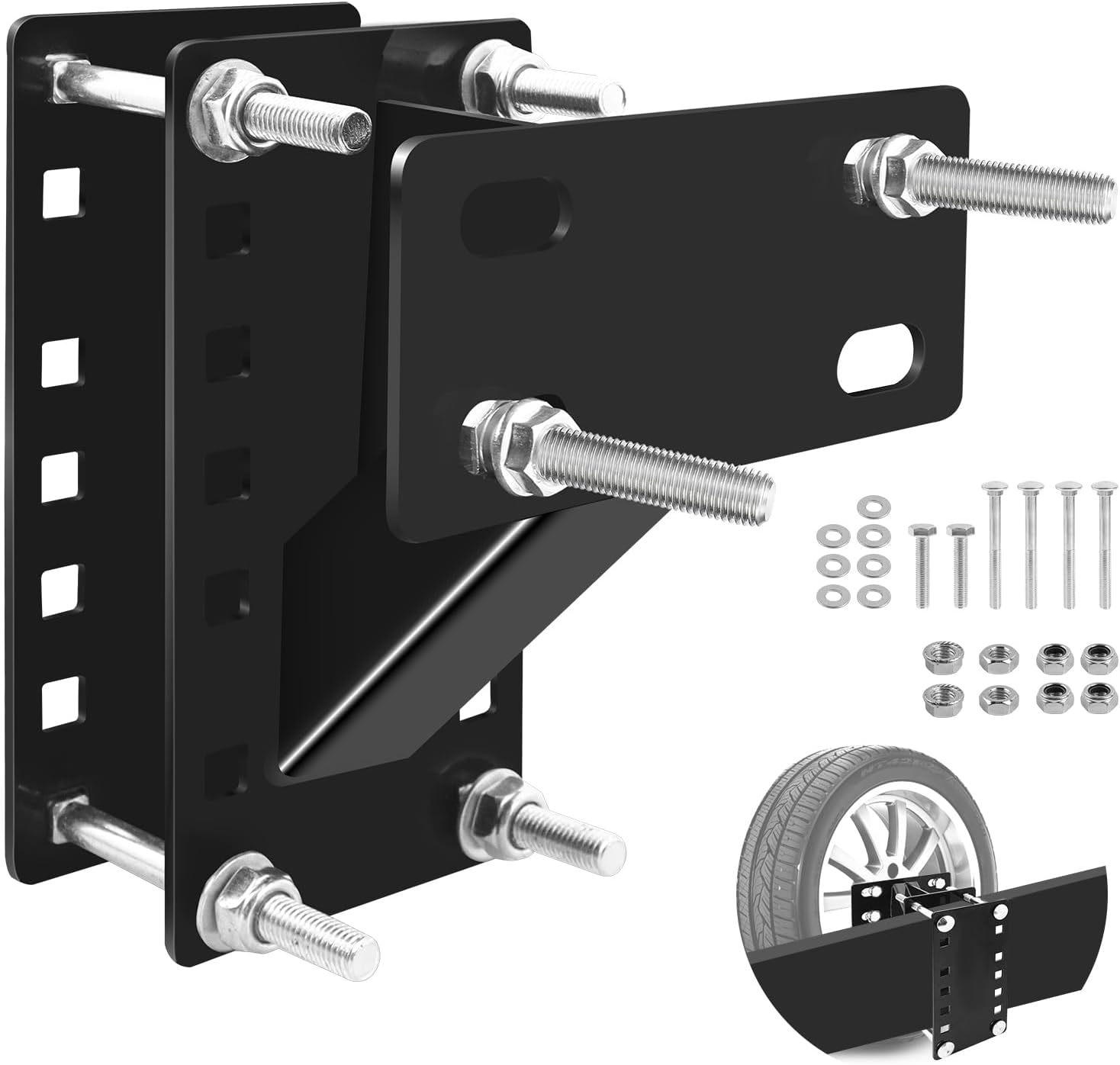
This universal spare tire mount carrier holder is built for utility trailers and boat trailers, offering a secure fit for 4, 5, and 6 lug wheels. It supports multiple bolt pattern sizes and a heavy-duty load capacity while resisting rust with a durable finish. The design allows easy installation and lets you choose the steel beam height for a better fit.

Secure a full-size spare on your trailer with this powder-coated steel spare tire mount bracket. It fits most 4-, 5-, and 6-lug wheel bolt patterns and mounts to trailer tongues up to 4 in wide and 5 in tall. Built for reliable carry with a max 150 lb load rating and includes zinc-plated hardware for straightforward installation.
Understanding Tacoma Spare Tire Sizes Through the Generations
The chart below provides documented examples rather than a universal replacement chart. Your truck may use a different size because Tacoma configurations vary by cab, drivetrain, package, market, and production date.
Spare Tire Size Chart
| Tacoma generation | Model years | Documented factory examples | What you should know |
|---|---|---|---|
| First generation | 1995 to 2004 | The 2004 manual lists P205/75R15, P225/75R15, P235/55R16, and P265/70R16 tire configurations. | Two-wheel-drive, PreRunner, four-wheel-drive, cab, and wheel packages differ. Check the truck’s original specification. |
| Second generation | 2005 to 2015 | The 2015 manual lists configurations including P215/70R15, P245/75R16, P265/70R16, P265/65R17, and P255/45R18. | Do not assume that every second-generation spare is 265/70R16. |
| Third generation | 2016 to 2023 | The 2023 manual includes configurations such as P245/75R16 and 265/70R16, with additional types depending on the truck. | An aftermarket 17-inch wheel does not prove that the factory spare or carrier was designed for a 17-inch oversized tire. |
| Fourth generation | 2024 and newer | Examples include 245/70R17 with a T175/90D18 temporary spare, 245/70R17 with a matching spare, and 265/70R17 with a 245/75R17 spare. | Confirm whether your truck has a temporary or full-size spare and follow its specific pressure and use restrictions. |
The safest identification order is:
- Driver-side Tire and Loading Information label: Check the factory tire information for the vehicle.
- Owner’s manual: Find the tire-and-wheel specifications for your model year and configuration.
- Spare tire sidewall: Read the actual size, load index, speed symbol, construction, and DOT date code.
- Wheel inspection: Confirm the wheel attachment pattern, center fit, offset, brake clearance, and lug-nut seat design.
- Physical clearance test: Verify that the tire can be raised, secured, and kept clear of the exhaust, differential, hitch, crossmembers, and moving components.
Common Fitment Issues
A spare may have a suitable diameter but still fail to fit the wheel hub or under-bed carrier. Common problems include:
- The tire touches the differential housing or exhaust.
- The sidewall sits too close to a hot exhaust component.
- The hitch receiver or aftermarket bumper reduces carrier space.
- The hoist plate does not sit correctly inside the wheel.
- An aftermarket wheel requires a different lug-nut seat or wrench size.
- The tire’s load rating is too low for the truck’s axle requirements.
- The spare is close in labeled size but substantially different in measured diameter or tread depth.
- A compact spare has pressure, speed, distance, or towing restrictions.
Warning: Do not force an oversized spare into the carrier by storing it at 2 to 3 psi. Inflate every spare to the cold pressure specified by Toyota for that spare. A severely underinflated tire can overheat, fail, damage the wheel, or leave you stranded.
How to Choose the Right Spare Tire for Your Tacoma
Choose the spare by matching the complete system, not just the numbers printed before the letter R.
- Start with Toyota’s specification: Use the placard and owner’s manual for your exact model year.
- Identify the spare type: Determine whether Toyota supplied a full-size spare or temporary spare.
- Compare overall diameter: A replacement intended for emergency use should remain close enough to the installed tires to avoid major handling and driveline differences.
- Match load capability: The tire and wheel must support the required vehicle load. Do not choose a spare solely because it physically fits.
- Verify wheel compatibility: Confirm the mounting pattern, center opening, offset, brake clearance, and lug-seat design.
- Inspect carrier clearance: Test the tire at full specified pressure.
- Consider tread and construction: Matching brand, model, construction, tread pattern, and similar tread depth is preferable, especially on four-wheel-drive trucks.
- Plan for installation: Carry the correct lug nuts, wheel-lock key, wrench, jack, jack handle, and pressure gauge.
How to Read a Tacoma Tire Size
In a size such as 285/70R17:
- 285 is the nominal section width in millimeters.
- 70 is the sidewall height as a percentage of the width.
- R means radial construction.
- 17 is the wheel diameter in inches.
You can estimate nominal diameter with this formula:
Wheel diameter + 2 × (section width × aspect ratio ÷ 100 ÷ 25.4)
Note: Calculated diameter is only an estimate. Actual mounted diameter varies by tire model, tread design, wheel width, inflation pressure, load, and manufacturing tolerance. Use the tire manufacturer’s published dimensions when comparing close clearances.
Typical Spare Tire Sizes for 3rd Gen Tacomas
Third-generation Tacomas were produced from 2016 through 2023, but they did not all use one tire or spare size. Factory configurations, dealer-installed wheels, owner upgrades, and suspension changes can all affect what is currently on the truck.
Common Spare Sizes
The following sizes often appear in third-generation fitment discussions. They are comparison examples, not guaranteed under-bed fits:
- 265/70R16: Approximately 30.6 inches in nominal diameter.
- 265/65R17: Approximately 30.6 inches in nominal diameter.
- 265/70R17: Approximately 31.6 inches in nominal diameter.
- 285/70R17: Approximately 32.7 inches in nominal diameter.
- 255/80R17: Approximately 33.1 inches in nominal diameter.
- 255/85R16: Approximately 33.1 inches in nominal diameter.
- 285/75R17: Approximately 33.8 inches in nominal diameter.
A 285/70R17 may fit the under-bed location on some trucks, but tire model, hitch equipment, exhaust position, wheel design, and carrier tolerances can change the result. A claim that it fits every third-generation Tacoma without modification is not reliable.
Fitment Compatibility Issues
| Tire size | Approximate nominal diameter | Fitment guidance |
|---|---|---|
| 255/80R17 | About 33.1 inches | Narrower than a 285 but still requires a full carrier and component-clearance check. |
| 285/70R17 | About 32.7 inches | May fit some trucks, but universal no-modification fitment is not guaranteed. |
| 255/85R16 | About 33.1 inches | Check wheel compatibility, carrier plate position, differential clearance, and exhaust clearance. |
| 285/75R17 | About 33.8 inches | More likely to require carrier changes or external storage. Do not assume under-bed fitment. |
Key Considerations for Upgrading Your Tacoma Spare Tire
An upgraded spare should support the tires already installed on the truck. It should not be treated as a separate appearance upgrade.
- Overall diameter: Keep it reasonably close to the installed tires, especially on a four-wheel-drive truck.
- Load capacity: Choose a tire and wheel suitable for the truck’s axle and vehicle load requirements.
- Inflation pressure: Use Toyota’s specification for the applicable spare, not the maximum pressure molded on the replacement tire as your default target.
- Wheel fitment: Confirm every mounting dimension and lug-seat requirement.
- Carrier strength: A larger tire is heavier and places more load on the hoist, cable, crossmember, and retaining plate.
- Heat clearance: Maintain safe separation from the exhaust and other hot components.
- Tread compatibility: A deeply treaded new spare can have a different rolling circumference from heavily worn road tires.
- TPMS expectations: Do not assume the truck monitors the spare’s pressure. Check it manually.
Pro Tip: Before buying an oversized spare, create a simple clearance record. Measure the available carrier space, note the nearest exhaust and differential points, identify the hitch or bumper model, and compare the tire manufacturer’s actual mounted diameter and section width.
How to Install and Maintain Larger Spare Tires
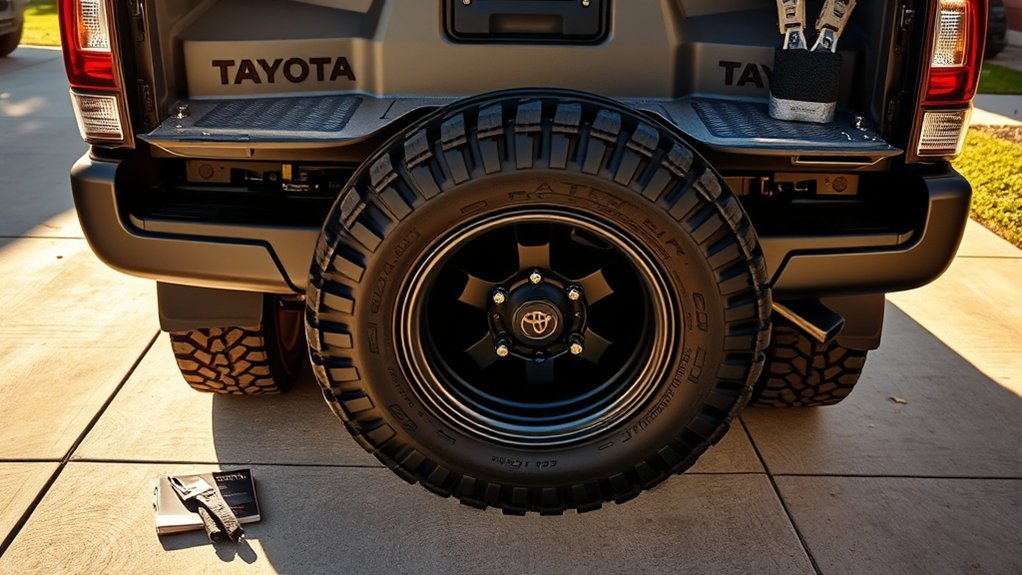
Test an oversized spare while the Tacoma is parked on a hard, level surface. Wear gloves and keep your body clear of the tire’s path while using the hoist.
- Confirm pressure first: Inflate the spare to its specified cold pressure before testing fitment.
- Inspect the hoist: Look for fraying, corrosion, kinks, binding, a damaged retainer, or a loose mounting point.
- Lower the carrier fully: Use the factory jack-handle tools and keep tension controlled.
- Position the retainer correctly: Make sure the plate passes through the wheel and lies flat in its intended position.
- Raise the tire slowly: Watch every side of the tire as it approaches the differential, exhaust, hitch, crossmember, and bed.
- Stop if anything contacts: Do not use the hoist to crush the tire past an obstruction.
- Secure the tire: Raise it until Toyota’s procedure indicates that it is properly seated.
- Perform a retention check: Push, pull, and try to rotate the tire. It should not hang loosely or touch surrounding parts.
- Recheck after driving: Inspect the position and cable tension after the first trip and during regular maintenance.
If the tire is too heavy to position safely, use a second person or have a qualified shop perform the installation. Never work underneath a vehicle supported only by its emergency jack.
[Products Worth Considering]

This side-mounted U-bolt spare tire bracket helps keep a trailer spare wheel secure and protected while you travel. It supports trailer frames up to 2–3 inches wide and fits up to 15-inch tires for 4- or 5-lug wheels. The galvanized steel threaded carrier is built for long-lasting corrosion resistance and installs easily with included lug nuts and U-bolt.

This universal spare tire mount fits 4, 5, and 6 lug trailer wheels with bolt patterns from 4" to 5.5" and helps keep your tire securely locked in place. Its reinforced triangular structure with a sturdy behind plate is designed to handle up to 150 lbs, making it suitable for boat, camper, and RV spare tire mounting. The angled raised design reduces wind resistance and installation is straightforward with different length bolts and no drilling required.
Spare Tire Maintenance Checklist
- Check cold pressure at least once a month and before long trips.
- Inspect the tread and sidewalls for cracks, cuts, bulges, punctures, and deformation.
- Read the DOT date code and consider age along with condition and manufacturer guidance.
- Check for rust around the wheel, valve, hoist plate, cable, and crossmember.
- Confirm the tire remains tightly retained and clear of hot or moving components.
- Make sure the jack, wheel-nut wrench, extension tools, wheel-lock key, gloves, and flashlight are present.
- Verify that any separate lug nuts required by an aftermarket spare wheel are stored securely in the truck.
How to Solve Common Spare Tire Fitment Problems
Do not continue raising the tire when it binds. Identify the obstruction first.
- Tire contacts the differential: Recheck centering and carrier position. If contact remains, use a smaller compatible tire or a properly engineered external carrier.
- Tire is too close to the exhaust: Do not rely on sidewall compression. Use a safer carrier solution or have a qualified exhaust and fabrication shop evaluate the installation.
- Hitch blocks the spare: Verify whether the hitch manufacturer provides a compatible relocation solution. Do not loosen or omit structural fasteners.
- Hoist cable binds: Lower the tire, inspect the cable and mechanism, and replace damaged parts. Do not force a corroded hoist with excessive torque.
- Retainer will not sit flat: Confirm that the wheel’s center opening and shape work with the factory carrier plate.
- Aftermarket wheel uses different lug nuts: Carry the correct nuts and socket. Confirm the seat style and thread engagement before an emergency.
- Spare diameter differs from the road tires: Treat it as temporary emergency equipment, limit use, and repair or replace the regular tire promptly.
- TPMS warning remains on: Some spares may not have a registered pressure sensor. Check the owner’s manual and verify all tire pressures manually.
Proper sealing of TPMS valves and sensors matters when a sensor-equipped wheel is serviced, but TPMS does not replace manual pressure checks.
Alternatives to Standard Tacoma Spare Tires
If the desired full-size spare will not fit under the bed, consider one of these safer alternatives:
- Factory-size full spare: Often the simplest option when the road tires remain close to their original size.
- Toyota-supplied temporary spare: Use only according to the pressure, speed, distance, axle-position, and towing instructions in the owner’s manual.
- Hitch-mounted carrier: Choose a carrier rated for the combined wheel-and-tire weight and confirm that it does not exceed hitch or vehicle limits.
- Swing-out bumper carrier: Use a properly engineered system that accounts for hinge load, latch strength, rear visibility, lighting, and departure angle.
- Bed-mounted carrier: Secure it to a rated mounting system and account for payload, cargo space, and crash restraint.
- Tire repair kit and compressor: Useful for some small tread-area punctures, but not a substitute for a spare when the tire has sidewall damage, a large puncture, bead damage, or wheel damage.
When comparing alternatives, consider tread life, road manners, off-road traction, total weight, access to cargo, and whether you can safely remove and reinstall the tire alone.
User Experiences With Tacoma Spare Tire Modifications
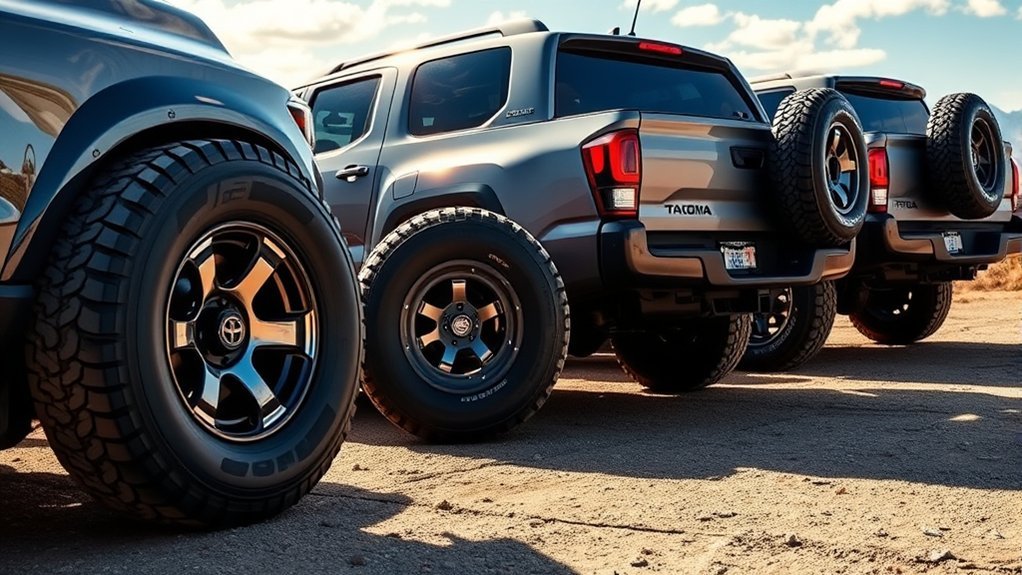
Tacoma owners often report different results with the same labeled tire size. Those differences are expected because two tires marked 285/70R17 can have different actual dimensions, shoulder shapes, tread depths, casing stiffness, and weights.
The truck itself may also differ because of:
- Model year and drivetrain
- Factory or aftermarket exhaust
- Receiver hitch design
- Rear bumper or skid-plate modifications
- Spare-hoist position and condition
- Wheel offset and center design
- Tire pressure during measurement
- Suspension, axle, or bed modifications
Owner experience can help identify possibilities, but it should not replace a measurement and inspection on your truck. A successful installation should leave the spare fully inflated, securely retained, and clear of heat, sharp edges, the differential, suspension movement, and exhaust movement.
Frequently Asked Questions
Can I use a different-brand spare tire on my Tacoma?
A matching make, model, construction, tread pattern, size, load rating, and similar tread depth is the better choice. A different-brand tire may be usable for a short emergency when all critical specifications are compatible, but replace or repair the regular tire promptly. Avoid prolonged use of mismatched tires, especially on a four-wheel-drive Tacoma.
How do I check my Tacoma’s spare tire pressure?
Check the pressure with an accurate gauge when the tire is cold, meaning the truck has been parked for at least three hours. Use the pressure listed for the spare in the owner’s manual or vehicle tire information. Do not use the maximum sidewall pressure as a substitute for Toyota’s specification.
Are spare tire sizes interchangeable between Tacoma generations?
Not automatically. Tacoma generations and configurations can differ in tire diameter, load needs, wheel mounting dimensions, brake clearance, lug hardware, carrier space, and temporary-spare design. Verify every specification instead of assuming that a spare from another generation will fit.
What tools do I need to change my Tacoma’s spare tire?
You normally need the factory jack, jack handle and extensions, wheel-nut wrench, and spare-lowering tools. A pressure gauge, wheel chocks, gloves, reflective warning equipment, flashlight, wheel-lock key, and torque wrench are also useful. Follow the owner’s manual for approved lifting points and final wheel-nut torque.
Where is the spare tire located on a Toyota Tacoma?
The spare is generally stored beneath the rear bed and held by a cable-operated hoist. The lowering tools are stored inside the cab, with their location varying by cab and model year. Check your owner’s manual before an emergency so you know where every tool is located.
Will a 285/70R17 spare fit under a third-generation Tacoma?
It may fit some trucks, but it is not guaranteed. A 285/70R17 has a nominal diameter of about 32.7 inches, while actual dimensions vary by tire model. Check the differential, exhaust, hitch, crossmember, hoist plate, and bed clearance with the tire at its proper pressure.
Does the Tacoma’s TPMS monitor the spare tire?
It depends on the year and spare configuration. Some spare wheels do not have a pressure transmitter, so the truck may not warn you when the spare is low. Check the spare manually every month even when no TPMS warning appears.
Can I drive in four-wheel drive with a mismatched spare?
A substantial difference in diameter, construction, or tread depth can create handling or driveline problems. Use the spare only as directed by Toyota, avoid unnecessary distance and load, and repair the normal tire as soon as possible. Follow any axle-position or four-wheel-drive restrictions in your owner’s manual.
Conclusion
The best Toyota Tacoma spare tire is not simply the largest tire that can be pushed beneath the bed. It must match the truck’s specifications closely enough to mount correctly, carry the required load, maintain predictable handling, and clear the carrier, differential, exhaust, hitch, and surrounding components.
Start with the tire placard, owner’s manual, and spare sidewall. Treat larger sizes such as 285/70R17, 255/80R17, or 285/75R17 as fitment projects that require measurement rather than guaranteed upgrades. Keep the spare fully inflated to its specified pressure, inspect it monthly, and use an appropriately rated external carrier when a full-size tire cannot be secured safely underneath the truck.
Sources
- Toyota 2024 Tacoma Owner’s Manual: Maintenance Data — fourth-generation tire, spare, pressure, wheel, and torque specifications
- Toyota 2024 Tacoma Owner’s Manual: Flat Tire Procedures — spare location, tools, lifting, installation, and retention guidance
- Toyota 2015 Tacoma Manuals and Warranties — second-generation specifications and emergency procedures
- Toyota 2004 Tacoma Manuals and Warranties — first-generation tire configurations and replacement guidance
- NHTSA TireWise — tire sizing, cold-pressure checks, spare maintenance, tread inspection, and tire-aging guidance

Related Articles
How Tire Weight Affects Toyota Tacoma Performance
How does tire weight influence your Toyota Tacoma's performance and efficiency? Discover the surprising effects that could change your driving experience.
Read More
Tire Noise Levels by Tire Type on a Toyota Tacoma
A comprehensive look at how tire types affect noise levels in your Toyota Tacoma reveals surprising insights that could enhance your driving experience.
Read More
How To Choose Tires for a Dual Use Toyota Tacoma
Unlock the secrets to selecting the perfect tires for your dual-use Toyota Tacoma, ensuring optimal performance and comfort on every adventure. Discover more inside!
Read More