
How to Air Down Tires for Off-Road: PSI Guide for Toyota Tundra
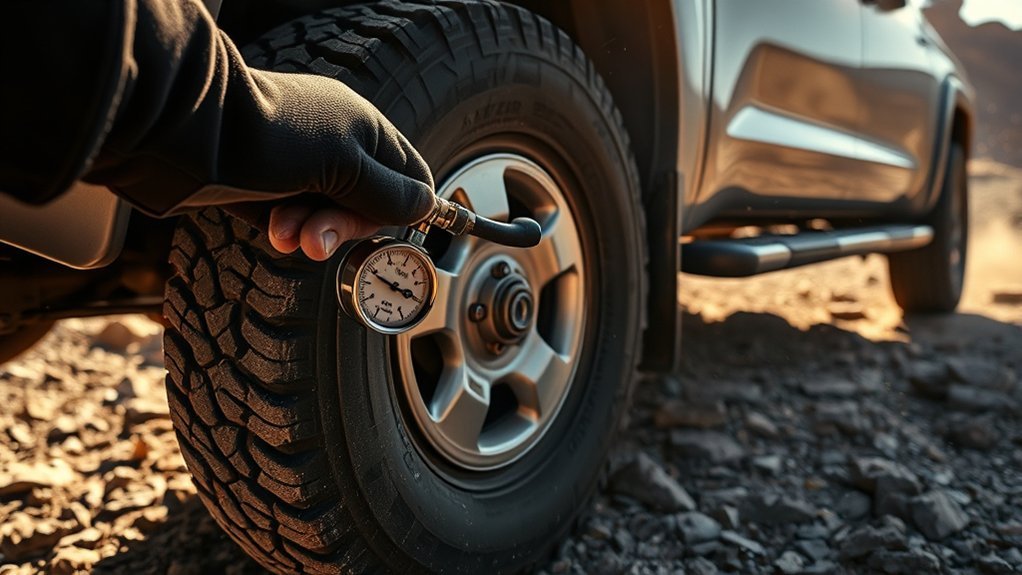
Airing down your Toyota Tundra tires before off-roading can make the truck feel more planted, improve traction, and smooth out rough trail chatter. The safe PSI is not one fixed number, though. Start with the terrain, your tire size, your wheel setup, and your truck’s load, then reinflate to the driver-door tire placard before driving at road speed.
Quick Answer
For a Toyota Tundra on standard non-beadlock wheels, start around 18–22 PSI for mixed trails, 15–20 PSI for rocks or mud, and 12–15 PSI for soft sand. Use these as trail-only starting points, drive slowly, and reinflate to the tire-and-loading placard pressure before pavement.
Key Takeaways
- Airing down increases the tire footprint, helping your Tundra float better in sand and grip uneven rocks or ruts.
- There is no universal Toyota Tundra off-road PSI. Tire construction, wheel size, load, speed, and terrain all matter.
- Do not use a generic PSI for road driving. Reinflate to the cold pressure shown on your Tundra’s tire-and-loading placard.
- Standard non-beadlock wheels need extra caution at very low PSI because the bead can unseat during sharp turns, side loads, or hard throttle.
At a Glance
| Time Required | 10–20 minutes to air down all four tires; 15–35 minutes to air back up, depending on compressor speed and tire size. |
| Difficulty | Easy, but it requires accurate pressure checks and conservative driving while aired down. |
| Tools Needed | Tire pressure gauge, tire deflator, portable air compressor or CO₂ tank, valve caps, tire repair kit, and a full-size spare. |
| Cost | Free if you already own the tools; about $40–$350+ for a gauge, deflators, and a capable portable compressor. |
Why Airing Down Your Tires Matters for Off-Roading
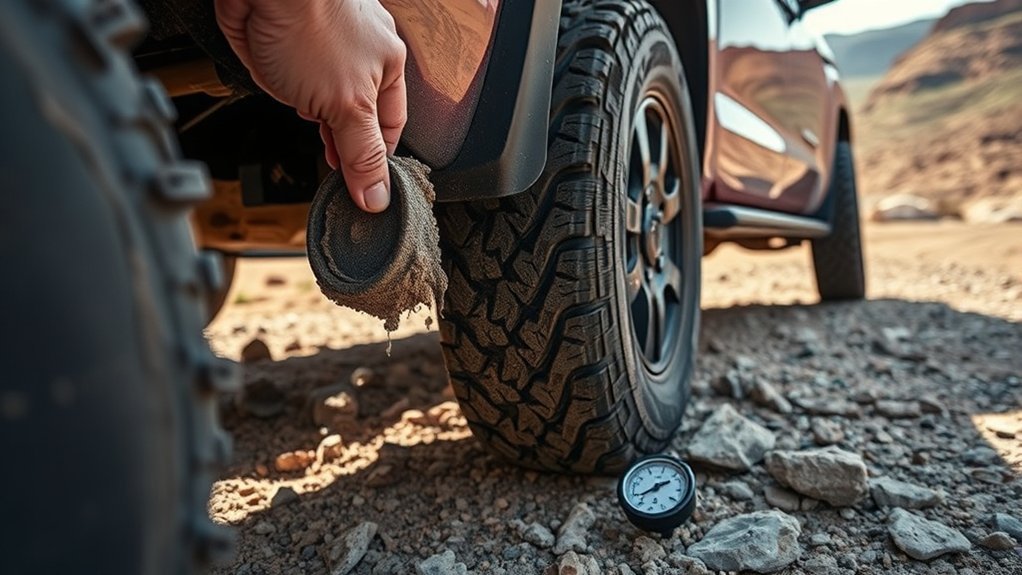
Airing down means lowering tire pressure before driving off-highway. This lets the tire flex more and puts a longer, wider footprint on the ground. That extra footprint can improve traction on loose surfaces, help the tire conform to rocks, and reduce harsh impacts through the cabin.
BFGoodrich describes airing down as a way to increase tire footprint for better traction over rocks and loose terrain, while also improving off-highway ride comfort. That is why many Tundra owners air down before sand, rocks, ruts, snow, or washboard trails. You still need to treat aired-down tires as a trail setting, not a highway setting.
For road use, follow the cold tire pressure listed by Toyota for your specific truck. Toyota’s Tundra owner information says the recommended cold tire inflation pressure and tire size are shown on the tire-and-loading information label. NHTSA TireWise also explains that the correct pressure is the vehicle manufacturer’s pressure on the tire label or in the owner’s manual, checked when the tires are cold.
Warning: Do not drive at highway speed on aired-down tires. Low tire pressure on pavement can cause poor handling, heat buildup, uneven wear, and tire failure. Air back up before returning to normal road speeds.
Best Starting PSI for a Toyota Tundra by Terrain
Use the table below as a practical starting point for a Toyota Tundra on light-truck all-terrain or mud-terrain tires and standard non-beadlock wheels. Adjust in small steps based on tire size, load, wheel diameter, trail speed, and how the truck feels.
| Terrain | Starting PSI | Best Use | Caution |
| Gravel roads / washboard | 22–28 PSI | Smoother ride and better control on rough roads. | Keep speeds moderate; add pressure for long, fast dirt-road sections. |
| Mixed trail driving | 18–22 PSI | General off-road use with dirt, ruts, small rocks, and mild climbs. | A good first setting for most Tundra owners new to airing down. |
| Rocky trails | 15–20 PSI | More grip and sidewall flex over uneven rocks. | Use careful throttle and avoid sharp turns at very low PSI. |
| Soft sand | 12–15 PSI | Better flotation so the truck rides on top instead of digging. | Avoid sudden steering, hard braking, and spinning the tires. |
| Mud | 15–20 PSI | More footprint and bite in ruts or sticky ground. | Too low can expose sidewalls and make steering feel vague. |
| Snow-covered trails | 12–18 PSI | Improves flotation and control in soft snow. | Ice is different from snow; lower PSI does not replace proper winter tires. |
Discount Tire lists general off-road guidelines of 12–15 PSI for sand or loose gravel, 15–20 PSI for rock, 15–20 PSI for mud, and 12–15 PSI for snow. Those numbers are useful, but your Tundra’s weight and tire setup may require staying on the higher side.
Before You Air Down: Check Your Tundra Setup
Before dropping pressure, take two minutes to check what your truck is actually running. A stock Tundra on factory-size tires behaves differently from a lifted Tundra on larger LT tires, and a loaded overland build behaves differently from an empty daily driver.
- Door placard: Use the driver-door tire-and-loading placard for road pressure and original tire size. Do not use the max PSI printed on the tire sidewall as your normal road setting.
- Tire construction: LT tires, all-terrain tires, mud-terrain tires, and passenger-rated tires flex differently at the same PSI.
- Wheel size: Larger-diameter wheels with shorter sidewalls usually have less room to flex safely.
- Beadlocks: Beadlock wheels can help retain the tire bead at low pressure, but most street-driven Tundras use standard wheels.
- Payload and towing: A truck loaded with camping gear, water, tools, or a trailer needs more pressure than an empty truck.
- Trail speed: The faster you drive, the more heat and stress low-pressure tires can build.
Note: If you changed to a tire size not listed on your Tundra’s placard, check your tire manufacturer’s load and inflation guidance. Toyo Tires explains that load and inflation tables help when optional tire sizes are not listed on the vehicle placard, while original equipment sizes should use the placard or owner’s manual.
How to Air Down Your Tires Safely: A Simple Step-by-Step Guide
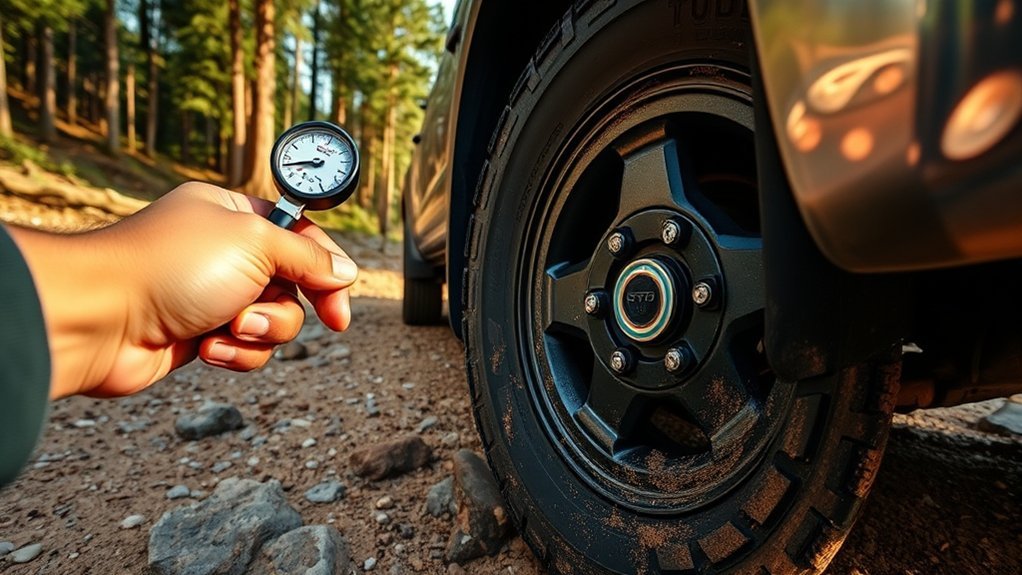
- Stop before the trail gets difficult. Choose flat, safe ground away from traffic. Set the parking brake and keep your tools within reach.
- Inspect each tire first. Look for cuts, bulges, exposed cords, missing valve caps, rocks in the bead area, or sidewall damage.
- Check your current PSI. Use a reliable tire pressure gauge. If the tires are warm from driving, remember that pressure will read higher than a true cold reading.
- Pick a conservative target. For a Tundra, 18–22 PSI is a safe starting range for many mixed trails. Drop lower only when the terrain requires it.
- Deflate evenly. Use a tire deflator or valve-core deflator and work around the truck so all four tires end up close to the same pressure.
- Recheck with a separate gauge. Do not rely only on the reading built into a deflator.
- Drive a short distance and reassess. If the truck still bounces or digs, remove 1–2 PSI. If the sidewalls look folded, steering feels vague, or the truck feels unstable, add pressure.
Pro Tip: Write your best PSI settings in a notes app after each trip. Record tire size, terrain, load, and what worked. Your own Tundra-specific log will be more useful than any single online number.
Must-Have Tools for Airing Down and Reinflating Your Tires
Airing down is only smart if you can air back up. Before leaving pavement, carry the tools needed to deflate accurately, reinflate safely, and handle a basic tire problem on the trail.
- Accurate tire pressure gauge: A quality analog or digital gauge helps you avoid guessing.
- Tire deflator: A valve-core deflator is fast, while preset deflators are convenient for repeated trail use.
- Portable air compressor or CO₂ tank: Choose a compressor that can handle large light-truck tires without overheating.
- Tire repair kit: Carry plugs, reamer, insertion tool, valve cores, valve caps, and pliers.
- Full-size spare: A mismatched temporary spare is not ideal for trail recovery.
- Gloves and a flashlight: Small tools matter when you are airing up after dark or in mud.
BFGoodrich recommends always having a way to air back up before returning to paved roads, such as a portable compressor or CO₂ tank.
How Low Is Too Low for a Tundra?
For most Toyota Tundras on standard non-beadlock wheels, pressures below about 15 PSI deserve extra caution, and pressures near or below 12 PSI should be reserved for soft terrain, low speed, and drivers who understand the risk. There is no magic cutoff because tire size, wheel width, sidewall stiffness, and load all change the answer.
Going too low can cause:
- Bead unseating: The tire can separate from the rim, especially during sharp turns or side-hill driving.
- Sidewall damage: Low pressure exposes more sidewall to rocks, roots, and debris.
- Rim strikes: The wheel can hit rocks through the tire if the tire cannot support the truck.
- Heat buildup: Low pressure at higher speed makes the tire flex more and run hotter.
- Vague steering: The truck may feel squirmy or delayed when turning.
Warning: Do not tow, haul heavy loads, or drive fast while aired down. If your Tundra is loaded for camping or overlanding, start higher than the table suggests and lower pressure only if the terrain demands it.
Expert Recommendations Based on Terrain
Terrain-Specific PSI Adjustments
Terrain changes the goal. Sand needs flotation, rocks need controlled tire flex, mud needs traction without exposing too much sidewall, and gravel needs comfort without heat buildup.
- Sand: Start around 15 PSI, then drop 1–2 PSI at a time if the Tundra digs instead of floating. Keep momentum smooth and avoid sharp steering.
- Rocks: Start around 18 PSI. Drop toward 15 PSI only for slow crawling where extra sidewall flex helps the tire wrap around obstacles.
- Mud: Start around 18–20 PSI. If the tire is not cleaning out or the truck spins, adjust carefully.
- Gravel and washboard: Start higher, often 22–28 PSI, especially if the road is long or speeds are moderate.
- Snow: Start around 15–18 PSI for soft trail snow, but remember that aired-down all-terrain tires are not a substitute for winter tires on icy roads.
Optimal Pressure for Crawling
For slow rock crawling in a Tundra, many drivers begin around 15–18 PSI on LT all-terrain or mud-terrain tires. This gives the tire more flex without immediately jumping to the lowest possible number. If your Tundra has heavier bumpers, skid plates, sliders, a bed rack, drawers, tools, or a rooftop tent, stay closer to the higher end.
If the sidewall folds heavily, the wheel gets close to rocks, or steering becomes sloppy, add 2–4 PSI. If the truck hops and loses grip at very low speed, reduce pressure in small steps.
Avoid These Common Mistakes When Airing Down
- Using one PSI for every trail: The best pressure changes with terrain, speed, load, tire construction, and driver experience.
- Forgetting the road-pressure placard: Your Tundra’s tire-and-loading label is the road-pressure reference, not a random online number.
- Dropping too low too soon: Start conservative and adjust in small steps. It is easier to release 2 PSI than to reseat a bead on the trail.
- Driving too fast while aired down: Low pressure and speed create heat, poor handling, and tire stress.
- Airing down without a compressor: Never leave pavement without a way to reinflate all four tires.
- Ignoring tire damage: Check sidewalls, tread, valve stems, and bead areas before and after difficult sections.
Troubleshooting Air-Down Problems on the Trail
If something feels wrong after airing down, stop and fix it before the problem becomes a recovery situation.
- Truck feels squirmy: Add 2–4 PSI and slow down. The tires may be too soft for your speed or load.
- Tires are digging in sand: Lower pressure 1–2 PSI, reduce wheelspin, and use smoother throttle.
- Bead leak or hissing near the rim: Stop immediately. Clean dirt from the bead area if possible, reinflate, and do not drive at speed until the tire holds pressure.
- TPMS light turns on: This is expected when pressure drops below the system threshold. Reinflate to placard pressure after the trail and recheck all tires.
- Compressor gets hot: Let it rest according to its duty cycle. A hot compressor can fail before all four tires are back to road pressure.
- One tire keeps losing pressure: Inspect for punctures, valve leaks, bead leaks, or sidewall damage. Use the spare if the tire cannot hold pressure safely.
How to Reinflate Your Tires After Off-Roading
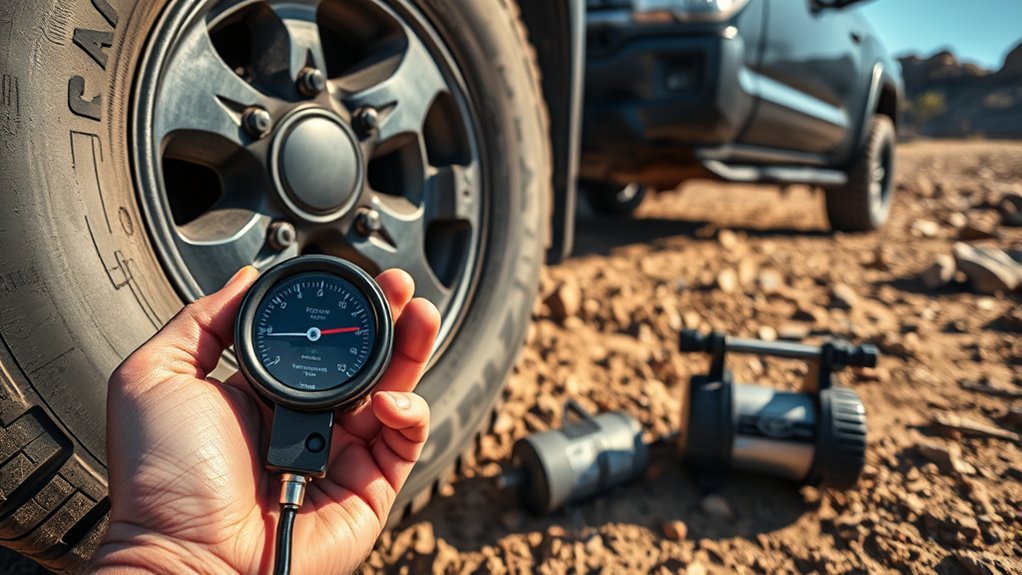
Before returning to pavement, reinflate your Toyota Tundra tires to the cold pressure shown on the driver-door tire-and-loading placard. Do not rely on a universal 30 PSI, 35 PSI, or 40 PSI recommendation unless that exact number appears on your truck’s placard for your tire and load setup.
Necessary Tools Required
- Portable compressor: A higher-output compressor saves time with large truck tires.
- Accurate tire pressure gauge: Use it after the compressor stops, not only while the compressor is running.
- Air hose and fittings: Check that they reach all four tires before the trip.
- Valve caps: Replace missing caps to help keep dirt and moisture out of the valve stem.
Recommended Tire Pressures
Your recommended on-road pressure is the cold PSI listed on your Tundra’s tire-and-loading placard. NHTSA explains that cold pressure means the vehicle has not been driven for at least three hours, or has been driven less than about one mile. If you air up while the tires are warm, inflate to the placard pressure before driving home, then recheck and fine-tune when the tires are cold.
- Park safely at the trail exit.
- Connect your compressor and inflate one tire at a time, or use a multi-tire inflation system if you have one.
- Pause and check pressure with a separate gauge.
- Repeat until all tires are at the proper road pressure.
- Drive a short distance, then confirm the truck tracks normally and no tire is losing pressure.
How to Monitor Tire Pressure and Prevent Wear
Good tire-pressure habits protect your tires long after the trail is over. Check pressure before off-road trips, after reinflating, and during normal maintenance. NHTSA recommends regular pressure checks because a tire can be underinflated before it looks low.
- Check when cold: Cold readings are the most accurate for setting road pressure.
- Inspect tread and sidewalls: Look for cuts, bulges, exposed cords, punctures, uneven wear, and missing chunks.
- Watch wear patterns: Center wear can suggest overinflation; shoulder wear can suggest underinflation or alignment issues.
- Do not ignore TPMS: TPMS is helpful, but it is not a replacement for a gauge.
- Check the spare: A flat spare is useless when a sidewall fails on the trail.
Final Thoughts on Airing Down: Ready to Conquer the Trails?
Airing down is one of the simplest ways to improve how a Toyota Tundra behaves off-road, but the best results come from small adjustments and good judgment. Start higher, lower pressure only when the terrain calls for it, and pay attention to how the truck feels.
Key Benefits Of Airing Down
- Better traction: More tire footprint helps on sand, rocks, snow, and loose soil.
- Smoother ride: Softer tires absorb washboard and trail chatter better than street-pressure tires.
- Improved control: The tire can conform to obstacles instead of bouncing off them.
- Less digging in soft terrain: Lower PSI helps the Tundra float better in sand or snow.
Optimal PSI Recommendations
For a stock or lightly modified Tundra, 18–22 PSI is a smart mixed-trail starting point. Move toward 15–18 PSI for slow rocks, 12–15 PSI for soft sand, and 22–28 PSI for gravel or washboard where speeds are higher. These are not road pressures. Always air back up to the placard pressure before pavement.
Essential Airing Down Gear
- Gauge: Confirms every pressure change.
- Deflator: Makes airing down faster and more even.
- Compressor: Gets you safely back to road pressure.
- Repair kit and spare: Gives you options if a tire is punctured or damaged.
Frequently Asked Questions
What PSI should I air down to when off-roading a Toyota Tundra?
Start around 18–22 PSI for mixed trails, 15–20 PSI for rocks or mud, and 12–15 PSI for soft sand. These are trail-only starting ranges. Adjust based on tire size, load, wheel setup, and how the truck feels.
Is 40 PSI too high for 4WD?
For many off-road conditions, 40 PSI is too high because the tire stays stiff and has less footprint. For road driving, however, 40 PSI may be correct on some vehicles or load setups if the placard says so. Use lower PSI for slow trail use and the placard pressure for pavement.
What PSI should Toyota Tundra tires be at on the road?
Use the cold tire pressure printed on your Tundra’s tire-and-loading placard, usually found on the driver-door jamb. The correct road PSI can vary by model year, trim, tire size, and load, so do not use a universal number.
Do I need beadlock wheels to air down a Tundra?
No. You can air down on standard wheels if you stay conservative and drive carefully. Beadlocks become more useful when running very low PSI, heavy side loads, or technical rock crawling. Without beadlocks, avoid sharp steering, high speed, and aggressive throttle at low pressure.
How fast can I drive with aired-down tires?
Keep speeds low and match speed to terrain. Aired-down tires flex more, build heat faster, and handle less precisely than tires at road pressure. Air back up before long paved sections or highway driving.
Should I air down all four tires?
Yes, most drivers air down all four tires for balanced traction and predictable handling. If your Tundra carries much more weight on one axle, you may run slightly different front and rear pressures, but keep changes small and controlled.
Will airing down trigger the TPMS light?
Yes, it often will. The TPMS light may turn on because trail pressure is below the system’s road-pressure threshold. Reinflate to the placard pressure after the trail, check all four tires with a gauge, and the warning should clear if there is no leak or system issue.
Conclusion
Airing down your Toyota Tundra tires can improve traction, comfort, and control off-road, especially on sand, rocks, mud, snow, and washboard trails. The safest approach is to start with a conservative PSI, adjust in small steps, and watch how the truck responds. Use the terrain table as a starting guide, carry a gauge and compressor, avoid very low PSI on standard wheels unless conditions require it, and always reinflate to your Tundra’s tire-and-loading placard pressure before driving on pavement.
Sources
- Toyota Owners — 2025 Tundra Tire Inflation Pressure — supports using the Tundra tire-and-loading information label for recommended cold tire pressure and tire size.
- NHTSA TireWise — supports cold tire pressure checks, placard-based inflation, TPMS limitations, and tire safety guidance.
- BFGoodrich Off-Road Tire Selection Guide — supports the no-universal-PSI warning, air-down benefits, bead-unseating risk, and airing up before pavement.
- Discount Tire — How To Air Down Tires — supports terrain-based off-road PSI starting ranges and safe deflation steps.
- Toyo Tires Load & Inflation Tables — supports using load/inflation data when changing to optional tire sizes.

Related Articles
Toyota Tundra Tire and Wheel Package: What to Consider Before Buying
Unlock the secrets to choosing the perfect tire and wheel package for your Toyota Tundra—essential tips await to enhance your ride.
Read More
Do Bigger Tires Void a Toyota Tundra Warranty? Magnuson-Moss Act Explained
Bigger tires might not void your Toyota Tundra warranty, but understanding the Magnuson-Moss Act is crucial—discover how to protect your investment effectively.
Read More
Toyota Tundra Tire Rack Setup: Garage Storage Ideas for Seasonal Sets
Better tire storage for your Toyota Tundra awaits—discover essential tips to maximize space and protect your seasonal sets in the garage!
Read More