What Is Flotation Tire Sizing? How to Convert Metric to Flotation for Tundra
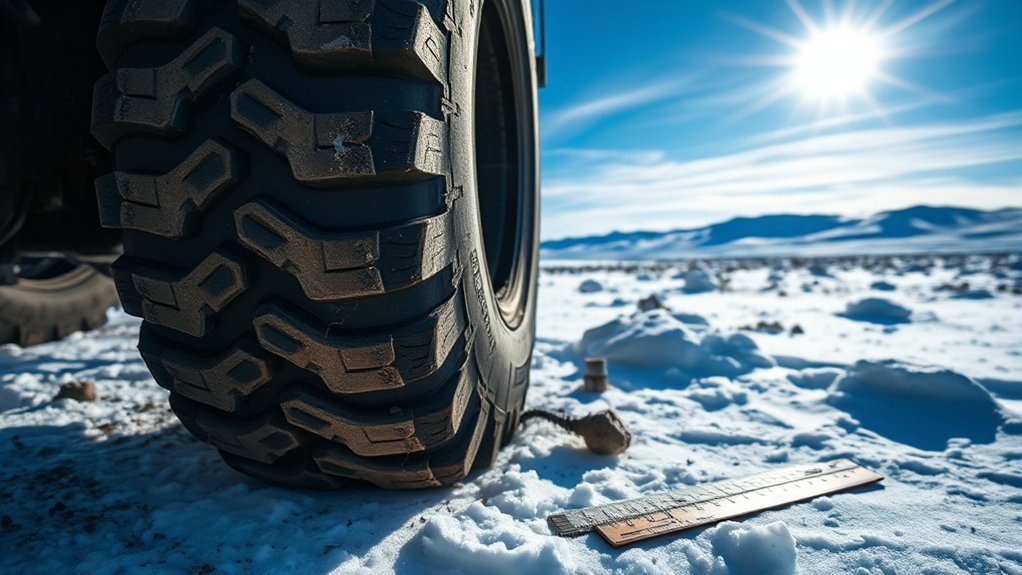
Flotation tire sizing refers to the way flotation tires are measured, using total diameter, width in inches, and rim diameter. To convert metric sizes like 275/70R18 to flotation, remember that it roughly translates to 33×11.50R18. For your Toyota Tundra, popular sizes include 33×12.50R17 and 35×12.50R20, enhancing off-road performance. Understanding these conversions is essential for ideal fit and performance on soft terrains, and there’s more to take into account for maximizing your off-road experience.
What Are Flotation Tires and Why Should You Consider Them for Off-Roading?
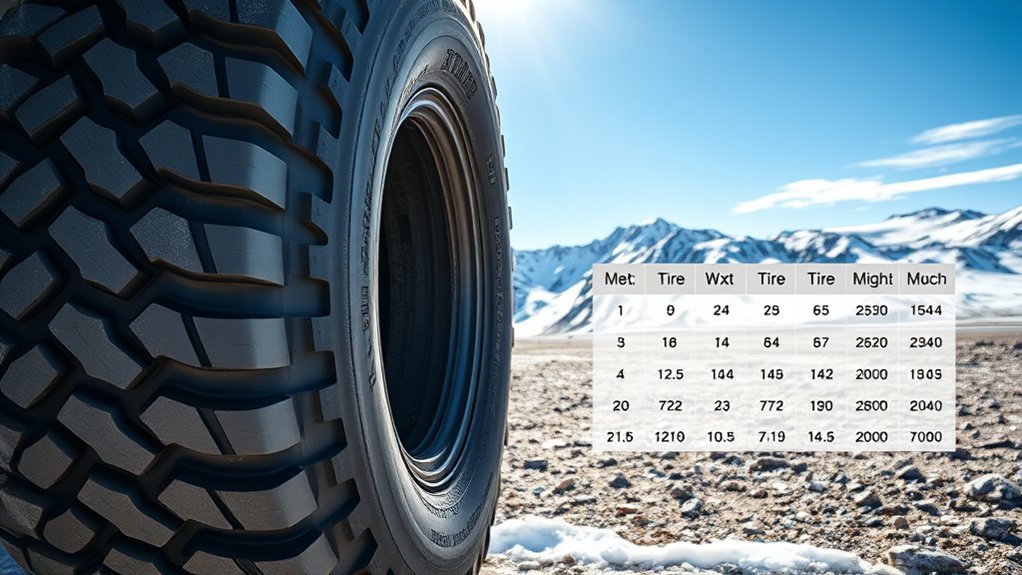
Flotation tires are specialized off-road tires designed to enhance your vehicle’s performance on loose and soft terrains. Their wide footprint considerably improves traction and stability, essential for traversing challenging landscapes. These tires feature optimized tread patterns that minimize sinking, allowing you to maintain better control and maneuverability in tough conditions.
Available in various sizes for trucks, ATVs, and agricultural machinery, flotation tires offer versatility for different applications. Unlike standard tires, these are sized by total diameter, width, and rim diameter, simplifying the process of finding the right fit for off-road environments. Additionally, flotation tires often support lower air pressure, which contributes to a softer ride and enhanced grip on uneven surfaces. By investing in this advanced tire technology, you elevate your off-road performance, ensuring you can tackle diverse terrains with confidence and agility.
Benefits of Upgrading to Flotation Tires for Off-Roading
Upgrading to flotation tires markedly enhances your traction performance and stability control on off-road terrain. Their wider footprint grips softer surfaces effectively, preventing slipping and improving your handling in challenging conditions. With flotation tires, you can tackle steep inclines and uneven ground with confidence.
Improved Traction Performance
When tackling off-road challenges, having the right tires can make all the difference in traction performance. Flotation tires feature a wider footprint that enhances traction on soft and loose surfaces like mud, sand, and snow. Their optimized tread patterns improve grip, allowing you to navigate challenging terrains with confidence. By upgrading to flotation tires, you’ll experience significant traction improvement, which is essential for off-road performance. These tires operate at lower air pressures, increasing the contact area with the ground and ensuring better ride comfort over uneven surfaces. Additionally, their construction allows for better load distribution, maintaining stability and control even when carrying heavier loads. Embrace your off-roading adventures with enhanced traction and freedom!
Enhanced Stability Control
Choosing the right tires is essential for maintaining stability during off-road adventures. Flotation tires offer a wider footprint, enhancing your vehicle’s tire performance on soft or loose terrains. This wider stance reduces the risk of sinking, allowing your Tundra to maintain superior control in challenging conditions. Additionally, operating at lower air pressures increases the contact area with the ground, which greatly improves grip and ride comfort. This enhanced stability is vital for safe towing and maneuvering rugged trails. Furthermore, flotation tires minimize soil disturbance, preserving terrain integrity during your excursions. By upgrading, you’ll experience improved off-road handling, ensuring each adventure is not only safer but also more liberating.
How Flotation Tires Differ From Metric Tires
Flotation tires and metric tires differ fundamentally in their sizing systems, which can impact their suitability for various applications. Flotation tires are sized using total tire diameter, width in inches, and rim diameter, such as 33×12.50R15. In contrast, metric tires use millimeters for width and a percentage for sidewall height, like 315/70R15. This distinction is essential for achieving the proper fit for vehicles like the Toyota Tundra.
Flotation advantages include a wider footprint that enhances traction on loose terrains while minimizing soil disturbance, making them ideal for agricultural and off-road uses. Additionally, the tire construction of flotation tires is tailored for lower pressures, enabling better performance on soft surfaces compared to the stiffer designs of most metric tires. Understanding these differences allows you to select the right tire for your needs, ensuring peak performance and versatility.
Flotation Tire Sizes: What You Need to Know
Understanding flotation tire sizes is vital for achieving ideal vehicle performance, especially in challenging terrains. These sizes, expressed in inches (e.g., 33×12.50R15), indicate tire diameter, width, and rim diameter. The first number represents the tire diameter, while the second indicates width. Flotation tires provide a wider footprint, enhancing traction on soft or loose surfaces—perfect for off-roading and agricultural applications.
To help you grasp flotation tire sizes, here’s a quick reference table:
| Flotation Size | Metric Equivalent |
|---|---|
| 33×12.50R15 | 315/75R15 |
| 35×12.50R17 | 325/70R17 |
| 37×12.50R20 | 375/65R20 |
When selecting flotation tire brands, remember that proper flotation tire maintenance is essential for longevity and performance. Understanding these sizes guarantees compatibility with vehicles like the Toyota Tundra, optimizing your driving experience.
[Products Worth Considering]

The VIAIR 400P EF is a 12V portable air compressor designed for off‑road trucks and SUVs, delivering fast, high‑performance inflation for up to 35‑inch tires. Its upgraded head improves heat dissipation and reduces noise, while a 5‑in‑1 hose and dual‑compartment bag add convenience. Versatile power options and a stable I‑Beam sand tray make it ideal for rugged terrain and heavy‑duty use.

The VIAIR 300P delivers reliable tire inflation for trucks, SUVs, and jeeps with up to 150 PSI pressure and a 33% duty cycle, ensuring quick recovery from flats on and off road. Its 12‑volt operation and 2.30 CFM free flow make it ideal for emergency roadside use, while the deluxe dual‑compartment carry bag adds convenience and portability. Easy to connect to a vehicle battery and equipped with a 5‑in‑1 gauge, it provides accurate pressure monitoring and hassle‑free operation.

This heavy‑duty tire inflator kit features a 50‑foot hybrid polymer hose and a universal glad‑hand attachment, allowing trucks to tap onboard air for quick tire inflation. The 30° dual air chuck reaches hard‑to‑reach valve stems, while weather‑resistant construction ensures reliable performance indoors and out. Ideal for fleet managers and truck drivers who need a portable, high‑pressure solution.
Steps to Convert Metric Tire Sizes to Flotation Sizes
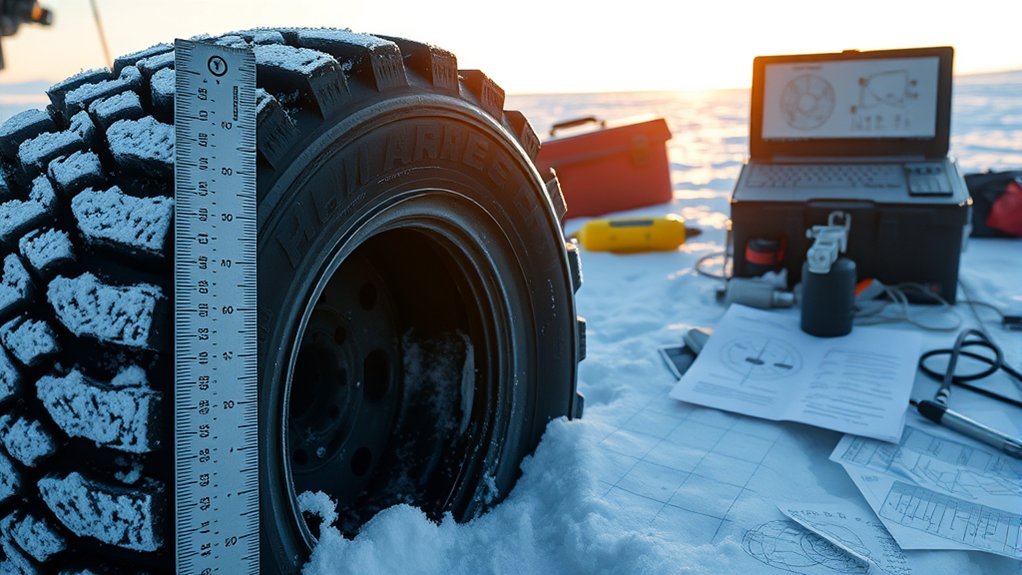
When converting metric tire sizes to flotation sizes, you’ll first need to identify the tire’s width in millimeters and the aspect ratio, which reflects the sidewall height as a percentage of that width. Next, calculate the overall diameter using the formula: (width × aspect ratio ÷ 100 × 2) + rim diameter. For instance, a metric size of 275/70R18 translates to an overall diameter of about 32.2 inches, roughly equivalent to a flotation size of 33×11.50R18.
After determining the diameter, use a tire size conversion chart to find the nearest flotation size that matches your calculation. Remember, flotation tires generally offer a wider footprint, enhancing traction on soft surfaces compared to metric tires. This understanding is essential for effective tire maintenance, ensuring you’re equipped for size comparisons that meet your performance needs.
[Products Worth Considering]

The AstroAI MC3 offers versatile, high‑pressure and high‑volume inflation with dual metal motors and OmniVent heat dissipation, delivering up to 160 PSI and 350 L/min. It runs on 110 V AC, 12 V DC, or a built‑in rechargeable battery, providing up to 20 minutes of continuous use. Integrated storage and a digital HD screen make it convenient for car, bike, and outdoor inflation needs.

The Byczone cordless air compressor delivers fast inflation up to 30L/min and precise pressure control with +/-0.5 PSI accuracy, making it ideal for cars, bikes, and sports balls. Its durable nylon braided body and brushless motor ensure reliable performance in any weather, while the built‑in flashlight provides SOS and constant lighting for nighttime emergencies. Compatible with a wide range of Dewalt 18V/20V batteries, it offers up to 20 minutes of continuous operation without a cord.
Popular Flotation Tire Sizes for the Toyota Tundra
When selecting flotation tires for your Toyota Tundra, popular sizes like 33×12.50R17 and 35×12.50R20 enhance off-road traction and stability. These wider tires are specifically designed to handle soft terrains, making them ideal for various conditions. Make certain that your Tundra’s lift and wheel well clearance align with your chosen tire size to avoid fitment issues.
Common Flotation Sizes
For Toyota Tundra owners seeking enhanced performance on soft terrains, popular flotation tire sizes like 33×12.50R17 and 35×12.50R18 are excellent choices. These sizes provide a wider tire width, improving terrain suitability by offering better traction and reduced soil disturbance. Here are some common flotation sizes you might consider:
- 33×12.50R17: Ideal for off-road applications, balancing performance and comfort.
- 35×12.50R18: Maximizes footprint for superior grip on soft surfaces.
- 285/70R17: A metric equivalent that translates to approximately 33×11.50R17 in flotation sizing.
Each of these options features reinforced sidewalls, ensuring your Tundra can handle heavy towing and rugged terrains with ease. Choose wisely to elevate your off-road experience!
Tundra Tire Compatibility
Selecting the right flotation tire size for your Toyota Tundra is essential for optimizing both off-road performance and on-road comfort. Popular sizes like 33×12.50R15 and 35×12.50R17 enhance traction on loose terrains, providing a wider footprint that stabilizes your vehicle while minimizing soil disturbance. When converting metric sizes, a 275/70R18 corresponds to approximately 33×11.50R18, so always consult conversion charts for accuracy. Additionally, if your Tundra has lift kits or modifications, consider options like 37×12.50R20 for increased ground clearance. Remember, the correct flotation tire size impacts your towing capacity and ride comfort. Proper tire pressure is important to maintain load capacity and performance, ensuring you get the most out of your Tundra’s capabilities.
Key Factors to Consider When Selecting Flotation Tires
Understanding the key factors in choosing flotation tires is essential for achieving ideal performance on soft and loose terrains. Proper tire selection directly impacts your vehicle’s capability and efficiency. Here are some critical aspects to evaluate:
- Tire Dimensions: Flotation tires are specified by total diameter, width, and rim diameter (e.g., 33×12.50R15), differing from metric sizes.
- Terrain Suitability: Confirm the tires are designed for the specific conditions you’ll encounter, such as agricultural or off-road applications.
- Load Index and Speed Rating: These specifications determine how much weight the tires can handle and their performance under various speeds.
How to Troubleshoot Common Issues With Flotation Tires?
Flotation tires are essential for ideal performance on soft terrains, but they can encounter various issues that affect their functionality. To guarantee peak performance, follow these troubleshooting steps:
| Common Issue | Solution |
|---|---|
| Improper Air Pressure | Regularly check and adjust air pressure to manufacturer specifications. |
| Uneven Tread Wear | Inspect tread depth; realign or redistribute loads if needed. |
| Visible Damage | Look for cuts, punctures, or bulges; replace damaged tires immediately. |
| Incorrect Sizing | Verify compatibility with your vehicle; consult size charts as needed. |
Resources for Finding the Right Flotation Tires for Your Tundra
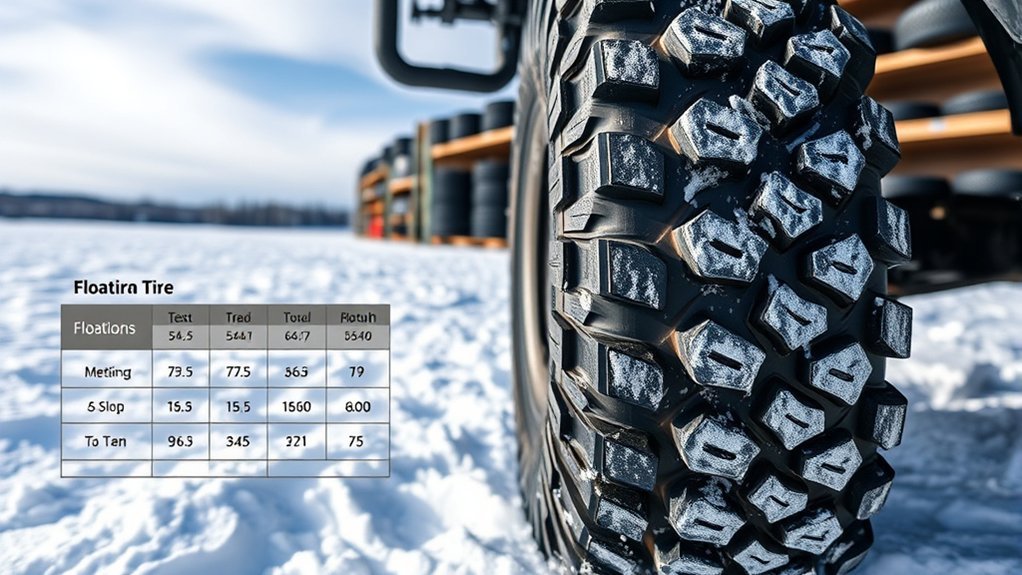
Finding the right flotation tires for your Toyota Tundra can greatly enhance its performance on soft terrains. To guarantee you select the best tires, utilize these resources:
Selecting the ideal flotation tires for your Toyota Tundra significantly improves its capability on soft terrains.
- Tire Conversion Charts: These charts help you accurately convert metric sizes to flotation sizes, guaranteeing compatibility with your Tundra.
- Trusted Tire Retailers: Consult local or online experts who specialize in flotation tires. They can guide you on suitable options that match your needs.
- Online Calculators: Use specialized calculators for flotation tire conversions to determine the best size and load ratings for your vehicle.
Frequently Asked Questions
Can I Use Flotation Tires on Paved Roads?
Yes, you can use flotation tires on paved roads, but their off-road performance and traction capabilities may diminish. They often provide a bouncy ride, potentially leading to uneven wear and reduced handling on hard surfaces.
How Do Flotation Tires Affect Fuel Efficiency?
Flotation tires can reduce fuel efficiency due to increased rolling resistance, though they offer traction advantages in off-road conditions. For peak tire performance, balance your choice between off-road capability and paved road efficiency.
What Is the Lifespan of Flotation Tires?
Flotation tires typically last 30,000 to 50,000 miles, depending on tread patterns and driving conditions. Good tire performance enhances your vehicle’s efficiency, letting you glide over terrain like a bird soaring through the sky.
Are Flotation Tires More Expensive Than Standard Tires?
Yes, flotation tires are generally more expensive than standard tires. However, their advantages, like improved traction and reduced soil compaction in various applications, often justify the higher cost for those needing enhanced performance.
Do Flotation Tires Require Special Maintenance?
Flotation tires don’t require special maintenance, but keep an eye on tire pressure and tread patterns. Like traversing uncharted waters, staying vigilant guarantees peak performance and a smooth ride through any terrain.
Conclusion
To sum up, choosing the right flotation tires can greatly enhance your off-roading experience. By understanding the distinct differences between flotation and metric sizes, you can confidently convert and select the perfect fit for your Tundra. Prioritizing performance, protection, and proper sizing guarantees safer, smoother journeys over challenging terrains. Don’t hesitate to dive deeper into your options; your adventure awaits with the right tires beneath you!

Related Articles
Toyota Tundra Tire Performance in Rain: What Affects Wet-Road Grip
Wonder how tire composition, tread design, and pressure impact your Toyota Tundra's wet-road grip? Discover the secrets to safer driving in the rain.
Read More
Why Are My Tires So Loud? How Tread Design Affects Road Noise
Learn why loud tires disrupt your drive and discover how tread design influences road noise—your quiet ride awaits just ahead.
Read More
How Tire Width Affects Traction and Fuel Economy on a Truck
Get ready to explore how tire width influences your truck's traction and fuel economy, and discover the crucial trade-offs you need to consider.
Read More