Is Tire Insurance Worth It for 4Runner Owners

Tire insurance suits you only when your risk profile justifies the premium outlay. For 4Runner owners, dealer packages near $500 over six years carry modification restrictions that often void coverage for your upgraded wheels and all-terrain tires. Independent shop warranties run 40-60% cheaper at ~$130 but still impose exclusions on curb damage and cosmetic defects. Your driving terrain, tire replacement frequency, and modification plans determine whether you’re transferring genuine risk or leaking capital into underutilized coverage. Understanding the buried limitations protects you from claim denials when you actually need payout.
What Tire Insurance Covers: and What Dealers Don’t Mention

While dealers often frame tire insurance as extensive protection, you’re actually purchasing coverage with significant gaps that warrant scrutiny. Your policy likely covers punctures and blowouts, yet tire repair exclusions frequently omit curb damage and cosmetic wheel defects—costs you’ll absorb entirely. These warranty limitations compound when you modify your 4Runner; aftermarket tires or wheels void coverage if they deviate from manufacturer specifications. You’re also exposed when wheels won’t seal with replacement tires—wheel replacement costs fall outside typical policies. Dealers rarely disclose payout caps or deductible structures resembling traditional insurance, leaving you undercompensated after incidents. Independent tire shops offer alternative road hazard warranties with fewer restrictions and lower premiums. You must dissect every exclusion before signing; dealer plans command premiums disproportionate to actual protection rendered. Your financial exposure persists where coverage terminates.
Dealer vs. Tire Shop: Where to Buy Your Tire Insurance
You’ll face a stark cost differential when weighing dealer packages against tire shop alternatives, with independent providers typically offering comparable coverage at 40-60% lower premiums. Coverage flexibility becomes your critical risk variable: dealer policies often lock you into proprietary service networks and restrict aftermarket tire selections, whereas tire shops generally permit broader modification allowances and transferable benefits. Before committing, analyze your total cost of ownership across the policy lifecycle, factoring in hidden maintenance mandates and opportunity costs from reduced tire choice autonomy.
Cost Comparison Analysis
Because tire insurance pricing varies dramatically by source, you must evaluate where you purchase coverage to avoid overpaying for equivalent protection.
Dealer packages run roughly $300 upfront or $15 monthly—totaling near $500 over six years—while independent shops like Discount Tire offer comparable road hazard coverage for approximately $130 with zero recurring fees. This pricing disparity compounds when you factor tire longevity; you’re fundamentally financing protection long after your original tires wear out.
Warranty exclusions create additional risk. Dealer plans often restrict transferability and bury limitations in dense documentation. Independent warranties typically move seamlessly to new vehicles. Factor your driving terrain and puncture history: a single $40 patch rarely justifies years of premiums. Calculate break-even points rigorously—emotional security carries quantifiable costs.
Coverage Flexibility Differences
Where you purchase tire insurance fundamentally shapes your coverage parameters, particularly when you’re running oversized all-terrains or modified suspension on your 4Runner. Dealer warranty terms typically enforce rigid manufacturer specifications, instantly voiding your protection if you’ve upgraded to aggressive tread patterns or lifted your rig without documented approval. You’re basically locked into their ecosystem, tethered to dealership service bays for every rotation and inspection.
Independent tire shops liberate your build choices. Their warranty terms accommodate aftermarket compatibility, covering your 35-inch KO2s or Method wheels without punitive exclusions. You transfer coverage between vehicles, maintaining protection if you sell your 4Runner. Road hazard plans run roughly $130 for four tires—substantially less than dealer bundles—while including lifetime balancing and rotation. Analyze your modification trajectory before committing; freedom demands compatible coverage architecture.
Tire Insurance Costs: Dealer vs. Tire Shop Price Breakdown
Three hundred dollars at the dealership versus roughly half that at your local tire shop—this gap in tire protection pricing demands scrutiny before you commit. Your cost evaluation reveals stark asymmetries: dealerships extract premium margins for identical coverage, while independent shops like Discount Tire deliver comparable road hazard warranties near $130 for four tires. You encounter tire warranty types ranging from $20 per tire at budget-focused retailers to inflated dealer packages burdened with hidden restrictions.
You must dissect these structures analytically. Dealer plans frequently lock you into rigid terms, transfer limitations, and opaque exclusions that erode value. Conversely, independent offerings—such as lifetime balance and rotation bundles—grant operational flexibility and transferable benefits. This liberates you from dealership dependency.
Your risk calculation favors transparency. When you compare total ownership costs, independent tire shops consistently outperform dealer alternatives, freeing capital for higher-priority vehicle investments.
Will Tire Insurance Cover Your Aftermarket Wheels and Bigger Tires?
You risk claim denial if your aftermarket wheels and oversized tires deviate from manufacturer specifications, as most tire insurance policies enforce strict compatibility requirements. Review your policy’s fine print to confirm whether your modifications void coverage before you file a claim for curb damage or replacement. Pre-approval from your dealership or insurer protects you from unexpected exclusions, but you must verify size limits and approval processes in writing.
Coverage Limitations Apply
Although you’ve upgraded your 4Runner with aftermarket wheels and larger tires for improved off-road capability, your tire insurance policy likely contains specific exclusions that could leave you exposed to significant out-of-pocket costs. Coverage exclusions frequently target aftermarket compatibility issues, voiding protection when wheels fail to meet manufacturer specifications. You must verify that your modifications align precisely with policy requirements.
Dealership-purchased plans typically mandate buying tires directly through them, immediately disqualifying your independent upgrades. Larger-than-stock sizes demand pre-approval, creating bureaucratic obstacles when filing damage claims. Sidewall damage—common in aggressive off-roading—often triggers complete replacement costs you’ll bear alone.
Scrutinize policy fine print for modification restrictions. Your pursuit of trail liberation shouldn’t translate to financial vulnerability. Understand exactly where your coverage ends before committing to premium payments.
Size Specifications Matter
Since you’ve deviated from the factory 265/70R17 specification that Toyota engineered for your 4Runner, you’re now operating in a coverage gray zone where insurers scrutinize every millimeter of deviation.
Your tire size adjustments to 285/70R17 demand rigorous adherence to manufacturer guidelines. Without dealership documentation validating compatibility, you’ve forfeited protection against curb damage and road hazards. Insurers require signed approval proving your modifications meet engineering tolerances—otherwise, claims face automatic denial.
You’re trading freedom for vulnerability. That aggressive stance and extra sidewall look commanding, but one puncture could cost you $1,200 out-of-pocket when your policy voids. Verify specifications before mounting. Obtain written authorization. Your liberation depends on bureaucratic compliance—paradoxical, yet non-negotiable. Measure twice, or pay twice.
When Tire Insurance Pays Off: Real 4Runner Owner Stories
When you’re traversing rocky trails or urban potholes in your 4Runner, tire damage isn’t a matter of if—it’s a matter of when. Real life experiences from fellow owners demonstrate this reality repeatedly. You’ll encounter punctures, blowouts, and rim damage that demand immediate replacement.
The financial benefits materialize quickly. Owners report recouping premiums after one or two claims—often $800-$1,200 per incident for all-terrain tires plus rims. Your risk exposure drops greatly when coverage extends to curb damage in urban environments and off-road hazards alike.
Consider your driving patterns: frequent trail use elevates probability of damage. The claims process proves streamlined, reducing downtime and administrative burden. You’re liberated from sudden out-of-pocket shocks that constrain your mobility and budget.
Peace of mind isn’t abstract—it’s calculated risk transfer. When you weigh predictable premiums against volatile replacement costs, the value proposition becomes quantifiable. Your 4Runner demands resilient support; tire insurance delivers it.
Maintenance Traps and Tire Specs That Void Your Coverage
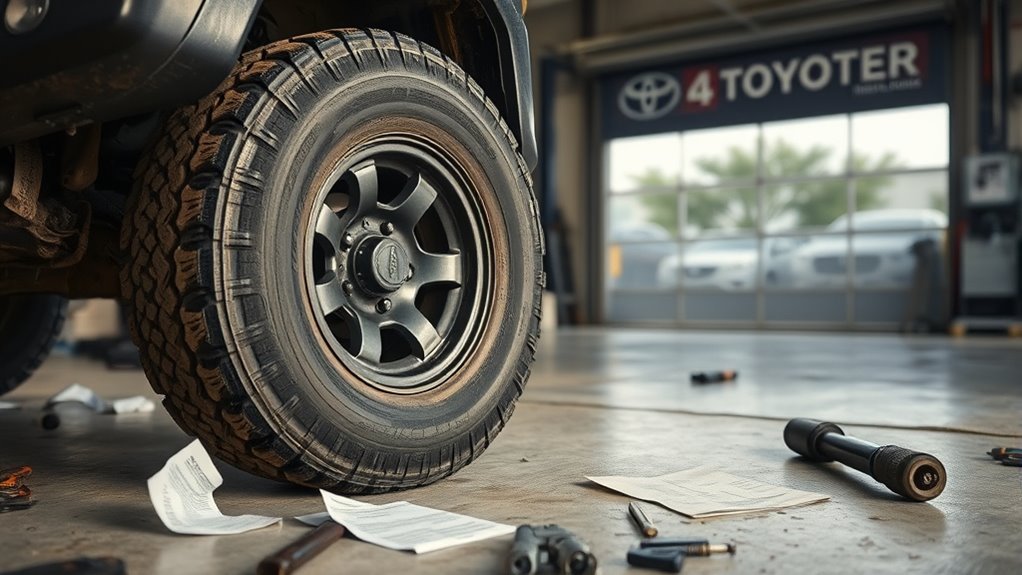
If you’re running aftermarket wheels or non-spec tires on your 4Runner, your coverage is already compromised. You must obtain dealership sign-off before modifying tire or wheel specifications, or you forfeit protection entirely.
You navigate maintenance pitfalls every time you service outside authorized channels. Some warranty loopholes explicitly demand dealership maintenance records; skip this, and you void your coverage retroactively. You assume risk with every independent mount and balance—improper technique becomes grounds for claim denial.
Independent service puts your warranty on the line—dealership records aren’t optional, they’re protection.
You face additional exposure with curb damage claims. Non-factory rims nullify this protection unless you’ve confirmed specifications directly with your dealer. You also need to recognize that road hazard policies exclude cosmetic wheel damage entirely; alloy scuffs come out of your pocket regardless.
You liberate yourself from these traps through rigorous documentation, specification verification, and understanding exactly where your policy boundaries lie. Precision protects your investment.
How to Cancel Dealer Tire Protection and Get Your Refund
Why continue paying for compromised coverage? You initiate the cancellation process by contacting your originating dealership immediately—delay amplifies financial bleed. Request their specific termination protocols; most dealers mandate written submission including your plan details and personal identifiers. Scrutinize your agreement’s prorated refund calculations; you’re reclaiming residual value, not full premium. Document every correspondence—your paper trail insulates against processing failures. Monitor the refund timeline aggressively; institutional inertia thrives on your disengagement. Execute within grace periods to maximize recovery. This isn’t passive consumerism—it’s strategic extraction from a depreciating asset. Your 4Runner demands tires that perform, not bureaucratic entanglements that drain. Act. Recover. Redirect capital toward genuine mechanical resilience.
The DIY Alternative: Building Your Own Tire Replacement Fund
Extract yourself from dealer dependency entirely by constructing a self-directed tire reserve. You establish tire savings strategies by allocating $20–$30 monthly into a dedicated high-interest account. Over 24–36 months, this compounds into $480–$1,080—sufficient to absorb single or multiple tire failures without liquidity strain.
You eliminate premium leakage, administrative friction, and claim denial risk. Calculate your exposure: four tires at $100–$300 each creates a $400–$1,200 liability. Size your emergency fund to this threshold plus 20% contingency for mounting and alignment. You retain complete capital control, deploy funds instantly, and circumvent insurer profit extraction.
This framework demands discipline, not complexity. You automate transfers, segregate the account, and treat tire reserves as non-negotiable infrastructure. The payoff: operational autonomy. You resolve failures on your timeline, select preferred vendors, and preserve capital for superior allocation. Insurance dependency dissolves; financial sovereignty accrues.
Who Actually Needs Tire Insurance (and Who Should Skip It)

Where exactly does tire insurance fit within your 4Runner’s risk architecture? You need to calibrate your exposure profile against actual driving conditions.
| Risk Factor | High-Need Profile | Skip-It Profile |
|---|---|---|
| Terrain | Rugged/off-road, urban hazards | Well-maintained highways |
| Tire History | Frequent damage/replacement | Proven tire longevity |
| Usage | Daily commuting, long distances | Occasional recreational |
| Financial Priority | Peace of mind, predictable costs | Self-insured tolerance |
| Cost-Benefit | $20/tire beats replacement | Premiums exceed repair costs |
You face elevated risk if you’re traversing pothole-riddled streets or rocky trails—road hazards don’t negotiate. Your replacement frequency signals whether insurance functions as smart hedging or wasted premium. Scrutinize policy exclusions; coverage gaps erode value fast. If your track record demonstrates tire longevity and your routes minimize urban hazards, you’re liberating capital by self-insuring. Calculate your break-even: two destroyed tires typically justify the package. Choose deliberately.
Toyota’s Platinum Package vs. Tire Shop Warranties: Key Differences
How exactly do Toyota’s Platinum Tire Protection Package and third-party tire shop warranties diverge in their risk-transfer mechanics?
You’ll find the Platinum Package accepts aftermarket tires without requiring direct Toyota purchase, expanding your sourcing freedom. However, coverage caps at specific models—primarily 20-inch rim vehicles—while your 5th gen 4Runner likely runs 265/70R17s. Verify tire size with your dealership before committing; mismatch voids protection.
Third-party warranties, like Discount Tire’s road hazard coverage near $130 for four tires, undercut dealership pricing substantially. You’re also gaining transferable coverage and lifetime balance/rotation services—maintenance benefits the Platinum Package typically excludes.
Critical Warranty Exclusions demand scrutiny: dealership plans often nullify aftermarket wheel protection when curb damage occurs. You’re absorbing risks you assumed were transferred. Tire shop agreements generally lack such punitive clauses against wheel modifications.
Calculate your total cost of ownership against actual replacement frequency. You’re optimizing capital allocation by selecting mechanisms aligned with your modification trajectory and driving environment.
Frequently Asked Questions
Are 4runners Expensive to Insure?
Your 4Runner’s insurance rates run $1,200-$1,800 yearly—higher than sedans due to SUV repair costs, though you’ll offset this through manageable maintenance costs and potential safety feature discounts that reduce your long-term risk exposure.
Does Toyota Cover a Nail in a Tire?
Toyota’s Tire Protection Package may cover nail damage, but you’ll need to verify your specific warranty coverage terms. Check your tire maintenance exclusions and confirm with your dealer before assuming protection applies.
Conclusion
You’ve crunched the numbers, weighed the risks, and mapped your driving reality. For most 4Runner owners running stock setups on pavement, you’re self-insuring profitably. But take it from Marcus in Moab: his $1,200 35″ mud terrain replacement after a sidewall slice on Fins & Things? That dealer policy paid 3x its premium. Your call hinges on terrain, tire cost, and your appetite for volatility. Build the fund or buy the peace—just don’t drift into the decision.

Related Articles
How Long Do OEM Tires Last on a New 4Runner
Good 4Runner owners know OEM tires wear surprisingly fast—here's what determines whether yours last 15,000 or 65,000 miles.
Read More
Tire Chain Requirements for a Toyota 4Runner by State
Informed drivers know tire chain requirements for their Toyota 4Runner vary by state—discover essential regulations and avoid costly fines.
Read More
Does Tire Brand Really Matter for Off-Road Performance
It's not just the tread—discover which hidden engineering features separate recovery calls from conquered trails.
Read More