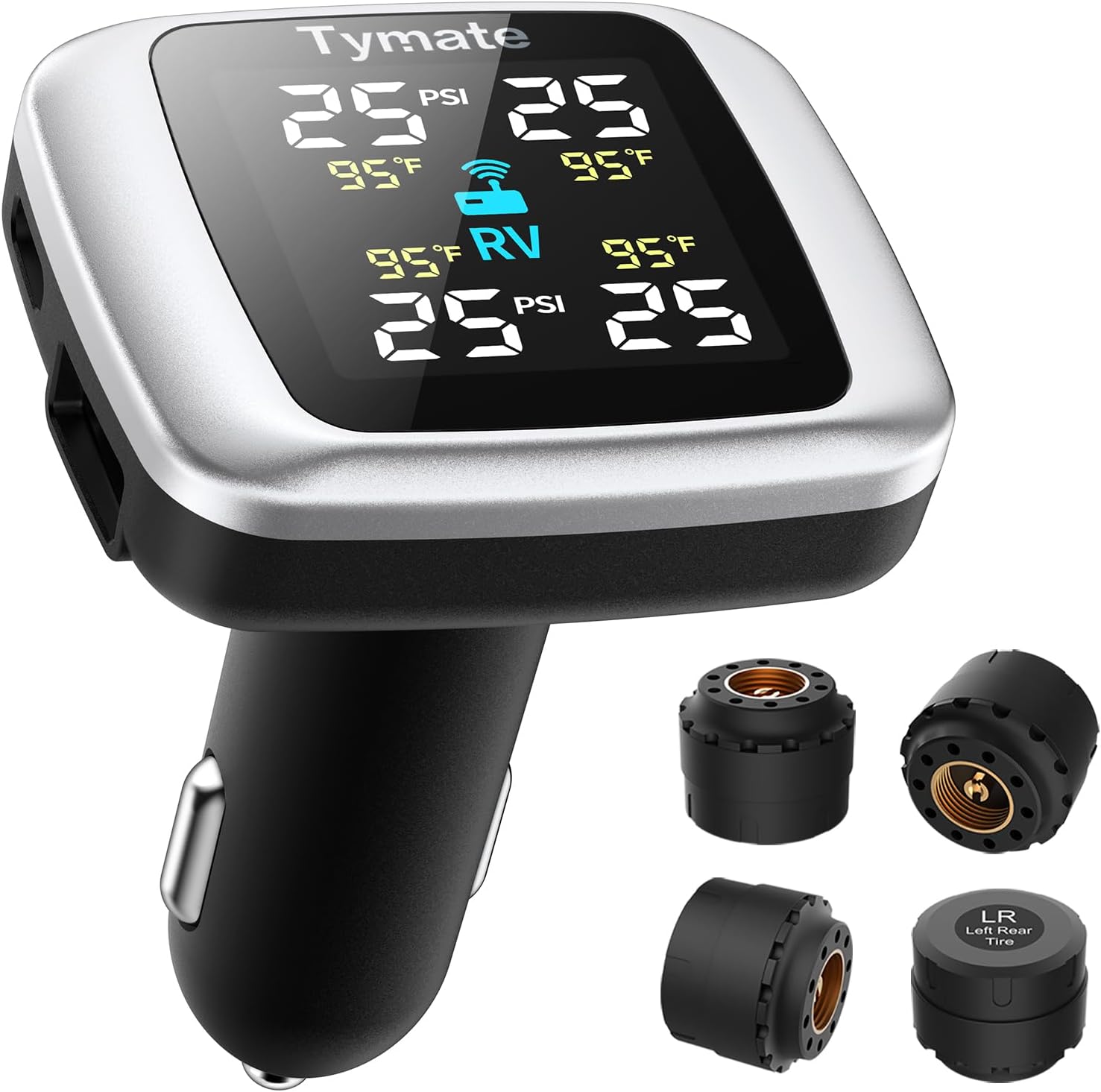
Troubleshooting the 4Runner Tire Pressure Monitoring System
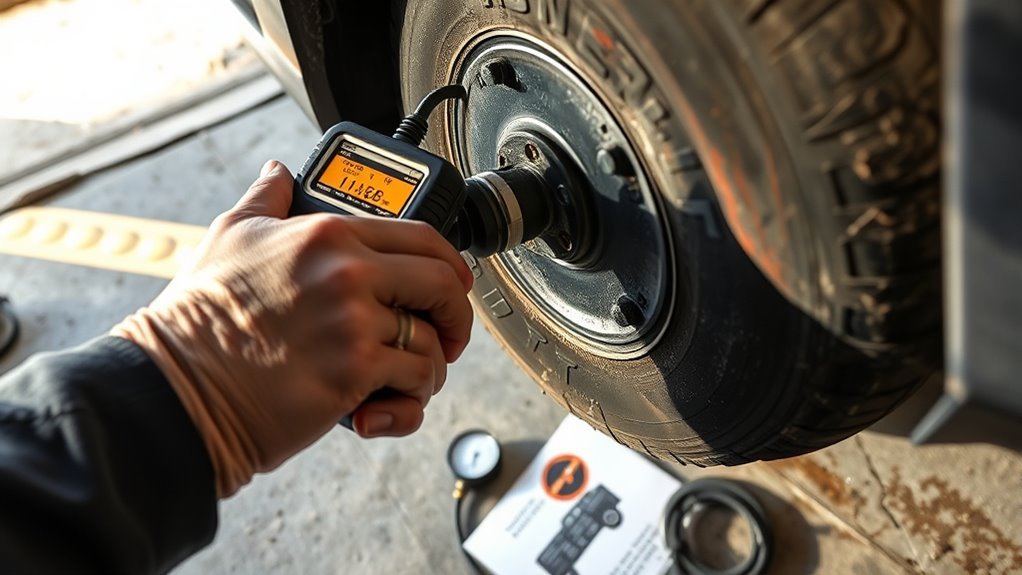
Start your 4Runner TPMS troubleshooting by verifying cold tire pressure at 33 psi, then reset the system using the driver-side dashboard button until the light blinks three times. Drive 25 mph for 10-30 minutes to allow sensor registration, as highway speeds accelerate calibration faster than city driving. If the light persists beyond 20 miles, you’re likely facing sensor battery depletion or protocol communication failure rather than a simple registration issue. The deeper diagnostics below will pinpoint whether you need a $50 reprogram or a $200 replacement.
The Fastest Way to Reset Your 4Runner’s TPMS

Reset your 4Runner’s TPMS in minutes by parking on level ground and inflating all four tires to the manufacturer’s specified cold pressure—typically 33 psi. Turn your ignition to ON without starting the engine, then locate and press the TPMS reset button beneath the driver-side dashboard. Hold until the warning light blinks slowly three times—your system’s resetting.
Drive at 25 mph for ten to thirty minutes to complete TPMS calibration tips you’ve now initiated. The warning light extinguishes automatically once finished. You’re free from dashboard distractions and false alarms.
Drive at 25 mph for ten to thirty minutes to complete TPMS calibration. The warning light extinguishes automatically once finished—you’re free from dashboard distractions and false alarms.
Tire pressure importance cannot be overstated for system reliability. Check pressures monthly with a quality gauge—temperature swings and gradual seepage compromise readings. Proper inflation liberates you from premature tire wear, reduced fuel economy, and handling degradation.
This reset protocol restores functionality when sensors detect legitimate pressure discrepancies. Master this procedure, and you’ll resolve most TPMS issues independently—no dealership dependency required.
5 TPMS Failures Every 4Runner Owner Faces
Even when you’ve mastered the reset procedure, your 4Runner’s TPMS can still betray you through sensor failures that demand deeper troubleshooting. You will encounter four primary failure modes that require methodical diagnosis.
First, improper sensor installation during tire changes corrupts data transmission, forcing you into repeated sensor calibration cycles that never resolve. Second, aggressive rotation schedules disrupt wheel position mapping, causing individual sensors to drop offline without triggering immediate warning light activation—you must monitor for delayed readouts. Third, OEM sensor transfers to aftermarket wheels frequently fail to establish new communication protocols, leaving you with dead zones until reprogramming or replacement. Finally, seasonal temperature swings generate false positives; you’ll need disciplined pressure monitoring to distinguish legitimate alerts from environmental noise.
Your liberation from dependency requires understanding these failure signatures. When your warning light persists post-correction, you are confronting hardware malfunction, not operator error. Systematic elimination of these variables restores your authority over vehicle diagnostics.
Is Your TPMS Sensor Dead or Just Unregistered?
You’ve mapped the common failure modes, but you’re still staring at that warning light—now you need to determine whether you’re dealing with a failed component or a communication breakdown. Before condemning a TPMS sensor to the scrap heap, verify if it’s simply lost in the registration process.
Different sensor types behave differently during transfers to new wheels—some demand immediate reprogramming while others self-learn. Your diagnostic tools reveal the truth: an OBD-II scanner exposes non-reporting sensors versus confirmed failures.
Troubleshooting tips to isolate the culprit:
- Drive at 25 mph for 10-30 minutes to force automatic registration
- Check for delayed pressure readouts that eventually stabilize
- Scan for disconnected spare tire sensors triggering phantom malfunctions
- Monitor warning lights during varied driving conditions
Sensor lifespan matters, but premature replacement wastes money when re-registration suffices. Methodical elimination separates dead hardware from communication gaps—liberating you from unnecessary parts bills and persistent dashboard anxiety.
New Tire Installation: The #1 Cause of Persistent TPMS Lights
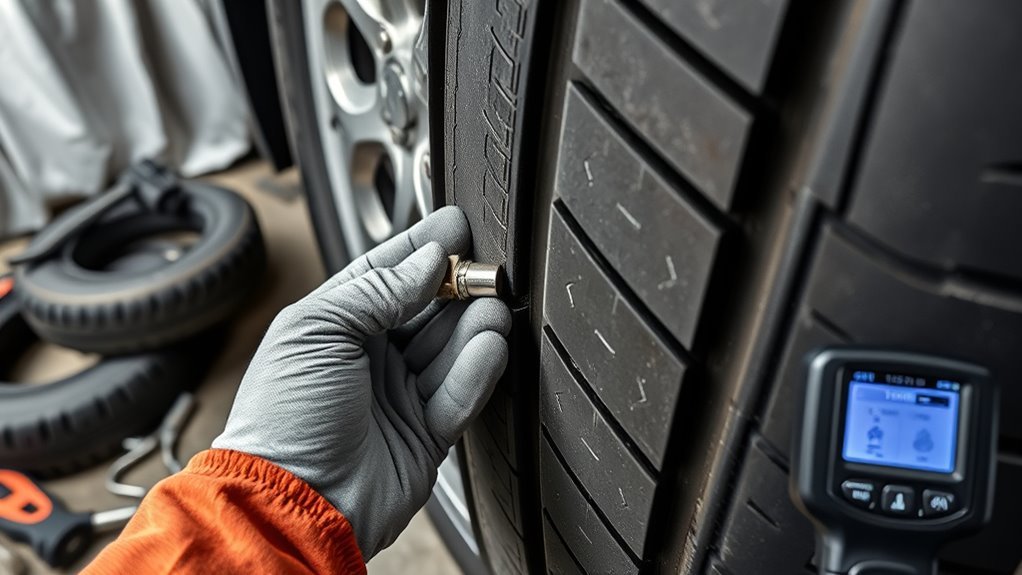
When you’re staring at that stubborn amber tire icon after fresh rubber’s been mounted, you’re almost certainly dealing with a registration failure rather than component death. Your technician likely skipped the critical initialization sequence that pairs each sensor to its new position.
New tire installation disrupts the established communication between your 4Runner’s computer and its TPMS sensors. Each sensor broadcasts a unique identifier, and your vehicle tracks these by wheel position. When tires move—or new ones arrive uninitialized—the system loses its reference points. You must demand proper sensor calibration before leaving the shop.
Frequent tire rotation compounds this vulnerability. Each shuffle risks decoupling sensors from their assigned locations, forcing another reset. Verify your valve stems are aluminum; rubber stems signal missing sensors or improper hardware. Don’t accept illuminated warnings as normal. You own this system—insist on functional TPMS that protects your investment without false alarms.
Why Highway Driving Fixes TPMS Faster Than City Streets
Fresh sensor registration won’t always silence that amber warning immediately—sometimes your 4Runner needs road time to complete the handshake. Highway driving accelerates sensor activation far more effectively than city crawling. At sustained 60-70 mph, you’re generating the consistent wheel rotation and airflow that TPMS modules crave for calibration.
Here’s why open road wins:
- Steady speed maintains stable tire pressure readings without interruption
- Extended 20-mile stretches allow complete sensor handshake cycles
- Uninterrupted airflow prevents the pressure fluctuations that confuse city trips
- Higher rotational frequency pings the receiver more reliably than stop-and-go traffic
Your short urban errands won’t cut it. Those five-mile commutes with traffic lights keep sensors in limbo, never reaching the threshold for full activation. When that light persists post-service, point your 4Runner toward the interstate. Give it distance, not duration. The system liberates itself through motion—specifically, the right kind of motion.
How Removing Your Spare Tire Breaks TPMS Registration
Because the TPMS treats your spare as an active network node, yanking it from the undercarriage creates an immediate communication gap that the module can’t ignore. Your 4Runner’s system expects five sensors; remove one, and you’ve triggered registration problems that cascade through the entire network.
| Component | Function | Consequence of Removal |
|---|---|---|
| Spare tire | Houses 5th TPMS sensor | System detects missing node |
| TPMS module | Manages sensor network | Cannot complete registration cycle |
| Pressure readings | Display individual tire data | Position errors or blank values |
| Dashboard | Alerts driver to faults | Persistent warning illumination |
You didn’t buy this rig to fight warning lights. Yet here you are—sensor issues corrupting your pressure readings because you liberated yourself from 50 pounds of steel. The module hunts for that fifth signal, fails, and throws codes. Check your manual. Some 4Runners need dealer intervention to re-register a four-sensor configuration. Others demand you restore the spare. Know your system’s architecture before you modify.
When DIY Fixes Fail: Signs You Need Professional TPMS Repair
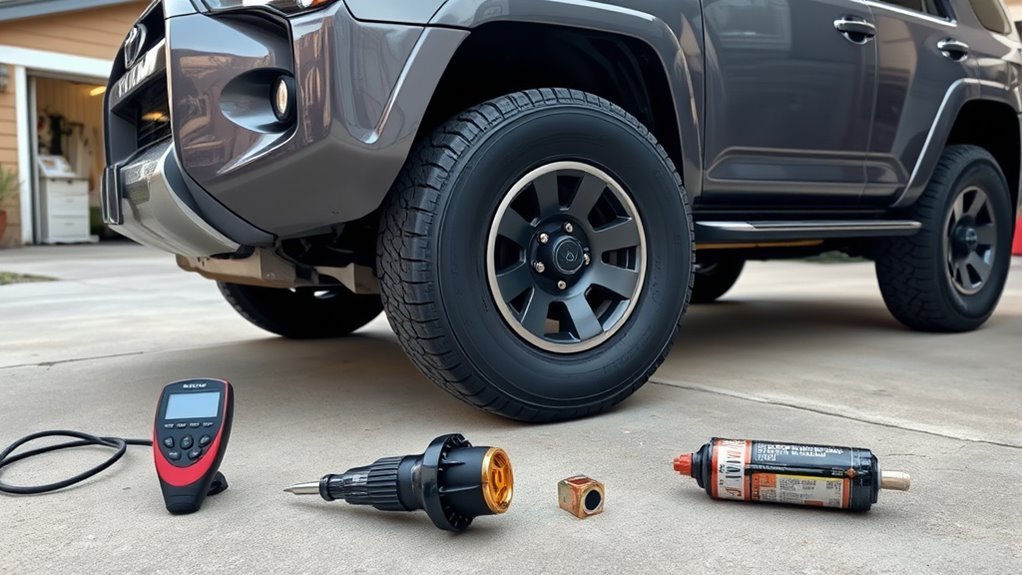
Though you’ve methodically checked pressures and cycled the ignition through the reset protocol, that amber warning persists—an indicator that your 4Runner’s TPMS has moved beyond the reach of driveway diagnostics.
Certain symptoms demand professional intervention. Recognize these critical thresholds:
- Persistent illumination after verified proper inflation signals potential sensor malfunction requiring dealer-grade diagnostic tools
- Erratic readings following tire service suggest corrupted sensor registration or physical damage
- Intermittent warnings without pressure fluctuations indicate electrical faults in the monitoring circuit
- Recurrent low-pressure alerts despite confirmed inflation point to undetected tire leaks or failed valve-stem sensors
When reset procedures fail, you’ve exhausted consumer-level remedies. TPMS architecture integrates wheel-mounted transmitters, receiver modules, and body control computers—systems demanding proprietary scan tools for accurate fault isolation. Continuing to operate with compromised monitoring undermines the safety net designed to prevent blowouts and uneven wear. Professional technicians possess the equipment to identify whether you’re facing individual sensor failure, antenna interference, or module corruption. Escalate promptly; accurate pressure data preserves both tire longevity and your autonomy on the trail.
Reprogram or Replace? The $50 vs. $200 TPMS Decision
When that TPMS light refuses to extinguish, you’re weighing a $50 reprogramming against a $200+ sensor replacement—and the wrong choice wastes money without fixing the underlying fault.
Start your troubleshooting tips with sensor lifespan assessment. Check your 4Runner’s service records; sensors older than 5-7 years often suffer battery depletion or seal degradation. If reprogramming fails, you’ve likely identified damaged hardware requiring replacement.
Your cost analysis must factor recurrence. Repeated $50 reprogramming attempts on aging sensors exceed single replacement expenses. OEM sensors guarantee sensor compatibility with your 4Runner’s specific protocol, avoiding intermittent communication failures common with universal alternatives.
Consult your manual’s reprogramming sequence first—many Toyota models allow owner-initiated relearn procedures. If the light persists after proper execution, professional diagnostic scanning reveals whether you’re addressing protocol errors or hardware failure. Choose replacement when sensors approach end-of-life; reprogram only when age and condition support continued operation.
Why Your TPMS Light Needs 20 Miles to Turn Off
While you’ve corrected your tire pressures and perhaps initiated a reset, your 4Runner’s TPMS light stubbornly glows for roughly twenty miles—and that’s by design, not malfunction.
Your TPMS requires this distance to complete sensor calibration. During these miles, the system continuously samples pressure data from each wheel-mounted transmitter, establishing new baseline values after your pressure adjustment. This isn’t idle waiting; it’s active verification.
Several factors influence how quickly your light extinguishes:
- Highway speeds accelerate pressure registration versus stop-and-go city traffic
- Cold ambient temperatures extend calibration duration
- Aftermarket wheels may introduce signal interference
- Simultaneous pressure adjustments on multiple tires demand additional sampling cycles
Verify you’ve achieved proper inflation before resetting—chronic underinflation prevents light extinguishment regardless of distance driven. If illumination persists beyond twenty miles, you’ve likely encountered sensor malfunction or improper installation requiring diagnostic intervention. Your patience during this calibration window verifies accurate, reliable monitoring.
Essential TPMS Tools for 4Runner Owners
Three tools form the foundation of effective TPMS management for 4Runner: a precision tire pressure gauge, a capable OBD-II scanner, and a portable air compressor. You need these TPMS tools to maintain autonomy over your vehicle’s health without dealer dependency.
Your tire pressure gauge eliminates guesswork. Check cold pressure monthly—before TPMS warnings appear. You catch deviations early, preventing premature wear and fuel waste.
Your OBD-II scanner reveals what dashboard lights obscure. You identify non-reporting sensors, pinpoint malfunction codes, and verify system integrity without service bay queues.
Your portable air compressor delivers immediate correction. You adjust tire pressure anywhere, resetting thresholds on your terms.
Consider aluminum valve stems visual confirmation of TPMS-equipped wheels. Add a reset tool for post-rotation recalibration.
These instruments transfer diagnostic power to you. You monitor, diagnose, and resolve independently—no appointments, no delays, no uncertainty.
Frequently Asked Questions
Why Is My Tire Pressure Light Blinking When My Tires Are Fine on My Toyota?
Your blinking light signals a TPMS sensor malfunction or recalibration needed, not low pressure. You’ve got a faulty sensor, installation issue, or uncalibrated system after tire service. Drive 20 miles to reset it.
How Much Does It Cost to Replace a Tire Sensor on a 4runner?
You’ll spend $75–$225 per sensor replacement, like Maria who paid $180 at her dealer for OEM reliability. Your tire sensor types matter—aftermarket saves cash, but OEM liberates you from repeat failures.
Why Is My Toyota Saying Low Tire Pressure but the Tire Looks Full?
Your tire pressure reading likely stems from a sensor malfunction or actual underinflation invisible to the eye. Check pressure manually with a gauge—slow leaks, temperature drops, or damaged sensors can all trigger false warnings despite appearances.
Conclusion
Your 4Runner’s TPMS isn’t a cryptic riddle—it’s a precision instrument demanding methodical attention. You’ve mapped the sensor landscape, weighed reprogramming against replacement, and learned patience beats brute force. Treat this system like clockwork: calibrated, deliberate, exact. When the light extinguishes after those twenty miles, you’ll know you’ve mastered the machine’s language. Drive confidently; your tires now speak truthfully.

Related Articles

4Runner Hub Centric Ring Install: Tips to Avoid Problems
Never install hub centric rings on your 4Runner without checking this critical measurement first—it could destroy your wheels.
Read More
Can You Use Run-Flat Tires on a Toyota 4Runner
Not all run-flat tires are suitable for your Toyota 4Runner; discover essential tips to ensure you make the right choice.
Read More
Tire Tread Pattern Types: Symmetrical, Directional, and More
Uncover the secrets of tire tread patterns—symmetrical, directional, and more—essential for your vehicle's performance and safety. Discover which design suits your needs best!
Read More