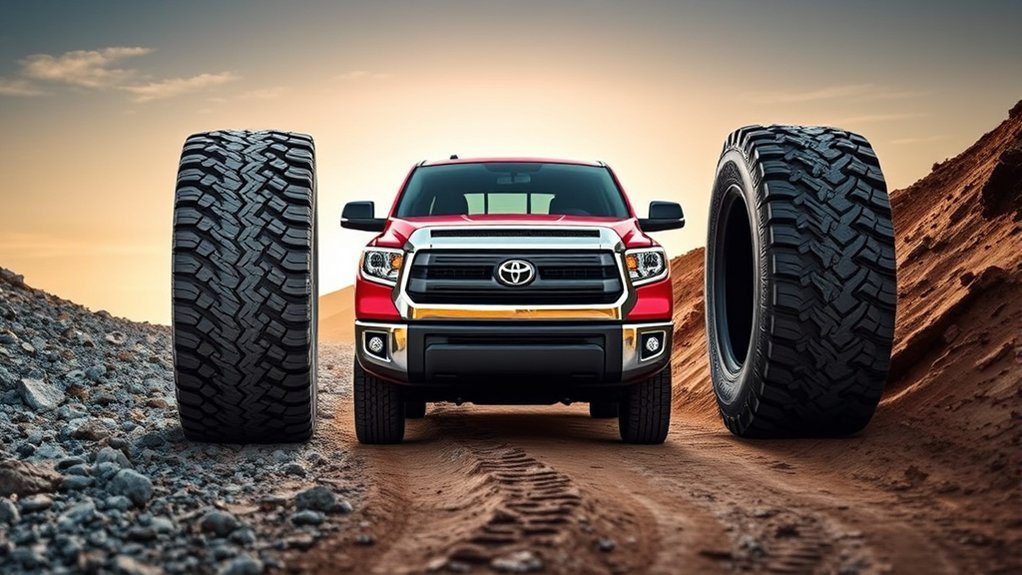
Choosing between all-terrain and mud-terrain tires for your Toyota Tundra comes down to where you drive most often. All-terrain tires usually suit daily driving, towing, gravel roads, and occasional trails. Mud-terrain tires make more sense when deep mud, loose soil, rocks, and demanding off-road routes are a regular part of your driving.
Quick Answer
Choose all-terrain tires if your Tundra spends most of its time on pavement with occasional trail, gravel, or snow use. Choose mud-terrain tires if you regularly drive through deep mud, loose dirt, or rocky terrain and accept more road noise, firmer handling, faster pavement wear, and potentially higher fuel use.
Key Takeaways
- All-terrain tires are the better default for commuting, highway travel, towing, gravel roads, and moderate off-road use.
- Mud-terrain tires provide more bite in deep mud and loose terrain because of their larger tread blocks and wider voids.
- Mud-terrain tires are generally louder and less refined on pavement, but noise and wet-road performance vary by model.
- Do not choose a tire by tread appearance alone. Match the size, load capacity, speed rating, and inflation requirements for your exact Tundra.
- For frequent snow or ice, check for the three-peak mountain snowflake symbol and consider dedicated winter tires for severe conditions.
All-Terrain vs. Mud-Terrain Tires: Which Is Right for Your Tundra?
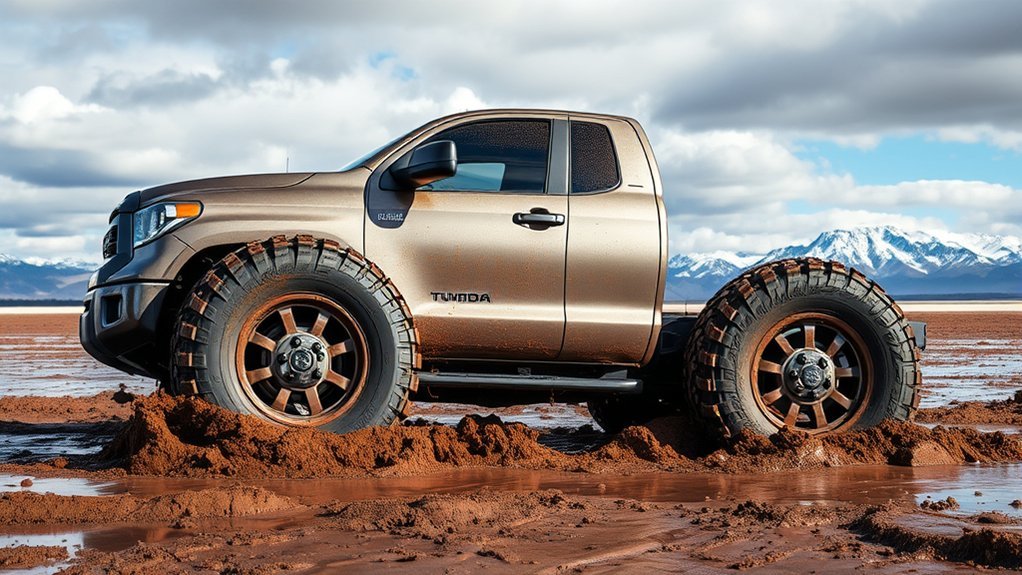
NHTSA describes all-terrain tires as a compromise between on-road driving and off-road capability. Their tread patterns normally include smaller voids, more tread contact with the road, and additional edges or sipes compared with most mud-terrain designs.
Mud-terrain tires use larger, more widely spaced tread blocks. The open spaces help the tread release mud and loose material instead of packing solid. Many models also add aggressive shoulder blocks and reinforced sidewall features for difficult trails.
Those designs create different strengths. An all-terrain tire usually feels more settled during commuting and highway travel. A mud-terrain tire normally provides more usable traction when the trail surface becomes deep, soft, loose, or heavily rutted.
| Comparison | All-Terrain | Mud-Terrain |
| Best use | Daily driving with occasional trails, gravel, dirt, or snow | Frequent deep mud, loose soil, rocks, and demanding off-road routes |
| Highway comfort | Usually smoother and quieter | Usually louder with more tread vibration |
| Deep mud | Suitable for light or occasional mud, depending on the model | Stronger self-cleaning and forward traction |
| Wet pavement | Often more road-focused, but performance varies by model | Large tread blocks may feel less precise; check individual test results |
| Tread life | Often better for high pavement mileage | May wear faster when used mainly on pavement |
| Fuel use | Usually the more efficient of the two categories | Extra mass and aggressive tread can increase fuel use |
| Snow | Some models carry 3PMSF certification | Aggressive appearance does not guarantee strong packed-snow or ice traction |
| Best Tundra owner | Commuter, traveler, tower, camper, or occasional trail driver | Dedicated off-road driver who regularly needs maximum loose-terrain traction |
[Products Worth Considering]

The SAFELIFE dial tire tread depth gauge measures tread depth in 1/32 inch increments with clear, easy-to-read 2-inch dial face. Color zones using a traffic light system help you quickly judge whether tread is low, marginal, or ample for safer driving. Built with a durable zinc cast body and a metal detect probe for precise, comfortable use across cars, motorcycles, trucks, and buses.

These universal tire valve stem caps help protect valve cores from dust, debris, and moisture while helping maintain stable tire pressure. The corrosion-resistant metal construction and sealed design provide reliable protection in road grime, mud, and winter conditions. Twist-on installation makes them quick to fit on cars, SUVs, trucks, and motorcycles.

Monitor tire tread wear with a smart, color-coded depth gauge that shows clear condition ranges at a glance. The bar is range marked for fast, easy readings, helping you maintain safer traction and performance. Each gauge is portable with a pocket clip, and the set includes 20 units for daily use and sharing.
How Tread Design Changes Performance
All-terrain tires keep more rubber in contact with the pavement. Their smaller tread voids can improve steering consistency, road manners, and noise control. Many models also include siping, which creates additional biting edges for wet roads and light snow.
Mud-terrain tires leave more open space between their tread blocks. According to Continental’s tire-type guidance, these large, aggressive blocks are designed for soft surfaces such as mud and loose terrain. The voids give displaced material room to escape as the tire rotates.
Sidewall construction also matters. Some off-road tires add reinforced sidewalls, protective shoulder features, or extra rubber around vulnerable areas. However, construction varies by model, so you should check the manufacturer’s specifications rather than assuming every mud-terrain tire has the same protection.
Performance: Off-Road vs. On-Road
Pavement and Highway Driving
All-terrain tires normally provide the better compromise for a Tundra that spends most of its time on paved roads. They tend to offer more predictable steering, less tread vibration, and lower noise than mud-terrain tires.
Do not assume every all-terrain tire has excellent wet grip. Tire compounds, tread depth, siping, casing design, and wear can produce major differences between models. Compare wet-braking tests for the exact tire and size whenever those results are available.
Gravel, Dirt, and Forest Roads
All-terrain tires work well for maintained dirt roads, gravel, campsites, job sites, and moderate trails. Their tread offers more loose-surface grip than a typical highway tire without creating the same pavement compromises as most mud-terrain designs.
A mud-terrain tire can still perform well on these surfaces, but its additional capability may be unnecessary when deep mud and difficult obstacles are rare.
Deep Mud, Rocks, and Loose Terrain
Mud-terrain tires become more useful when the tread must dig through soft material and clear itself repeatedly. Their large voids reduce mud packing, while aggressive shoulder tread can help when the truck sinks into ruts.
For rocky routes, look beyond the category label. Sidewall construction, puncture resistance, tread durability, and the tire manufacturer’s intended use are more informative than tread appearance alone.
Sand requires a different approach. A highly aggressive tread can dig downward when the driver applies too much throttle. Tire pressure, vehicle weight, driving technique, and flotation can matter as much as the AT or MT label.
What Noise, Ride, and Steering Changes Should You Expect?
All-terrain tires usually produce less tread noise than mud-terrain tires. A well-designed all-terrain model may remain comfortable during long highway trips, although it will often be more noticeable than a road-focused highway tire.
Mud-terrain tires commonly produce a hum, growl, or rhythmic tread sound that becomes more obvious as speed increases. Noise may also grow as the tread wears unevenly.
Ride comfort depends on more than the tread pattern. An LT tire with a heavy casing or higher load range may feel firmer than a lighter P-metric tire. Tire pressure, wheel diameter, sidewall height, and vehicle load also affect how much impact reaches the cabin.
Pro Tip: If a previously quiet tire develops a new roar, vibration, or pulsing sound, inspect its pressure and tread wear. Cupping, poor balance, worn suspension parts, or incorrect alignment can create more noise than the original tread design.
How Long Will Each Tire Last?
No reliable mileage range applies to every all-terrain or mud-terrain tire. Two tires in the same category can use different compounds, tread depths, casing designs, and warranties.
All-terrain tires often provide better longevity when a Tundra accumulates most of its mileage on pavement. Mud-terrain tires may wear faster during frequent highway use because their large tread blocks can flex, heat, and develop irregular wear.
Your results will depend on:
- Inflation pressure: Underinflation increases heat and shoulder wear, while overinflation can concentrate wear near the center.
- Rotation: Regular rotation helps control front-to-rear and side-to-side wear differences when the tire design allows it.
- Alignment: Incorrect toe or camber can destroy an expensive set of tires early.
- Towing and payload: Extra load increases heat and stress.
- Driving surface: Sharp rock, rough pavement, mud, and gravel create different wear patterns.
- Driving style: Hard acceleration, heavy braking, and fast cornering increase wear.
- Tire model: Warranty coverage and tread compounds vary within both categories.
NHTSA recommends checking pressure and tread at least monthly, balancing new tires, correcting alignment problems, and following the vehicle manufacturer’s rotation guidance. Tires should be replaced when damaged or worn to the treadwear indicators, even if a mileage warranty has not expired.
How Do Tire Weight and Tread Affect Fuel Economy?
All-terrain tires usually place less of a fuel-economy penalty on a Tundra than similarly sized mud-terrain tires, but there is no universal MPG difference.
The EPA explains that tire materials, construction, and tread design influence rolling resistance. Tire weight, width, diameter, inflation, wheel weight, vehicle speed, temperature, and driving conditions also affect fuel use.
A larger or heavier tire can require more energy during acceleration. A wider tread and aggressive pattern can also increase rolling and aerodynamic resistance. The result may be slower acceleration, more frequent transmission shifting, and lower fuel economy, but the size of the change depends on the complete truck setup.
The tire category alone cannot predict your MPG. Size, mass, inflation pressure, tread design, wheel weight, speed, load, and driving conditions all contribute.
Cost Comparison and Total Ownership
Do not rely on one fixed price range for all-terrain or mud-terrain tires. A Tundra may use several wheel diameters and tire sizes depending on its model year, trim, options, and modifications. LT construction and higher load ranges can also raise the purchase price.
Compare the complete installed cost:
- Price of four matching tires
- Mounting and balancing
- New valve components or TPMS service when required
- Alignment inspection or adjustment
- Road-hazard coverage
- Manufacturer mileage warranty and exclusions
- Expected pavement wear for your use
- Possible fuel-economy changes
- Replacement availability in your tire size
An all-terrain tire often provides better total value for a daily-driven Tundra because it normally offers a more useful balance of road comfort, wear, and trail capability. A mud-terrain tire can still be the better investment when getting through difficult terrain matters more than highway refinement.
[Products Worth Considering]

Measure tire tread depth quickly and accurately with this LUMITECO dial gauge that reads in 1/32" increments up to 14/32". The color-coded green/yellow/red zones make it easy to judge tire wear and know when replacement is needed. A rugged, compact design with a protective pouch helps keep the gauge ready for use on cars, trucks, motorcycles, and more.

Accurately measure tire tread depth with a calibrated gauge marked from 0 to 1 inch in 1/32 inch increments. The color-coded bar helps you quickly identify tread condition ranges, supporting safe driving for trucks, motorcycles, automobiles, and passenger vehicles.

Orange Seal regular formula tubeless sealant quickly seals punctures and forms a durable bond inside your tire to help reduce flats. Made with natural latex, it adheres effectively to rubber and seals from the inside out, including the critical bead-to-rim interface for a reliable ride. It seals punctures up to 1/4 inch, slices up to 3/4 inch, and performs in temperatures as low as 11°F across MTB, road, cyclocross, gravel, and e-bike applications.
Tundra Fitment, Load Rating, and Towing Safety
Before comparing tread patterns, identify the correct tire specification for your exact Tundra. Toyota has used different tire sizes across generations, trims, wheel packages, and configurations.
Check the driver-door Tire and Loading Information label and the Toyota owner’s manual for your model year. Confirm:
- Original tire size
- Recommended cold inflation pressure
- Required load capacity or load index
- Wheel diameter and width compatibility
- Speed rating
- Payload and towing requirements
- Clearance around suspension, brakes, fenders, and bodywork
Warning: Never install a tire with insufficient load capacity for the truck, passengers, cargo, trailer tongue weight, and intended towing use. Use the cold pressure listed by Toyota for the approved tire setup, not the maximum pressure molded on the tire sidewall. Consult a qualified tire professional before changing tire size, construction, or load range.
P-Metric vs. LT Tires
Some Tundra owners consider switching from a passenger-type tire to an LT, or light-truck, tire. LT tires may offer a stronger casing and additional load capability in an appropriate size, which can help with heavy use and rough terrain.
However, an LT tire may also weigh more and ride more firmly. Its required pressure may differ from the original tire. Do not assume that a high sidewall maximum pressure is the correct everyday setting.
Oversized Tires and Wheels
Increasing tire diameter or width can change clearance, steering feel, effective gearing, braking response, acceleration, fuel use, and speedometer accuracy. A tire that fits while the truck is parked may rub when the suspension compresses or the steering reaches full lock.
Have the complete setup checked under steering and suspension movement. Significant size changes may also require wheel-offset, suspension, calibration, or drivetrain considerations.
Snow, Ice, and Rain Performance
Do not judge winter ability by an aggressive tread pattern. Wide mud-terrain voids may work well in loose material but do not automatically provide strong packed-snow, slush, or ice traction.
Look for the three-peak mountain snowflake, or 3PMSF, symbol when severe-snow capability matters. Transport Canada explains that tires carrying the symbol meet a defined snow-traction performance requirement.
The symbol does not mean every certified all-terrain tire performs like a dedicated winter tire on ice. Drivers facing frequent freezing temperatures, packed snow, or ice should consider four matched winter tires designed for those conditions.
For rain, compare model-specific wet-braking and hydroplaning results. Tread category alone does not tell you how quickly a tire will stop on wet pavement.
Note: The “M+S” or “M/S” marking is not the same as the three-peak mountain snowflake symbol. Check the actual sidewall markings and manufacturer specifications when winter traction is a priority.
Which Tire Should You Choose?
[Products Worth Considering]

The Continental Grand Prix 5000 is an allround road bike tire engineered for faster rolling, improved ride comfort, and enhanced puncture protection. It features a Vectran Breaker cut-protection layer, Lazer Grip micro-profile tread for confident cornering control, and Active Comfort Technology to damp vibration for smoother rides. BlackChili compound optimizes grip and speed for everyday performance and long-lasting confidence.

Keep your tires properly inflated with this analog VONDIOR tire pressure gauge, designed for fast, easy readings without batteries. The swiveling, two-axis hose and large glow dial help you measure at any tire angle with instant visibility. Built with a protective rubber shield, it supports durable, low-maintenance use for cars and trucks.
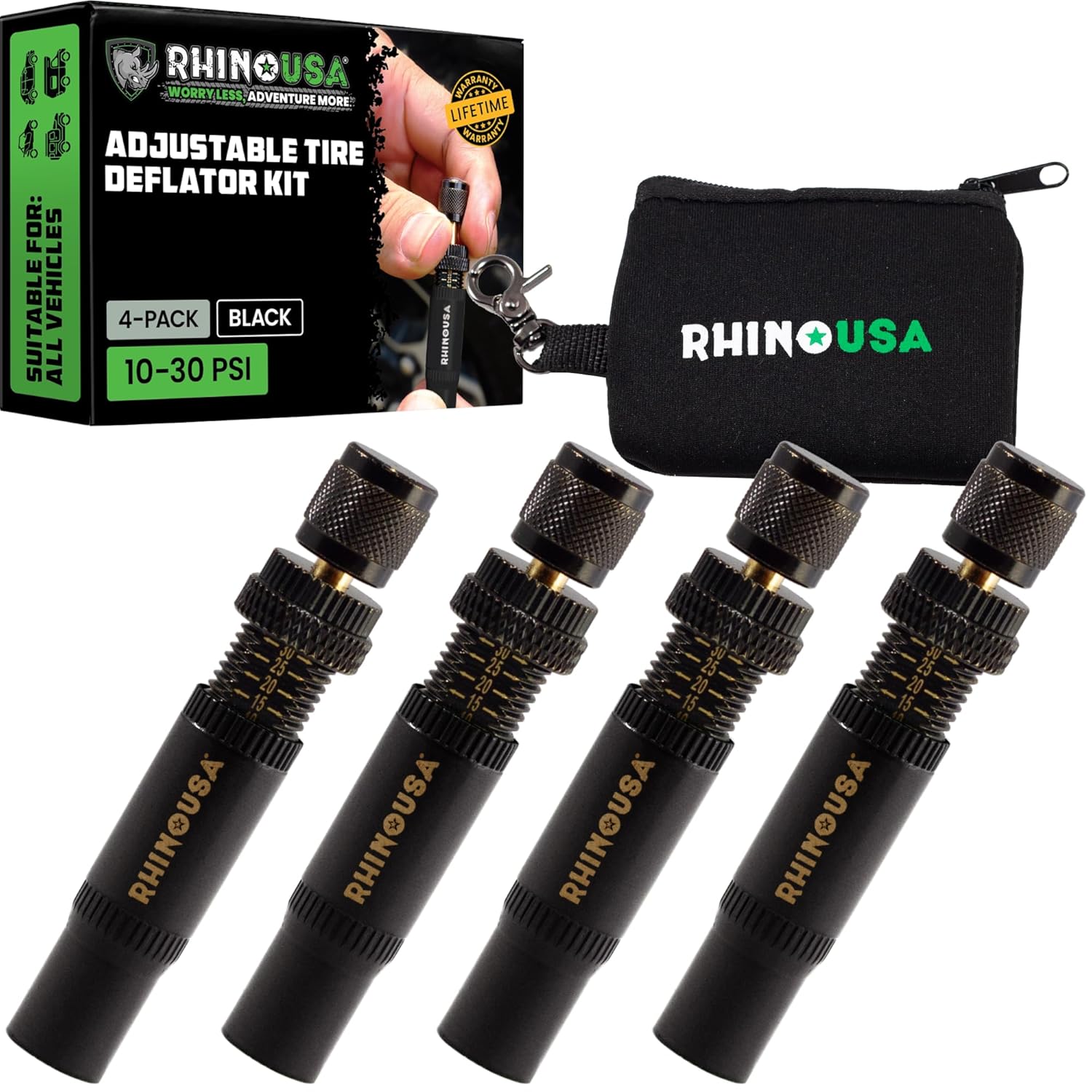
Use the Rhino USA adjustable tire deflators to air down all four tires at once by screwing one deflator onto each valve stem, letting you step away while the tires reach your preset pressure. Each deflator independently adjusts across a 10–30 PSI range with laser-etched indicators for quick setup and verification, making it ideal for beach, sand, and rocky off-road trails.
Choose All-Terrain Tires If
- Your Tundra is a daily driver.
- You spend most of your time on paved roads.
- You tow a camper, boat, or utility trailer on highways.
- You drive on gravel, dirt roads, job sites, or moderate trails.
- You value lower road noise and more predictable highway behavior.
- You want better pavement wear than a typical mud-terrain tire.
- You need occasional snow capability and can select an appropriate 3PMSF model.
Choose Mud-Terrain Tires If
- You regularly encounter deep mud or heavily rutted trails.
- Your off-road routes include loose soil, rocks, or difficult obstacles.
- Self-cleaning tread is more important than quiet highway travel.
- You accept additional tread noise and a firmer on-road feel.
- You are prepared for potentially faster pavement wear and higher fuel use.
- The selected model provides the correct size and load capacity for your Tundra.
Consider Rugged-Terrain Tires as a Middle Ground
Rugged-terrain or hybrid-terrain tires sit between traditional all-terrain and mud-terrain designs. They often use more aggressive shoulders and larger voids than an all-terrain tire while keeping more pavement-friendly tread through the center.
This category may suit a Tundra owner who wants stronger trail traction and appearance without moving fully to a mud-terrain tire. Noise, wet grip, and tread life still vary by model, so compare actual test results rather than relying on the category name.
Frequently Asked Questions
Do all-terrain tires last longer than mud-terrain tires?
All-terrain tires often last longer when most driving occurs on pavement, but no mileage range applies to every tire. Compare the exact model’s warranty, tread depth, construction, and test results. Inflation, rotation, alignment, towing, road conditions, and driving style also affect tread life.
Are all-terrain tires quieter than mud-terrain tires?
They are generally quieter because they use smaller tread voids and maintain more continuous contact with the pavement. However, individual all-terrain tires can still produce noticeable highway noise, especially as the tread wears.
Can you daily-drive a Tundra on mud-terrain tires?
Yes, provided the tires have the correct size and load capacity. Expect more tread noise, less refined steering, possible wet-road tradeoffs, and potentially faster wear than a pavement-focused all-terrain tire. A mud-terrain design is usually unnecessary when difficult off-road use is rare.
Are all-terrain tires good in snow?
Some are. Look for the three-peak mountain snowflake symbol and model-specific snow tests. A certified all-terrain tire can help in snow, but dedicated winter tires normally remain the stronger choice for frequent ice, packed snow, and sustained freezing temperatures.
Should you install LT tires on a Toyota Tundra?
LT tires may benefit heavy-duty, towing, hauling, or rough-road use when properly selected. They may also add weight and create a firmer ride. Match the tire’s size and load capacity to your truck, and have a qualified professional determine the correct inflation requirements.
Will larger all-terrain or mud-terrain tires reduce Tundra MPG?
They can, particularly when the replacement is heavier, wider, taller, or more aggressive than the original tire. There is no fixed MPG loss. Rolling resistance, inflation, wheel weight, speed, load, gearing, weather, and driving style determine the actual change.
Conclusion
For most Toyota Tundra owners, an all-terrain tire is the practical choice. It provides useful traction on gravel, dirt, campsites, and moderate trails while preserving more of the comfort, road manners, and tread life needed for everyday driving.
A mud-terrain tire is worth the tradeoffs when deep mud, loose soil, rocks, and difficult trails are regular driving conditions rather than occasional events. Before buying either type, verify the tire size, load capacity, cold inflation requirements, wheel fitment, and towing needs for your exact Tundra.
Sources
- National Highway Traffic Safety Administration: TireWise — tire selection, pressure, tread, rotation, sizing, and safety guidance.
- Toyota Manuals and Warranties — model-year-specific Tundra tire, loading, inflation, and maintenance information.
- Continental Tire Types Guide — all-terrain and mud-terrain tread design, intended use, noise, and road-comfort differences.
- U.S. Environmental Protection Agency: Vehicle Efficiency Technologies — relationship between tire construction, rolling resistance, and fuel efficiency.
- Transport Canada: Using Winter Tires — severe-snow markings, winter traction, matching tires, and cold-weather pressure guidance.