
Troubleshooting the 4Runner Tire Pressure Monitoring System
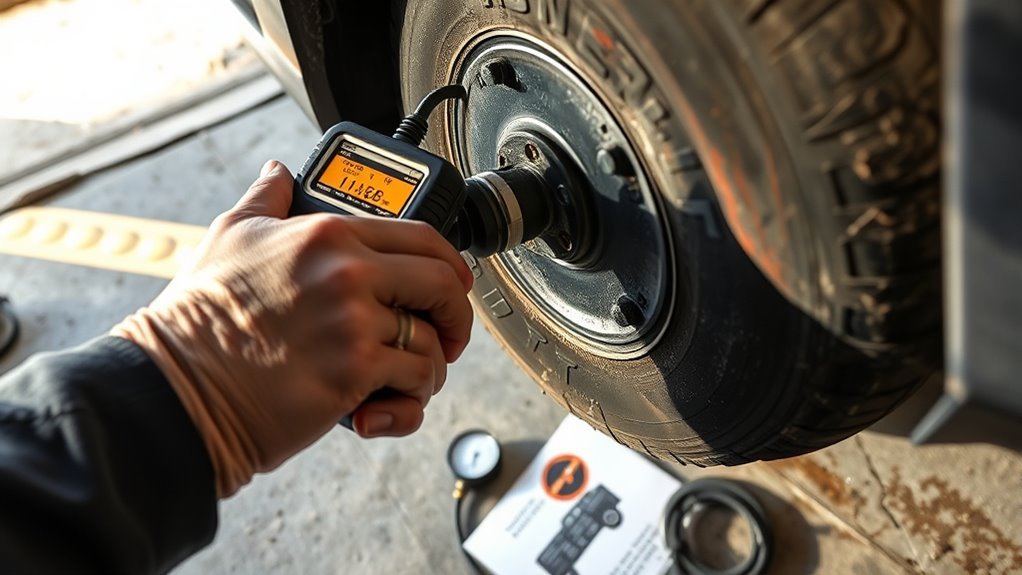
A Toyota 4Runner tire-pressure warning can mean two very different things: one or more tires are low, or the Tire Pressure Monitoring System (TPMS) has a fault. Start with an accurate cold-pressure check, not a reset. Then follow the procedure for your exact model year, because 4Runner controls and sensor-registration steps differ across generations and trims.
Quick Answer
Check every tire cold and inflate it to the pressure on the driver-door placard. A steady TPMS light usually points to low pressure; a light that flashes for about a minute and then stays on indicates a system malfunction. Use your model-year manual to initialize or register sensors, then seek TPMS-capable diagnostics if the warning remains.
Key Takeaways
- Use the cold pressure printed on your 4Runner’s tire-and-loading label. Do not assume every model uses 33 psi.
- A steady light and a flashing-then-steady light have different meanings and require different responses.
- Initialization, wheel-position learning, and sensor ID registration are separate procedures.
- A standard engine-code reader may not access TPMS data. Advanced diagnosis requires a TPMS-capable tool.
- Spare-tire monitoring varies by model year, tire package, and market, so confirm it in the owner’s manual.
At a Glance
| Time Required | 10 to 60 minutes, depending on whether the system only needs pressure correction or must complete registration |
| Difficulty | Easy for pressure checks and initialization; moderate for sensor diagnosis |
| Tools Needed | Accurate tire-pressure gauge, air source, model-year owner’s manual, and a TPMS-capable scan/activation tool for advanced faults |
| Cost | Often $0 for pressure correction; shop diagnosis, programming, and sensor replacement vary by location and sensor type |
Warning: Do not initialize the TPMS while a tire is underinflated. Doing so can store an unsafe pressure as the new reference. If a tire is visibly damaged, rapidly losing air, or unusually hot, stop driving and arrange repair.
Understand the TPMS Light Before Resetting
The warning pattern is your first diagnostic clue. According to the National Highway Traffic Safety Administration, a TPMS light that stays on usually means at least one monitored tire is significantly underinflated. Check all tires with a gauge as soon as it is safe.
If the light flashes for roughly 60 to 90 seconds and then remains on, the system has detected a malfunction. Possible causes include an unregistered sensor, a dead sensor battery, an incompatible replacement sensor, radio interference, or a damaged sensor. Driving farther may complete a registration procedure that is already in progress, but ordinary driving does not repair dead hardware.
| Warning Pattern | Most Likely Meaning | First Action |
|---|---|---|
| Steady light | Low pressure, a leak, or pressure affected by temperature | Inspect and measure every tire cold |
| Flashes, then stays on | TPMS malfunction or incomplete sensor registration | Check the manual and scan the sensors with a TPMS-capable tool |
| Comes on during cold weather, then goes off | A marginally low tire may cross the warning threshold as temperature drops | Set cold pressure to the door-placard specification |
[Products Worth Considering]
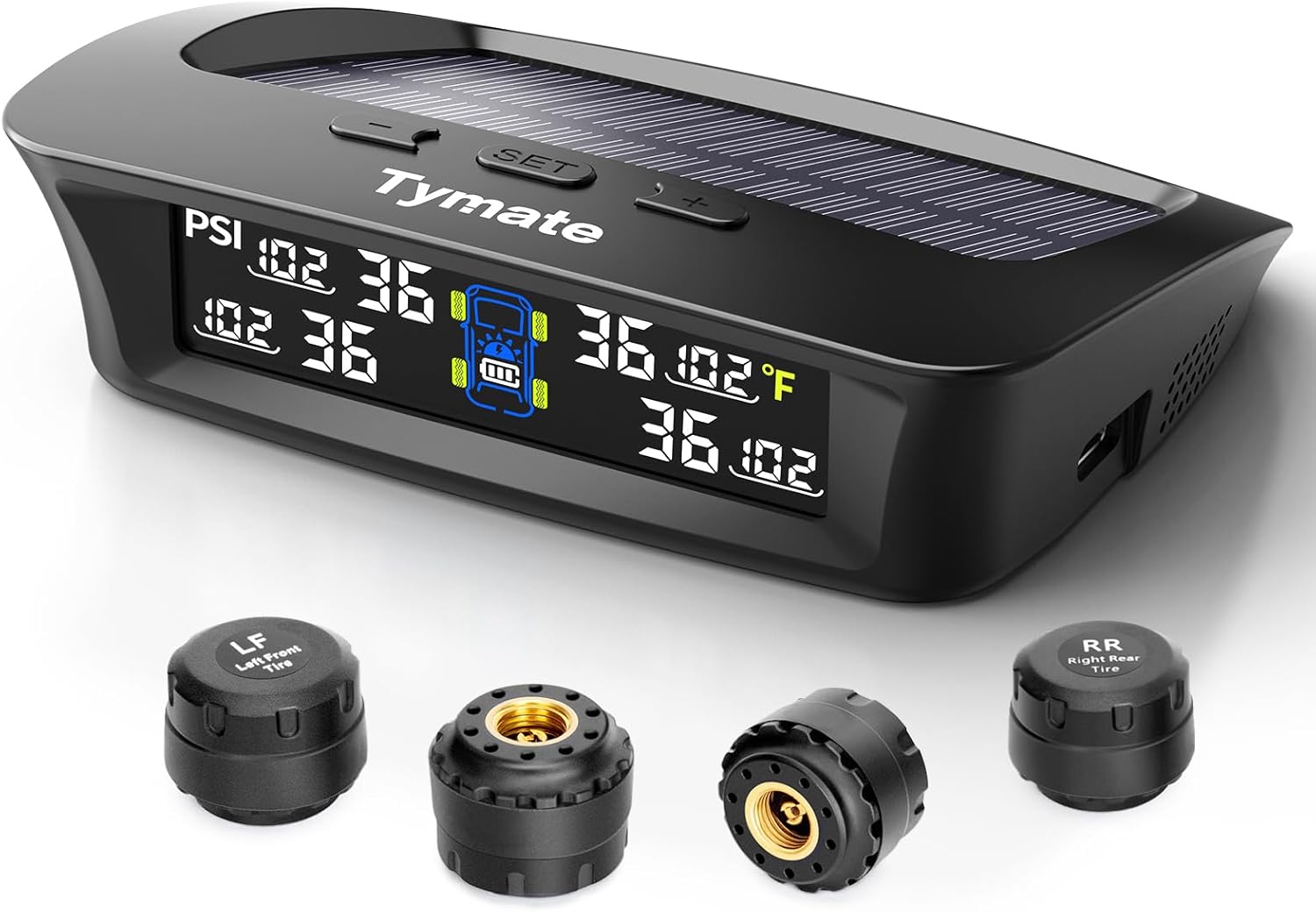
The Tymate TM3 RV TPMS delivers real-time tire pressure monitoring from 0 to 144 PSI with accurate readings and dependable wireless communication. It includes four external sensors with pre-pairing, six alarm modes for rapid leak, pressure extremes, temperature, and signal loss, plus an easy-reference setup for alert thresholds. Solar and USB-C charging help keep the display powered, while the color LCD and adaptive backlight improve visibility for safer driving and towing.

EVOULTES heavy duty tire inflator with an integrated gauge delivers accurate pressure readings from 10–120 PSI, helping you inflate, deflate, and check tires in one tool. The 16.5-inch extended dual-head air chuck with swivel base reaches hard-to-access dual wheel valves on trucks and RVs. A brass trigger core and side-mounted air release valve make operation smooth, with standard 1/4" NPT threading and quick-connect compatibility for easy setup.
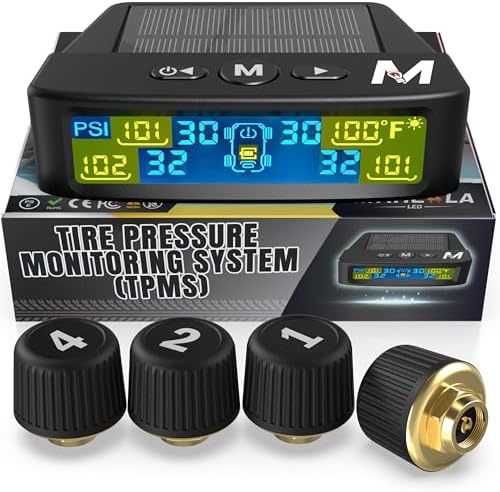
Marcala’s TPMS set of four sensors helps you monitor tire pressure and temperature in real time while driving, with updates every second. The bright color LCD uses auto-dimming for easy viewing, powered by dual solar and USB charging, and offers six alarm modes. Built for trailers, RVs, campers, trucks, and towing setups, the sensors support monitoring 1-4 wheels up to 98 PSI with IP67 waterproof protection.
The Fastest Safe Way to Reset Your 4Runner’s TPMS

Park on level ground and let the tires cool. A practical cold reading means the vehicle has been parked for several hours or driven only a short distance. Find the tire-and-loading label on the driver-side door jamb and set all monitored tires to that specification. The tire sidewall shows the tire’s maximum pressure, not the vehicle’s recommended operating pressure.
Next, use the initialization method listed for your exact model year. Toyota has changed the controls across 4Runner generations. Some older versions use a physical reset switch, while later versions use the multi-information display and a TPWS or “Set Pressure” menu. The safest reference is Toyota’s official owner-manual lookup.
Basic Reset Sequence
- Inspect each tire for nails, sidewall damage, valve leaks, and obvious underinflation.
- Measure the tires cold and adjust them to the driver-door placard.
- Turn the ignition on and follow the model-specific TPMS initialization command.
- Confirm the warning light blinks as described in the owner’s manual.
- Drive only as directed by the manual so the system can finish learning.
- Recheck pressure and investigate if the light returns.
Pro Tip: Photograph the door-placard pressure and save the correct manual page on your phone. This prevents a future reset from being based on a guessed pressure or a procedure from the wrong model year.
Correct pressure comes before initialization. A reset cannot repair a puncture, a leaking valve, a dead sensor battery, or an incompatible sensor.
5 Common TPMS Problems 4Runner Owners Face
Repeated resets fail when the warning is caused by something other than low pressure. These are the five most useful possibilities to check:
- Actual low pressure or a slow leak: A nail, bead leak, damaged valve core, or temperature drop can trigger a steady light.
- Initialization was performed at the wrong pressure: The system may learn an incorrect baseline when tires are warm or not adjusted first.
- Sensor IDs were not registered: New sensors, a second wheel set, or some tire-service procedures require ID registration in addition to initialization.
- A sensor is damaged or its battery is depleted: TPMS batteries are sealed inside most sensors. Industry guidance commonly places service life in a broad five-to-ten-year range, but heat, mileage, and sensor design affect it.
- The sensor, wheel, or radio environment is incompatible: Wrong-frequency sensors, poor programming, certain aftermarket wheels, nearby radio interference, or receiver faults can block communication.
Tire rotation alone does not automatically “corrupt” every 4Runner’s sensor mapping. Some model years display tire position and may require a wheel-position learning procedure, while others only need pressure initialization. Follow the instructions for the installed system rather than applying one procedure to every vehicle.
Is Your TPMS Sensor Dead or Just Unregistered?
A TPMS-capable activation tool can trigger each sensor at the wheel and report its ID, pressure, temperature, and battery status when supported. If all sensors respond but the vehicle does not recognize them, registration or compatibility is more likely than battery failure. If one sensor will not respond at all, the technician should confirm tool compatibility before replacing it.
A generic OBD-II code reader is not automatically a TPMS scanner. Many basic readers only access emissions-related powertrain codes. Use a device that specifically lists Toyota TPMS activation, relearn, and registration support for your model year.
Use this diagnostic order:
- Verify cold pressure with a separate gauge.
- Read the warning pattern: steady or flashing-then-steady.
- Activate all installed sensors with a TPMS tool.
- Compare sensor IDs with the IDs stored in the vehicle.
- Confirm the sensor frequency and application match the 4Runner.
- Inspect stems, seals, and valve cores for leaks or corrosion.
- Test the vehicle receiver and related modules only after sensor faults are ruled out.
Why TPMS Lights Often Appear After New Tire Installation
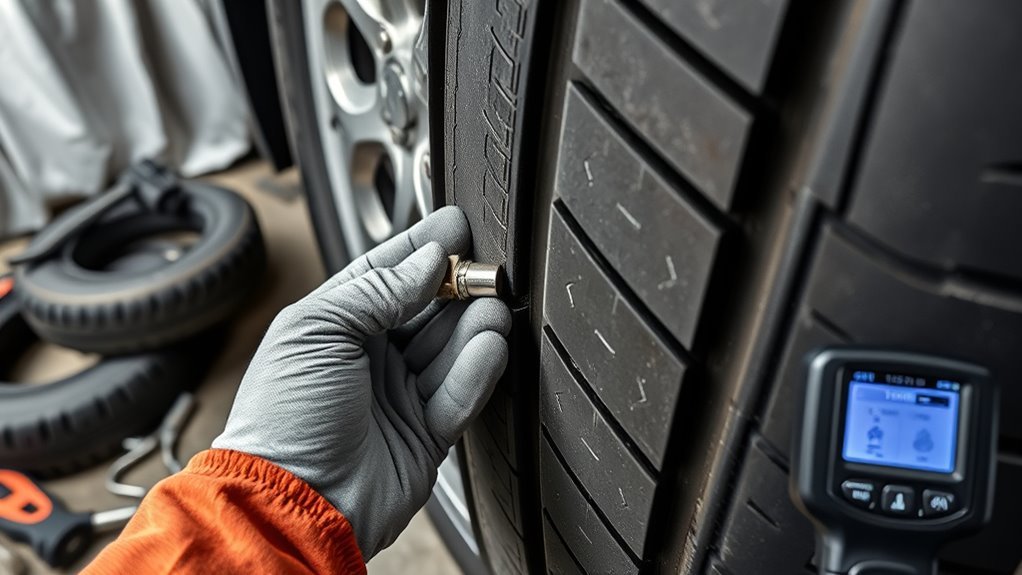
A tire change can expose an existing weak sensor battery or create a new problem if a sensor is damaged during mounting. The light may also appear when new sensors have not been programmed, their IDs have not been registered, or the wrong sensor application was installed.
Ask the shop to confirm four separate items: each sensor responds, each ID matches the vehicle, the correct wheel set is selected, and the system has been initialized at the proper cold pressure. If the 4Runner displays individual tire pressures, verify that all expected positions populate after the learning drive.
Do not judge TPMS fitment by valve-stem material. TPMS sensors are available with both rubber snap-in and aluminum clamp-in stems. Schrader’s sensor-service guidance explains that either stem style may be used, so an aluminum stem is not proof that a sensor is present and a rubber stem is not proof that it is missing.
Why Steady Driving Can Complete TPMS Registration
Some Toyota relearn procedures require sustained forward driving, often around 25 mph or more, while the vehicle identifies sensor IDs or wheel positions. Stop-and-go traffic can delay the process because the vehicle spends less time above the required speed. The reason is the programmed learning condition, not airflow cooling the sensors.
You do not need to drive at 60 to 70 mph. Use a safe, legal road where you can maintain the speed stated in your manual. Some Toyota procedures finish in roughly 10 to 30 minutes, while difficult radio or traffic conditions can make them take longer. If the manual’s maximum learning window passes, stop repeating the drive and diagnose the system.
- Start only after pressure and initialization are correct.
- Drive on a paved road at the manual’s specified minimum speed.
- Avoid carrying an unregistered sensor-equipped wheel inside or beside the vehicle during registration.
- Do not use a learning drive to mask a flashing malfunction light.
Does Removing the Spare Tire Affect 4Runner TPMS?
It depends on the year and tire package. Some 4Runners monitor the spare, while other configurations use a spare without a transmitter. Toyota manuals also distinguish between wheel and tire packages, so the vehicle may expect four or five sensor signals.
| Configuration | Possible Result | What to Do |
|---|---|---|
| Spare has a registered sensor | Low spare pressure or a missing signal may trigger a warning | Check spare pressure and confirm its ID is registered |
| Spare has no sensor | The system normally monitors only the road-wheel sensors | Check the spare manually every month |
| Sensor-equipped wheel is stored near the vehicle | Registration may be delayed or the wrong signal may be detected | Move unused sensor-equipped wheels away during relearn |
Before removing the spare for an off-road setup, check the “Tires,” “Tire Pressure Warning System,” and emergency tire-change sections of your model-year manual. Do not assume the module always requires exactly five sensors.
[Products Worth Considering]
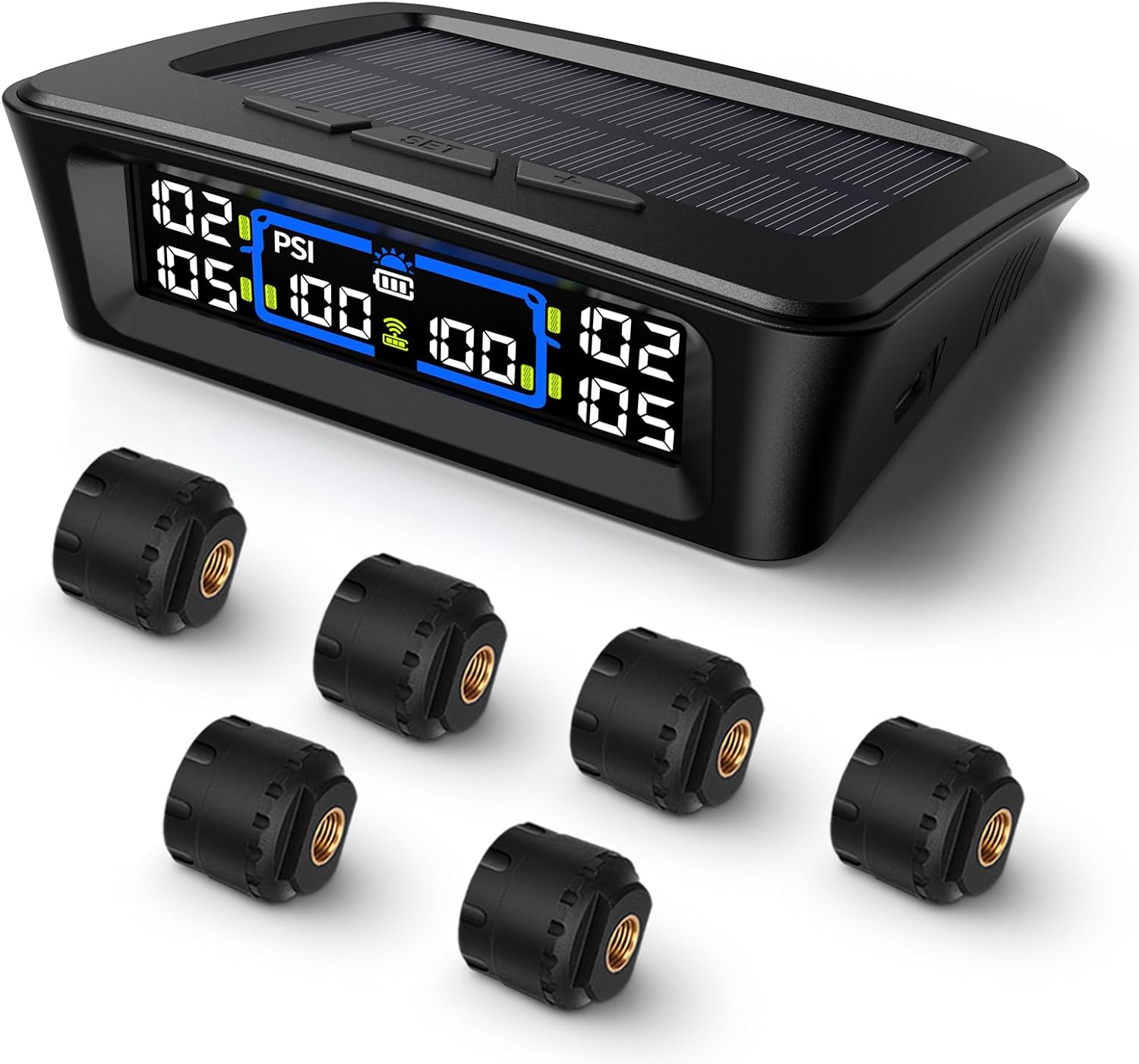
The Tymate TM12 RV TPMS delivers real-time tire pressure and temperature monitoring with a stable 433Hz display for safer long-distance driving. It supports simultaneous monitoring across vehicle and trailer zones, includes six alarm modes for pressure, temperature, leakage, battery, and signal loss, and features easy DIY installation with auto calibration. Power is supplied via USB-C charging or solar recharging, with a wide 0–144 PSI range and up to 50 ft signal coverage for RVs and towable trailers.

Keep RV, trailer, or truck dual-axle tires protected with waterproof, UV-resistant covers that help guard against sunlight, snow, rust, and dirt. The dual tire covers are easy to install with a rope/bungee fastener for a stable fit that won’t easily slip. Designed for 27–30 inch diameter wheels, they help maintain tire condition through harsh weather.
When DIY Fixes Fail: Signs You Need Professional TPMS Repair
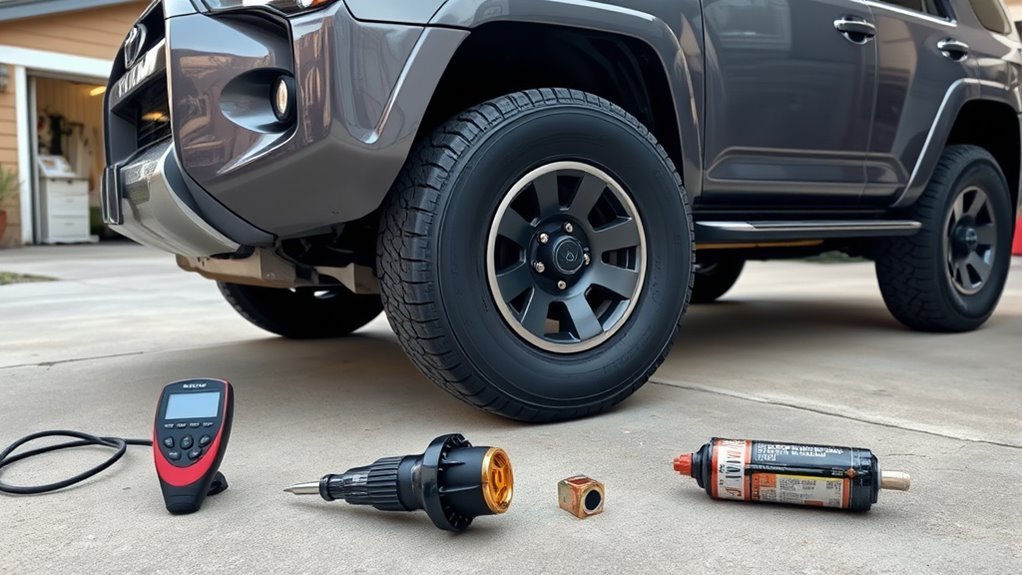
Professional diagnosis is appropriate when the light flashes and then stays on, a sensor does not respond to activation, the system will not store IDs, or individual pressure readings remain blank after the correct learning procedure.
- Pressure drops again after inflation, suggesting a puncture, bead leak, valve leak, or wheel damage.
- The warning began immediately after tire or wheel service.
- One or more sensors show no ID or no battery response.
- The installed sensor frequency or application does not match the vehicle.
- Registration fails after the full procedure in the owner’s manual.
- The vehicle has communication or body-control fault codes that require factory-capable diagnostics.
Ask for a sensor-by-sensor scan report before approving replacement. It should show which sensors respond, their IDs, whether those IDs are stored in the vehicle, and which fault codes are present. This evidence prevents replacing good sensors because of a registration or receiver problem.
Reprogram or Replace? Why the $50 vs. $200 Shortcut Can Mislead You
Fixed prices cannot determine the repair. Labor rates, sensor brand, valve-service parts, programming access, and the number of failed sensors all affect the bill. Diagnose the fault first.
- Reprogram or register: Choose this when the sensor responds correctly, matches the vehicle, and only its ID or wheel set is missing from the vehicle.
- Service the valve components: Choose this when the sensor electronics work but the stem, grommet, nut, core, or cap is leaking or corroded.
- Replace the sensor: Choose this when the battery is depleted, the housing is damaged, the sensor will not transmit, or the part is incompatible.
- Diagnose the vehicle: Choose this when all sensors test correctly but the receiver or control module cannot communicate.
TPMS sensor batteries are normally sealed, so a dead battery usually means replacing the sensor body. If several original sensors are the same age and one battery has failed, ask the shop to test the remaining sensors and compare the cost of replacing one now versus repeating tire dismounting later.
Why the TPMS Light May Stay On After 20 Miles
Twenty miles is not a universal reset rule. Some Toyota registration procedures use time and minimum speed rather than a fixed distance. A steady low-pressure light may turn off after the corrected pressure is recognized, while ID registration can take 10 to 30 minutes or longer under difficult conditions.
If the warning is still present after the full procedure:
- Confirm the tires were cold when pressure was set.
- Confirm the placard pressure was used, not the sidewall maximum.
- Check whether the light is steady or flashing before becoming steady.
- Verify all sensors transmit and their IDs are registered.
- Check the spare if your configuration monitors it.
- Inspect for a slow leak that lowered pressure during the drive.
Note: Cold weather can lower tire pressure enough to trigger the light. Do not bleed warm tires down after driving; let them cool and set them to the placard pressure.
Essential TPMS Tools for 4Runner Owners
Three basic tools cover most owner-level work:
- Accurate tire-pressure gauge: Use it monthly and before a reset. Visual inspection cannot confirm correct pressure.
- Portable air compressor: Choose one with a hose and gauge that can reach the spare if your 4Runner carries a full-size tire underneath.
- Model-year owner’s manual: It identifies the correct pressure source, initialization menu, registration requirements, and spare-tire configuration.
For advanced work, add a Toyota-compatible TPMS activation and diagnostic tool. It should support the exact year, sensor frequency, relearn type, and ID-registration method. A basic OBD-II reader remains useful for engine diagnostics, but it should not be presented as a complete TPMS solution unless its manufacturer specifically confirms that capability.
Keep plastic valve caps installed and replace the sensor’s service kit when the tire is dismounted, as recommended by the sensor or vehicle service procedure. Moisture, corrosion, and reused sealing parts can create slow leaks even when the electronics still work.
Frequently Asked Questions
Why is my Toyota tire-pressure light blinking when the tires are properly inflated?
A light that flashes for about a minute and then remains on indicates a TPMS malfunction, not simply low pressure. A sensor may be unregistered, incompatible, damaged, or low on battery. Scan every sensor with a TPMS-capable tool instead of relying on a longer drive.
How much does it cost to replace a tire-pressure sensor on a 4Runner?
There is no reliable universal price. The total depends on the sensor, valve-service parts, tire dismounting, programming, local labor, and how many sensors need service. Request a written quote and a scan report identifying the failed sensor before approving replacement.
Why does my Toyota say a tire is low when it looks full?
A tire can be significantly underinflated without looking flat. Check it with an accurate gauge when cold. Temperature changes, a small puncture, a bead leak, or a leaking valve may lower pressure enough to trigger the warning.
Can I reset a 4Runner TPMS without a scan tool?
You can usually correct pressure and perform owner-accessible initialization without a scan tool. New sensor IDs, incompatible parts, dead batteries, and module faults may require a TPMS-capable tool or professional service. Follow the procedure for your exact model year.
Does the Toyota 4Runner spare tire have a TPMS sensor?
Some 4Runner configurations monitor the spare and others do not. The answer depends on model year, market, wheel package, and equipment. Check whether the spare pressure appears on the display and confirm the configuration in the owner’s manual.
Conclusion
Start every 4Runner TPMS diagnosis with cold pressure and the driver-door placard. Then separate a steady low-pressure warning from a flashing malfunction warning. Use the correct model-year initialization or registration procedure, and confirm every sensor before replacing parts. When a proper relearn fails, a TPMS-capable scan is faster and safer than repeating resets or driving arbitrary distances.
Sources
- Toyota Owner’s Manuals and Warranties — model-year-specific TPMS initialization, registration, tire-pressure, and spare-tire instructions.
- NHTSA TireWise: Tire Safety and TPMS — warning-light meaning, monthly pressure checks, and TPMS limitations.
- Schrader TPMS: Serviceable vs. Replaceable Components — rubber and aluminum stem types, service kits, and malfunction-light diagnosis.
- Bartec Auto ID: Understanding TPMS Battery Life — typical sensor battery-life range and replacement considerations.

Related Articles

Best Toyota 4Runner Tires Under $150 2026 – Top Budget All-Terrain Tires
You use your Toyota 4Runner for a mix of highway miles and off-road adventures, so choosing capable all‑terrain tires that cost less than $150…
Read More
Best Budget Tires for Toyota 4Runner 2026 – Top Affordable Performance Tires
You rely on your Toyota 4Runner for a mix of daily driving and weekend adventures, and the tires you choose shape safety, comfort, and…
Read More
Best On Road All Terrain Tires for Toyota 4Runner 2026 – Top Highway-Friendly A/T Tires
You want all-terrain tires that let your 2026 Toyota 4Runner feel planted and quiet on the highway while still offering capable off-road traction when…
Read More