
Hyundai Sonata Cupped Tires Making Noise: Causes & Solutions
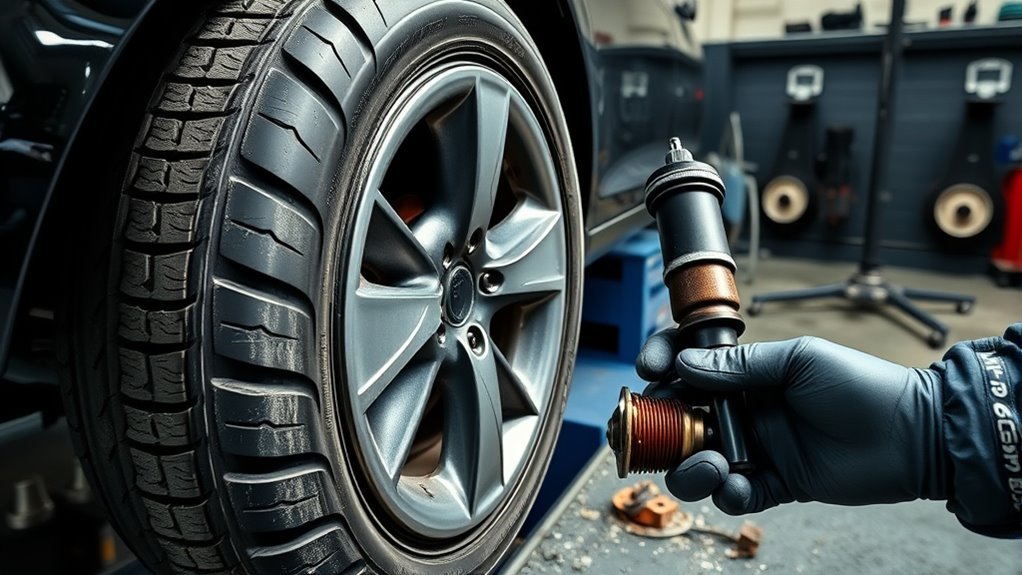
If your Hyundai Sonata’s tires are cupped, the tread has developed uneven, scalloped low spots that can cause humming, vibration, roughness, and faster tire wear. The tire is not usually the only problem. Cupping often points to an underlying issue such as worn shocks or struts, wheel imbalance, incorrect tire pressure, poor alignment, or skipped rotations.
Quick Answer
Cupped tires on a Hyundai Sonata usually mean the tire is bouncing or contacting the road unevenly. Check tread depth, tire pressure, wheel balance, alignment, and suspension parts first. Mild cupping may be monitored after the root cause is fixed, but severe cupping, strong vibration, exposed cords, or low tread usually means tire replacement.
Key Takeaways
- Tire cupping looks like scooped or scalloped dips around the tread, often every few inches.
- Common causes include worn shocks or struts, loose suspension or steering parts, misalignment, wheel imbalance, incorrect tire pressure, and skipped rotations.
- Cupped tread usually cannot be “repaired” back to smooth rubber; the goal is to fix the cause and decide whether the tire is still safe.
- Hyundai recommends rotating tires every 12,000 km or 7,500 miles, or sooner if irregular wear develops.
- Do not keep driving on tires with exposed cords, bulges, deep scalloping, very low tread, or vibration that affects control.
At a Glance
| Time Required | 10–15 minutes for a basic tire inspection; longer if a shop checks balance, alignment, and suspension |
| Difficulty | Easy to spot; professional service recommended for diagnosis and repair |
| Tools Needed | Flashlight, tire-pressure gauge, tread-depth gauge or penny, gloves, and a safe flat parking area |
| Cost | Free for a visual inspection; professional balancing, alignment, suspension repair, or tire replacement varies by shop and tire size |
What Is Tire Cupping and How Does It Affect Your Hyundai Sonata?
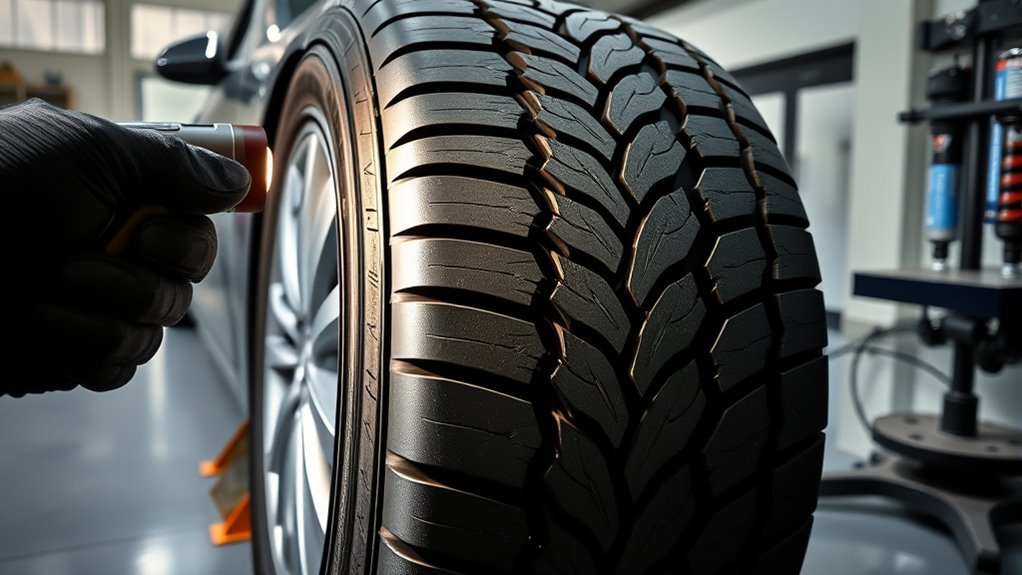
Tire cupping, also called tire scalloping, is an irregular wear pattern where the tread develops scooped-out dips around the tire. Instead of wearing smoothly across the tread, the tire forms alternating high and low spots. Bridgestone describes this as a pattern that can look as if small sections of tread were scooped out every few inches.
On a Hyundai Sonata, cupped tires can make the car feel rougher than normal, especially at highway speeds. You may hear a rhythmic humming, droning, or growling sound that gets louder as speed increases. You may also feel vibration through the steering wheel, seat, or floor.
Cupping is not a Sonata-only defect. It is usually a sign that the tire is not staying in smooth, even contact with the road. That can happen when shocks, struts, bushings, ball joints, wheel balance, alignment, or tire pressure are not right.
Note: Cupping is different from normal tread wear. A tire can still have legal tread depth and still be noisy or unsafe if the tread is badly scalloped, damaged, or vibrating.
Why Ignoring Cupped Tires Can Lead to Bigger Problems
Ignoring cupped tires can make your Sonata noisier, rougher, and harder to diagnose later. The longer the tire rolls with uneven contact, the more the high and low spots can spread across the tread.
More importantly, cupping may point to a problem beyond the tire itself. A worn strut, leaking shock, loose suspension bushing, bent wheel, or alignment issue can continue damaging a new tire if it is not corrected first.
- Ride comfort gets worse: cupped tread can create a steady hum, vibration, or droning sound.
- Traction may drop: uneven tread contact can reduce confidence in rain, emergency braking, or quick maneuvers.
- Suspension problems can progress: worn shocks, struts, or steering parts may get worse if ignored.
- New tires can wear early: replacing tires without fixing the cause can make the same pattern return.
- Diagnosis gets harder: tire noise can mask wheel bearing, brake, or suspension noises.
Warning: Do not keep driving normally if you see exposed cords, fabric, sidewall bulges, deep cracks, or tread worn to 2/32 inch. Have the tire replaced and the vehicle inspected before highway driving.
Common Causes of Tire Cupping in Your Hyundai Sonata
Cupping usually has more than one possible cause. The best approach is to inspect the tires, wheels, alignment, steering, suspension, and maintenance history together instead of blaming the tire alone.
[Products Worth Considering]

EVOULTES heavy duty tire inflator with an integrated gauge delivers accurate pressure readings from 10–120 PSI, helping you inflate, deflate, and check tires in one tool. The 16.5-inch extended dual-head air chuck with swivel base reaches hard-to-access dual wheel valves on trucks and RVs. A brass trigger core and side-mounted air release valve make operation smooth, with standard 1/4" NPT threading and quick-connect compatibility for easy setup.

The JACO FlowPro Tire Inflator measures, inflates, and airs down tires up to 100 PSI with battery-free operation and ±2% accuracy after calibration. It features a glowing pressure dial for night visibility, a heavy-duty steel build with a hybrid hose, and a precision push-to-inflate thumb trigger. The patented Lightning Air Chuck locks on for a secure seal, and the kit includes quick-connect hardware for easy inline use with your air compressor.
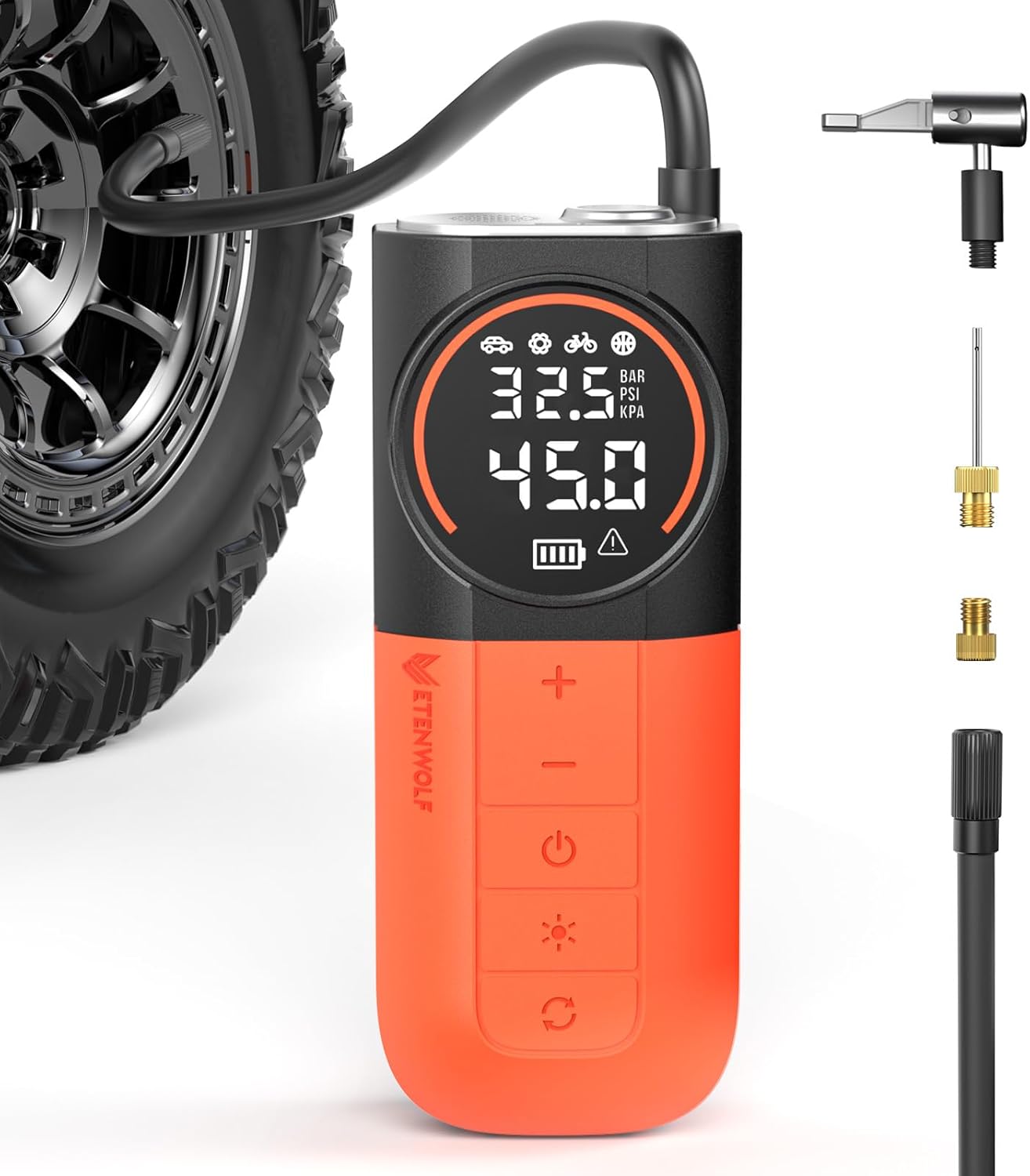
The ETENWOLF S1 cordless tire inflator delivers ultra-fast inflation with up to 160 PSI and a 20 L/min airflow for quicker tire top-offs. Its 5200mAh battery and cooling system support inflating many tires and sports balls on a single charge, while the digital pressure gauge and multi-unit display help you reach the right pressure accurately. With preset modes, pressure memory, an auto-stop feature, and an LED flashlight, it’s built for easy roadside and everyday use.
Misalignment Issues
Wheel alignment controls how the tires meet the road. If toe, camber, or caster angles are out of specification, the tire may scrub or carry load unevenly. That can contribute to feathering, shoulder wear, and in some cases cupping-like irregular wear.
Common alignment warning signs include:
- The Sonata pulls or drifts to one side on a straight, level road.
- The steering wheel sits off-center while driving straight.
- One tire edge wears faster than the other.
- New tire noise appears after a pothole hit, curb strike, or suspension repair.
If alignment is off, correcting it can stop new uneven wear from forming. It will not put missing rubber back on an already cupped tire.
Worn Suspension Components
Worn shocks, struts, bushings, ball joints, control arms, or steering parts can let the tire bounce instead of staying planted. Michelin identifies cupping, dipping, and scalloping as a worn-parts symptom and notes that out-of-balance wheels or suspension and steering service may be involved.
Watch for these suspension-related clues:
- Extra bouncing after bumps
- Nose-diving while braking
- Clunking over rough roads
- Uneven ride height
- Oil leakage around a shock or strut
- Scalloping that keeps returning after rotations
If the suspension is worn, replacing tires first is usually a short-term fix. The new tires can develop the same pattern until the worn parts are corrected.
Unbalanced Wheels or Tire Runout
An out-of-balance tire and wheel assembly can shake as it rotates. That repeated vibration may contribute to uneven wear and can make existing cupping feel worse. A bent wheel, tire runout, or a tire that is not seated correctly can create similar symptoms.
Balancing is especially important if the vibration started after new tires, a tire rotation, wheel repair, or a hard pothole hit. Ask the shop to check for wheel damage and tire runout if balancing alone does not solve the vibration.
Incorrect Tire Pressure
Incorrect tire pressure changes the tire’s contact patch. Underinflation, overinflation, or uneven pressure between tires can increase irregular wear, heat, and handling problems.
Check pressure when the tires are cold, before driving or after the car has been parked for at least three hours. Use the recommended cold PSI on the Sonata’s driver-side door-jamb tire placard or in the owner’s manual, not the maximum pressure printed on the tire sidewall.
Pro Tip: Check tire pressure monthly and before long trips. A TPMS light usually warns only after a tire is significantly underinflated, so it does not replace a gauge check.
Skipped or Late Tire Rotations
Tires do not wear evenly at the same position. Front tires handle more steering and braking forces, while rear tires can develop their own irregular patterns if they stay in one position too long.
Hyundai recommends rotating tires every 12,000 km or 7,500 miles, or sooner if irregular wear develops. During rotation, Hyundai also advises checking tire balance, uneven wear, damage, tire pressures, and wheel-nut torque.
Tire Quality Concerns
Tire quality can play a role, but it is rarely the only cause. Lower-quality tires or tires with weaker internal construction may show irregular wear sooner when the vehicle already has poor balance, worn suspension, or alignment issues.
Choose the correct tire size, load rating, and speed rating for your Sonata. Also match tires by type and condition when possible. Mixing worn and new tires, different tread designs, or mismatched tire types can make vibration and uneven wear harder to diagnose.
How to Recognize Symptoms of Tire Cupping in Your Vehicle
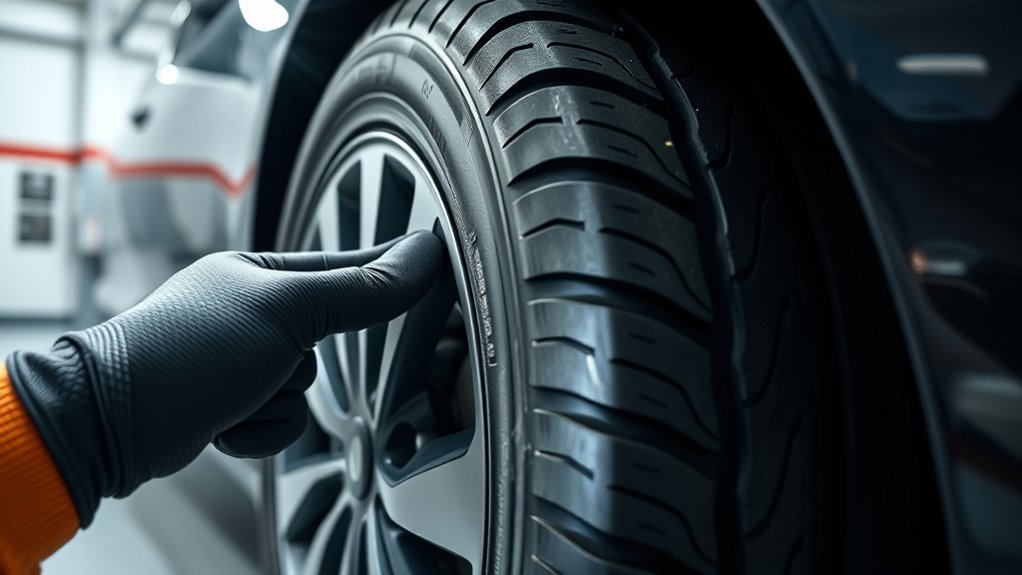
You can often spot tire cupping before it becomes severe. Park on level ground, turn the steering wheel to expose the front tread, and inspect each tire with a flashlight.
Visual Indicators of Cupping
Look for:
- Scalloped dips around the tread
- Alternating high and low patches
- Wavy, patchy, or chopped-looking tread blocks
- One section of tread that looks more worn than the next
- Rough tread that feels uneven when you run your hand over it
Compare all four tires. If one tire is much worse than the others, suspect a localized issue such as a bent wheel, bad shock or strut, loose suspension part, or balance problem at that corner.
Noise and Vibration Symptoms
Cupped tires often create a rhythmic hum, drone, or growl that increases with road speed. You may also feel vibration through the steering wheel, seat, or floor.
Noise from cupped tires can sound similar to a bad wheel bearing, but there are clues:
- Cupped tire noise often changes after tire rotation because the noisy tire moves to another position.
- Wheel bearing noise may change when loading one side of the car during gentle turns.
- Wheel imbalance often feels strongest at a certain speed range.
- Alignment issues often show up as pulling, off-center steering, or edge wear.
If you are not sure which problem you have, do not guess. A tire shop or mechanic can road-test the car, rotate tires, check wheel bearings, inspect suspension, and confirm whether the noise is tire-related.
Fixing Cupped Tires: Repair or Replace?
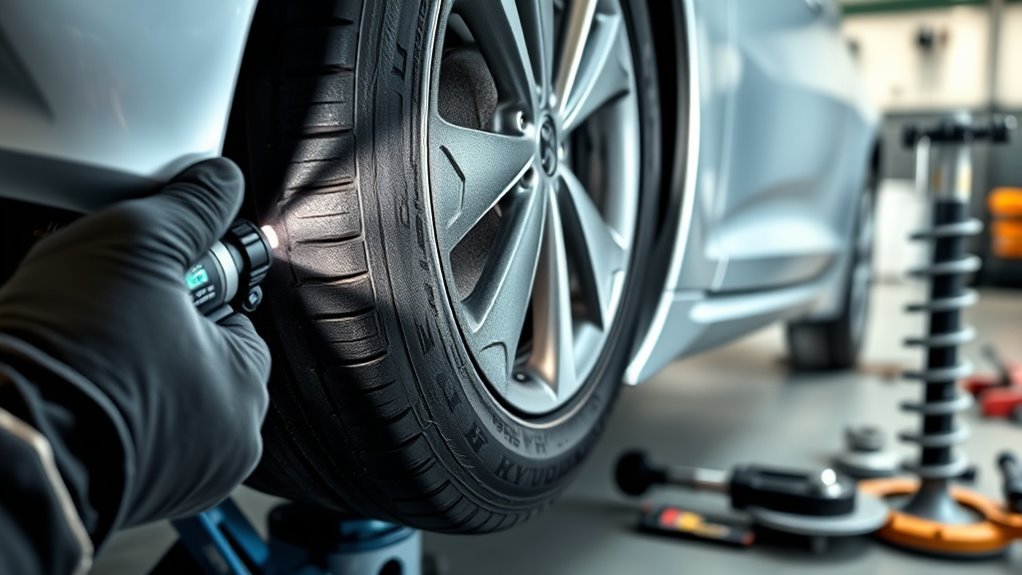
The honest answer is this: you can often fix the cause of tire cupping, but you usually cannot restore the missing tread. Once rubber has worn away in scalloped patches, alignment, balancing, or rotation will not make the tread perfectly smooth again.
Use this repair sequence:
- Inspect the tire first. Check for exposed cords, bulges, cracks, punctures, uneven tread depth, and tread worn to 2/32 inch.
- Set cold tire pressure. Inflate all tires to the Sonata’s door-jamb placard specification.
- Check wheel balance. Rebalance if vibration is present or if tires were recently installed or rotated.
- Inspect suspension and steering. Look for worn shocks, struts, bushings, ball joints, tie rods, and control arms.
- Check alignment. Align the vehicle after worn parts are repaired, after hard impacts, or when pulling or uneven wear is present.
- Decide on the tire. Mild cupping may be usable for a while after the cause is fixed, but severe noise, vibration, low tread, or damage usually means replacement.
Note: If you replace cupped tires without correcting balance, alignment, pressure, or suspension problems, the new tires can develop the same wear pattern.
[Products Worth Considering]

This portable cordless tire inflator delivers up to 160 PSI with fast 17 L/min airflow to help you quickly top up tires and get back on the road. It features dual power mode, running on a 21V rechargeable battery or a 12V DC adapter for convenient roadside use. An automatic shut-off with digital pressure gauge helps prevent overinflation, and a built-in LED light improves visibility in low-light conditions.

The AstroAI L7 Air Tire Inflator refills car tires quickly with up to 150PSI max pressure and a fast 1-minute inflation claim. It includes 5 preset modes for car, motorcycle, bicycle, balls, and manual use, along with an auto shutoff to help prevent overinflation. Designed for convenience, it features a digital gauge with unit switching, a top LED light with multiple modes, and USB-C/USB ports for backup power.
How to Inspect Your Tires for Cupping: Key Steps to Follow
A simple inspection can tell you whether your Sonata needs tire service soon. Follow these steps in a safe, well-lit area.
- Park safely. Choose level ground, set the parking brake, and let the tires cool before checking pressure.
- Look across the tread. Use a flashlight to find wavy, scalloped, or scooped-out patches.
- Feel the tread carefully. Run your hand lightly over the tread surface. Wear gloves if the tread is sharp or damaged.
- Measure tread depth. Use a tread-depth gauge. Replace tires at 2/32 inch, and consider replacement earlier if traction, noise, or wet-weather grip is poor.
- Check tire pressure cold. Match the driver-door placard, then recheck after adding air.
- Compare all four tires. If one corner is much worse, suspect that wheel, tire, suspension corner, or brake area.
- Road-test gently. Listen for humming and feel for vibration. Avoid highway speeds if the vibration affects control.
- Schedule diagnosis. Ask for balance, alignment, suspension, steering, and wheel-bearing checks if cupping is visible.
Warning: Never crawl under a vehicle supported only by a jack. If a tire must be removed for inspection, use proper jack points and jack stands, or let a professional handle it.
Cupping vs. Other Tire Wear Patterns
Not every uneven tire is cupped. Reading the pattern helps narrow down the cause.
- Cupping or scalloping: scooped dips around the tread; often linked to worn suspension, imbalance, or inconsistent road contact.
- Feathering: tread blocks feel smooth one way and sharp the other; often linked to toe alignment.
- One-edge wear: inner or outer shoulder wears faster; often linked to camber, toe, worn parts, or hard cornering.
- Center wear: center tread wears faster; often linked to overinflation or load/tire mismatch.
- Both-edge wear: both shoulders wear faster; often linked to underinflation or heavy loads.
- Flat spot: one patch is worn more than the rest; can follow hard braking, long parking, or a tire defect.
If the pattern is not obvious, take clear photos of each tire and show them to the shop. A good technician can often connect the wear pattern to a likely mechanical cause.
How to Keep Your Sonata’s Tires Healthy and Cupping-Free
Preventing cupping is mostly about keeping each tire in steady, even contact with the road.
- Rotate on schedule: follow Hyundai’s 7,500-mile rotation guidance, or rotate sooner if uneven wear appears.
- Check pressure monthly: use the cold PSI on the driver-door placard.
- Balance when needed: balance tires after installation and when vibration appears.
- Check alignment when symptoms appear: pulling, uneven wear, off-center steering, or a hard pothole hit are signs to schedule an alignment check.
- Inspect shocks and struts: replace worn or leaking parts before they damage another tire set.
- Buy suitable tires: use the correct size, load rating, and tire type for your Sonata and driving conditions.
- Avoid harsh impacts: potholes, curbs, and aggressive cornering can damage wheels, suspension, and alignment.
The best time to stop tire cupping is before the tread pattern becomes deep. Pressure checks, rotations, balance, alignment, and suspension inspections cost less than replacing tires early.
The Role of Suspension and Alignment in Tire Health
Your Sonata’s suspension keeps the tires pressed evenly against the road. Shocks and struts control bounce. Bushings, control arms, tie rods, and ball joints hold the wheels in the correct position. Alignment sets the tire angles so the car tracks straight and the tread wears evenly.
When any of these systems are worn or out of adjustment, the tire can skip, scrub, or carry load unevenly. That is why a proper tire-cupping diagnosis should include both the tire and the vehicle parts controlling it.
Ask the technician to check:
- Shock and strut condition
- Leaks around suspension dampers
- Loose tie rods or ball joints
- Control-arm bushings
- Wheel bearings
- Wheel runout or bent rims
- Four-wheel alignment readings
- Dynamic tire balance
If suspension parts are replaced, align the vehicle afterward. If tires are replaced, balance them during installation and recheck pressure after the first drive.
When Should You Consult a Professional for Tire Issues?
Consult a professional as soon as you notice visible scalloping, strong vibration, repeated tire noise, or handling changes. Tire cupping can start as a comfort problem, but it may point to a safety or suspension issue.
Schedule service if:
- The steering wheel or seat vibrates at speed.
- The car pulls even after pressure is corrected.
- One tire is much louder or more worn than the others.
- The tread has deep scalloped dips.
- You see cords, fabric, cracks, bulges, or cuts.
- The tire is at or near 2/32 inch tread depth.
- Noise continues after rotation or balancing.
- You recently hit a pothole or curb.
For the best result, ask for a full tire-and-chassis inspection instead of only a tire rotation. The shop should check tire condition, balance, alignment, wheel damage, wheel bearings, suspension, and steering parts.
Frequently Asked Questions
Can cupped tires cause noise?
Yes. Cupped tires commonly cause a rhythmic humming, growling, or droning noise that gets louder with speed. The sound may change after tire rotation because the noisy tire moves to a different position.
What is the main cause of tire cupping?
There is not always one single cause. The most common causes are worn shocks or struts, loose suspension or steering parts, wheel imbalance, poor alignment, incorrect tire pressure, and skipped rotations.
What happens if you drive on cupped tires?
Light cupping may mainly cause noise, but severe cupping can create vibration, rough handling, reduced traction, and faster tire wear. If the tire has exposed cords, bulges, deep damage, or tread worn to 2/32 inch, replace it before normal driving.
How do you get rid of cupping on tires?
You fix the cause first: correct tire pressure, balance the wheels, inspect suspension and steering, and align the vehicle if needed. The worn tread itself usually cannot be restored, so badly cupped tires may still need replacement.
Will an alignment fix cupped tires?
An alignment can fix one cause of uneven wear, but it will not smooth out tread that has already worn away. If the cupping is mild, the tire may remain usable after the cause is fixed. If it is severe or noisy, replacement may be the better option.
How often should Hyundai Sonata tires be rotated?
Hyundai recommends rotating tires every 12,000 km or 7,500 miles, or sooner if irregular wear develops. During rotation, check balance, uneven wear, damage, pressure, and wheel-nut torque.
Conclusion
Cupped tires on a Hyundai Sonata are more than an annoying noise problem. They are a sign that the tire is wearing unevenly and that another issue may be allowing the tread to bounce, scrub, or contact the road poorly. Start with a careful tire inspection, cold pressure check, tread-depth check, balance, alignment, and suspension review.
If the cupping is mild and the tire is otherwise safe, fixing the root cause may let you keep driving on it for a while. If the tread is deeply scalloped, noisy, vibrating, damaged, or worn to the safety limit, replacing the tire is the safer choice. Treat the cupping as a warning sign early, and your Sonata will ride quieter, handle better, and protect its next set of tires.
Sources
- Hyundai Owner’s Manual: Tire Rotation — Sonata tire rotation interval, balance checks, pressure checks, and abnormal wear causes.
- NHTSA TireWise — tire pressure, tread depth, balance, alignment, rotation, and tire safety guidance.
- Bridgestone: Tire Cupping — tire cupping definition, causes, repair limits, and prevention guidance.
- Michelin: Symptom Cups — cupping, dipping, scalloping, worn parts, balance, and suspension/steering service guidance.

Related Articles

Danger of Using Summer Tires in Winter on a Hyundai Sonata
Potentially perilous, using summer tires in winter on your Hyundai Sonata can compromise safety—discover the hidden dangers that await you on icy roads.
Read More
Can You Mix Nitrogen and Air in Hyundai Sonata Tires? Answered
Discover the implications of mixing nitrogen and air in your Hyundai Sonata tires—are the benefits worth the risks? Explore the answer inside!
Read More
How to Tell If Hyundai Sonata Tires Are Too Old to Use Safely
Understand how to assess the age of your Hyundai Sonata tires and discover crucial signs of deterioration that could compromise your safety on the road.
Read More