What Does 105T Mean on a Tire? Load, Speed & Rating Guide
105T on a tire means you’re looking at a load index of 105 and a T speed rating. That means each tire can carry up to 2,039 pounds when properly inflated and is certified for speeds up to 118 mph. You should match or exceed your vehicle maker’s required load and speed ratings for safe handling, braking, and stability. Check the sidewall and your owner’s manual, and you’ll see why the right rating matters.
Key Takeaways
- 105 is the tire’s load index, meaning each tire can carry 2,039 pounds when properly inflated.
- T is the speed rating, indicating the tire is certified for speeds up to 118 mph.
- Together, 105T shows both load-carrying capacity and maximum safe speed rating.
- Replacement tires should match or exceed the vehicle manufacturer’s required load index and speed rating.
- Using mismatched tires can hurt handling, stability, and safety, especially under heavy loads or high speeds.
What Does 105T Mean on a Tire?
A tire marked 105T tells you two key things: 105 is the load index, meaning the tire can support up to 2,039 pounds when properly inflated, and T is the speed rating, meaning it’s approved for speeds up to 118 mph under recommended conditions. You use the load index to judge tire capacity, and you use the speed rating to verify safe high-speed performance. When you choose replacement tires, match or exceed the vehicle maker’s required 105 and T values; that protects handling, braking, and stability. If you fit a lower-rated tire, you compromise safety and surrender control your vehicle was built to deliver. Check the sidewall, confirm the specification, and don’t assume all tires with similar size markings perform the same. This code gives you a fast, reliable way to verify that your tires can carry the load and handle the speed your driving demands. Additionally, ensuring your tires meet the manufacturer’s recommended tire sizes is crucial for optimal performance and safety.
How Much Weight Can 105T Carry?
A 105 load index means each tire can carry up to 2,039 pounds when you keep it properly inflated. With a T speed rating, you can safely run the tire up to 118 mph under recommended conditions. If you’re selecting a set, four 105T tires support about 8,156 pounds total, so you should confirm they meet or exceed your vehicle’s GVWR and manual specs. Additionally, it’s important to consider all-season tire performance when choosing tires for varied driving conditions.
105 Load Capacity
When you see a 105 load index on a 105T tire, it means the tire can safely carry up to 2,039 pounds when properly inflated. You’re reading a standardized load capacity rating, not a guess. The load index appears on the sidewall beside the tire speed ratings, and the T indicates a maximum speed of 118 mph. Use this specification to confirm the tire can support your vehicle and cargo without overstress, heat buildup, or blowout risk. You should match or exceed the vehicle’s GVWR with the combined load capacity of all tires. If you exceed the rated load index, you compromise safety and performance. Choose correctly, and you keep control, reliability, and freedom on the road.
Weight Limits Explained
A 105T tire can carry 2,039 pounds per tire when it’s properly inflated, so a set of four can support 8,156 pounds total. That figure comes from the load index, which tells you the tire’s load carrying capacity. To stay within safe weight limits, you need correct tire pressure and you shouldn’t exceed the rating on any tire. If you overload your vehicle, you risk heat buildup, uneven wear, tire damage, and blowouts. A 105 rating gives you solid capacity for many passenger vehicles and light trucks, but you still have to match the tire to your vehicle’s specs. Check your owner’s manual or tire placard before you load cargo, tow, or carry passengers.
Speed Rating T Details
The T in 105T is the speed rating, and it means the tire is certified for speeds up to 118 mph (190 km/h), while the 105 load index tells you it can carry 2,039 pounds when properly inflated. You should treat the tire’s speed rating and load index as safety limits, not suggestions. If you exceed either, you risk heat buildup, tread failure, and loss of control.
- Load index: 105 equals 2,039 pounds.
- Speed rating: T equals 118 mph rated speed.
- Use case: fit for standard passenger vehicles and daily driving.
Choose tires that match your vehicle’s needs so you can drive with confidence and autonomy. Always verify inflation, since low pressure reduces capacity and can compromise performance.
What the T Speed Rating Means
| Marking | Meaning | Safety note |
|---|---|---|
| T | 118 mph | Stay within spec |
| H | Higher limit | More speed margin |
| V | Even higher | Verify fitment |
| W | High performance | Not a substitute |
| Load index | Weight capacity | Check both ratings |
You’ll often see T on family sedans and minivans because it supports normal driving with a clear safety buffer. Rigorous lab tests certify the rating, so don’t exceed it. Using a lower-rated tire can erode control during hard acceleration, cornering, or emergency maneuvers, limiting your freedom and safety. Selecting tires with the right load ratings ensures optimal performance and safety for your vehicle.
Is 105T Right for Your Vehicle?
Is 105T right for your vehicle? You can answer that only by matching your vehicle’s needs to the tire’s load index and speed rating. The 105 load index supports up to 2,039 pounds per tire when inflated correctly, and the T speed rating allows 118 mph.
- Check your vehicle’s GVWR and axle loads.
- Confirm the owner’s manual says a 105 load index fits.
- Verify the speed rating T meets manufacturer limits.
If your vehicle’s required capacity is higher, 105T isn’t safe. If it matches, you’ll get stable handling, dependable braking, and everyday driving confidence. Additionally, consider the load index and speed rating of your current tires to ensure optimal performance. Don’t guess; use the tire placard and manual to make a precise choice. A correct 105T fit helps you drive freely without sacrificing control or safety.
Where to Find Tire Size Codes
You’ll usually find tire size codes molded into the tire’s sidewall, where they list the key details you need to confirm fitment, load capacity, and speed capability. Inspect the sidewall closely; the tire size code usually follows a format like P225/60R16 94H. In that code, P identifies a passenger tire, 225 is the width in millimeters, and 60 is the aspect ratio. Near the end, you’ll see the load index and speed rating, which tell you how much weight the tire can carry and the maximum speed it’s built to handle. If the sidewall is dirty or worn, check your vehicle owner’s manual, the driver’s side door jamb, or the inside of the fuel filler cap. Use these references to verify the correct tire size before you buy or install anything. Reading the code accurately helps you keep your vehicle compliant, safe, and fully under your control. Additionally, ensure the tire size aligns with RAV4 specifications to optimize performance.
Can You Mix Different Speed Ratings?
You shouldn’t mix different speed-rated tires, because the mismatch can change handling and make the vehicle less predictable. When ratings differ, the lowest speed-rated tire sets the maximum safe speed for the set. If you must run a mismatch temporarily, put the lower-rated tires on the front axle to reduce the risk of oversteer. Additionally, it’s important to consider tire ratings to ensure optimal performance and safety.
Mixing Speed Ratings
Mixing different speed-rated tires isn’t recommended because it can reduce handling precision and compromise vehicle safety. When you’re mixing, you create uneven speed rating and performance limits that can affect steering response, cornering, and braking. Your vehicle’s safe operating speed matches the lowest-rated tire, so one mismatched tire can restrict the whole set.
- Fit uniform tires for balanced handling and safety.
- If you must mix, place lower-rated tires on the front axle.
- Follow the manufacturer’s specifications to protect performance.
In high-speed driving, these differences can trigger instability and make recovery harder. Choose matching ratings whenever possible so you keep control, preserve safety margins, and drive with the freedom that comes from predictable tire behavior.
Lowest Rating Wins
When different speed ratings are fitted together, the lowest-rated tire sets the practical limit for the entire vehicle, and that can reduce acceleration, cornering, and overall safety. You shouldn’t treat mixed specs as a harmless shortcut: your car’s handling becomes defined by the lowest speed-rated tire, not the right tire for each wheel. That means the load index and speed rating must work together as a matched set, because uniform tires deliver more predictable response, braking, and stability. For the safest setup, follow the manufacturer’s recommended speed rating and avoid combinations that force the vehicle to operate beyond the weakest tire’s limits. If you must replace one tire, choose the same rating so you keep control, freedom, and confidence on the road.
Front Axle Placement
If you need to run different speed ratings, place the lower-rated tires on the front axle to reduce the chance of oversteer and keep the vehicle more controllable at the limit. You should still treat this as a compromise, not a best practice. Different load index and speed rating values can change tire handling, grip, and braking, so your vehicle’s safe top speed becomes the lowest-rated tire installed.
- Keep the front axle on the lower-rated pair.
- Drive below the weakest tire’s speed rating.
- Replace all four tires with matching size and type when you can.
For safer, freer driving, uniform tires deliver the most predictable response and the best protection.
When You Should Match the OEM Rating
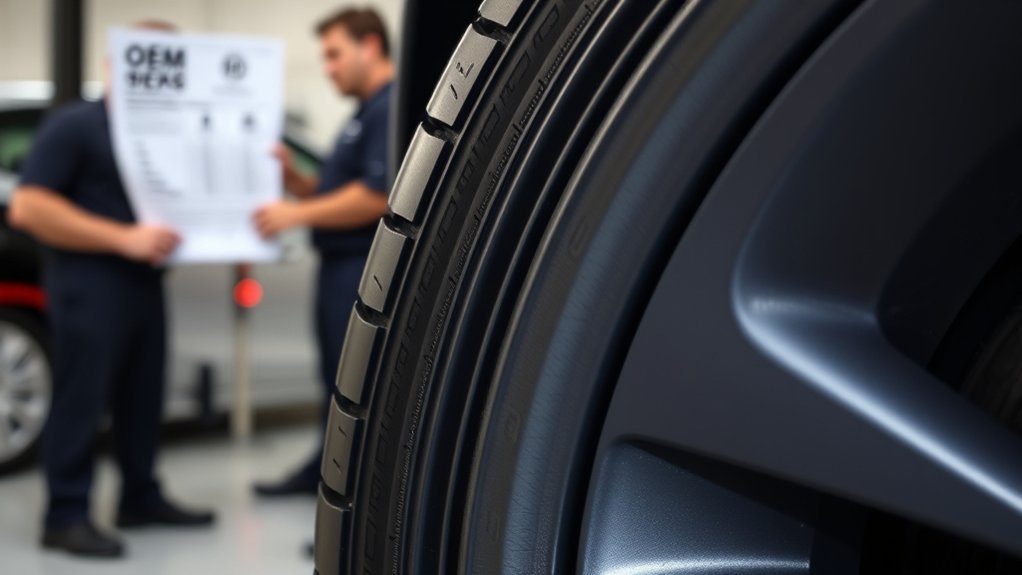
You should match the OEM tire rating whenever you replace tires, because the load index and speed rating were selected for your vehicle’s weight, handling, and performance requirements. A 105 load index supports 2,039 pounds per tire when inflated correctly, and a T speed rating covers 118 mph. If you install a tire below those OEM specifications, you can reduce braking stability, steering response, and high-speed safety margins. That’s not freedom; that’s unnecessary risk. Use the vehicle manual or tire placard to verify the correct numbers before you buy. OEM ratings aren’t arbitrary—they reflect the chassis, suspension, and expected operating load your vehicle was engineered around. You can exceed them only when the replacement tire meets or surpasses both values. Matching the original rating keeps the vehicle’s dynamics predictable, preserves compliance, and protects you and your passengers. Always confirm fitment before installation. Additionally, selecting tires with a proper treadwear warranty ensures you maintain expected performance and longevity.
How to Choose the Right Replacement Tire
To choose the right replacement tire, start by matching or exceeding the original load index and speed rating so the tire can safely carry the vehicle’s weight and handle its intended operating speed. Check the vehicle manual or tire placard for the right size, load index, and speed rating before you buy. A load index of 105 supports 2,039 pounds per tire when inflated correctly, while a T speed rating allows 118 mph, which fits most daily driving.
Match or exceed factory load index and speed rating for safe, confident driving.
- Verify the replacement tire matches or exceeds factory specs.
- Confirm all four tires share the same ratings.
- Review treadwear rating for expected service life.
Never mix mismatched ratings, because uneven grip and load capacity can reduce stability and control. Choose a replacement tire that protects your freedom to drive with confidence, not one that only fits the rim. Additionally, consider tread depth and road noise when selecting tires to ensure a comfortable driving experience.
Frequently Asked Questions
What Is the Difference Between 105H and 105T Tires?
105H and 105T tires share the same load capacity, but 105H lets you drive faster, up to 130 mph, while 105T tops out at 118 mph. You should match speed ratings to your driving conditions to protect tire performance and safety. Both may have similar tread design, yet the H rating supports higher-speed stability. Don’t mix ratings unless your vehicle maker approves it.
Which Tire Rating Is Better, H or T?
H is better if you want higher tire performance and more tire safety at faster driving conditions. T works well for routine commuting, but H gives you stronger handling, firmer cornering, and better braking when the road turns demanding. You should still match the tire’s load capacity to your vehicle, because speed rating alone doesn’t guarantee safety. Choose H when you want more control and freedom on the move.
What Is the Difference Between 105T and 107T Tires?
105T tires carry less load than 107T tires, so you’ll get lower load capacity with 105T and higher load capacity with 107T. Both share the same T speed rating, so tire performance at up to 118 mph stays the same. You should choose 107T for heavier vehicles or tougher road conditions, especially when safety, temperature resistance, and proper weight support matter. Match or exceed your vehicle’s required rating.
Which Speed Rating Is Better, S or T?
T is better if you want higher tire performance and speed capabilities, because it supports up to 118 mph versus S at 112 mph. You’ll usually get better grip and cornering from T-rated tires, especially in changing weather conditions or when your driving habits include frequent highway travel. Still, you should follow your vehicle maker’s recommendation, since the safest choice matches your car’s load, handling, and intended use.
Conclusion
In the end, 105T means your tire can carry about 2,039 pounds at its rated pressure and is approved for speeds up to 118 mph. That T rating is common, but it should still match your vehicle’s needs. In fact, underinflated or overloaded tires cause a large share of tire failures. Check your owner’s manual, confirm the OEM spec, and choose replacements that keep your ride safe, stable, and legal.

Related Articles
What Does 107T Mean on a Tire? Load, Speed & Rating Guide
Get the meaning of 107T tire ratings, including load and speed limits, to find out why it matters before your next drive.
Read More
What Does 111H Mean on a Tire? Load, Speed & Rating Guide
Tire code 111H reveals load and speed limits, but what they mean for your vehicle may surprise you.
Read More
What Does 114H Mean on a Tire? Load, Speed & Rating Guide
Find out what 114H really means for tire load, speed, and safety—before you pick the wrong one.
Read More