
How to Fix a TPMS Sensor Fault in a RAV4: Diagnosis and Solutions
A TPMS sensor fault on a Toyota RAV4 usually means the tire pressure warning system needs attention, not just that one tire is a little low. Start with a cold tire-pressure check, then use the RAV4’s TPWS reset or set-pressure procedure only after the tires match the driver-door placard. If the light blinks for about one minute and then stays on, treat it as a system malfunction that may need a TPMS scan tool or professional diagnosis.
Quick Answer
To fix a RAV4 TPMS sensor fault, check all tires cold, inflate them to the pressure on the driver-door tire placard, inspect the valve stems, then initialize or set the TPWS only if the warning is a low-pressure warning. A blinking light that stays on usually means a sensor, ID registration, receiver, or system fault needs diagnosis.
Key Takeaways
- A solid tire-pressure light usually points to low tire pressure; a light that blinks for about a minute and then stays on points to a TPMS malfunction.
- Do not use a universal PSI number. Use the cold tire pressure printed on your RAV4’s driver-door tire and loading information label.
- Resetting or initializing TPWS is only appropriate after the tires are correctly inflated; it will not repair a dead sensor battery or unregistered sensor ID.
- After tire replacement, wheel swaps, or TPMS sensor replacement, the sensor IDs may need to be registered with the vehicle.
- If the warning returns after correct inflation and initialization, a shop or Toyota dealer can read sensor IDs, live pressure data, and TPMS trouble codes.
At a Glance
| Time Required | 10–20 minutes for tire-pressure and visual checks; longer if a sensor scan or tire dismount is needed. |
| Difficulty | Beginner for pressure checks; intermediate to professional for sensor programming or electrical diagnosis. |
| Tools Needed | Accurate tire-pressure gauge, air source, flashlight, valve caps, soapy water for leak checks, and a TPMS-capable scan tool if the warning persists. |
| Cost | Usually $0–$20 for DIY pressure correction. Sensor replacement, programming, valve kits, mount/balance labor, and diagnostics vary by shop and model year. |
Common Symptoms of TPMS Issues
The first clue is usually the tire-shaped warning light with an exclamation point. On a RAV4 with a tire pressure warning system, the system uses tire pressure warning valves and transmitters to detect low tire inflation pressure before it becomes a bigger problem, and some models can show tire pressure data on the multi-information display. You can review Toyota’s owner-manual information on the system here: Toyota RAV4 tire pressure warning system.
Common symptoms include:
- A tire pressure warning light that stays on after startup.
- A light that blinks for about one minute and then remains illuminated.
- A dashboard message such as “Tire Pressure System Malfunction” or similar wording, depending on model year and trim.
- Missing, blank, or inconsistent tire pressure readings on the display.
- A warning that appears soon after tire rotation, tire replacement, wheel replacement, or seasonal wheel swaps.
- A warning that returns after you have already inflated the tires.
Warning: If the tire pressure light comes on while driving and the RAV4 feels unstable, pulls to one side, vibrates, or you suspect a flat tire, slow down carefully and stop in a safe place before inspecting the tires.
[Products Worth Considering]

EVOULTES heavy duty tire inflator with an integrated gauge delivers accurate pressure readings from 10–120 PSI, helping you inflate, deflate, and check tires in one tool. The 16.5-inch extended dual-head air chuck with swivel base reaches hard-to-access dual wheel valves on trucks and RVs. A brass trigger core and side-mounted air release valve make operation smooth, with standard 1/4" NPT threading and quick-connect compatibility for easy setup.

The AstroAI 2 pack air chucks provide a heavy-duty, closed-flow locking design that helps keep air flowing during inflation while securely attaching to the valve stem. Built with 250 PSI rated brass components and compatible with Schrader valves, they feature 1/4" female NPT threads for a wide fit with common inflators. The straight tip and locking clip make filling tires and monitoring pressure more convenient.

Upgrade your Toyota tire setup with these corrosion-resistant, leak-proof valve stem caps designed to help protect the valve core from water, snow, and road grime. The caps feature a snug rubber seal and durable copper alloy construction to resist rust and oxidation while maintaining stable tire pressure. Ideal for replacing worn original caps and keeping your wheels looking clean and stylish.
Low Tire Pressure Warning vs. TPMS Sensor Fault
Before replacing a sensor, identify which type of warning you have. A low tire pressure warning and a TPMS sensor fault are not the same problem.
| What You See | Most Likely Meaning | First Action |
|---|---|---|
| Light comes on and stays solid | One or more tires may be below the recommended cold pressure. | Check all tires cold and inflate to the driver-door placard. |
| Light blinks for about one minute, then stays on | TPMS malfunction, such as a failed sensor, unregistered ID, receiver issue, or system fault. | Check pressure first, then scan the TPMS if the warning remains. |
| Warning appears after tire or wheel service | Sensor may have been damaged, moved, replaced, or not registered. | Ask the shop to verify sensor IDs and TPMS registration. |
| Pressure values are missing or inconsistent | Sensor signal, battery, ID registration, or receiver communication issue. | Use a TPMS scan tool or professional diagnostic service. |
Federal TPMS rules are designed to warn drivers about significant under-inflation. Under FMVSS No. 138, the system must warn when tire pressure reaches a specified low threshold, including the 25% below recommended cold inflation pressure requirement described in the standard. You can read the rule here: 49 CFR § 571.138 Tire Pressure Monitoring Systems.
Steps to Diagnose Common TPMS Symptoms
1. Read the Warning Light Behavior
Start by watching the warning light at startup. If it comes on and stays solid, begin with tire pressure. If it blinks for about one minute and then stays on, Toyota identifies that pattern as a tire pressure warning system malfunction. That does not automatically mean every sensor is bad, but it does mean the system needs more than a simple pressure adjustment if the light remains after the basics are corrected. Toyota’s warning-light guidance is available here: Toyota RAV4 warning lights.
2. Check Tire Pressures Cold
Use an accurate tire-pressure gauge before the vehicle has been driven, ideally after it has been parked for at least three hours. Do not rely on the tire sidewall maximum pressure. The correct pressure is on the driver-door tire and loading information label or in the owner’s manual. NHTSA also recommends using the vehicle manufacturer’s cold inflation pressure shown on the vehicle placard or certification label: NHTSA TireWise tire safety guidance.
Check:
- Left front tire.
- Right front tire.
- Left rear tire.
- Right rear tire.
- The spare tire, if your RAV4 is equipped with one.
Note: A spare tire may be present even if it is not shown as an individual pressure reading on your display. Check it monthly anyway, because a neglected spare may be unusable when you need it.
Checking Tire Pressures First
Do this before assuming a TPMS sensor has failed:
- Park safely on level ground. Turn the vehicle off and let the tires cool.
- Find the tire placard. Open the driver’s door and look for the tire and loading information label.
- Measure each tire with a gauge. Compare each reading with the placard value.
- Inflate or release air only as needed. Bring each tire to the recommended cold pressure.
- Install valve caps. Missing caps can allow dirt and moisture to damage valve cores.
- Inspect for damage. Look for nails, cuts, bulges, cracked valve stems, corrosion, or air leaks.
- Drive normally and recheck. If the pressure light clears, the issue was likely low pressure. If it returns, continue diagnosis.
Pro Tip: If a tire keeps losing pressure, spray soapy water around the tread, valve stem, and bead area. Bubbles can reveal a leak before you blame the TPMS sensor.
How to Inspect and Reset Your RAV4’s TPMS Sensors
Once the tires are at the correct cold pressure, inspect the visible parts of the system. You cannot see the sensor body without removing the tire from the wheel, but you can still check the valve area.
Inspect the Valve Stems
- Look for cracked rubber stems or bent metal stems.
- Check for corrosion around metal valve stems.
- Make sure the valve caps are present and not seized.
- Listen for air leaks or use soapy water to check for bubbles.
- Think back to recent tire work; sensors are sometimes damaged during mounting or dismounting.
Initialize or Set Pressure Only When Appropriate
Use the RAV4’s TPWS reset, initialization, or “set pressure” function after the tires have been adjusted to the correct cold pressure. The exact menu path depends on model year, display type, and trim. Many newer RAV4 models use the multi-information display and TPWS settings. Some older models use a physical reset button.
General process:
- Set all tires to the correct cold pressure from the placard.
- Park safely and turn the vehicle on as directed by your owner’s manual.
- Open the vehicle settings or TPWS menu, or use the reset button if your model has one.
- Select the pressure-setting or initialization option.
- Drive normally so the system can receive sensor data.
Warning: Do not initialize TPWS with underinflated tires. The system may learn the wrong baseline and delay a future warning.
Know When ID Registration Is Needed
Each TPMS valve and transmitter has a unique ID code. If a sensor is replaced, a new wheel-and-tire set is installed, or a second tire set is used, the RAV4 may need sensor ID registration. This is different from a simple reset. Registration usually requires the vehicle’s TPWS menu, a TPMS scan tool, or dealer-level diagnostic equipment.
Suspect an ID-registration issue if the warning started after:
- New tires were installed.
- New wheels were installed.
- A TPMS sensor was replaced.
- Winter or off-road wheels were swapped onto the vehicle.
- A used wheel with an unknown sensor was installed.
Signs It’s Time to Consult a Professional for TPMS Issues?
You can safely handle pressure checks and visual inspections yourself. A professional diagnosis is the better move when the warning points to sensor communication, programming, or wiring.
[Products Worth Considering]

These universal tire valve stem caps help protect your valve core from dust, debris, moisture, and corrosion, supporting more stable tire pressure. The aluminum alloy design resists long-term wear, while the sealing construction helps help prevent air leakage. They twist on easily for quick installation and help safeguard driving safety across cars, SUVs, trucks, and motorcycles.

This solid brass tire inflation hose adapter screws into your inflator and uses a locking press clip to securely clamp onto the tire valve stem. It helps reduce air leakage for fast, efficient pumping and is designed for reliable performance with a wide range of vehicles and inflator setups.
Persistent Warning Lights
Visit a qualified tire shop or Toyota dealer if the light still blinks and stays on after all tires are correctly inflated. A technician can use a TPMS scan tool to check whether each sensor is transmitting, whether the IDs match the vehicle, whether the batteries are weak, and whether the TPMS receiver or ECU has stored trouble codes.
Inconsistent Pressure Readings
If one tire shows a pressure reading that jumps around, disappears, or never updates, the issue may be sensor battery age, signal loss, sensor damage, or ID registration. It can also happen after tire service if the wrong sensor was installed or a sensor was not programmed correctly.
After Tire or Wheel Service
If the warning began immediately after tire mounting, balancing, rotation, wheel replacement, or sensor replacement, return to the shop and ask them to verify the TPMS sensor IDs and live sensor data. This is often faster and cheaper than guessing which sensor is bad.
Essential Tools for DIY TPMS Troubleshooting
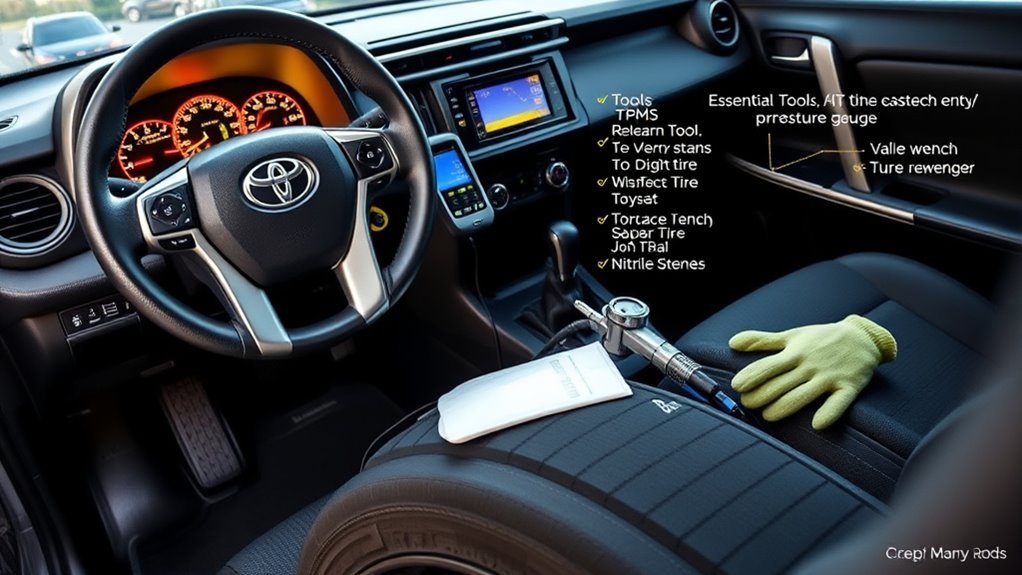
You do not need a professional scan tool for the first round of checks. Start with simple tools and move up only if the warning remains.
- Tire-pressure gauge: Use a quality digital or dial gauge and check pressures cold.
- Air compressor or reliable air pump: Inflate tires to the placard pressure.
- Flashlight: Inspect valve stems, sidewalls, tread, and bead areas.
- Soapy water: Find slow leaks around the valve stem, tread puncture, or bead.
- Valve caps: Replace missing or cracked caps to keep dirt and moisture out.
- TPMS scan tool: Helpful for reading sensor IDs, signal status, pressure, and temperature.
- Professional diagnostic tool: Needed when sensor registration, receiver faults, or TPMS codes are involved.
A TPMS warning is a safety alert, not just a dashboard annoyance. Correct tire pressure supports braking, handling, tire life, and fuel economy.
Preventative Maintenance Tips for Your RAV4’s TPMS
Good tire habits reduce false warnings and help the TPMS do its job. The system is a backup warning system, not a replacement for regular tire maintenance.
| Action | Frequency | Why It Helps |
|---|---|---|
| Check tire pressure cold | Monthly and before long trips | Prevents low-pressure warnings and uneven tire wear. |
| Check the spare tire if equipped | Monthly | Keeps the spare usable during an emergency. |
| Inspect valve stems and caps | Each pressure check | Catches leaks, corrosion, or physical damage early. |
| Ask for TPMS service during tire replacement | When tires are replaced | Saves labor if valve kits or aging sensors need attention. |
| Record sensor IDs when replacing sensors | During sensor service | Makes future registration and troubleshooting easier. |
Note: Tire pressure rises after driving because the tires heat up. Do not bleed hot tires down to the cold placard pressure unless your owner’s manual specifically instructs you to compensate for warm readings.
Frequently Asked Questions
How much does it cost to replace a TPMS sensor on a Toyota RAV4?
The cost depends on the model year, sensor type, shop labor, valve kit, programming, and whether the tire must be dismounted and rebalanced. A simple tire-pressure correction may cost nothing, while sensor replacement usually includes parts plus labor. Get a written quote before replacing all sensors, because one failed sensor does not always mean all four are bad.
How do you diagnose a TPMS sensor?
First, check all tire pressures cold and correct them to the driver-door placard. Then watch the warning light. If it blinks for about one minute and stays on, use a TPMS scan tool or visit a shop to read each sensor’s ID, pressure, temperature, battery status, and signal. This confirms whether the problem is a sensor, registration issue, receiver fault, or wiring problem.
Can I drive with a TPMS sensor fault?
You may be able to drive cautiously if the tires are correctly inflated and undamaged, but the TPMS may not warn you about a future pressure loss while the system is malfunctioning. Check pressure manually with a gauge and schedule diagnosis soon. Stop driving if a tire looks flat, the vehicle pulls, or handling feels abnormal.
Why did the TPMS light come on after new tires?
The tires may not have been inflated to the correct cold pressure, a sensor may have been damaged during installation, or the TPMS sensor IDs may not be registered correctly. Return to the tire shop and ask them to verify tire pressures, sensor operation, and ID registration.
Does resetting TPMS fix a bad sensor?
No. Resetting or initializing TPMS only teaches the system the current correct tire pressure baseline or refreshes the system procedure. It will not repair a dead sensor battery, broken valve/transmitter, unregistered sensor ID, damaged receiver, or wiring fault.
Conclusion
A RAV4 TPMS sensor fault is easiest to fix when you diagnose it in the right order. Check the tires cold first, use the placard pressure, inspect the valve stems, and only reset or initialize the system after the tires are correctly inflated. If the warning light blinks for about one minute and then stays on, move beyond a simple reset and have the TPMS scanned. That extra step prevents guesswork, avoids unnecessary sensor replacement, and keeps your RAV4’s tire-pressure warning system ready for a real low-pressure event.
Sources
- Toyota RAV4 Owner’s Manual — Tires and Tire Pressure Warning System — supports how the RAV4 TPWS uses tire pressure warning valves/transmitters.
- Toyota RAV4 Owner’s Manual — Warning Lights — supports the blinking-then-solid malfunction warning guidance.
- NHTSA TireWise Tire Safety — supports cold tire-pressure checking and use of the vehicle placard/certification label.
- 49 CFR § 571.138 — Tire Pressure Monitoring Systems — supports federal TPMS performance requirements.
- Toyota 2025 RAV4 Digital Owner’s Manual — supports model-specific owner-manual lookup for TPWS menus and procedures.

Related Articles

Toyota RAV4 TPMS Reset: Easy Steps That Work
Unlock the secrets to resetting your Toyota RAV4's TPMS effortlessly—discover the essential steps to ensure your tires are always safe.
Read More
Toyota RAV4 Tire Rotation: DIY Steps & Pattern
Take control of your Toyota RAV4's tire maintenance with our simple DIY rotation guide—discover the best steps for optimal performance and longevity!
Read More
Mix Tire Brands on a Toyota RAV4? Expert Guide
Keeping your RAV4 safe? Learn when mixing tire brands risks traction, ABS/TCS and AWD damage — and what exact matches you must insist on.
Read More