
What Is Tire Rolling Resistance? Impact on Fuel & Speed

Tire rolling resistance is the energy your tires lose to hysteresis and deformation as they roll, measured by the rolling resistance coefficient (RRC); lower RRC means less fuel use. It typically accounts for 3–11% of passenger car fuel consumption and each 10% RRC reduction yields roughly 1% fuel-economy gain, improving EV range similarly. Under‑inflation and aggressive tread boost RRC, while silica compounds and optimized geometry cut it—keep pressure, choose low‑RRC tires to save energy and see how further measures help.
What Is Tire Rolling Resistance and Why It Matters?

Because tires deform as they roll, they dissipate energy that opposes motion—this is tire rolling resistance—and it directly affects fuel use, accounting for roughly 3–11% of gasoline consumption in passenger cars. You should view rolling resistance as a measurable loss quantified by the rolling resistance coefficient; lower coefficients increase tire efficiency and translate to real fuel savings (roughly 10% lower resistance ≈ 1% better fuel economy). Design choices—tread compound, silica use, construction—and inflation pressure dominate resistance. Under-inflation raises consumption about 0.5–1% per 10 psi lost, so maintenance is pivotal. Regulatory labels (EU A–E) provide actionable metrics: A-rated tires can save ~0.5 L/100 km versus E. Select low-resistance tires to optimize operational energy use and reduce consumption.
How Hysteresis in Rubber Causes Energy Loss
When a tire enters and leaves the contact patch, its rubber undergoes repeated deformation and recovery that doesn’t perfectly reverse—this hysteresis converts part of the wheel’s mechanical work into heat and raises rolling resistance. You should understand hysteresis effects as internal friction within the polymer network: cyclic strain causes molecular rearrangement and viscoelastic damping that dissipates energy as heat. That loss increases the torque you must supply to sustain motion, especially at higher speeds or under heavier loads. Measured impacts are nontrivial—under‑inflation can raise hysteresis and boost fuel use roughly 0.5–1% per 10 psi below spec. Material science reduces hysteresis via fillers like silica and optimized compounding, which lower dissipative losses and improve energy efficiency without materially degrading traction.
How Rolling Resistance Affects Fuel Use and EV Range (Real Numbers)
If you cut a tire’s rolling resistance by 10%, you’ll typically see about a 1% improvement in fuel economy—roughly 14 gallons saved over 12,000 miles—because rolling losses account for roughly 4–11% of vehicle fuel use and can be far higher for heavy trucks (up to ~30% of energy). You’ll gain measurable fuel efficiency and EV range: lower rolling resistance reduces energy demand per mile, improving battery utilization and vehicle dynamics. Projected savings include ≈$70/year or ~$360 over 62,000 miles for typical passenger tires. The environmental impact follows directly from reduced fuel burn and lower emissions. Use the table below to compare metrics and communicate cost reduction and energy savings.
| Metric | Value |
|---|---|
| Passenger fuel savings | 14 gal/12,000 mi |
| Truck energy loss | up to ~30% |
| Silica | 14 gal/12,000 mi |
| Optimized compounding | 14 gal/12,000 mi |
| Which lower dissipative losses | 14 gal/12,000 mi |
Tire Design Vs. Maintenance: Features That Change Rolling Resistance
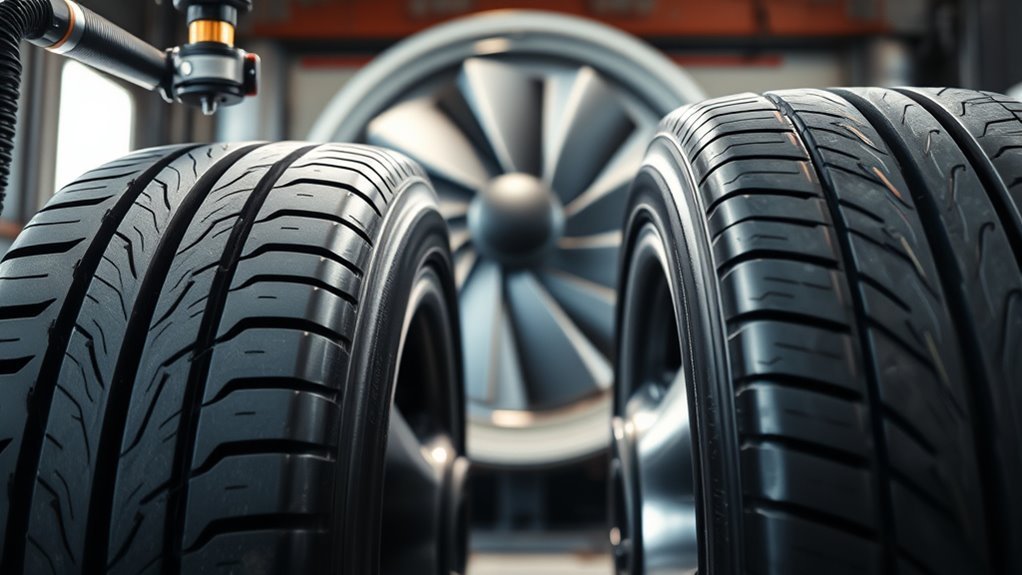
You’ll see rolling resistance driven both by design—compound choice, tread pattern and construction—and by maintenance actions like inflation, rotation and alignment. For example, silica-enhanced compounds and shallower tread can lower hysteretic losses while under-inflation of 10 psi can raise rolling resistance 0.5–1% (reducing fuel economy ~3% overall if tires stay under-inflated). We’ll quantify trade-offs between compound/tread choices and routine maintenance to show cost, fuel and range impacts.
Tire Compound Choices
Although tread pattern and construction matter, the rubber compound you choose often dictates a tire’s rolling resistance: silica-enriched formulations cut hysteresis and energy loss, lowering rolling resistance without sacrificing grip, while carbon-black–heavy or older polymer blends typically waste more energy. You should prioritize tire material innovations that target reduced hysteresis, weight reduction, and thermal stability. Data: a 10% drop in rolling resistance yields ~1% fuel economy improvement; small compound gains compound over tire life.
- Silica benefits: lower hysteresis, improved wet grip, measurable RRC reduction.
- Lightweight polymers and optimized fillers: reduce inertial and deformation losses.
- Maintenance synergy: proper inflation preserves compound performance; low pressure increases consumption by ~0.5–1% per 10 psi.
Tread Pattern Design
When engineers optimize tread pattern design, they cut rolling resistance by reducing unnecessary deformation and limiting the tire’s effective contact area with the road; shallower tread depths, fewer transverse grooves, and continuous center ribs all lower hysteresis and deformation losses, translating into measurable RRC gains. You’ll see tread innovation focus on groove count, rib continuity and silica-loaded compounds to reduce heat generation and hysteresis. That yields lower energy loss while preserving traction targets via performance balance trade-offs. Design data show shallower depths and continuous center ribs reduce flexing and sidewall strain. Choose patterns that match vehicle demands—low RRC for steady-state highway use, more grooves for wet grip. Maintenance complements design but isn’t covered here.
| Feature | Effect on RRC |
|---|---|
| Shallow depth | Decreases hysteresis |
| Continuous rib | Lowers deformation losses |
Inflation And Maintenance
If you keep tires at their recommended pressures and follow a disciplined maintenance schedule, you’ll cut rolling resistance markedly: every 10 psi of under-inflation can raise fuel consumption roughly 0.5–1%. You should monitor tire pressure frequently and adhere to maintenance schedules to preserve designed low-resistance characteristics from the compound, tread and sidewall architecture. Under-inflation and misalignment increase hysteresis and energy loss; the last fifth of tread often consumes ~6.5% less fuel than new tread, so extending life matters.
- Maintain correct tire pressure: check cold, monthly, and before long trips.
- Implement rotation and alignment per manufacturer maintenance schedules to prevent uneven wear.
- Choose lightweight, thin-sidewall designs and energy-efficient compounds for baseline low rolling resistance.
How Tire Pressure and Tread Wear Alter Rolling Resistance Over Time
Because tire pressure and tread depth directly change how much energy your tires dissipate, small maintenance lapses can measurably alter rolling resistance and fuel use: you’ll see immediate effects from tire pressure deviations and gradual shifts as tread wears. Under-inflation (≈10 psi low) raises rolling losses and increases fuel use roughly 0.5–1%. As tread wears, resistance typically falls; the final 20% of tread can consume about 6.5% less fuel than new tread. Tread design matters—shallower profiles usually lower resistance but reduce traction. A 10% reduction in rolling resistance corresponds to ~1% fuel-economy gain. To optimize performance, you should monitor tire pressure regularly, perform rotations to equalize wear, and balance low rolling resistance goals against safety and traction requirements.
Measuring Rolling Resistance and What the EU Label Tells You
You’ll see rolling resistance reported as a coefficient that quantifies energy loss per distance, with lower coefficients meaning less fuel burned. The EU tire label translates laboratory measurements into an A–E scale for rolling resistance (plus wet braking and noise), where A versus E can save roughly 0.5 L/100 km. Use the label to compare coefficients: each ~10% reduction in rolling resistance yields about a 1% fuel-economy gain, so class differences can meaningfully affect operating costs.
How Rolling Resistance Is Measured
When comparing tires, manufacturers and labs measure the force needed to keep a tire rolling at a constant speed—reported as Newtons (N) or as a rolling resistance coefficient (RRC)—using standardized drum or road-wheel tests that control speed, load, temperature and inflation to isolate hysteresis losses in the rubber and structure. You’ll see results framed by measurement standards that link tire performance to quantifiable fuel impact. Test protocols specify conditioning, repeat runs, and statistical averaging to reduce variance. You should interpret RRC alongside construction variables: pressure, tread and compound.
- Controlled variables: speed, load, temperature, inflation
- Output metrics: Newtons (N), RRC, percentage differences
- Consumer relevance: expected fuel savings, comparative ranking
EU Tire Label Explained
The EU tire label quantifies rolling resistance on a clear A-to-E scale, where A indicates the lowest rolling resistance and up to ~0.5 L/100 km fuel savings versus E-rated tires; this corresponds to roughly a 7.5% fuel-economy improvement and measurable CO2 reduction. You’ll use the label’s rolling resistance coefficient (RRC) to compare tires quantitatively: RRC measures energy lost as heat during rolling and maps to the A–E classes. The label also reports wet grip and external noise so you can balance efficiency with safety and comfort. For fleet managers and drivers, tire label benefits include predictable fuel-cost reductions and emissions gains. Clear presentation drives consumer awareness, enabling data-driven purchasing that aligns with EU sustainable-transportation targets.
Interpreting Class A–E
A clear A–E scale on the EU tire label lets you compare rolling resistance quantitatively: A-rated tires have the lowest rolling resistance and save roughly 0.5 L/100 km versus E-rated tires, while rolling resistance overall accounts for about 3–11% of passenger-vehicle fuel use. You should use the label to assess tire efficiency and quantify expected fuel and emissions savings. The rolling resistance coefficient, obtained via standardized tests, maps directly to class and to energy loss from tire deformation. A 10% coefficient reduction yields ~1% fuel economy gain; that relation helps estimate long-term environmental impact and operating cost.
- Choose A or B for best fuel savings and lower CO2 output.
- Balance efficiency with safety and performance metrics.
- Use certified coefficients to compare models.
Low-Rolling-Resistance Technologies : Continental Examples
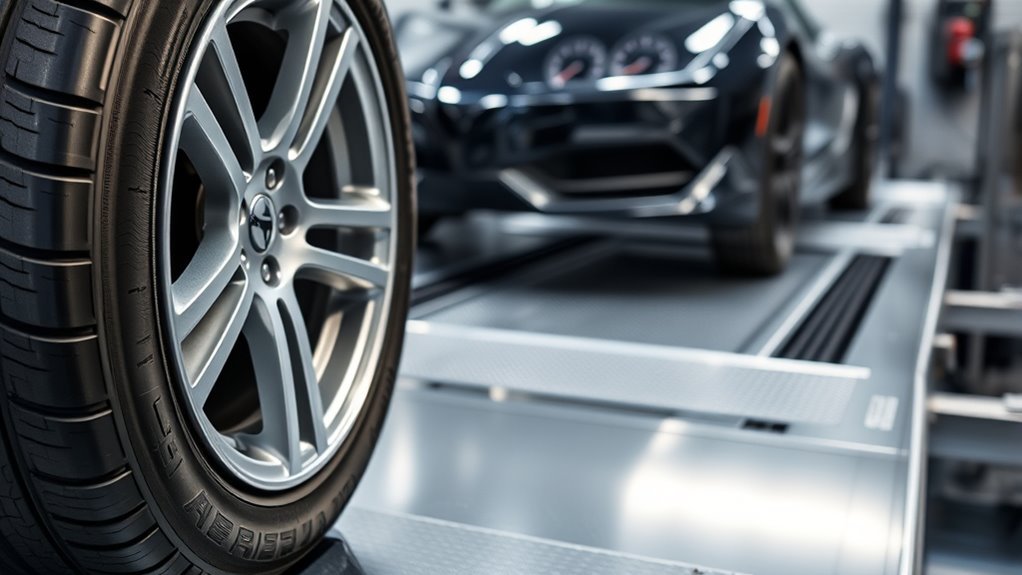
Although they target different use cases, Continental’s low-rolling-resistance technologies consistently combine tailored silica-enhanced tread compounds, optimized tread geometry, and material innovations to cut energy loss while preserving braking and wet-grip performance. You’ll see sustainability innovations and performance enhancements across ranges: EcoContact 7 and PremiumContact 7 use specialized rubber and tread patterns to minimize hysteresis without sacrificing safety. The Conti EfficientPro 5 delivers class A EU rolling-resistance performance for long-haul duty, improving fuel efficiency significantly. Silica-enriched compounds reduce braking distances and rolling resistance concurrently, yielding roughly 0.5 L/100 km fuel savings versus E-rated tires. UltraContact NXT pairs top EU ratings for rolling resistance, wet braking, and exterior noise with up to 65% renewable/recycled content, demonstrating measurable gains in life-cycle efficiency.
Actionable Checklist for Drivers and Fleets to Reduce Rolling Resistance
Building on how Continental cuts hysteresis and losses with silica compounds and optimized geometry, you can capture measurable efficiency gains through routine tire care and fleet practices. Prioritize tire efficiency and quantifiable fuel savings by instituting a standardized checklist: monitor pressure, choose low-rolling-resistance tires, and schedule alignments and rotations. Under-inflation raises rolling resistance ~10% and costs 0.5–1% fuel per 10 psi below spec. Low-RR tires yield ~1–2% fuel economy improvement per 10% RR reduction. Misalignment can increase energy use up to 10%; balancing improves economy 1–3% and extends life up to 40%.
- Check and maintain pressure daily/weekly to spec.
- Switch to certified low-rolling-resistance tires for routes.
- Rotate every 5,000–8,000 miles and align regularly.
Frequently Asked Questions
Does Rolling Resistance Impact Fuel Efficiency?
Yes — you’ll improve fuel efficiency by reducing rolling resistance; proper tire pressure and optimized tread design cut energy loss, yielding measurable gains (roughly 10% resistance drop ≈ 1% fuel economy), saving fuel and costs.
How Does Rolling Resistance Affect Speed?
Like a drag on a kite, rolling resistance reduces speed by forcing you to supply extra power; improving tire performance lowers this drag, enhancing speed dynamics, so you’ll see measurable gains in acceleration and top speed.
What Is the 105% Rule for Tires?
The 105% rule says you shouldn’t exceed 105% of the manufacturer’s cold tire pressure; you’ll preserve ideal tire pressure, minimize adverse tread design effects, reduce rolling resistance, and maintain fuel efficiency and predictable handling.
Conclusion
You’ve seen how rolling resistance—driven mainly by rubber hysteresis—bleeds energy like a slow leak, cutting fuel economy by roughly 1–4% per 0.01 in Crr and trimming EV range similarly. Prioritize low-Crr tires, correct pressure, and timely replacement: they’re high-impact, low-effort fixes. Use EU label and measured Crr data when you buy, monitor pressure weekly, and log tread wear. Think of it as tightening every bolt on efficiency—small gains stack into real savings.

Related Articles
What Does THE P Stand For on a Tire? Full Meaning Explained
I’ll explain what the “P” on a tire really means and why it could change how you choose your next set.
Read More
How to Use a Tubeless Tire Repair Kit: Complete Field Guide
Learn how to fix tubeless tire punctures fast with the right kit, because one small mistake can leave you stranded on the trail.
Read More
How to Tell a Tire’s Diameter: Easy Guide to Reading Tire Size
Want to decode tire sidewall numbers and find the right diameter, but wonder what those hidden digits really mean?
Read More