
How Wide Is a 235 Tire? Exact Width & Fitment Guide
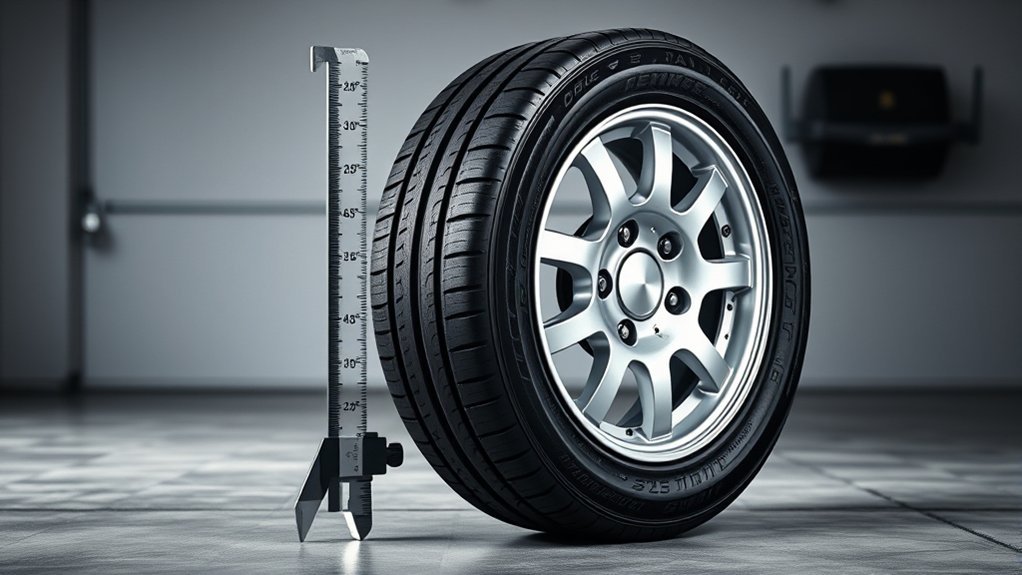
A 235 tire has a nominal section width of 235 millimeters, which is about 9.25 inches from sidewall to sidewall. That first number tells you the tire’s width category, but it does not tell you the full tire height, load rating, wheel fit, or vehicle compatibility by itself. To choose safely, match the full size code, such as 235/75R15, 235/70R16, or 235/65R17, to your vehicle placard, wheel specs, and the tire maker’s approved rim-width range.
Last updated: August 18, 2026. Rim-width examples, mounted-width guidance, source links, and fitment FAQs were rechecked against current tire-industry and manufacturer references.
Quick Answer
A 235 tire is about 235 mm wide, or 9.25 inches, measured as nominal section width. It is wider than a 225 tire and narrower than a 245 tire. Rim fitment depends on the exact tire model, aspect ratio, wheel diameter, load rating, and vehicle clearance.
Key Takeaways
- A 235 tire is about 235 mm wide, which converts to roughly 9.25 inches.
- The “235” number is section width, not overall tire diameter or guaranteed tread width.
- A 235/75R15 is about 28.9 inches tall by formula, so it is not a true 31-inch tire.
- Approved rim width varies by full size and tire model; checked manufacturer examples range from 6.0–8.0 inches for a 235/75R15 to 7.5–9.0 inches for a 235/45R18.
- Load capacity comes from the load index on the sidewall, not from the 235 width alone.
235 Tire Size at a Glance
| Question | Short Answer |
|---|---|
| How wide is a 235 tire? | 235 mm, or about 9.25 inches, nominal section width |
| Is 235 the tread width? | No. It is section width; tread width varies by tire design |
| Is 235 a 31-inch tire? | Not by itself; 235/75R15 calculates to about 28.9 inches tall |
| What rim width fits? | It depends on the full size and tire model; use the maker’s approved range |
Verification note: The mounted-width guidance below was cross-checked with Michelin, replacement and inflation advice with USTMA and NHTSA, and rim-width examples with current Goodyear specifications.
[Products Worth Considering]

Keep RV, trailer, or truck dual-axle tires protected with waterproof, UV-resistant covers that help guard against sunlight, snow, rust, and dirt. The dual tire covers are easy to install with a rope/bungee fastener for a stable fit that won’t easily slip. Designed for 27–30 inch diameter wheels, they help maintain tire condition through harsh weather.

The Tymate TM3 RV TPMS delivers real-time tire pressure monitoring from 0 to 144 PSI with accurate readings and dependable wireless communication. It includes four external sensors with pre-pairing, six alarm modes for rapid leak, pressure extremes, temperature, and signal loss, plus an easy-reference setup for alert thresholds. Solar and USB-C charging help keep the display powered, while the color LCD and adaptive backlight improve visibility for safer driving and towing.
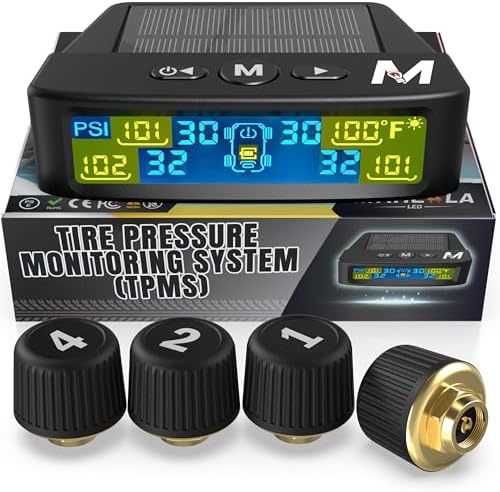
Marcala’s TPMS set of four sensors helps you monitor tire pressure and temperature in real time while driving, with updates every second. The bright color LCD uses auto-dimming for easy viewing, powered by dual solar and USB charging, and offers six alarm modes. Built for trailers, RVs, campers, trucks, and towing setups, the sensors support monitoring 1-4 wheels up to 98 PSI with IP67 waterproof protection.
How Wide Is a 235 Tire?
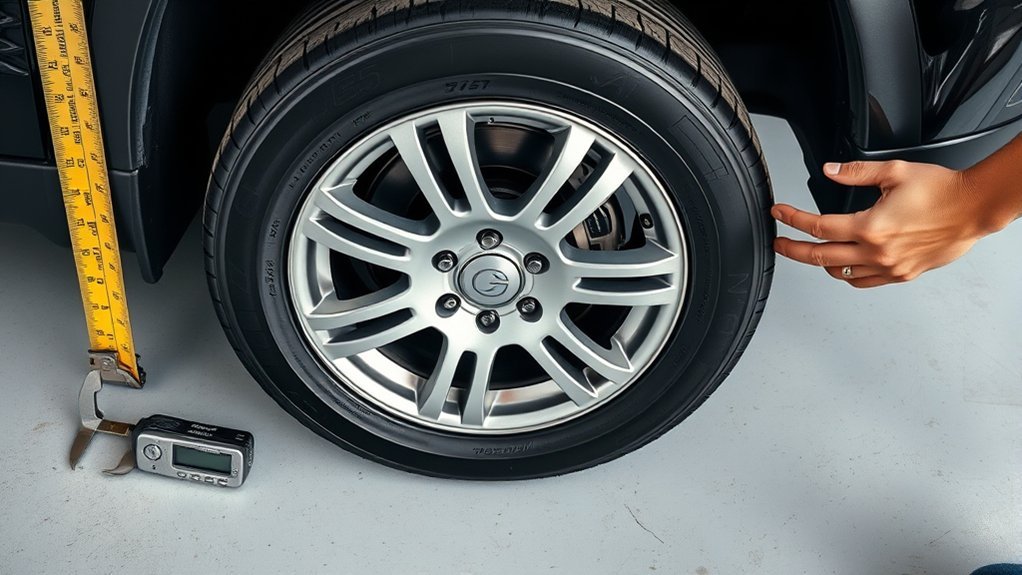
A 235 tire is 235 millimeters wide by nominal section width. Converted to inches, that is about 9.25 inches because 235 ÷ 25.4 = 9.25. In a tire size such as 235/75R15, the first number is the section width in millimeters, the second number is the aspect ratio, the “R” means radial construction, and the final number is the wheel diameter in inches.
That means a 235 tire is not automatically one fixed height. The height changes with the aspect ratio and wheel diameter. For example, a 235/75R15 has a sidewall height of about 176 mm, or 6.94 inches, and an estimated overall diameter of about 28.9 inches. A 235/45R18 is still a 235-width tire, but it is much shorter because the sidewall is only 45% of 235 mm.
Note: Section width is measured across the tire’s sidewalls on a specified measuring rim. Michelin states that section width varies by about 0.2 inch (5 mm) for every 0.5-inch change in rim width. Use this only as a planning estimate; the exact tire maker’s published dimensions control fitment. Michelin published sizing notes.
235 Tire Width in Inches and Millimeters
The width conversion is simple: 235 mm equals about 9.25 inches. This makes a 235 tire a common middle-ground size for SUVs, crossovers, light trucks, and some passenger cars. It is wider than many economy-focused sizes but not as wide as a 245 or 255 setup.
| Tire Width | Approx. Inches | Compared With 235 |
|---|---|---|
| 225 mm | 8.86 in | About 0.39 in narrower |
| 235 mm | 9.25 in | Baseline size |
| 245 mm | 9.65 in | About 0.39 in wider |
A wider tire can change steering feel, road contact shape, and sidewall support. However, width alone does not guarantee better grip. Tire compound, tread design, vehicle weight, inflation pressure, alignment, and road conditions all matter.
What Rims Fit a 235 Tire?
A 235 tire can fit several rim widths, but there is no single rim-width answer for every 235 tire. The safe range depends on the exact size and tire model. A tall 235/75R15 SUV tire may have a different approved rim range than a lower-profile 235/45R18 performance tire. Always check the tire manufacturer’s spec sheet before buying wheels or tires.
Warning: Do not choose a wheel based only on the 235 width. An approved setup must match wheel diameter, rim width, bolt pattern, offset, load rating, speed rating, tire pressure, suspension clearance, brake clearance, and the vehicle manufacturer’s recommended tire size.
Rim Width Range
The approved rim width can change substantially even when the first number stays 235. For example, one current Goodyear 235/75R15 specification lists an approved range of 6.0 to 8.0 inches, while a Goodyear 235/45R18 specification lists 7.5 to 9.0 inches. That is why “235” alone cannot tell you the correct wheel width. Check the spec sheet for the exact tire model you plan to mount.
For fitment planning, check these items before you buy:
- Full tire size: 235/75R15, 235/70R16, 235/65R17, and 235/45R18 are not the same height.
- Approved rim width: use the tire manufacturer’s listed minimum and maximum wheel width.
- Wheel diameter: the R15, R16, R17, or R18 part must match the wheel diameter.
- Load index and speed rating: use the designation recommended by the vehicle or tire manufacturer; do not install a lower load-carrying capacity than specified.
- Clearance: confirm space at the fenders, suspension, brakes, and steering lock.
- Inflation pressure: use the vehicle placard or owner’s manual, not the maximum pressure molded on the tire.
USTMA’s replacement guidance says replacement tires should use the size, load index, and speed-rating designation recommended by the vehicle or tire manufacturer. NHTSA likewise directs drivers to use the vehicle manufacturer’s recommended cold inflation pressure from the tire-information placard or certification label.
Will a 235 Tire Fit a 7-Inch Rim?
Sometimes. A 7-inch rim falls inside the approved range of the Goodyear 235/75R15 example checked for this update, but it falls below the 7.5-inch minimum listed for the checked Goodyear 235/45R18 example. So a 7-inch wheel cannot be approved or rejected from the “235” number alone. Match the full size and exact tire model to the manufacturer’s rim-width table.
Common Fitment Sizes
Common 235 sizes include 235/75R15, 235/70R16, 235/65R17, 235/60R18, and 235/45R18. The width stays at 235 mm, but the overall diameter changes because the aspect ratio and wheel diameter change.
| Size Example | Approx. Sidewall Height | Approx. Overall Diameter |
|---|---|---|
| 235/75R15 | 6.94 in | 28.9 in |
| 235/70R16 | 6.48 in | 29.0 in |
| 235/65R17 | 6.01 in | 29.0 in |
| 235/45R18 | 4.16 in | 26.3 in |
Compatibility Considerations
Wheel fitment is more than width. A 235 tire must match the wheel diameter, and the wheel itself must match the vehicle’s bolt pattern, offset, center bore, brake clearance, and load rating. If you are changing from the factory tire size, compare the new overall diameter with the original size to avoid rubbing, speedometer error, ABS/traction-control issues, or poor handling.
Pro Tip: Before buying, look up your exact tire model’s specification table. The approved rim-width range, measured section width, tread width, outside diameter, load index, and maximum load are usually listed there.
235 Tire Vs 225 and 245 Width
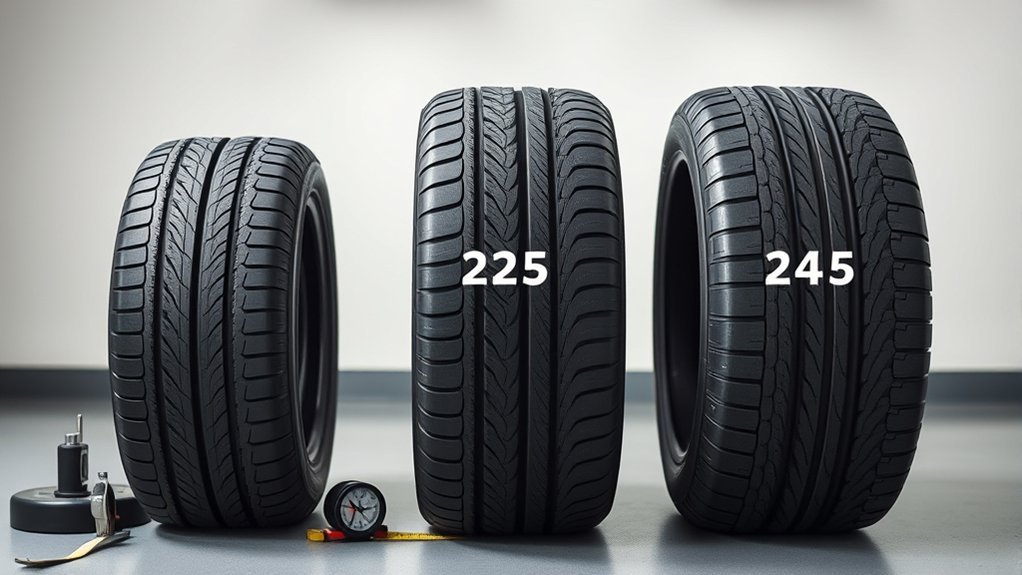
A 235 tire sits between a 225 and a 245. A 225 is about 8.86 inches wide, a 235 is about 9.25 inches wide, and a 245 is about 9.65 inches wide. Each step changes width by 10 mm, or about 0.39 inches.
For a centered comparison, a 10 mm increase in nominal section width works out to about 5 mm, or 0.20 inch, per side before you account for wheel width, offset, shoulder shape, or the tire’s actual published section width. That per-side view is more useful when you are estimating inner strut or outer fender clearance.
- 225 tire: 10 mm narrower than a 235, so it needs slightly less nominal lateral space; performance still depends on the full size and tire model.
- 235 tire: the middle width in this comparison; fitment still depends on aspect ratio, wheel diameter, rim width, load rating, and clearance.
- 245 tire: 10 mm wider than a 235, so it needs slightly more nominal lateral space and may require a different approved rim range.
If your vehicle came with 225 or 245 tires, changing to a 235 can alter overall diameter, clearance, steering response, and the available load or speed rating depending on the full replacement size and tire model. Always compare the complete size and service description, not just the first number.
[Products Worth Considering]

The Tymate TM12 RV TPMS delivers real-time tire pressure and temperature monitoring with a stable 433Hz display for safer long-distance driving. It supports simultaneous monitoring across vehicle and trailer zones, includes six alarm modes for pressure, temperature, leakage, battery, and signal loss, and features easy DIY installation with auto calibration. Power is supplied via USB-C charging or solar recharging, with a wide 0–144 PSI range and up to 50 ft signal coverage for RVs and towable trailers.

RVMATE dual-axle RV tire covers help shield your tires from sunlight, snow, rust, and dirt to keep them in better condition in harsh weather. Made with heavy-duty waterproof, UV-resistant 420D Oxford fabric, they provide strong shading and help reduce wear. They install easily by placing the cover on the wheel and fastening the rope for a stable fit.
How Does a 235 Tire Affect Ride Quality?
A 235 tire can feel comfortable and stable when it is matched correctly to the vehicle and wheel. The ride quality depends more on the full size than on width alone. A 235/75R15 has a tall sidewall that can absorb bumps well. A 235/45R18 has the same nominal width but a shorter sidewall, so it may feel firmer over potholes and rough pavement.
Do not predict ride or grip from the 235 width alone. Tread design, compound, casing construction, sidewall height, wheel width, vehicle weight, alignment, and inflation pressure all affect how the tire feels. Underinflation can increase heat, irregular wear, and rolling resistance, while excessive pressure can make the ride harsher and increase vulnerability to impact damage.
Where a 235 Tire Works Best
A 235 tire works best on vehicles that were designed for that width or have a manufacturer-approved alternate size. You will commonly see 235-width tires on SUVs, light trucks, crossovers, minivans, and some passenger cars. If you are changing from a 225 or 245, compare the full replacement size against the vehicle placard and the exact tire specifications rather than treating width as the only fitment variable.
Best Vehicle Types
Many 235 sizes are common on vehicles that need a mix of comfort, load support, traction, and stable handling. Good candidates include:
- SUVs and crossovers with factory or approved 235 sizes
- Light trucks with the correct load index or LT rating
- Minivans and family vehicles using the correct service description
- Passenger cars that list a 235 size on the placard or approved fitment guide
Do not assume that one 235 tire can replace another. A passenger 235/65R17 and an LT235/75R15 may have different construction, pressure requirements, load ratings, and ride behavior.
Common Fitment Uses
Fitment-wise, a 235 tire is often used when drivers want a stable width without moving to an overly wide tire. It can support daily driving, highway use, light-duty hauling, and mild all-weather traction when the tire type matches the vehicle and driving conditions.
| Vehicle Type | Typical Use | What to Check |
|---|---|---|
| SUV | Daily driving and highway travel | Placard size, load index, clearance |
| Light truck | Mixed-duty driving and hauling | LT rating, pressure, wheel load rating |
| Crossover | Comfort, wet traction, family use | Overall diameter and speed rating |
| Passenger car | Handling and road stability | Rim width, offset, fender clearance |
Frequently Asked Questions
How wide are 235 tires in inches?
A 235 tire is about 9.25 inches wide. The calculation is 235 millimeters divided by 25.4. This is nominal section width, so the exact mounted width can vary slightly by tire model, rim width, and inflation pressure.
Is a 235 a 31-inch tire?
No. The 235 number only tells you width, not overall tire diameter. A common 235/75R15 is about 28.9 inches tall by formula. To get close to 31 inches, you need a different full tire size, not just a 235 width.
Is a 235 wider than a 225?
Yes. A 235 tire is 10 mm wider than a 225 tire. In inches, a 235 is about 9.25 inches wide, while a 225 is about 8.86 inches wide. The difference is roughly 0.39 inches.
Is a 235 or 245 tire wider?
A 245 tire is wider. It is 10 mm wider than a 235 tire, or about 0.39 inches wider. Before switching from 235 to 245, confirm rim width, fender clearance, suspension clearance, load rating, and overall diameter.
Can I put 235 tires on 225 rims?
Maybe, but only if the wheel width is approved for the exact 235 tire you want to install. Do not judge by the old tire width alone. Check the wheel width stamped on the rim and compare it with the tire manufacturer’s approved rim-width range.
Does a 235 tire use more gas than a 225?
It can, but not always. A wider tire may add rolling resistance or weight, but fuel economy also depends on tire compound, tread pattern, inflation pressure, vehicle alignment, and driving style. Compare tire model specs, not width alone.
Will a 235 tire fit a 7-inch rim?
Some will and some will not. The checked Goodyear 235/75R15 example approves a 7-inch rim, while the checked Goodyear 235/45R18 example starts at 7.5 inches. Use the approved rim-width range for your exact tire size and model.
Is 235 the tire’s tread width?
No. The 235 number is nominal section width, measured across the tire’s widest sidewall-to-sidewall section under specified conditions. Tread width is a different measurement and can vary between tire models that share the same 235 size label.
Conclusion
A 235 tire is about 9.25 inches wide, but width is only one part of tire fitment. The full tire size tells you sidewall height and wheel diameter, while the service description tells you load index and speed rating. Before buying, confirm the vehicle placard, approved rim width, clearance, and the exact tire maker’s specifications. If you are comparing a larger width, see our guide to how wide a 265 tire is. If the service description is unclear, use our load index and speed rating guide as a decoding example.
Sources
- Tire Rack — How Do I Read My Tire Size On My Sidewall? — supports tire-size code definitions.
- Michelin — Primacy Tour A/S published sizing notes — supports specified measuring-rim conditions and the approximate change in section width with rim-width changes.
- USTMA — Replacing Tires — supports replacement size, load-index, and speed-rating guidance.
- NHTSA TireWise — Tire Safety Ratings and Awareness — supports vehicle-placard and cold-inflation-pressure guidance.
- Goodyear published specifications — 235/75R15 example — lists a 6.0- to 8.0-inch approved rim range, 6.5-inch measuring rim, and 28.9-inch outside diameter for the checked example.
- Goodyear published specifications — 235/45R18 example — lists a 7.5- to 9.0-inch approved rim range and 8.0-inch measuring rim for the checked example.

Related Articles

Firestone Tire Installation Cost: Full Price Guide
Compare Firestone tire installation costs and discover what hidden fees could change your final bill.
Read More
Tire Rack vs Costco: Which Is Better for Tires?
Pick the better tire deal between Tire Rack and Costco before hidden differences change your choice.
Read More
How Much Does It Cost to Install Rims?
Need to know what installing rims really costs? Discover the hidden fees and price factors before you pay more than you should.
Read More