
Why Tire Load Rating Matters: Safety & Legal Requirements

You need tire load ratings that meet or exceed your vehicle’s specifications because they set each tire’s maximum weight capacity; using lower-rated tires risks overheating, structural failure, poor handling, and longer stopping distances, and can void warranties or trigger legal and insurance consequences. Find the index on the sidewall, convert it with an official chart, and follow the placard or owner’s manual when replacing tires. Keep pressure, inspections, and load distribution current to stay compliant—continue for specifics on selection and maintenance.
What Is a Tire Load Rating and Where to Find It on the Sidewall

A tire load rating is a two- or three-digit numerical code stamped on the sidewall that tells you the maximum weight a single tire can safely carry at the correct inflation; for example, in “205/55 R17 91V” the “91” is the load index. You locate this code adjacent to the tire size and speed rating on the sidewall and confirm it against the vehicle’s placard or owner’s manual. You must recognize the load rating importance: choosing tires with equal or higher ratings preserves structural integrity, prevents overheating, and reduces failure risk. Follow tire safety standards and manufacturer guidance to maintain compliance, avoid fines, and protect insurance coverage. Inspect sidewalls for legible markings and replace tires that have been altered or damaged, since unreadable ratings undermine lawful operation. By applying precise verification and documented reference points, you secure both freedom of movement and regulatory adherence without compromise.
Reading Load Index: How to Convert the Number to Pounds
Start by noting that the load index on your tire is a coded number that maps directly to a specific weight capacity per tire. Use an official load index lookup table to convert that number into pounds (for example, index 91 = 1,356 lbs; index 100 = 1,764 lbs). Always verify the converted per-tire capacity meets or exceeds your vehicle’s GVWR to maintain safety and compliance.
Load Index Meaning
Look at the tire’s sidewall to find the load index number—it’s your direct code for how much weight that tire can safely carry when properly inflated. You need to understand load index significance: that numeric code maps to pounds, and tire safety implications hinge on matching it to vehicle specs. Use standardized charts to convert the index to a specific pound capacity and never exceed it.
| Index | Pounds |
|---|---|
| 91 | 1,356 |
| 95 | 1,521 |
Check indices during maintenance and before heavy loads. Staying compliant protects your freedom to travel without risk of tire failure and meets legal requirements for safe operation.
Lookup Table Use
When you read the load index on a tire’s sidewall, convert that number to pounds using an official load index chart so you can confirm the tire meets your vehicle’s required capacity; for example, index 91 equals about 1,356 lb. Use the lookup table benefits to check ranges—indexes span roughly 75 (≈853 lb) to 130 (≈2,866 lb). Consult your owner’s manual or tire placard to match load index applications to vehicle requirements. Don’t exceed ratings: overload risks overheating, structural damage, or failure.
- Verify the recommended index on the placard against the chart for each tire.
- Apply the chart to determine per-tire load capacity and total axle load.
- Reassess when changing tires, payloads, or towing to maintain compliance and freedom.
Convert Index To Pounds
Although the load index is just a number stamped on the sidewall, you must convert it to pounds using an official load index chart to know a tire’s true capacity; for example, index 91 equals 1,356 lb per tire. You’ll use a standardized load index chart to translate the load index into pounds, confirming tire specifications match your vehicle’s requirements. Each index step typically adds ~25–30 lb, so pick tires that meet or exceed manufacturer limits. Maintain correct tire pressure to avoid overheating and accidental overload. Below is a quick reference to illustrate conversion increments:
| Load Index | Pounds |
|---|---|
| 88 | 1,235 |
| 89 | 1,279 |
| 90 | 1,323 |
| 91 | 1,356 |
Why Tire Load Ratings Matter for Safety and Accident Prevention
Because every tire is rated for a specific maximum load, you must match tire load ratings to your vehicle’s weight and intended use to prevent overheating, blowouts, and loss of control. You’ll protect yourself and others by preventing tire overheating and emphasizing blowout prevention through proper loading. Correct ratings preserve vehicle stability and avoid traction compromise that lengthens braking distance and raises accident risk. Compliance is practical liberation: following ratings reduces legal compliance problems and limits insurance issues after incidents.
- Overload consequences: heat buildup, tread separation, sudden failure—highway speeds multiply accident risk.
- Handling impacts: uneven or under-rated tires degrade vehicle stability, increase stopping distance, and reduce cornering grip.
- Liability control: documented adherence to load limits supports legal defense and insurance claims, keeping you free from avoidable penalties.
Be precise with load choices, check loads regularly, and act decisively to maintain safety, stability, and compliance.
How to Find the Correct Tire Load Rating for Your Vehicle (Placard, Manual, Current Tires)
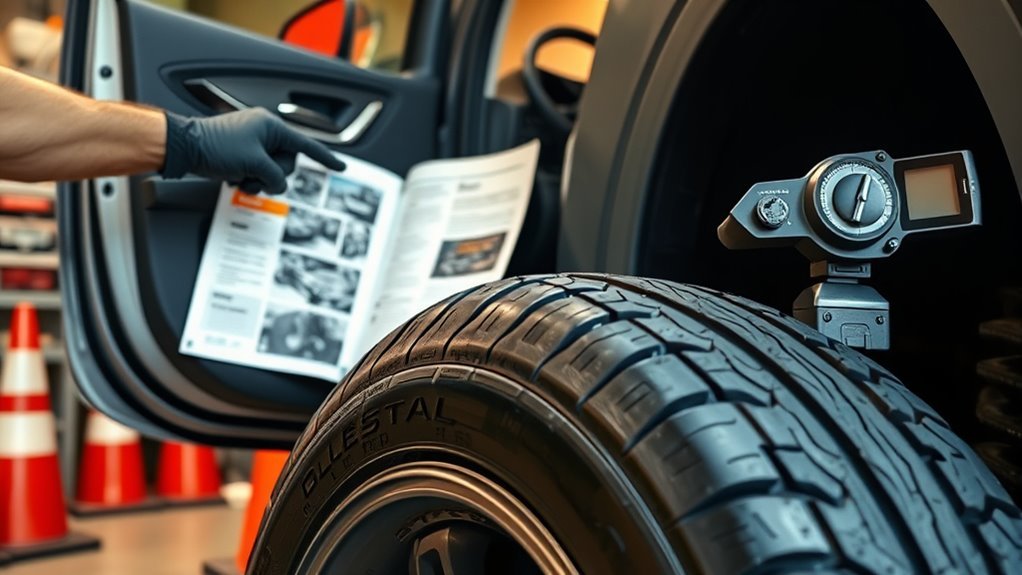
Start by checking two primary sources: the tire placard (usually on the driver’s door jamb or inside the fuel filler door) and your owner’s manual, both of which list the manufacturer-recommended load rating or load range for safe operation. You’ll use those specs as the baseline for compliant tire selection. Next, inspect your current tires’ sidewalls: find the load index number adjacent to the size and speed rating to confirm what they’re rated to carry. Translate that numerical code using a standard load index chart to know each tire’s maximum weight capacity. Follow these tire selection tips: always match or exceed the placard/manual load rating, document the translation for reference, and prioritize manufacturer guidance over marketing claims. Don’t fall for load rating myths that suggest lower-rated tires will suffice because they look heavier or ride softer. By cross-referencing placard, manual, and sidewall data, you protect safety, legal compliance, and your freedom to drive with confidence.
Is It OK to Use Tires With a Different Load Rating?
Can you mix tire load ratings safely? You can, but only within strict limits. Tire compatibility matters: never fit tires with a lower load rating than the vehicle specifies unless they’re 3PMSF-marked winter tires intended as temporary exceptions. Using under‑rated tires risks overheating, structural failure, and legal exposure. Higher load‑rated tires are allowed, but they don’t raise the vehicle’s certified payload or override manufacturer limits.
You can mix load ratings only within strict limits — never use lower-rated tires unless temporary 3PMSF winter exceptions apply.
- Check the tire placard or owner’s manual for the required rating and choose replacements that meet or exceed that number.
- If considering lower-rated winter tires, verify they carry the 3PMSF symbol and understand their temporary role and diminished load safety under heavy use.
- Record changes and consult your insurer or regulator to confirm legal compliance; improper choices can affect claims.
You’re empowered to act: prioritize certified tire compatibility and load safety to preserve freedom of mobility while staying compliant and protected.
When to Choose XL, E, or Heavier Load‑Range Tires
When you routinely carry heavy loads, tow trailers, or operate a 3/4‑ton or 1‑ton truck, choose XL or heavier load‑range tires to match the vehicle’s service demands and GVWR. You’ll select XL when your SUV or larger vehicle needs higher inflation pressure and a reinforced structure for added capacity; XL provides margin over standard tires without moving to commercial load ranges. Opt for E load rated tires when loads approach 3,000–3,500 pounds per tire at up to 80 PSI — typical for heavy duty applications on 3/4‑ton and 1‑ton trucks. In the XL vs E decision, base choice on your maximum static load, towing frequency, and legal GVWR limits. Heavier load‑range tires give durability and stability under sustained weight, reducing legal and safety exposure. You must document ratings, maintain correct pressures, and follow jurisdictional requirements to keep insurance and compliance intact while preserving operational freedom.
How Improper Load Ratings Affect Handling, Wear, and Braking

If you fit tires with insufficient load ratings, you raise the risk of structural failure, accelerated wear, and degraded stopping performance under real‑world loads. You’ll notice handling becomes vague as the tire’s sidewall flexes beyond design limits, upsetting load distribution and reducing steering precision. Excessive flex generates heat, accelerates tread wear, and shortens service life. Braking suffers too: uneven contact patches and compromised tire performance increase stopping distances and raise liability exposure.
- Overload → structural failure risk, especially at speed; legal and insurance consequences follow.
- Excessive flexing → heat buildup, rapid tread wear, reduced longevity, uneven load distribution.
- Compromised handling/braking → poorer steering response, instability in maneuvers, longer stopping distances.
You must choose tires that meet manufacturer load specs to preserve predictable tire performance, minimize legal risk, and reclaim freedom of movement with safe, reliable equipment.
Tire Maintenance for Load Safety: Pressure, Inspection, and Loading Practices
Before every trip, check tire pressure with a reliable gauge and adjust to the manufacturer’s recommended PSI to prevent excess flexing and heat. Inspect each tire for tread wear, cuts, bulges, or uneven wear patterns and address any issues before loading. When you load the vehicle, follow the tire load ratings and distribute weight evenly to minimize stress and reduce the risk of failure.
Check Tire Pressure Regularly
Check tire pressure at least once a month and before any heavy towing or hauling to guarantee it matches the manufacturer’s recommended psi for your load conditions. You need reliable gauges and consistent safety checks to prevent low-pressure flexing, heat buildup, and potential blowouts. For liberation-minded drivers, this simple habit protects your freedom on the road and enforces responsibility.
- Use a calibrated gauge when tires are cold; record psi versus the vehicle/load chart.
- Inflate to the specified pressure for the expected load, especially during towing/hauling, matching tire load ratings.
- Repeat monthly and after impacts, logging results and correcting deviations promptly.
Stay disciplined: correct tire pressure preserves load capacity, extends tire life, and keeps you compliant.
Inspect Tires Before Loading
When preparing to load your vehicle, inspect each tire closely for correct pressure, visible damage, and adequate tread depth so you’re certain they’ll support the intended weight. Use prescribed tire inspection techniques: measure PSI with a calibrated gauge, confirm tread depth with a gauge or legal indicator, and scan sidewalls and tread for cuts, bulges, or embedded objects. Apply damage assessment tips by marking defects and removing the tire from service if you find structural compromise. Cross-check each tire’s load rating against planned cargo and distribute weight evenly to avoid unilateral stress. These precise steps keep you compliant, reduce failure risk under load, and preserve your freedom to travel without unnecessary constraint or hazard.
Legal, Warranty, and Liability Implications of Incorrect Load‑Rated Tires
If you fit tires that don’t meet your vehicle’s required load rating, you can face legal penalties, voided warranties, and denied insurance claims that leave you financially exposed. You must recognize legal consequences, warranty issues, liability risks, and compliance standards as interconnected obligations: regulators set load thresholds to protect public safety, manufacturers require adherence to preserve coverage, and insurers expect compliance to validate claims.
- Legal consequences: inspections or crashes revealing under‑rated tires can trigger fines, citations, or impoundment for noncompliance with vehicle codes.
- Warranty issues: manufacturers will deny coverage for failures when tires were overloaded or mismatched to rated capacity.
- Liability risks: tire failure from insufficient load rating creates civil exposure for damages, injuries, and defense costs.
You should document torque, load ratings, and purchase records to assert responsibility and pursue remedies. Stay compliant to free yourself from avoidable financial and legal bondage.
Frequently Asked Questions
Why Is Tire Load Rating Important?
Because it guarantees your tires meet required load capacity, you’ll maintain tire performance, safety, legal compliance, and handling; don’t exceed ratings, and you’ll protect occupants, avoid penalties, preserve stability, and extend tire lifespan.
Why Is Tire Safety Important?
A van driver who ignored tire maintenance caused a highway blowout; you’ll avoid that by prioritizing tire maintenance and driving safety, ensuring compliance, protecting others, preserving freedom to travel, and preventing legal or financial setbacks.
Conclusion
You’re responsible for matching tires to your vehicle’s load rating: failure to do so isn’t just risky—it’s common. Studies show overloaded tires contribute to about 30% of tire-related crashes, so check the sidewall, placard, or manual and convert the load index to pounds before purchasing. Use the same or higher rating, maintain correct pressure, and document inspections. Doing this keeps you compliant, preserves warranty coverage, and reduces liability in an incident.
Related Articles

Run-Flat Tires Explained: Safe Zero-Pressure Driving
Hesitant to change a tire? Discover how run‑flat technology lets you keep driving safely after a puncture—and what limits you must never ignore.
Read More
Signs You Need New Tires: Visual & Performance Clues
Lifelong safety starts with spotting tread wear, bulges, or vibration—learn the simple checks that tell you when tires must be replaced.
Read More
Tire Wear Indicator Bars: Built-In Safety Markers Decoded
On the brink of legal tread limits? Discover how tire wear indicator bars reveal danger and when to replace—read on to protect your ride.
Read More