What Tires for Towing With a Toyota RAV4? Key Factors
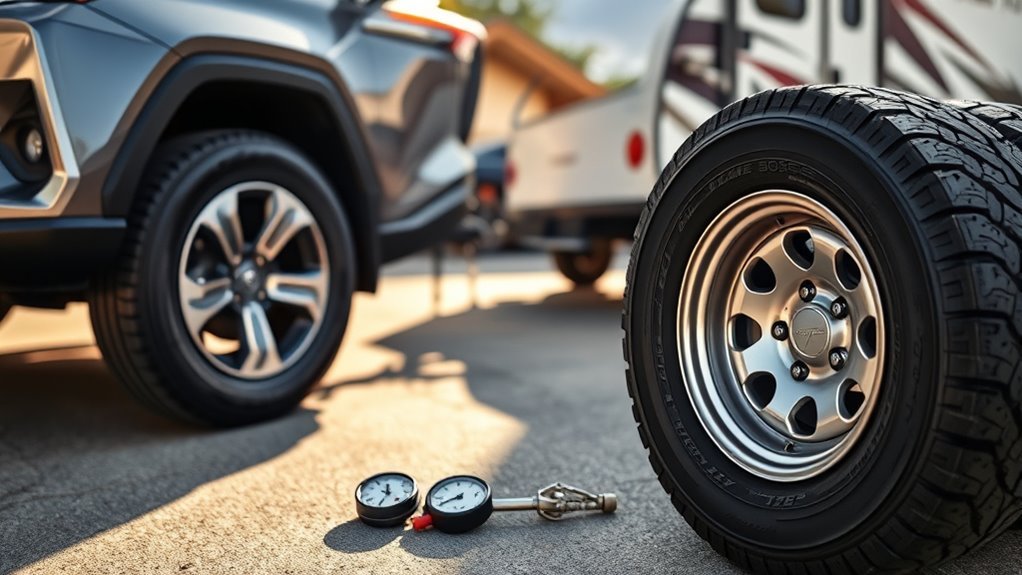
You’ll want tires with a higher load index and reinforced sidewalls to handle added tongue weight and heat when towing with a RAV4. Match or exceed the vehicle’s load-rating and use XL/extra‑load constructions for stability. Choose tread based on routes: all‑season for pavement, highway‑AT for quieter towing, A/T for light off‑road, and winter tires with 3PMSF for snow. Keep pressures a few psi above placard and inspect often; more specifics follow below.
Quick Picks: Best Tires for RAV4 Towing (3 Short Recommendations)
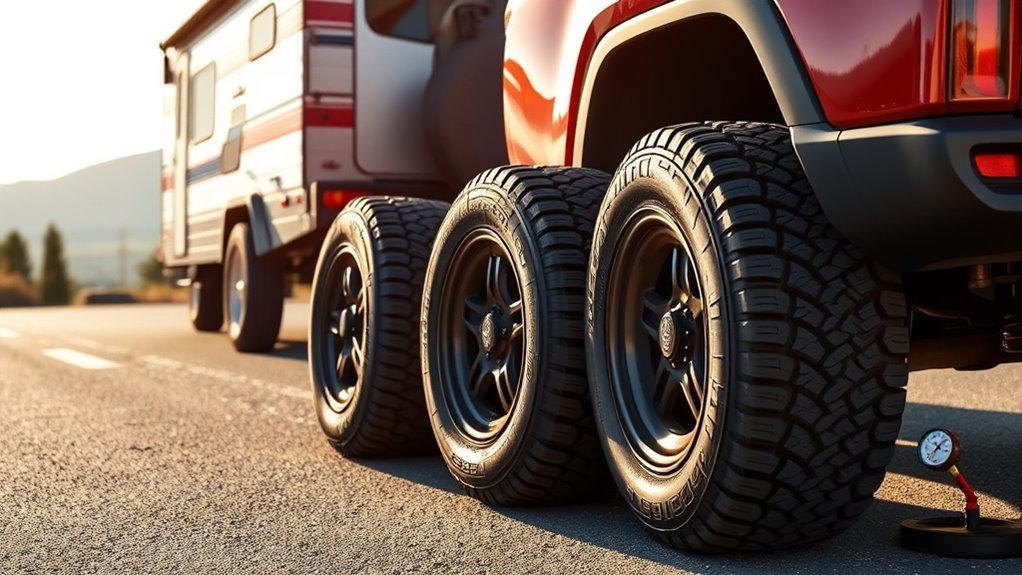
If you tow with your RAV4, pick tires that blend load capacity, stability, and predictable traction—start with these three: Falken Wild Peak A/T Trail. You’ll get robust construction and a higher load index, so you can haul confidently; its tread patterns deliver grip off and on pavement while keeping handling stable. Toyo Open Country A/T2. Choose this if you need stronger off-road bite; it’s tuned for traction but can increase tire noise on pavement, so expect a trade-off between aggression and cabin calm. Michelin Defender LTX M/S (or Firestone Destination A/T/2 for a lighter CUV-focused option). The Michelin balances all-season durability and predictable traction across conditions, aiding liberated travel with fewer compromises; Firestone’s lighter design can improve efficiency and comfort for daily towing. Pick based on required load rating, acceptable noise, and desired tread patterns to match your freedom to roam without overburdening the RAV4.
How Towing Changes RAV4 Tires (Loads, Heat, Wear)
Those three picks cover load capacity and traction, but towing changes how your RAV4’s tires behave: added weight raises per-tire load, increases heat generation, and accelerates wear patterns unless you use tires rated and constructed for the task. You’ll need tire selection that prioritizes higher load ratings, reinforced sidewalls, and tougher tread compounds to resist deformation and maintain steering precision under stress. Increased vertical and lateral forces produce more internal friction; that means more heat, so active heat management becomes critical—maintain correct pressures, monitor temperatures after long pulls, and avoid prolonged high-speed towing. Wear shifts toward shoulder and inner grooves when loads aren’t balanced; choose higher treadwear ratings and rotation schedules to extend service life. Inspect sidewalls for bulges and cuts after heavy use. If you want freedom on the road, treat tires as mission-critical equipment: select purpose-built units, manage heat proactively, and inspect and rotate on a strict cadence to keep capability and safety intact.
Tire Ratings That Matter for Towing (Load Index, XL/Ply, Speed)
When towing with your RAV4 you need tires rated to carry the extra weight, so pick a higher Load Index than stock to maintain safety and handling. Prefer Extra Load (XL) construction or higher ply ratings for stiffer sidewalls, improved stability, and puncture resistance under load. Also confirm the speed rating matches your typical towing speeds to avoid heat buildup and maintain performance.
Load Index Importance
Tire ratings matter: the load index tells you the maximum weight each tire can safely carry, so for towing with a RAV4 you should pick tires with a higher load index (or an XL/extra‑load designation) to maintain stability and avoid overloading; also match or exceed the vehicle’s required ply or load range (typically 4‑ply or higher for towing) and choose a speed rating suited to highway speeds to guarantee the tire’s construction handles sustained stress. You’ll prioritize load capacity and tire compatibility with the RAV4’s axle ratings and trailer tongue weight. Select tires like Falken Wild Peak A/T Trail or Firestone Destination A/T2 if their load index meets your towing demands. Keep pressures at manufacturer towing specs to prevent overheating and premature wear.
Ply And XL Ratings
Because towing adds sustained weight and heat, you should prioritize ply/load-range and XL ratings that give extra carcass strength and higher inflation capacity. Choose Load Range D (8-ply) or E (10-ply) when your RAV4 will haul heavier trailers; ply rating benefits are real—greater durability, reduced flex, and higher recommended pressures that curb overheating. XL tire advantages include higher load capacity for the same size, helping maintain stability and predictable handling under load. Check the load index number (e.g., 105 ≈ 2,039 lbs per tire) and match or exceed manufacturer specs. Never ignore the posted speed rating—P or Q ratings affect heat tolerance at highway speeds. Maintain proper inflation to prevent blowouts and preserve the reinforced carcass performance.
Which Tire Types to Pick: All‑Season, All‑Terrain, or Highway‑AT?
If you’re towing mostly on paved roads with moderate loads (around 1,500 lb), all‑season tires will give you the best compromise of ride comfort, predictable handling, and fuel economy; choose all‑terrain or highway‑AT only if your routes include rough surfaces or frequent light off‑road use.
Select all‑season when your priority is balanced tire performance across varied seasonal conditions and you want lower weight and rolling resistance for better MPG. Pick all‑terrain if you regularly face dirt, gravel, mud, or steep grades — their aggressive tread and stronger sidewalls provide traction and stability under lateral loads. Choose highway‑AT when you need a middle ground: quieter, more fuel‑efficient on pavement than full A/Ts but with enough bite for sporadic off‑road towing. Consider specific models’ weights (lighter A/Ts improve fuel use) and snow capability (3PMSF-rated designs for winter towing). Match your tire type to route profile and weather realities to preserve handling, efficiency, and the freedom to go where you choose.
Recommended Tire Sizes for RAV4 Towing (When to Keep Stock)
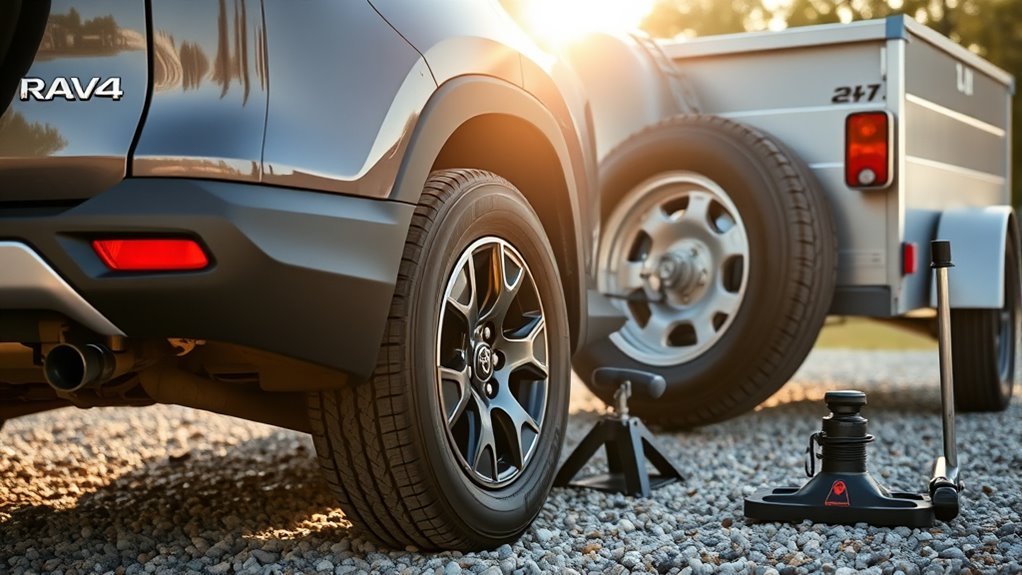
When your route profile and loads match the RAV4’s typical use, sticking with the factory 225/65R17 size is the safest choice for towing. You preserve steering geometry, ABS calibration, and the rated towing capacity (1,500 lb gas, up to 2,500 lb hybrid) by keeping stock tire size. For liberated drivers who value autonomy, this simplicity reduces variables and maintenance overhead.
If you need stronger support, select a higher load-index tire in the same 225/65R17 dimension rather than changing diameter or section width. Load-rated (LT-style) replacements increase sidewall strength and resistance to heat buildup while maintaining handling characteristics. Always confirm the tire’s load index meets or exceeds expected loads to prevent failure under tow. If you contemplate any different tire size, consult the vehicle specifications and ascertain compatibility with drivetrain, clearance, and towing capacity before proceeding.
Set Tire Pressure for Safe Towing (PSI Table & Examples)
Before you hook up a trailer, set your tire pressures to the towing range—typically 3–5 PSI above the placard value depending on load. Use the owner’s manual and a tire gauge to match the recommended PSI for your estimated tongue and gross trailer weights, and adjust per the example calculations in the table. Recheck pressures after temperature changes and during long trips to maintain handling, traction, and tire life.
Recommended PSI Ranges
For safe towing with your Toyota RAV4, set tire pressure within the manufacturer-recommended 30–35 PSI range and adjust as needed for added load by consulting the owner’s manual or tire placard; this range balances durability, handling, and fuel economy while preventing the excessive heat that under-inflation causes and the traction loss that comes from over-inflation. You should monitor tire pressure as part of towing safety: check cold PSI before departure and again after a run. Increase pressure modestly within the recommended band if the placard specifies higher values for heavier loads, never exceed maximum sidewall PSI. Avoid under-inflation to prevent heat buildup and wear; avoid over-inflation to preserve traction and control. Temperature changes alter readings, so recheck periodically.
Example Load Calculations
Now that you’ve confirmed the target PSI range, let’s work through concrete load calculations so you can set tire pressure accurately for specific towing scenarios. Calculate total trailer weight plus cargo, then estimate tongue weight (typically 10–15% of trailer). Add tongue weight to rear vehicle load; divide remaining vehicle weight across all four tires per typical load distribution, adjusting for rear bias. For a near-max tow of 1,500 lb with 10% tongue, inflate to the upper PSI (around 35 psi) to maintain handling and reduce wear. Choose tires with adequate load capacity for combined vehicle and cargo weight. Check tire pressure before each trip, verify load distribution, and correct PSI to match manufacturer specs to prevent blowouts and preserve fuel efficiency.
Best Tire Models for RAV4 Towing : By Use Case (Commute, Light Off‑Road, Winter)
When you’re towing with a RAV4, choose tires matched to the task: all‑season models like the Michelin CrossClimate2 give reliable traction, long tread life, and a comfortable ride for daily commuting; Falken WildPeak A/T Trail suits light off‑road towing with strong grip and cornering on unpaved surfaces; and Bridgestone Blizzak WS90 provides the ice‑and‑snow traction you need for winter hauling. For commute-focused towing you’ll favor tire longevity and balanced traction patterns—CrossClimate2 and Continental CrossContact LX25 deliver low noise, comfort, and reduced rolling resistance for better efficiency. If you push beyond pavement, WildPeak A/T Trail’s reinforced sidewalls and aggressive tread deliver predictable bite and lateral stability on gravel or dirt. In winter, Blizzak WS90’s compound and siping maximize braking and control on ice and packed snow. Hybrid owners who want towing and economy should consider Toyo AT3 for lower consumption without sacrificing load capability. Match tire choice to terrain, maintenance habits, and the freedom to tow confidently.
How Tire Weight and Rolling Resistance Affect MPG While Towing
When you tow with heavier tires, the added rotating mass and contact patch raise rolling resistance and cut MPG — for example, a 45 lb KO2 will cost noticeably more fuel than a 33 lb Destination A/T2. Rolling resistance is the primary tire-level drag term affecting fuel use, so lower-resistance compounds and optimized tread designs matter most under load. Also remember increased tire weight transfers more torque through the drivetrain and brakes, raising parasitic losses and reducing overall towing efficiency.
Tire Weight Impact
Although tire weight may seem minor, it directly affects rolling resistance and consequently MPG when you tow with a RAV4: heavier tires like a 45 lb BF Goodrich KO2 increase the energy needed to overcome rolling losses and inertia compared with a 33 lb Firestone Destination A/T2, so you’ll see lower fuel economy under load. You should favor lighter, purpose-designed towing tires to maximize towing efficiency without sacrificing tire durability; each 5 lb difference alone is small, but cumulative weight and tread design materially alter fuel consumption and vehicle dynamics. Lighter tires improve acceleration and reduce parasitic losses during starts, climbs, and sustained highway pulls. Choose tires balancing low weight, durable construction, and appropriate tread to free yourself from needless consumption while towing.
Rolling Resistance Basics
You’ve just seen how tire mass affects acceleration and inertia while towing; now let’s look at the mechanics behind that effect — rolling resistance. Rolling resistance is the frictional force opposing tire motion and it directly reduces MPG when you tow. Tire material and tread design determine deformation and hysteresis losses; softer compounds and aggressive treads typically raise rolling resistance. Heavier tires like Falken Wild Peak A/T Trail (37.9 lbs) can increase rolling drag versus lighter options such as the Firestone Destination A/T2 (33 lbs), though a 5 lb difference alone is often negligible—cumulative weight and load amplify the penalty. Maintain proper tire pressure to minimize contact patch deformation and drag. Choose construction and tread optimized for low rolling resistance to preserve fuel economy while towing.
Drive-Train Load Effects
Because tire mass and rolling resistance add resistive torque across the drivetrain, they directly raise the engine load and lower MPG while you tow, especially under sustained speeds or grades. You’ll notice heavier tires (e.g., 45 lb KO2 vs 33 lb Destination A/T2) increase rotational inertia and steady-state drag, forcing higher fuel burn to maintain speed. That extra torque demand reduces drive train efficiency and shifts load distribution toward transmission and engine cooling systems. Select lower rolling-resistance designs (Falken Wild Peak A/T Trail) or narrower sizes to reclaim MPG without sacrificing necessary stability. Balance tire choice against required traction: aggressive, heavy treads aid off-road freedom but cost highway economy. Optimize weight, tread compound, and pressure to maximize liberation through efficient towing.
Winter and Wet‑Weather Towing With a RAV4: Tire Choices and Driving Tips
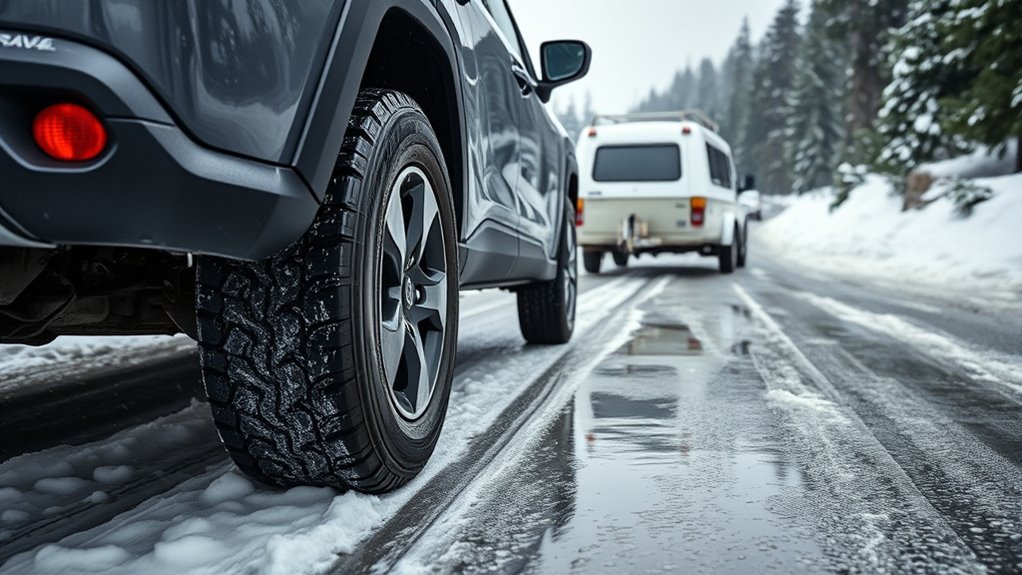
When you’re towing in winter or heavy rain, choose tires that prioritize traction, load capacity, and consistent pressure monitoring to keep the RAV4 stable and controllable. Select winter-specific Blizzak WS90s or high-performing all-season Michelin Defender LTX M/S for snow and ice, and consider Falken Wild Peak A/T Trail for wet-slush grip; Firestone Destination AT/2 works when you need higher load ratings. Check tire tread and pressure before every trip; worn tread and low pressure amplify risk under load.
- Confirm load rating and inflation to match trailer weight and avoid sidewall stress.
- Inspect tread depth and pattern for winter siping or channels that expel water; replace if compromised.
- Apply conservative driving techniques: lower speed, smooth inputs, increased following distance to regain autonomy on slippery roads.
You’ll liberate your mobility by making deliberate tire choices and precise preparations that keep the RAV4 controllable, safe, and ready for adverse-weather towing.
Towing Tire Maintenance Checklist for RAV4 Owners (Inspect, Rotate, Break‑In)
Before you hook up a trailer, inspect the RAV4’s tires for tread depth, sidewall damage, and correct PSI, since proper inflation and intact sidewalls are critical to carrying trailer loads safely. You’ll check tire pressure against the manufacturer’s PSI recommendation before every tow; underinflation reduces load capacity and increases heat buildup. Inspect tread patterns for uneven wear and depth—uneven tread signals alignment, balance, or suspension issues that reduce control while towing. Rotate tires every 5,000–7,500 miles to equalize wear under added towing stress and extend service life. For new tires, break them in by driving calmly at moderate speeds for the first 500 miles so the rubber beds in and grip stabilizes. Regularly examine sidewalls for cuts, bulges, or separations; replace any compromised tire immediately. Maintain alignment and balance to prevent localized wear and steering instability. Follow this checklist to retain autonomy on the road and tow with predictable, safe handling.
Frequently Asked Questions
Is a Toyota RAV4 Good for Towing?
Yes — you can tow with a Toyota RAV4, but you’ll need to respect towing capacity, manage weight distribution precisely, and use proper hitching and brakes so you’ll stay safe, compliant, and free to haul light loads responsibly.
Which Tires Are Better for Towing?
Like a steady anchor, choose all-season or all-terrain tire types with higher load ratings to match your towing capacity; pick durable, lighter models with strong treadwear and aggressive traction so you’ll tow confidently and stay free.
Conclusion
You’ll swap to stronger tires, check pressures, and maybe lose a bit of MPG — revolutionary, right? Seriously: pick tires with the right load index/XL rating, match type to your use (highway for hauling, AT for light trails, winter when needed), keep pressures and tread in spec, and rotate/inspect often. Do that, and your RAV4 will tow reliably without turning every trip into a roadside seminar on tire failure.

Related Articles
Upsizing Wheels on a Toyota RAV4: Pros, Cons, and Considerations
Boost your Toyota RAV4's performance with larger wheels, but discover the hidden trade-offs that could impact your ride before you decide.
Read More
Can I Change Tire Size on My Toyota RAV4? Rules and Recommendations
Are you considering changing the tire size on your Toyota RAV4? Discover the essential rules and recommendations before making a decision.
Read More
What to Do If the TPMS Light Comes On in Your RAV4
Understand the steps to take when the TPMS light illuminates in your RAV4, as overlooking it could lead to serious tire problems.
Read More